Stratospheric Decadal Changes Simulated with the MUAM during Decembers at the End of the 20th Century

  • Renqiang LIU ,
  • Jihong XIE ,
  • Ying LI
Expand
  • 1. Key Laboratory of Meteorological Disaster,Ministry of Education (KLME) / Collaborative Innovation Center on Forecast and Evaluation of Meteorological Disasters (CIC-FEMD),Nanjing University of Information Science & Technology,Nanjing 210044,Jiangsu,China
    2. Hanzhong Meteorological Administration,Hanzhong 723000,Shaanxi,China

Received date: 2021-11-25

  Revised date: 2022-04-09

  Online published: 2023-04-03

Cite this article

Renqiang LIU , Jihong XIE , Ying LI . Stratospheric Decadal Changes Simulated with the MUAM during Decembers at the End of the 20th Century[J]. Plateau Meteorology, 2023 , 42(2) : 448 -458 . DOI: 10.7522/j.issn.1000-0534.2022.00041

1 引言

平流层气候变化是全球变化的一个重要组成部分。观测和模拟研究显示, 在20世纪末约20年, 平流层总体呈降温趋势, 这主要是因温室气体的增加和臭氧减少引起的(Ramaswamy et al, 2001Thompson et al, 2012)。平流层冷却在热带平流层全年较为一致, 在两极则呈现年循环的特征, 这很可能与冬季显著的Brewer-Dobson环流变化以及极区春季严重的臭氧损耗有关(Randel and Wu, 1999Young et al, 2012)。异常的是, 在12月左右, 北极平流层整层和南极平流层的中上层均出现了增暖趋势(Randel and Wu, 1999Hu et al, 2005Thompson and Solomon, 2005Young et al, 2012Ivy et al, 2016)。
NCEP/NCAR和ERA-Interim再分析资料显示从20世纪80~90年代北半球早冬(11 -12月)行星波沿低纬度波导的传播减弱, 沿极地波导向平流层整层的传播趋势明显增强(Hu et al, 2005刘仁强等, 2018)。进一步研究表明, 北极低平流层面积加权的12月增暖趋势与60°N附近累积涡动热通量的增加显著相关(Liu and Fu, 2019)。数值模拟及分析表明, 向平流层的波通量的增加可以由温室气体和海表温度增加共同强迫产生(Butchart and Scaife, 2001Rind et al, 2002Butchart et al, 2006), 也可以由海表温度变化单独强迫引起(Braesicke and Pyle, 2004Hu and Pan, 2009)。
利用大气环流模式结合化学过程参数化, Mahlman et al(1994)发现“臭氧洞”可导致南极晚春/早夏(11 -12月)低平流层冷却约8 K, 而中平流层增暖约6 K, 这里显著的增暖主要与剩余经圈环流的加强有关。Keeble et al(2014)则利用一个全耦合的化学气候模式, 通过是否抑制极区平流层云粒子表面异相化学反应所导致的氯激活, 再现了这一温度变化的垂直偶极子结构, 即当南极平流层下部因短波加热减少而冷却时, 中上平流层主要由于动力加热以及较弱的短波加热增加而增温。其他基于不同类型模式或设计方案的温度变化理想试验也得出了类似的结果(Kiehl et al, 1988Rosier and Shine, 2000Austin, 2002Manzini et al, 2003Hu et al, 2015Lin et al, 2017)。
可以预见, 由于下垫面条件和臭氧损耗程度的差异巨大, 南、 北半球平流层极区在20世纪末12月左右增暖现象的机制会有明显的差异。对应于南、 北极平流层的增暖, 气候系统是表现为对人为气候强迫的响应为主, 还是以内部动力学变率为主?以及动力加热增温是因对流层波源的增强为主还是以从对流层到平流层传播环境的变化为主?这都是值得深入研究的问题。由此, 本文将利用一个中高层大气模式, 从下边界条件变化和辐射强迫的角度设计一组控制和敏感性试验, 对比研究1980—2000年期间平流层12月温度十年际变化特别是局部增暖的不同机理。

2 模式、 资料和试验设计

中高层大气模式(the Middle and Upper Atmosphere Model, MUAM)是一个3D全球格点机制性大气环流模式(Jacobi et al, 2006Pogoreltsev et al, 2007)。它的水平分辨率为5°×5.625°(纬度/经度), 垂直方向采用步长约0.4的无量纲对数压力坐标:
x = - l n ( p / p s ) ,   p s = 1000   h P a
式中: p是气压; p s表示标准参考气压。MUAM可以任意选取48~60模式层, 在中低层大气平均位势高度约等于无量纲高度乘以7 km; 本文选择48层模式, 垂直模拟范围从地面附近延伸至对数压力高度约135 km。在模式下边界(1000 hPa气压层)给定了气候学月平均的位势高度和温度场, 包括纬向平均态和纬向波数为1~3的定常行星波。此外, 通过在温度预报方程中插入一个nudging项使得模拟的纬向平均温度(1~6层或1~15 km)向再分析资料气候学纬向平均温度弛豫, 以便更准确地再现对流层直至低平流层高度的纬向平均场(Pogoreltsev et al, 20072009):
T t = F ( T ,   t ) - K T ¯ M U A M - T ¯ N C E P , K = ε / τ
式中: F ( T ,   t )表示造成温度倾向的强迫项; - K T ¯ M U A M - T ¯ N C E P为nudging项; τ = 5天和 ε = 1 - e - ( t / τ ) 2为松弛因子; T ¯ N C E P代表再分析的气候学纬向平均温度。
为了增加模式输入数据之间的独立性, 选用了不同来源的资料, 其中下边界条件及nudging场采用NCEP/NCAR再分析气候月平均资料, 其水平分辨率为2.5°×2.5°, 垂直方向17层; 臭氧浓度取自MERRA-2再分析资料, 水平分辨率为0.5°×0.625°(纬度/经度), 垂直方向42层; 二氧化碳浓度来自NOAA-ESRL的Mauna Loa观测站数据。另外, 本文利用ERA-Interim再分析资料检验模式模拟结果和分析偏差产生的原因, 其水平分辨率为2.5°×2.5°, 垂直方向37层。20世纪末12月平流层十年际变化, 取20世纪90年代平均(含2000年)减80年代平均(含1990年), 但在利用臭氧资料时扣除了受El Chichón和Mount Pinatubo火山爆发影响的1982 -1984年和1991 -1993年(Santer et al, 2000)。
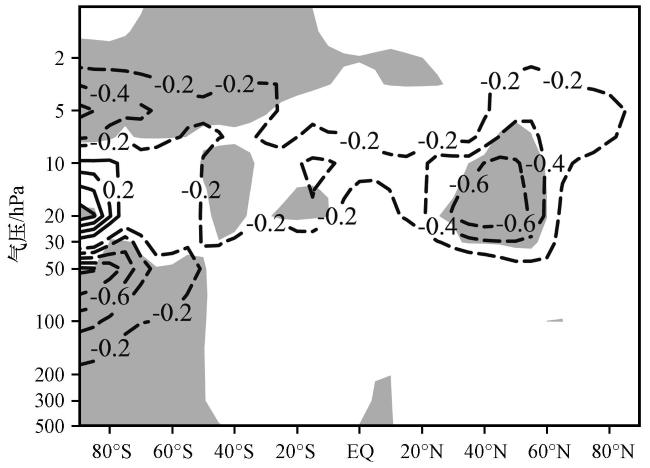
图1给出了根据MERRA-2再分析资料得到的在1980 -2000年12月臭氧质量混合比的十年际变化。首先, 在南极低平流层(200~30 hPa)臭氧浓度显著下降, 中心减少达0.8~1 ppm, 可以认为这是“臭氧洞”现象在南极晚春/早夏的表现(Keeble et al, 2014胡永云, 2020)。其次, 北半球中纬度中平流层臭氧减少明显。另外在南半球中低纬度中平流层和南极上平流层臭氧混合比也有所减少。反常的是, 在南极中平流层的局部区域(75°S -90°S, 30~10 hPa)臭氧混合比增加0.2~0.8 ppm, 但这个结果得到了观测和模拟验证(Stolarski et al, 2006Hu et al, 2015)。
图1 1980 -2000年12月平均的纬向平均臭氧质量混合比的十年际变化(20世纪90年代减80年代)[单位: ppm·(10a)-1

等值线间隔: 0.2 ppm·(10a)-1, 零等值线已被去掉; 实线(虚线)表示正(负)变化; 阴影区域表示臭氧浓度变化通过了置信度为95%的显著性检验

Fig.1 Decadal changes (1990s minus 1980s) of zonal-mean, monthly mean ozone mass mixing ratio during December for the period 1980 -2000 calculated from the MERRA-2 data.Unit: ppm·(10a)-1.Contour intervals are 0.2 ppm·(10a)-1, the zero contour line has been suppressed.The solid (dashed) contours represent positive (negative) changes.Shading areas indicate ozone concentration changes that are statistically significant at the 95% confidence level

为了评估下边界条件(LBC)、 二氧化碳(CO2)及臭氧(O3)浓度变化对20世纪末12月平流层温度十年际变化的分别影响, 基于MUAM模式设计了一组控制(CNTL)和敏感性试验(Run_i, i=1~7)。表1列出了在不同试验中需要指定的三个气候学月平均因子(O3、 CO2、 LBC)所在的时段以及在敏感性试验中时段相对于控制试验发生了变化的因子; 此外, nudging场总是设置为与O3浓度同步变化。以下给出的十年际变化模拟结果均为敏感性试验与控制试验输出的12月平均气候场之差(Run_i-CNTL, i=1~7)。
表1 MUAM数值试验中强迫场和下边界条件的配置

Table 1 Configurations of forcing fields and lower boundary conditions specified in MUAM experiments

试验 O3 CO2 LBC 变化因子
CNTL 1980 -1990年 1980 -1990年 1980 -1990年
Run_1 1990 -2000年 1980 -1990年 1980 -1990年 O3
Run_2 1980 -1990年 1980 -1990年 1990 -2000年 LBC
Run_3 1980 -1990年 1990 -2000年 1980 -1990年 CO2
Run_4 1990 -2000年 1990 -2000年 1980 -1990年 O3+CO2
Run_5 1990 -2000年 1980 -1990年 1990 -2000年 LBC+O3
Run_6 1980 -1990年 1990 -2000年 1990 -2000年 LBC+CO2
Run_7 1990 -2000年 1990 -2000年 1990 -2000年 LBC+O3+CO2

3 模拟的中层大气气候态及十年际变化

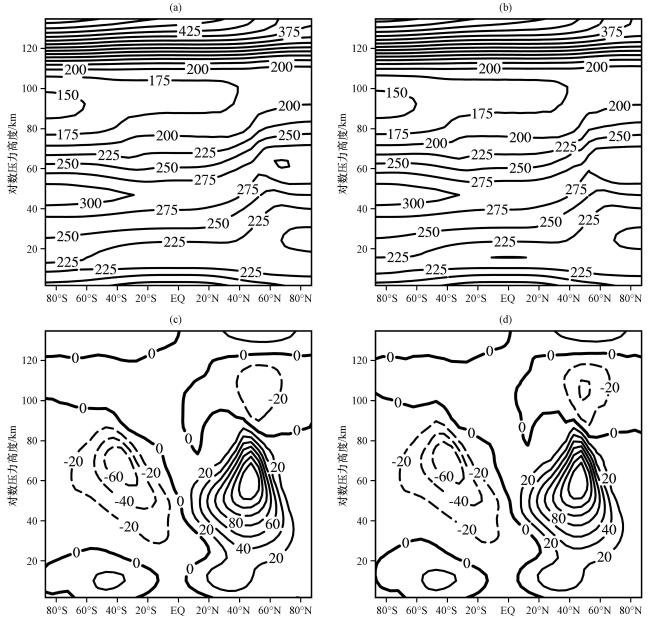
图2给出了MUAM模拟的20世纪80年代和90年代12月纬向平均温度及纬向风的纬度-高度剖面。此时南(北)半球接近夏(冬)至时, 从温度场[图2(a), (b)]中可以看出, 虽然30~50 km气层温度从初冬半球向初夏半球递增, 中间层却呈现冬半球温度高于夏半球的反常经向分布, 此外在20世纪90年代北极中低平流层和热带对流层顶的两个冷中心之间也出现相对较暖的区域且向上向极延伸, 这些偏离辐射平衡的气候学温度分布特征与中层大气的行星波和重力波活动有关(Andrews et al, 1987)。从风场[图2(c), (d)]可以看出, 虽然对流层赤道外地区盛行西风, 中层大气30~80 km冬夏半球却分别盛行西风和东风, 而在中间层顶附近纬向风又开始反转。以上这些典型的温度和风场气候态分布特征与其他观测和模式结果基本一致(Fleming et al, 1990Randel et al, 2004Garcia et al, 2007Smith, 2012)。MUAM模拟的中间层西风急流可能偏强, 这可以通过调节重力波参数化方案中重力波源的强度来改善, 但试验发现这对平流层气候以及两个整层气候场之差的影响很小(图略)。
图2 MUAM模拟的20世纪80年代(CNTL)(a, c)和90年代(Run_7)(b, d)12月平均的纬向平均温度(a, b, 单位: K)及纬向风(c, d, 单位: m·s-1

(c)和(d)中实线(虚线)表示西风(东风)

Fig.2 Zonal-mean, monthly mean temperature (a, b, unit: K) and zonal wind (c, d, unit: m·s-1) simulated with the MUAM during Decembers of the 1980s (CNTL) (a, c) and 1990s (Run_7) (b, d).In Fig.2(c) and (d), the solid (dashed) contours represent westerly (easterly) winds

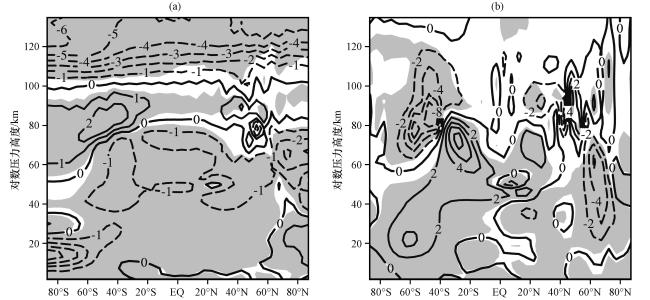
图3是根据图2得到的整层大气12月纬向平均温度和纬向风的十年际变化纬度-高度剖面。从图3(a)可以看出, 对流层以上大气呈冷却趋势且随高度加剧, 但中间层顶附近温度变化不显著甚至微弱增暖, MUAM模式能够较好地再现中层大气纬向平均的温度趋势(Akmaev et al, 2006Garcia et al, 2007)。以下主要关注平流层变化, 平流层温度趋势明显地水平不均匀, 其中北极中低平流层显著增温, 南极平流层低层显著降温但中上层微弱增温。相应地, 相较于20世纪80年代, 90年代12月北极中上平流层西风减速, 南极平流层低层西风加速(根据热成风原理, 极涡加速)中上层东风减速[图3(b)]。
图3 MUAM模拟的20世纪末12月纬向平均温度[a, 单位: K·(10a)-1]及纬向风[b, 单位: m·s-1·(10a)-1]的十年际变化(Run_7-CNTL)

阴影区域表示温度(a)和纬向风(b)变化通过了置信度为95%的显著性检验

Fig.3 Decadal changes (Run_7 minus CNTL) of zonal-mean temperature [a, unit: K·(10a)-1] and zonal wind [b, unit: m·s-1·(10a)-1] simulated with the MUAM during Decembers at the end of the 20th century.In Fig.3(a) and (b), the shaded indicate temperature (a) and zonal wind (b) changes that are statistically significant at the 95% confidence level

4 平流层十年际变化的敏感性试验

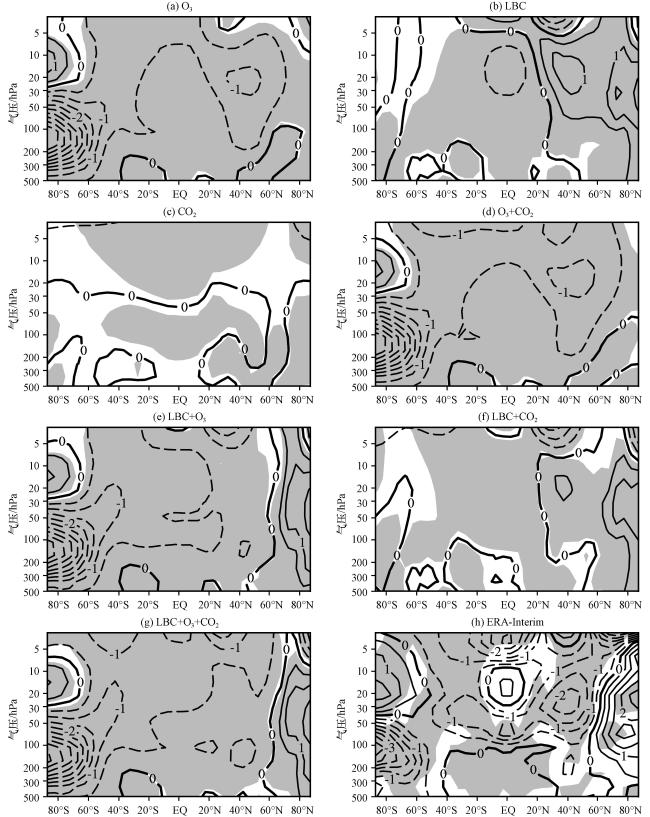
图4分别给出了MUAM敏感与控制试验得到的12月纬向平均温度之差以及根据ERA-Interim再分析资料计算的1980 -2000年12月纬向平均温度的十年际变化。图4(a)显示了平流层温度对臭氧浓度变化的响应。可以看到, 北半球中纬度平流层呈降温趋势且在20 hPa达到-1 K·(10a)-1, 这与该区域臭氧含量的减少相吻合(见图1)。南极中低平流层至中上对流层(500~30 hPa)显著冷却且在200~100 hPa达到-4.5 K·(10a)-1, 这显然与该区域附近显著的臭氧损耗有关, 但变冷区相对于臭氧减少区(200~30 hPa)明显向下扩展。南极中上平流层(30~1 hPa)异常增暖且在10 hPa附近达到1 K·(10a)-1, 但变暖区相对于臭氧浓度增加区(30~10 hPa)明显向上扩展。大量的臭氧强迫模拟试验表明12月平流层南极局部增暖主要是动力加热的结果(Mahlman et al, 1994Rosier and Shine, 2000Keeble et al, 2014Lin et al, 2017), 通过在MUAM试验Run_1中令nudging指向20世纪80年代也发现南极中平流层局地的臭氧增加只能导致基本上局限于相同局地区域的0.5 K·(10a)-1以下的非绝热增温(图略)。
图4 MUAM模拟的20世纪末12月纬向平均温度差(a~g)(Run_i-CNTL, i=1~7)及根据ERA-Interim再分析资料计算的1980 -2000年12月纬向平均温度十年际(20世纪90年代减80年代)变化(h) [单位: K·(10a)-1

实线(虚线)表示正(负)变化; 阴影区域表示温度变化通过了置信度为95%的显著性检验

Fig.4 Differences (a~g) (Run_i-CNTL, i=1-7) between zonal-mean temperatures simulated with the MUAM during Decembers at the end of the 20th century, and decadal changes (1990s minus 1980s) (h) of zonal-mean temperature during December for the period 1980 -2000 calculated from the ERA-Interim data.Unit: K·(10a)-1.The solid (dashed) contours represent positive (negative) changes.Shading areas indicate temperature changes that are statistically significant at the 95% confidence level

图4(b)显示了平流层温度对下边界条件变化的响应。可以看到, LBC单独变化对南半球的影响较小, 但北半球热带外平对流层大范围增温且在中纬度20 hPa和极区30 hPa附近达到1 K·(10a)-1。AMIP(Atmospheric Model Intercomparison Project)(Gates et al, 1999)海温强迫模拟试验分析表明海表温度增加所引起的波驱动的绝热加热增加是早冬平流层北极增暖的原因(Hu and Pan, 2009)。
图4(c)显示二氧化碳强迫仅导致中低平流层微弱变暖而中上平流层微弱变冷; 当叠加上臭氧强迫时[图4(d)], 相对于图4(a), 中上平流层特别是平流层顶附近冷却加强, 南极异常增暖区也稍微减小, 这与以往的模拟结果定性地一致(Rosier and Shine, 2000徐国强等, 2001Shine et al, 2003), 二氧化碳增加与臭氧减少的共同辐射效应只能导致北半球平流层变冷。
当LBC变化与臭氧强迫共同作用时[图4(e)], 南极中低平流层显著冷却区向上向北扩展[相对于图4(a)], 这可能意味着南极极涡进一步加强, 南极中上平流层异常增暖核心向下集中, 而北半球热带外增暖区域向极区大面积收缩[相对于图4(b)]。当LBC变化与二氧化碳强迫共同作用时[图4(f)], 南半球变化不明显[相对于图4(b)], 而北半球增温明显减弱且增暖区域有所减小。
图4(g)显示了三因子共同作用对平流层温度变化的影响[与图3(a)低层相同但等值线间隔减半]。相对于图4(e), 由于二氧化碳浓度增加所导致的向外空间的红外辐射发射冷却效应[参见图4(c)], 中上平流层特别是平流层顶附近冷却进一步加强, 两极增暖区域的顶部也都向下收缩。可以看到, 与ERA-Interim再分析资料计算结果对比[图4(h)], MUAM三因子变化试验能够基本再现1980 -2000年12月全球纬向平均温度的十年际变化特征, 特别是平流层南极温度变化的垂直偶极子结构以及北极中低层增暖。但是, MUAM模拟的平流层两极增暖偏弱, 而南极上对流层/低平流层冷却偏强, 这可能是因为模式低估了Brewer-Dobson环流在极区下沉支的加强所引起的动力加热增温。

5 平流层南北极局部增暖的动力机制

虽然研究表明1980 -2000年12月平流层南北极局部增暖主要是动力加热所导致(Mahlman et al, 1994Rosier and Shine, 2000Hu and Pan, 2009Keeble et al, 2014Ivy et al, 2016黎成超等, 2016Lin et al, 2017Liu and Fu, 2019), 但是, 动力加热增温的主要原因是对流层波源的增强还是从对流层到平流层传播环境的变化, 这仍然是值得深入研究的问题。
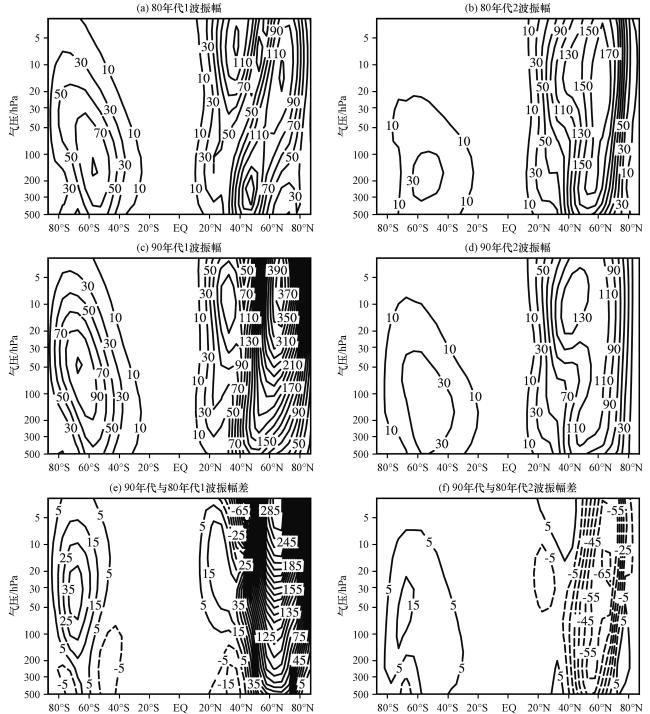
图5给出了MUAM模拟的20世纪80年代和90年代12月位势高度场中1波和2波的振幅及十年际变化的纬度-高度剖面。可以看到[图5(a)~(d)], 北半球热带外两波振幅结构深厚宽广, 1波振幅在20世纪80年代弱于2波, 但在90年代远强于2波。南半球热带外两波振幅分布近似呈椭圆形但1波深厚2波浅薄, 1波振幅总是强于2波, 但两波振幅均远弱于北半球。图5(e)和(f)显示从20世纪80~90年代, 北半球行星1波的上传显著增强, 而2波处于明显的削弱状态; 南半球1~2波的上传均增强, 但1波主导且上传增强至中上平流层更高高度。
图5 MUAM模拟的20世纪80年代(a, b)(CNTL)和90年代(c, d)(Run_7)12月位势高度1波(a, c)、 2波(b, d)振幅(单位: m)及1波(e)、 2波(f)振幅的十年际变化(e, f)(Run_7-CNTL)[单位: m·(10a)-1

(e), (f)中实线(虚线)表示正(负)变化

Fig.5 Amplitudes (a~d, unit: m) of stationary planetary waves with zonal wavenumbers 1 (a, c) and 2 (b, d) in geopotential height simulated with the MUAM during Decembers of the 1980s (a, b) (CNTL) and 1990s (c, d) (Run_7), and their decadal changes (e, f) (Run_7-CNTL) [unit: m·(10a)-1], respectively, for waves 1 (e) and 2 (f).The solid (dashed) contours in (e, f) represent positive (negative) changes

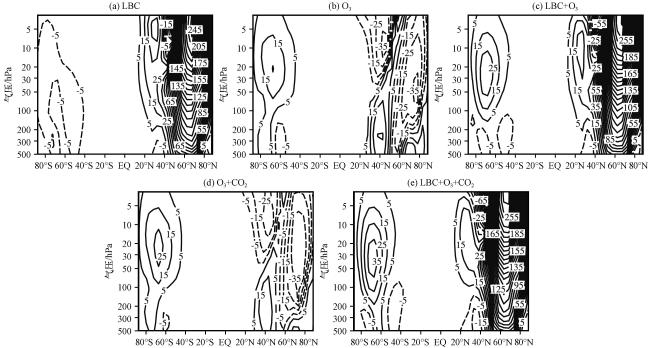
图6分别给出了由不同的MUAM敏感与控制试验得到的12月位势高度场中1波振幅的十年际变化[其中图6(e)与图5(e)相同]。从图6中可以看到, LBC单独变化[图6(a)]导致北半球热带外1波上传显著增强, 而南半球1波上传稍微削弱。相反地, 单独臭氧强迫[图6(b)]导致北半球1波上传明显削弱, 而南半球1波上传明显增强。当臭氧强迫与LBC变化共同作用时[图6(c)], 北半球1波显著增强但与LBC单独变化时相当, 南半球1波明显增强且在南极中上平流层比单独臭氧强迫时增强约2/3。图6(d)显示当叠加上二氧化碳强迫时, 相对于图6(b)、 1波上传在南极中平流层增强约2/3; 图6(e)显示当叠加上二氧化碳强迫时, 相对于图6(c)、 1波上传在南极中低平流层增强约2/5。
图6 MUAM模拟的20世纪末12月位势高度1波振幅的十年际变化(a~e)(Run_i-CNTL, i=2, 1, 5, 4, 7)[单位: m·(10a)-1

实线(虚线)表示正(负)变化

Fig.6 Decadal changes (a~e) (Run_i-CNTL, i=2, 1, 5, 4, 7) of geopotential height amplitude for wave 1 simulated with the MUAM during Decembers at the end of the 20th century.Unit: m·(10a)-1.The solid (dashed) contours represent positive (negative) changes

综合来看, 1980 -2000年12月北极平流层增暖主要与LBC变化导致北半球热带外行星1波的上传显著增强有关, 相应地, 2波处于明显的削弱状态, 北极中上平流层西风减速, 这与北半球环状模的负极趋势相对应(Hartmann et al, 2000Chen et al, 2003Hu and Pan, 2009); 而单独臭氧或臭氧与二氧化碳共同强迫均导致1波削弱和北半球平流层变冷。南极平流层温度变化的垂直偶极子结构主要与南极低平流层显著的臭氧损耗及其相关的辐射—动力反馈有关(Keeble et al, 2014Lin et al, 2017), LBC变化和南极中平流层局地的臭氧增加对中上层的增暖也有一定的贡献, 二氧化碳增加只能引起中低平流层1波振幅增加, LBC单独变化甚至引起1波的削弱; 因此, 低层臭氧损耗(参见图1)所诱导的极涡加速[参见图3(b)]使得波传播环境或条件变得更加有利于1~2波上传增强(1波主导)至更高高度[参见图5图6(b)]可能是最终导致中上层增暖的主要原因。

6 结论

利用中高层大气模式(MUAM)研究20世纪末12月平流层气候态的十年际变化, 基于一组控制和敏感性试验评估下边界条件、 二氧化碳及臭氧浓度变化三因子对平流层温度变化的分别影响, 着重探讨了平流层南北极局部增暖的机制差异, 结论如下:
(1) MUAM模式能够较好地再现中层大气纬向平均的温度场和风场的气候态分布特征以及温度趋势。相较于20世纪80年代, 90年代12月北极中上平流层西风减速, 中低层增温; 南极平流层低层西风加速温度降低, 中上层东风减速温度升高。
(2) 结合MUAM试验纬向平均温度及位势高度波动振幅的变化分析表明, 北极平流层的增暖主要与下边界条件变化导致北半球热带外行星1波的上传显著增强有关, 相应地, 2波处于明显的削弱状态; 而单独臭氧或臭氧与二氧化碳共同强迫均导致1波削弱和北半球平流层变冷。
(3) 南极平流层温度变化的垂直偶极子结构主要与南极低平流层显著的臭氧损耗及其相关的辐射-动力反馈有关, 下边界条件变化和南极中平流层局地的臭氧增加对中上层的增暖也有一定的贡献, 二氧化碳增加只能引起中低平流层1波振幅增加, 下边界条件单独变化甚至引起1波的削弱; 因此, 低层臭氧损耗所诱导的极涡加速使得波传播环境或条件变得更加有利于1~2波上传增强(1波主导)至更高高度可能是最终导致南极平流层中上层增暖的主要原因。
(4) 二氧化碳增加在平流层仅引起中上层进一步冷却和增暖区域略微减小, 而臭氧减少导致北半球平流层增暖区域向极区大面积收缩, 这些试验结果定性地合理, 但可能也与nudging项的设置跟随臭氧浓度变化有关。对比ERA-Interim再分析结果, MUAM三因子变化试验能够基本再现1980 -2000年12月全球纬向平均温度的十年际变化特征, 特别是平流层南极温度变化的垂直偶极子结构以及北极中低层增暖。但是, MUAM模拟的平流层两极增暖偏弱, 而南极上对流层/低平流层冷却偏强, 这可能是因为模式低估了Brewer-Dobson环流在极区下沉支的加强所引起的动力加热增温。
MUAM试验并未再现ERA-Interim再分析热带区域从对流层到平流层复杂的温度变化结构, 这很可能是因为我们没有考虑全球水汽的变化(Shine et al, 2003), 除此之外, 下边界行星波强迫和臭氧变化的不确定性、 重力波强迫(Haynes, 2005)等也可能是引起模拟偏差的因素。

References

null
Akmaev R A Fomichev V I Zhu X2006.Impact of middle-atmospheric composition changes on greenhouse cooling in the upper atmosphere[J].Journal of Atmospheric and Solar-Terrestrial Physics68(17): 1879-1889.DOI: 10.1016/j.jastp.2006.03.008 .
null
Andrews D G Holton J R Leovy C B1987.Middle atmosphere dynamics[M].San Diego: Academic Press, 489.
null
Austin J2002.A three-dimensional coupled chemistry-climate model simulation of past stratospheric trends[J].Journal of the Atmospheric Sciences59(2): 218-232.DOI: 10.1175/1520-0469(2002)059<0218: atdccc>2.0.co; 2 .
null
Braesicke P Pyle J A2004.Sensitivity of dynamics and ozone to different representations of SSTs in the Unified Model[J].Quarterly Journal of the Royal Meteorological Society130(601): 2033-2045.DOI: 10.1256/qj.03.183 .
null
Butchart N Scaife A A2001.Removal of chlorofluorocarbons by increased mass exchange between the stratosphere and troposphere in a changing climate[J].Nature410(6830): 799-802.DOI: 10.1038/35071047 .
null
Butchart N Scaife A A Bourqui M, et al, 2006.Simulations of anthropogenic change in the strength of the Brewer-Dobson circulation[J].Climate Dynamics27(7/8): 727-741.DOI: 10.1007/s00382-006-0162-4 .
null
Chen W Takahashi M Graf H F2003.Interannual variations of stationary planetary wave activity in the northern winter troposphere and stratosphere and their relations to NAM and SST[J].Journal of Geophysical Research: Atmospheres, 108(D24).DOI: 10.1029/2003JD003834 .
null
Fleming E L Chandra S Barnett J J, et al, 1990.Zonal mean temperature, pressure, zonal wind and geopotential height as functions of latitude[J].Advances in Space Research10(12): 11-59.DOI: 10.1016/0273-1177(90)90386-e .
null
Garcia R R Marsh D R Kinnison D E, et al, 2007.Simulation of secular trends in the middle atmosphere, 1950-2003[J].Journal of Geophysical Research: Atmospheres, 112: 09301.DOI: 10.1029/2006JD007485 .
null
Gates W L Boyle J S Covey C, et al, 1999.An overview of the results of the Atmospheric Model Intercomparison Project (AMIP I)[J].Bulletin of the American Meteorological Society80(1): 29-56.DOI: 10.1175/1520-0477(1999)080<0029: aootro>2.0.co; 2 .
null
Hartmann D L Wallace J M Limpasuvan V, et al, 2000.Can ozone depletion and global warming interact to produce rapid climate change?[J].Proceedings of the National Academy of Sciences97(4): 1412-1417.DOI: 10.1073/pnas.97.4.1412 .
null
Haynes P2005.Stratospheric dynamics[J].Annual Review of Fluid Mechanics, 37: 263-293.DOI: 10.1146/annurev.fluid.37. 061903.175710 .
null
Hu D Z Tian W S Xie F, et al, 2015.Impacts of stratospheric ozone depletion and recovery on wave propagation in the boreal winter stratosphere[J].Journal of Geophysical Research: Atmospheres120(16): 8299-8317.DOI: 10.1002/ 2014JD022855 .
null
Hu Y Y Pan L F2009.Arctic stratospheric winter warming forced by observed SSTs[J].Geophysical Research Letters36(11).DOI: 10.1029/2009GL037832 .
null
Hu Y Y Tung K K Liu J P2005.A closer comparison of early and late-winter atmospheric trends in the Northern Hemisphere[J].Journal of Climate18(16): 3204-3216.DOI: 10.1175/jcli3468.1 .
null
Ivy D J Solomon S Rieder H E2016.Radiative and dynamical influences on polar stratospheric temperature trends[J].Journal of Climate29(13): 4927-4938.DOI: 10.1175/JCLI-D-15-0503.1 .
null
Jacobi C Fr?hlich K Pogoreltsev A2006.Quasi two-day-wave modulation of gravity wave flux and consequences for the planetary wave propagation in a simple circulation model[J].Journal of Atmospheric and Solar-Terrestrial Physics, 68: 283-292.DOI: 10.1016/j.jastp.2005.01.017 .
null
Keeble J Braesicke P Abraham N L, et al, 2014.The impact of polar stratospheric ozone loss on Southern Hemisphere stratospheric circulation and climate[J].Atmospheric Chemistry Physics14(12): 13705-13717.DOI: 10.5194/acp-14-13705-2014 .
null
Kiehl J T Boville B A Briegleb B P1988.Response of a general circulation model to a prescribed Antarctic ozone hole[J].Nature332(6164): 501-504.DOI: 10.1038/332501a0 .
null
Lin P Paynter D Polvani L, et al, 2017.Dependence of model‐simulated response to ozone depletion on stratospheric polar vortex climatology[J].Geophysical Research Letters44(12): 6391-6398.DOI: 10.1002/2017GL073862 .
null
Liu R Q Fu Y Y2019.Verification of an approximate thermodynamic equation with application to study on Arctic stratospheric temperature changes[J].Journal of the Atmospheric Sciences76(1): 3-9.DOI: 10.1175/JAS-D-18-0109.1 .
null
Mahlman J D Pinto J P Umscheid L J1994.Transport, radiative, and dynamical effects of the Antarctic ozone hole: A GFDL "SKYHI" model experiment[J].Journal of the Atmospheric Sciences51(4): 489-508.DOI: 10.1175/1520-0469(1994)051<0489: tradeo>2.0.co; 2 .
null
Manzini E Steil B Brühl C, et al, 2003.A new interactive chemistry-climate model: 2.Sensitivity of the middle atmosphere to ozone depletion and increase in greenhouse gases and implications for recent stratospheric cooling[J].Journal of Geophysical Research: Atmospheres, 108(D14).DOI: 10.1029/2002JD002977 .
null
Pogoreltsev A I Vlasov A A Fr?hlich K, et al, 2007.Planetary waves in coupling the lower and upper atmosphere[J].Journal of Atmospheric and Solar-Terrestrial Physics69(17/18): 2083-2101.DOI: 10.1016/j.jastp.2007.05.014 .
null
Pogoreltsev A I Kanukhina A Y Suvorova E V, et al, 2009.Variability of planetary waves as a signature of possible climatic changes[J].Journal of Atmospheric and Solar-Terrestrial Physics, 71: 1529-1539.DOI: 10.1016/j.jastp.2009.05.011 .
null
Ramaswamy V Chanin M L Angell J, et al, 2001.Stratospheric temperature trends: Observations and model simulations[J].Reviews of Geophysics39(1): 71-122.DOI: 10.1029/1999rg000065 .
null
Randel W J Udelhofen P Fleming E, et al, 2004.The SPARC Intercomparison of Middle-Atmosphere Climatologies[J].Journal of Climate, 17: 986-1003.DOI: 10.1175/1520-0442(2004)017<0986: tsiomc>2.0.co; 2 .
null
Randel W Wu F1999.Cooling of the Arctic and Antarctic polar stratospheres due to ozone depletion[J].Journal of Climate12(5): 1467-1479.DOI: 10.1175/1520-0442(1999)012<1467: cotaaa>2.0.co; 2 .
null
Rind D Lonergan P Balachandran N K, et al, 2002.2×CO2 and solar variability influences on the troposphere through wave-mean flow interactions[J].Journal of the Meteorological Society of Japan80(4B): 863-876.DOI: 10.2151/jmsj.80.863 .
null
Rosier S M Shine K P2000.The effect of two decades of ozone change on stratospheric temperature as indicated by a general circulation model[J].Geophysical Research Letters27(17): 2617-2620.DOI: 10.1029/2000gl011584 .
null
Santer B D Wigley T M L Boyle J S, et al, 2000.Statistical significance of trends and trend differences in layer‐average atmospheric temperature time series[J].Journal of Geophysical Research: Atmospheres105(D6): 7337-7356.DOI: 10.1029/1999jd901105 .
null
Shine K P Bourqui M S Forster P M F, et al, 2003.A comparison of model-simulated trends in stratospheric temperatures[J].Quarterly Journal of the Royal Meteorological Society, 129: 1565-1588.DOI: 10.1256/qj.02.186 .
null
Smith A K2012.Global dynamics of the MLT[J].Surveys in Geophysics33(6): 1177-1230.DOI: 10.1007/s10712-012-9196-9 .
null
Stolarski R S Douglass A R Gupta M, et al, 2006.An ozone increase in the Antarctic summer stratosphere: a dynamical response to the ozone hole[J].Geophysical Research Letters33(21).DOI: 10.1029/2006GL026820 .
null
Thompson D W J Seidel D J Randel W J, et al, 2012.The mystery of recent stratospheric temperature trends[J].Nature491(7426): 692-697.DOI: 10.1038/nature11579 .
null
Thompson D W J Solomon S2005.Recent stratospheric climate trends as evidenced in radiosonde data: global structure and tropospheric linkages[J].Journal of Climate18(22): 4785-4795.DOI: 10.1175/jcli3585.1 .
null
Young P J Rosenlof K H Solomon S, et al, 2012.Changes in stratospheric temperatures and their implications for changes in the Brewer-Dobson circulation, 1979-2005[J].Journal of Climate, 25(5): 1759-1772.DOI: 10.1175/2011JCLI4048.1 .
null
胡永云, 2020.南极臭氧洞的发现[J].科学通报65(18): 1797-1803.DOI: 10.1360/TB-2020-0097 .
null
黎成超, 郭世昌, 易琦, 等, 2016.北半球中高纬地区冬季大气臭氧与极涡强度关系[J].高原气象35(5): 1290-1297.DOI: 10. 7522/j.issn.1000-0534.2015.00026 .
null
刘仁强, 黎颖, 付焱焱, 等, 2018.北半球极区平流层冬季12月与1-2月气候变化形势的对比[J].大气科学学报41(3): 416-422.DOI: 10.13878/j.cnki.dqkxxb.20160929001 .
null
徐国强, 朱乾根, 刘宣飞, 2001.极区大气臭氧变化对中国气候影响的数值模拟[J].高原气象20(3): 275-282.
Outlines

/