
Advances of Theoretical, Observational, and Numerical Studies on Relative Dispersion of Cloud Droplet Spectra

  • Fei WANG ,
  • Chunsong LU
Expand
  • 1. Key Laboratory for Cloud Physics,Chinese Academy of Meteorological Sciences,Beijing,100081,China
    2. Key Laboratory for Aerosol-Cloud-Precipitation of China Meteorological Administration,Nanjing University of Information Science & Technology,Nanjing 210044,Jiangsu,China

Received date: 2021-10-19

  Revised date: 2022-06-24

  Online published: 2023-07-18

Cite this article

Fei WANG , Chunsong LU . Advances of Theoretical, Observational, and Numerical Studies on Relative Dispersion of Cloud Droplet Spectra[J]. Plateau Meteorology, 2023 , 42(4) : 809 -820 . DOI: 10.7522/j.issn.1000-0534.2022.00067

1 引言

传统意义上的云-降水过程是指在一定的热力和动力条件下, 大气中的水所经历的物理和化学过程。近年来随着对气溶胶和大气污染研究的不断深入, 越来越多的证据表明, 在某些云-降水过程中, 大气气溶胶扮演了至关重要的角色。气溶胶在大气系统中的含量很少, 但其对于大气环境、 气候系统、 水循环甚至生态系统有着重要的影响(李占清, 2020)。气溶胶可通过散射和吸收太阳辐射从而直接影响地-气系统的辐射收支(Charlson and Hofmann, 1992), 也可作为云凝结核(CCN)或冰核(IN)改变云的宏微观特性和降水特征从而间接影响气候(Twomey, 1974; Albrecht, 1989)。历年的IPCC报告显示, 有关气溶胶对云和降水过程的影响机理及气候效应的探讨逐渐增多, 但与之对应的不确定性并未减小(Stocker et al, 2014)。这一方面的研究逐渐成为大气科学领域的前沿热点。
相比于气溶胶直接效应, 气溶胶对云和降水的间接影响更为不确定。例如第一间接效应(又称“Twomey”效应)指出“若云中含水量保持不变, 气溶胶数量(N a)增加会导致云滴数目(N c)增加, 云滴尺度(R e)降低”(Twomey, 1974)。但与之相反的结论(气溶胶或云滴数浓度与云滴有效半径呈正相关)也在许多观测研究中得到(Bulgin et al, 2008; Yuan et al, 2008; Grandey and Stier, 2010)。而气溶胶对降水的间接影响则表现得更为复杂, 根据第二间接效应(又称“Albrecht”效应), 气溶胶可作为CCN或IN参与云过程进而对降水甚至全球水循环产生影响。背景气溶胶增加会通过降低云中过饱和度使得云滴谱变窄, 从而抑制降水的形成(Rosenfeld et al, 2001; Chandrakar et al, 2016)。此外, 气溶胶也可通过加强云中对流活动, 加速云水转化效率, 从而增加地面降水(Koren et al, 2005)。观测和模拟研究结果显示, 气溶胶引起降水增加或减少的情况均有出现(Li et al, 2011; Tao et al, 2012)。
很多学者在气溶胶-云相互作用的研究中, 将刻画云的特征参量重点放在N c和R e上, 忽略了云中粒子谱分布变化所带来的影响。而这种影响可能是云滴有效半径的参数化以及云水自动转化过程中不可忽视的重要因素(解小宁等, 2015)。云滴的谱分布可通过改变暖云的云水-雨水转化效率从而对降水即第二间接效应产生影响; 又可通过影响云滴有效半径从而改变云的光学特性来影响第一间接效应。研究表明, 云滴谱离散度(ε)是衡量云滴粒子尺度分布以及离散程度的参数, 对气溶胶间接效应有着重要的影响(Liu and Daum, 2002)。例如云凝结核的增加使得云滴谱更扁平化, 导致云滴碰并减少, 进而抑制降水的发生; 而云滴谱增宽有利于加速云中的碰并过程, 进而促进降水形成(陆春松和徐晓齐, 2021)。Xie and Liu (2011)认为, 不同污染背景下, 云滴谱离散度能够显著影响云的微物理特征和地面降水。但是很多模式的云微物理参数化方案中并没有充分考虑这一因素所带来的影响, 从而给模拟结果带来了很大的不确定性。
本文回顾了近年来国内外开展的云滴谱离散度的研究进展, 重点探讨了云滴谱离散度与云中微物理参量和动力过程的相关性, 以及离散度效应对第一、 第二间接效应影响。为进一步认识云滴谱离散度在气溶胶-云相互关系中的作用提供参考, 并对未来的研究重点和工作方向进行展望。

2 云滴谱离散度的概念

云滴谱宽度是影响云的辐射强迫和云中降水形成的重要特性之一(Pawlowska et al, 2006)。描述云滴谱宽度及其谱型分布的重要参数是云滴谱的离散程度。云滴谱离散度(relative dispersion, ε)可由下式表示:
ε   = σ R m
式中: σ为云滴谱分布标准差; R m为云滴的平均半径。作为描述云滴谱宽度的特征参数, ε对模式中云微物理参数化方案的研究非常重要(Liu et al, 2017)。当ε=0时, 表示所有云滴都在同一个尺度上; 随着ε增大, 云滴间的尺度差异增加, 较大的ε表明小云滴和大云滴有着比较高的混合度。根据气溶胶的间接效应, 背景气溶胶浓度的变化可以影响云中粒子大小和浓度, 进而对云滴谱离散度产生影响, 这种效应称为气溶胶离散度效应或谱型效应(Liu and Daum, 2002)。早在20世纪60年代, 就有学者提出了云滴谱离散度的概念(Simpson and Wiggert, 1969), 并认为ε与云滴数浓度有明显的相关性, 海洋云(N c≈50 cm-3)对应的ε约0.366, 大陆云(N c≈2000 cm-3)对应的ε约0.146。Hudson and Yum(1997)研究指出, 针对初生的云滴, 大陆云中的ε要明显高于海洋云。Miles et al(2000)利用飞机观测资料计算大陆性云的ε=0.483±0.243, 海洋性云的ε=0.395±0.131。有研究表明, 影响ε的因素很多, 不仅是云滴数浓度, 还包括云中的上升速度、 液水含量等, 甚至气溶胶的理化特性、 云中的凝结、 碰并和夹卷过程等都会对ε产生不同的影响, 而且ε与云中相关参量之间的关系以及对间接效应产生的影响还存在很大的不确定性, 需要对背后的机理进行更加深入的研究。

3 云滴谱离散度的相关研究进展

3.1  ε 与 N c 或 N a 的相关性研究

云滴谱离散度的研究在过去20年中一直是云物理领域的研究重点(Desai et al, 2019), 近年来国内外的观测和模拟研究表明, 由于研究地区不同、 观测手段和模拟方法不同, ε与N c的相关性关系存在很大的不确定性(图1)。研究结果显示, ε既有随N c增加而增加(Liu and Daum, 2002; Pandithurai et al, 2012; Anil et al, 2016; Martin et al, 1994; Prabha et al, 2012; Wang et al, 2021b), 也有随N c增加而减小的(Pawlowska et al, 2006; Lu et al, 2007; Ma et al, 2010; Lu et al, 2012; Cecchini et al, 2017; Desai et al, 2019); 还有观测研究表明, ε随N c增加变化不明显或呈逐渐收敛的趋势(Zhao et al, 2006; Deng et al, 2009; 余欣洋, 2018)。
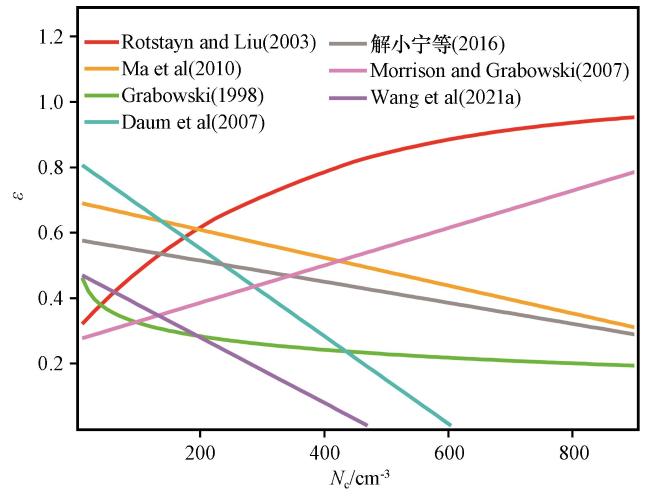
图1 不同研究得到的ε与N c相关性示意图

Fig.1 Relative dispersion (ε) as a function of cloud droplet number concentration (N c) in different studies

根据云滴的凝结增长和碰并理论, 许多学者认为, 随着云滴数浓度的增加, 云滴谱离散度也会增加。Liu and Daum(2002)对比了大量的污染和清洁背景的海洋性积云观测资料发现, 污染云中ε与N c普遍呈正相关。随后, Rotstayn and Liu(2003, 2009)利用模式结果验证了这种正相关关系。Yum and Hudson(2005)提出相比于云滴谱较宽的海洋性云, 大陆云中粒子尺度小, 因此云滴谱离散度更大, ε随N c增加而增加。Liu et al(2006b)通过理论推导, 将公式计算得到的ε-N c关系进行参数化, 并在绝热气块模式(adiabatic parcel model)中区分不同上升速度进行了模拟, 发现得到二者正相关关系与观测结果较为一致。Pandithurai et al(2012)利用印度地区大陆性积云的飞机观测资料研究发现, 背景气溶胶浓度增加会导致云中的N c与ε均增加, ε与N c呈正相关。
由于ε与N c的相互作用机制复杂, 二者的相关关系存在很大的不确定性, 不同的试验方法和观测地区可能得到不同的结论。Ma et al(2010)在研究华北地区非降水层状云的飞机观测资料时发现, 在严重污染背景下, 随着N c增加, ε逐渐减小。Wang et al(2011)在模拟浅积云云中微物理参量的变化中发现, 气溶胶浓度增加会导致N c与ε呈明显的负相关, 认为这种现象可能与云中的碰并过程有关。亚马逊地区的研究结果也表明, 生物质燃烧带来的CCN浓度增加会导致云中出现较高的云滴浓度和较低的ε现象(Martins and Silva, 2009)。Lu and Seinfeld(2006)在模拟海洋性层积云的研究认为, 云的微物理特性主要受pre-cloud的气溶胶特性影响, ε与N c呈负相关关系。Lu et al(2012)通过分析RACORO试验中浅积云的飞机资料也得到类似结果, 认为ε与N c以及云中的垂直速度均呈负相关。解小宁等(2016)分析陕西地区的一次降水性层状云飞机观测资料发现, 当液水含量大于0.01 g·cm-3时, ε随N c呈显著的递减关系, 并对ε-N c关系进行了参数化描述。
还有学者认为ε与N c的相关性不仅仅是简单的单调增减关系。例如Zhao et al(2006)通过对中国多个地区的机载云微物理参量统计发现, 当N c浓度较低时, ε变化较大(通常在0.2~0.8之间), 随着N c浓度增加, ε逐渐收敛于某一固定值(0.4~0.5)。Deng et al(2009)分析北京地区的暖云飞机观测资料时得到了类似结果, 并提出N c浓度较高时ε的收敛值会因不同类型的云而不同。余欣洋(2018)在研究黄山顶的地基云雾观测资料时也验证了这一现象。Lu et al(2007)总结了多次大型试验的ε与N c关系, 认为ε在云滴浓度N c<100 cm-3的变化范围显著大于N c>100 cm-3。除此之外, 还有一些学者发现ε随N c没有显著变化, Brenguier et al(2011)分析了数十个地区的积云飞机观测资料, 认为ε与N c没有明显的相关性。Tas et al(2015)在研究土耳其地区的积云微物理特征时发现, ε通常介于0.25~0.35之间, 且对云滴数浓度和含水量无明显相关。Lu et al(2008a)通过分析大陆性浅积云的飞机观测资料时也认为积聚模态气溶胶浓度变化与云中ε无明显相关性, 即云滴谱的离散度效应与环境气溶胶浓度无关, 且不会抵消Twomey冷却效应。
表1为近年来开展的ε与N c的相关性研究, 值得注意的是, ε与N c的负相关关系有很多发生在受特定污染影响的地区(N a浓度较高), 例如严重的人为污染排放(Ma et al, 2010)、 生物质燃烧(Martins and Silva, 2009)或受二者共同影响的地区(Cecchini et al, 2017)。而二者正相关关系的研究大多出现在清洁的海洋云条件下。虽然不同条件下ε与N c之间的关系存在一定的差异, 但云滴谱离散度仍是气溶胶第一和第二间接效应中必须量化考虑的重要参数之一, 在气溶胶-云-辐射-降水之间的相互作用过程中不可忽视。
表1 近年来开展的 ε-N c 相关性研究

Table 1 Correlational studies of ε-N c in recent years

引文 相关性 拟合关系 云类型 研究方法
Liu and Daum, 2002 正相关 海洋性云 观测
Rotstayn and Liu, 2003, 2009 正相关 ε=1-0.7exp(-0.003N c) 海洋性层云 观测和数值模拟
Pandithurai et al, 2012 正相关 大陆性积云(暖) 观测
Morrison and Grabowski, 2007 正相关 ε=0.0005714N c+0.2714 层积云(暖) 观测
Anil et al, 2016 正相关 大陆性暖云 观测
Peng and Lohmann, 2003 正相关 β(ε)=1.18+0.00045N c 海洋性层云 观测
Lu et al, 2007 正相关 海洋性层云/层积云 观测
Lu et al, 2012 负相关 大陆性积云 观测
Pawlowska et al, 2006 负相关 观测
Ma et al, 2010 负相关 ε=0.694-0.000426N c 非降水性大陆云 观测
Martins and Silva, 2009 负相关 海洋性层积云 观测
Desai et al, 2019 负相关 观测
Grabowski, 1998 负相关 ε=0.146-5.964×10⁻² ln(N c/2000) 海洋性云和大陆性云 理论计算
Daum et al, 2007 负相关 ε=0.82-0.00134N c 海洋性层云/层积云 观测
解小宁等, 2016 负相关 ε=0.579-7.42×10⁻⁴ N c+4.2×10⁻⁴ N c 降水性大陆云 观测
Cecchini et al, 2017 负相关 观测
Wang et al, 2021a 负相关 ε=0.48-0.001N c 层积云(暖) 观测
张屹等, 2021 负相关 ε=1.61N c-0.26 大陆性层积云 观测
张屹等, 2021 负相关 ε=1.62N c-0.25 大陆性积云 观测
Zhao et al, 2006 收敛相关 大陆性云 观测
Deng et al, 2009 收敛相关 大陆性云 观测
Tas et al, 2015 不相关 观测
Lu et al, 2008b 不明 大陆性积云 观测

3.2  ε 与云中微物理参量和动力过程的影响机制研究

上述ε与N c甚至N a相关关系的不确定性间接意味着影响ε的因素较多, 成因较为复杂。有研究表明他们之间的相互关系既与环境气溶胶的物理性质、 化学组成有关, 又受到云中上升速度、 夹卷混合等过程的影响, 而且ε会随着云的不同发展阶段以及云中不同部位而变化。
一般来说, 背景气溶胶浓度增加, 会导致云中的N c增加, 但ε是否增加与云中的垂直速度(w)密切相关, Liu et al(2006b)认为云中较大的上升气流速度会导致N c增加但ε降低, 并利用这种关系改进了Twomey(1974)关于云反照率效应的表达式(增加了垂直速度的参数化公式)。针对大陆非降水性积云(non-drizzling cumuli)的研究也得到类似结论, 即云中上升速度增大时, N c增大, ε降低, ε与w呈反比(Lu et al, 2012)。云中的上升气流是影响ε与N c之间相关性的重要因素, ε不仅与w呈反比, 而且与云中的液态水含量(LWC)密切相关(Berg et al, 2011)。Reutter et al(2009)深入研究发现当云中垂直速度与背景气溶胶含量的比值较大时, 云滴会出现过饱和, N c与w无明显关系, 此时背景气溶胶浓度占主导; 相反, 若云滴未达到饱和, N c与上升气流存在较强相关。除w外, 云中湍流的强弱也会导致云滴浓度改变、 云滴谱宽度增加, 从而改变云滴谱离散度(Liu et al, 2002; Wang et al, 2009)。由于垂直气流带来的云内混合程度差异, 包括夹卷、 混合过程也是导致N c与ε呈负相关的另一个原因(Desai et al, 2019)。Lu and Seinfeld(2006)通过大涡模拟研究气溶胶的间接效应时发现云中的夹卷过程和云滴的碰并过程均会影响ε与N c。由于受到湍流以及夹卷混合过程的影响, 真实大气中的云滴谱与理论上绝热过程中谱的特征存在很大不同(Liu and Hallett, 1998; Yum et al, 2015), 环境空气的夹卷是影响ε的重要因素(Tölle and Krueger, 2014; Lasher-Trapp et al, 2005; Su et al, 1998)。有学者通过观测(Burnet and Brenguier, 2007)和数值模拟(Su et al, 1998)研究发现, 不考虑夹卷混合得到的云滴谱要比实际大气中的云滴谱窄。Lu et al(2013)针对浅积云的观测结果表明, ε和夹卷率正相关, 由于观测到的云滴谱标准差介于0.75~1 μm, 因此ε增加主要是因为夹卷混合过程使云中的R m减小; 随着夹卷率的增大, 大滴浓度减小, 小滴浓度增加。Guo et al(2018)指出ε和夹卷率负相关, 主要是由于, 随着夹卷率的增大, 大滴和小滴浓度同时减小。除了夹卷率(动力), 夹卷混合机制(微物理)也是影响ε的重要因子。Luo et al(2020)基于观测资料的一维气块模式(explicit mixing parcel model, EMPM)研究发现, 随着均匀混合程度(homogeneous mixing degree)的增大, ε与均匀混合程度之间的关系从正相关转为负相关, 主要与云滴的部分蒸发和完全蒸发有关。受夹卷混合过程的影响, 当云滴谱较宽时, ε与N c以及云中含水量均为正相关; 随着云滴谱收窄, 上述参量逐渐转变为负相关。而ε与云滴体积半径(R v)之间的关系不受云滴谱宽的影响, 始终为负相关(Luo et al, 2021)。张屹等(2021)对美国大陆性层积云和积云研究发现, 两类云的含水量相当, 但积云中的垂直速度更大, 相比于层积云具有较高的云滴数浓度和较小的云滴平均半径, 因此层积云和积云的ε相差不大, 且ε与N c和w呈显著的负相关。他们将这种负相关关系归因为云中不同部位的夹卷强弱的差异, 即云中核心部位上升气流占主导, 较大的垂直速度和较高的云滴数浓度使得小云滴比大云滴增长得更快, 因此ε变小。而云边界处夹卷作用占主导, 垂直速度小, 云滴蒸发、 稀释导致云滴数浓度降低并出现大小差异, 致使ε增加。
除了上述ε与云中动力过程的相关性研究外, 还有学者对云中不同部位ε的变化进行了研究。理论结果显示, 假定R m随高度增加这一结果恒定, 则不考虑夹卷混合作用下, 在云团绝热上升过程中, 云滴谱宽度逐渐变窄, 即ε随高度不变或减小(Pruppacher and Klett, 2012; Fletcher, 2011; Wang et al, 2021b)。朱磊等(2020)认为海洋性云团的低层云滴谱离散度较大与云底处气溶胶粒子的核化过程有关。很多早期的研究结果显示, 积层混合云中ε随高度接近恒定(Nicholls and Leighton, 1986; Politovich, 1993; Martin et al 1994)。Cecchini et al(2017)在亚马逊地区的观测试验(HALO)结果也显示, 大多数污染云团中ε对高度并不敏感。但近年来一些在海洋上空开展的观测试验[例如ACE2 (Brenguier et al, 2000)、 RICO(Rauber et al, 2007)和MASE(Lu et al, 2007)等]中发现, ε随高度呈不同程度的变化。Pawlowska et al(2006)利用ACE2资料研究认为海洋云(受海洋气团影响)中ε随高度增加逐渐减小, ε最大值出现在云底处, 主要是由于夹卷混合和上升气流的作用, 这与Lu et al(2007)在MASE试验中13架次穿云探测得到的结果类似。而ACE2试验中大陆云(受污染气团影响)的研究结果以及RICO试验的观测结果(Arabas et al, 2009)则表明, ε随高度不变或略有增加, 在云中靠近云底的几百米, ε的平均值在0.2左右。从整个试验结果来看, ACE2中海洋性云的ε=0.1~0.2, 大陆性云的ε=0.2~0.4, MASE试验结果显示ε=0.2~0.6, 而RICO观测的ε介于0.1~0.8之间。产生上述差异的原因主要是由于不同试验中观测得到的σ差异造成。由于R m随高度逐渐增加, ACE2和MASE试验中对海洋云的观测显示σ随高度无明显变化, 因此造成ε随高度增加逐渐减小; 而RICO试验和ACE2试验中大陆云个例的R m和σ均随高度逐渐增加, 导致ε随高度不变或略有增加。另外观测区域污染背景不同也是造成上述ε差异的原因之一(Prabha et al, 2012)。模拟结果显示, 当背景气溶胶浓度较低时, 云滴粒子的碰并增强, 凝结作用减弱, 是影响两者相关性的主要因素。在云中强上升气流区域(weak mixing region), 表现为接近绝热, 云滴有效半径更大, 标准差更小, 因此云中ε更低, 而在垂直速度较弱的区域(strong mixing region), 上述参量的表现则相反。而在中等气溶胶浓度背景条件下(aerosol mixing ratio<100 mg-1), 云中的ε随高度无明显变化, 只有在严重污染条件下(aerosol mixing ratio>2000 mg-1), ε随高度逐渐增加(Wang et al, 2011)。
除此之外, ε还与云团的发展程度密切相关。相较于 “发展阶段”和“减弱阶段”, 处于“成熟阶段”的云团ε往往偏小, ε可以通过R v的线性关系来表示(Tas et al, 2012)。而Lu et al(2020)认为ε与R v的关系存在非单调性, 云团初生阶段, 二者表现为正相关; 随着R v的增加(R v>2.2 μm), 二者逐渐由正相关转向负相关。甚至有研究发现, 边界层内的湍流动能会通过影响云中的动力过程间接造成云团不同发展阶段云滴谱离散度的差异(吴尚等, 2020)。这主要与气溶胶核化以及云滴的凝结和碰并过程有关。还有研究认为相对湿度也是影响两者相关关系的重要参数(Martins and Silva, 2009), 它通过影响CCN的活化过程, 改变CCN-云滴的转化率来影响二者之间的相关关系。

3.3 由 ε 引起的辐射强迫变化研究(第一间接效应)

在研究气溶胶的间接效应时, 早期的气候模式大多假定ε不变, 主要关注云中液态水含量和云滴数浓度, 从而很大程度上忽略了ε的影响(Jones and Slingo, 1996; Kiehl et al, 2000)。由于ε是反映云滴尺度的参数, 越来越多的研究表明, ε对云的辐射强迫特性(即气溶胶第一间接效应)产生显著影响(Liu and Daum, 2000, 2002; Peng and Lohmann, 2003; Xie and Liu, 2013; Xie et al, 2017)。如果ε随N c的增加而增大(即ε-N c正相关), 那么R e减小的程度会变小, 也就是说离散度效应会抵消部分第一间接效应; 相反而言, 如果ε随N c的增加而减小(即ε-N c负相关), 则离散度的改变会增强第一间接效应(陆春松等, 2021)。有研究认为气溶胶的间接辐射强迫中, 近一半是由于云滴尺度变化造成的(Ghan et al, 2001)。不同的ε-N c参数化关系会导致全球模式中对间接效应估算出现不同程度(-10%~13%)的抵消或增强(Wang et al, 2020)。
Liu and Daum(2002)通过分析清洁和污染条件下海洋云的观测数据指出, N a的增加导致N c与ε同时增大, 从而改变云的反照率, 且增大的ε所产生的增温效应抵消了10%~80%的Twomey冷却效应。也就是说云滴谱的离散度效应可能会造成第一间接效应的显著高估。Rotstayn and Liu(2003)将观测得到的参数化离散度(Liu and Daum, 2002)和理论计算的固定离散度, 并在全球气候模式CSIRO中进行敏感性试验, 发现考虑了云滴离散度效应后, 气溶胶第一间接效应会降低12%~35%。Pandithurai et al(2012)认为背景气溶胶的增加导致印度大陆性积云中N c和ε增加, 由此带来的离散度效应会抵消39%由云滴增加带来的冷却效应。陆春松等(2021)利用飞机资料评估层积云的气溶胶间接效应发现, 云滴谱离散度效应对气溶胶间接效应的贡献主要为抵消作用, 这种抵消作用在云中含水量中等时(0.24 g·m-3)最大。还有研究学者通过观测研究(Chen et al, 2012; Anil et al, 2016)、 模式模拟(Wood et al, 2002; Yum and Hudson, 2005)和理论计算(Liu et al, 2006b)等得到类似结论, 认为较高的ε可以抵消部分气溶胶间接效应, 使目前被高估的气溶胶总量更接近于真实值(Rotstayn and Liu, 2003; Kumar et al, 2014; Peng et al, 2007)。
大尺度的模式模拟中, 一般通过云滴有效半径作为关键参量来在云中的微物理特性和光学特性之间建立联系(Slingo and Schrecker, 1982)。因此, 云滴光学特性同样受云滴谱分布的影响。前面提到Liu and Daum(2002)的研究认为背景气溶胶浓度增加导致云滴散度增大而且云会变得更暗(cloud darkening)。但是在污染云和清洁云中, 他们并未区分背景气象场和云中相对速度的影响。相反, Lu and Seinfeld(2006)在大涡模式中将气象场恒定, 只改变背景气溶胶浓度, 发现了相反的结果, 即气溶胶浓度增加, 云滴离散度降低, 云变得更亮(cloud brightening)。随后Ma et al(2010)在观测试验中也发现了类似结果, N a增加时(污染增强导致云滴浓度增加), ε会减小, 进而减小了云滴的有效半径, 增强了气溶胶的第一间接效应。
Lu et al(2007)讨论了造成上述结果的原因, 在较大尺度的云系中, 背景气溶胶浓度增加会使云中LWC减小, ε增加, 二者的共同作用使得Twomey效应削弱; 而针对较小的云团(受船尾迹扰动影响的云系), 云中LWC增加, ε降低, 导致间接效应增强。造成这种反差的主要原因可能与不同尺度的云受到的外界气象条件影响程度有关。例如, 大尺度的云, 不同的气象条件会导致云顶的混合程度, 云底的上升速度, 毛毛雨密度, 甚至地表蒸发都会不同; 而小尺度较为的独立云团, 污染(ship track-perturbed)或者清洁条件下对应的气象要素廓线差别不大, 在研究间接效应时很少会考虑由于气象场的差别导致的云中LWC和ε的变化。此外, 很多气溶胶间接效应的研究中, 未考虑云滴谱离散度带来的影响, 这使得相关理论研究和模式模拟仍然具有一定的局限性(Hudson et al, 2012)。

3.4  ε 对降水过程的影响(第二间接效应)

ε是量化气溶胶对云和降水影响的重要参数, 其通过影响云微物理参数化方案中的云水-雨水间的自动转化过程, 进一步影响降水的发生和地面降水量的高低(Liu and Daum, 2004; Liu et al, 2006a; Xie and Liu, 2009)。模式研究表明, 不同气溶胶背景下, ε能够显著影响云微物理特征和地面降水量(Xie and Liu, 2011)。
由于云滴谱离散度是云滴分布标准差与平均半径之比, 它可以表征云滴谱相对于R m的平均偏离程度。当ε=0时, 表示所有云滴都在同一个尺度上; 随着ε的增加, 不同尺度的云滴之间有较好的混合程度。研究表明, 较高的ε会增加云滴之间的碰并效率, 加速云水-雨水的自动转化过程, 从而增加产生降水的可能(Liu et al, 2006a; Liu and Daum, 2004), 甚至改变地面降水分布。Peng and Lohmann(2003)对加拿大地区两次实验的飞机观测资料的研究发现, 气溶胶浓度的增加导致ε与β(为云滴有效半径与平均体积半径之比, 后文中详细介绍)显著增加。将上述观测资料建立的N c-β(ε)参数化关系放入 ECHAM4 全球气候模式中, 结果显示, ε的增大会提高云水向雨水的转化效率, 降低气溶胶的第二间接效应。在考虑云滴的离散度效应后, 气溶胶间接效应会降低15%。Rotstayn and Liu(2005)在气候模式中同样考虑云滴谱离散度效应对云水转化率影响, 利用新的参数化方案模拟结果显示, 针对暖云的第二间接效应减少了61%。解小宁等(2015)认为云水的自动转化效率与ε呈正相关, 即一块云中若ε较大, 则大云滴和小云滴有较好和混合度, 进而云滴的碰并效率较高, 容易产生降水。因此, 云滴谱离散度可以通过改变云水自动转化率来改变降水, 进而在气溶胶-云-降水的相互关系中发挥至关重要的作用。
此外, 前文提到的ε与N c的相关性差异, 也会对地面降水产生不同程度的影响。Xie and Liu(2013)在数值模式中耦合了不同类型的ε与N c关系, 研究了中尺度对流系统中气溶胶对降水的影响。结果显示, 模式中耦合二者不同的相关关系式所呈现出的降水特征明显不同。Chen et al(2012)分析海洋积层混合云的观测资料发现, 相比于清洁个例, 污染云更容易导致强降水发生, 其中, 由于云团体积增大(cloud thickness effect)导致的第二间接效应最明显, 其次为Twomey效应和云滴谱离散度效应。Xie and Liu(2011)将考虑ε的云水-雨水自动转化过程的参数化方案应用于WRF模式中, 研究了ε与N c的相关关系对深对流云地面降水的影响。认为气溶胶对地表降水的影响强烈依赖于ε与N c间的相关性: 当两者为正相关时, 无论是海洋背景还是大陆背景, 模式结果显示累积雨量随着环境气溶胶的增加而增多; 而当两者表现为负相关时, 若N a较高, 则较小的ε会抑制云水-雨水的自动转化过程, 使地面降水量减少。上述模式研究的云微物理方案中, ε通常假定为常数或从利用观测得到的统计关系求得, 而这种假定或统计关系并不适用于所有的实际情况, 刘煜和李维亮(2015)基于Gamma分布函数提出了一种计算ε解析解的方法, 该方法通过了实际观测资料的验证, 且应用到双参数云微物理方案中, 结果显示对降水的模拟有所改善。

4 结论和展望

本文回顾了云滴谱离散度的概念以及针对云滴谱离散度开展的观测试验、 理论计算和数值模式相关研究进展, 包括云滴谱离散度与气溶胶和云滴数浓度的相关性、 云度谱离散度对云中动力过程的影响机制以及由云滴谱离散度引起的气溶胶间接效应的相关研究; 讨论了云滴谱离散度在气溶胶-云-降水相互作用过程中的重要性, 以及由于云滴谱离散度效应导致可能出现的气溶胶间接效应估算的差异和不确定性。
从过往开展的云滴谱离散度研究来看, ε-N a或ε-N c的相关关系是描述云内微物理和动力过程, 以及量化气溶胶对云和降水影响时的重要因子之一。但不同地区、 不同云系的观测结果显示, ε-N a或ε-N c的相关性存在很大差异, 既有正相关也有负相关, 甚至不相关。这与气溶胶核化、 云中垂直速度、 夹卷混合, 以及云滴的凝结和碰并过程等存在密切联系。正是由于离散度与气溶胶或云滴浓度相关关系的复杂性, 使得利用观测资料估算云滴有效半径和云水的自动转化效率时存在很大的不确定性(即云滴谱离散度效应), 造成对云宏微观特性以及地面降水的高估或低估, 对气溶胶间接效应的计算产生影响。基于上述研究现状, 云滴谱离散度的相关研究可以但不限于在以下两方面深入开展:
(1) 在不同地区、 不同类型云系开展云外气溶胶和云内微物理参量的飞机和山地观测试验, 改进中尺度或区域模式中云滴谱和云水自动转化过程的参数化方案, 有助于提高我国典型地区云和降水的数值模拟和预报预测能力。
(2) 同一地区针对某一类云系开展针对性的气溶胶和云降水参量观测试验, 得到较为稳定的云滴谱离散度与背景气溶胶或云滴微物理参量的相关关系, 深入研究可对该地区气溶胶间接效应及其不确定性展开针对性评估。
总之, 开展基于理论计算、 观测试验和数值模拟的云滴谱离散度及其相关参量的研究, 建立考虑离散度效应的参数化方案并在模式中开展实际应用, 无疑是对理解气溶胶-云-降水之间相互作用, 以及提高云和降水数值预报准确率, 具有重要的科研和应用价值。

References

null
Albrecht B A, 1989.Aerosols, cloud microphysics, and fractional cloudiness[J].Science, 245: 1227-1231.DOI: 10.1126/science. 245.4923.1227 .
null
Anil K K V, Pandithurai G, Leena P P, et al, 2016.Investigation of aerosol indirect effects on monsoon clouds using ground-based measurements over a high-altitude site in Western Ghats[J].Atmospheric Chemistry and Physics, 16: 8423-8430.DOI: 10. 5194/acp-16-8423-2016 .
null
Arabas S, Pawlowska H, Grabowski W, 2009.Effective radius and droplet spectral width from in-situ aircraft observations in trade-wind cumuli during RICO[J].Geophysical Research Letters, 36: L11803, DOI: 10.1029/2009GL038257.
null
Berg L K, Berkowitz C M, Barnard J C, et al, 2011.Observations of the first aerosol indirect effect in shallow cumuli[J].Geophysical Research Letters, 38: L03809.DOI: 10.1029/2010gl046047 .
null
Brenguier J L, Burnet F, Geoffroy O, 2011.Cloud optical thickness and liquid water path-does the k coefficient vary with droplet concentration?[J].Atmospheric Chemistry and Physics, 11: 9771-9786.DOI: 10.5194/acp-11-9771-2011 .
null
Brenguier J, Chuang P, Fouquart Y, et al, 2000.An overview of the ACE-2 CLOUDYCOLUMN closure experiment[J].Tellus B, 52(2): 815-827.DOI: 10.1034/j.1600-0889.2000.00047.x .
null
Bulgin C E, Palmer P I, Thomas G E, et al, 2008.Regional and seasonal variations of the Twomey indirect effect as observed by the ATSR-2 satellite instrument[J].Geophysical Research Letters, 35: L02811.DOI: 10.1029/2007gl031394 .
null
Burnet F, Brenguier J L, 2007.Observational study of the entrainment-mixing process in warm convective clouds[J].Journal of the Atmospheric Sciences, 64(6): 1995-2011.DOI: 10.1175/jas3928.1 .
null
Cecchini M A, Machado L A, Andreae M O, et al, 2017.Sensitivities of Amazonian clouds to aerosols and updraft speed[J].Atmospheric Chemistry and Physics, 17: 10037-10050.DOI: 10. 5194/acp-17-10037-2017 .
null
Chandrakar K K, Cantrell W, Chang K, et al, 2016.Aerosol indirect effect from turbulence-induced broadening of cloud-droplet size distributions[J].Proceedings of the National Academy of Sciences, 113: 14243-14248.DOI: 10.1073/pnas.1612686113 .
null
Charlson R J, Hofmann D J, 1992.Climate forcing by anthropogenic aerosols[J].Science, 255: 423-430.DOI: 10.1126/science. 255.5043.423 .
null
Chen Y C, Christensen M, Xue L L, et al, 2012.Occurrence of lower cloud albedo in ship tracks[J].Atmospheric Chemistry and Physics, 12: 8223–8235.DOI: 10.5194/acp-12-8223-2012 .
null
Daum P, Liu Y G, McGraw R, et al, 2007.Microphysical properties of stratus/stratocumulus clouds during the 2005 marine stratus/stratocumulus experiment (MASE)[C].AGU Fall Meeting Abstracts.
null
Deng Z Z, Zhao C S, Zhang Q, et al, 2009.Statistical analysis of microphysical properties and the parameterization of effective radius of warm clouds in Beijing area[J].Atmospheric Research, 93(4): 888-896.DOI: 10.1016/j.atmosres.2009.04.011 .
null
Desai N, Glienke S, Fugal J, et al, 2019.Search for microphysical signatures of stochastic condensation in marine boundary layer clouds using Airborne Digital Holography[J].Journal of Geophysical Research: Atmospheres, 124: 2739-2752.DOI: 10. 1029/2018jd029033 .
null
Fletcher N H, 2011.The physics of rainclouds[M].Cambridge: Cambridge University Press.
null
Ghan S J, Easter R C, Chapman E G, et al, 2001.A physically based estimate of radiative forcing by anthropogenic sulfate aerosol[J].Journal of Geophysical Research: Atmospheres, 106: 5279-5293.DOI: 10.1029/2000JD900503 .
null
Grabowski W W, 1998.Toward cloud resolving modeling of large-scale tropical circulations: A simple cloud microphysics parameterization[J].Journal of the Atmospheric Sciences, 55: 3283-3298.DOI: 10.1175/1520-0469 .
null
Grandey B, Stier P, 2010.A critical look at spatial scale choices in satellite-based aerosol indirect effect studies[J].Atmospheric Chemistry and Physics, 10(23): 11459-11470.DOI: 10.5194/acp-10-11459-2010 .
null
Guo X H, Lu C S, Zhao T L, et al, 2018.Observational study of the relationship between entrainment rate and relative dispersion in deep convective clouds[J].Atmospheric Research, 199: 186-192.DOI: 10.1016/j.atmosres.2017.09.013 .
null
Hudson J G, Noble S, Jha V, 2012.Cloud droplet spectral width relationship to CCN spectra and vertical velocity[J].Journal of Geophysical Research: Atmospheres, 117: D11211.DOI: 10.1029/2012jd017546 .
null
Hudson, J G, Yum S S, 1997.Droplet spectral broadening in marine stratus[J].Journal of the Atmospheric Sciences, 54: 2642-2654.DOI: 10.1175/1520-0469(1997)054<2642: DSBIMS>2.0.CO; 2 .
null
Jones A, Slingo A, 1996.Predicting cloud-droplet effective radius and indirect sulphate aerosol forcing using a general circulation model[J].Quarterly Journal of the Royal Meteorological Society, 122(535): 1573-1595.DOI: 10.1002/qj.49712253506 .
null
Kiehl J, Schneider T, Rasch P, et al, 2000.Radiative forcing due to sulfate aerosols from simulations with the National Center for Atmospheric Research Community Climate Model, Version3[J].Journal of Geophysical Research: Atmospheres, 105(D1): 1441-1457.DOI: 10.1029/1999jd900495 .
null
Koren I, Kaufman Y J, Rosenfeld D, et al, 2005.Aerosol invigoration and restructuring of Atlantic convective clouds[J].Geophysical Research Letters, 32: L14828.DOI: 10.1029/2005GL023187 .
null
Kumar B, Schumacher J, Shaw R A, 2014.Lagrangian mixing dynamics at the cloudy-clear air interface[J].Journal of the Atmospheric Sciences, 71: 2564-2580.DOI: 10.1175/JAS-D-13-0294.1 .
null
Lasher-Trapp S G, Cooper W A, Blyth A M, 2005.Broadening of droplet size distributions from entrainment and mixing in a cumulus cloud[J].Quarterly Journal of the Royal Meteorological Society, 131: 195-220.DOI: 10.1256/qj.03.199 .
null
Li Z Q, Niu F, Fan J W, et al, 2011.Long-term impacts of aerosols on the vertical development of clouds and precipitation[J].Nature Geoscience, 4(12): 888-894.DOI: 10.1038/ngeo1313 .
null
Liu Y G, Daum P H, 2000.Spectral dispersion of cloud droplet size distributions and the parameterization of cloud droplet effective radius[J].Geophysical Research Letters, 27(13): 1903-1906.DOI: 10.1029/1999gl011011 .
null
Liu Y G, Daum P H, 2002.Anthropogenic aerosols: indirect warming effect from dispersion forcing[J].Nature, 419(6907): 580-581.DOI: 10.1038/419580a .
null
Liu Y G, Daum P H, 2004.Parameterization of the autoconversion process.Part I: analytical formulation of the Kessler-type parameterizations[J].Journal of the Atmospheric Sciences, 61(13): 1539-1548.DOI: 10.1175/1520-0469(2004)061<1539: potapi>2.0.co; 2 .
null
Liu Y G, Daum P H, Hallett J, 2002.A generalized systems theory for the effect of varying fluctuations on cloud droplet size distributions[J].Journal of the Atmospheric Sciences, 59: 2279-2290.DOI: 10.1175/1520-0469(2002)059<2279: AGSTFT>2.0.CO; 2 .
null
Liu Y G, Daum P H, McGraw R, et al, 2006a.Parameterization of the autoconversion process.Part II: Generalization of Sundqvist-type parameterizations[J].Journal of the Atmospheric Sciences, 63(3): 1103-1109.DOI: 10.1175/jas3675.1 .
null
Liu Y G, Daum P H, Yum S S, 2006b.Analytical expression for the relative dispersion of the cloud droplet size distribution[J].Geophysical Research Letters, 33: L02810.DOI: 10.1029/2005GL024052 .
null
Liu Y G, Hallett J, 1998.On size distributions of cloud droplets growing by condensation: A new conceptual model[J].Journal of the Atmospheric Sciences, 55: 527-536.DOI: 10.1175/1520-0469(1998)055<0527: osdocd>2.0.co; 2 .
null
Liu Y, Lu C S, Li W L, 2017.Skewness of cloud droplet spectrum and an improved estimation for its relative dispersion[J].Meteorology and Atmospheric Physics, 129: 47-56.DOI: 10.1007/s00703-016-0458-9 .
null
Lu C S, Liu Y G, Niu S J, et al, 2012.Observed impacts of vertical velocity on cloud microphysics and implications for aerosol indirect effects[J].Geophysical Research Letters, 39: L21808.DOI: 10.1029/2012gl053599 .
null
Lu C S, Liu Y G, Yum S S, et al, 2020.Reconciling contrasting relationships between relative dispersion and volume-mean radius of cloud droplet size distributions[J].Journal of Geophysical Research: Atmospheres, 125(9): e2019JD031868.DOI: 10. 1029/2019JD031868 .
null
Lu C S, Niu S J, Liu Y G, et al, 2013.Empirical relationship between entrainment rate and microphysics in cumulus clouds[J].Geophysical Research Letters, 40(10): 2333-2338.DOI: 10. 1002/grl.50445 .
null
Lu M L, Conant W C, Jonsson H H, et al, 2007.The Marine Stratus/Stratocumulus Experiment (MASE): Aerosol-cloud relationships in marine stratocumulus[J].Journal of Geophysical Research: Atmospheres, 112: D10209.DOI: 1029/2006jd007985 .
null
Lu M L, Feingold G, Jonsson H H, et al, 2008a.Aerosol-cloud relationships in continental shallow cumulus[J].Journal of Geophysical Research: Atmospheres, 113: D15201.DOI: 10.1029/2007jd009354 .
null
Lu M L, Feingold G, Jonsson H H, et al, 2008b.Aerosol-cloud relationships in continental shallow cumulus[J].Journal of Geophysical Research: Atmospheres, 113: D15201.DOI: 10.1029/2007JD009354 .
null
Lu M L, Seinfeld J H, 2006.Effect of aerosol number concentration on cloud droplet dispersion: a large-eddy simulation study and implications for aerosol indirect forcing[J].Journal of Geophysical Research: Atmospheres, 111: D02207.DOI: 10.1029/2005JD006419 .
null
Luo S, Lu C S, Liu Y G, et al, 2020.Parameterizations of entrainment-mixing mechanisms and their effects on cloud droplet spectral width based on numerical simulations[J].Journal of Geophysical Research: Atmospheres, 125(22): e2020JD032972.DOI: 10.1029/2007JD009354 .
null
Luo S, Lu C S, Liu Y G, et al, 2021.Consideration of initial cloud droplet size distribution shapes in quantifying different entrainment-mixing mechanisms[J].Journal of Geophysical Research: Atmospheres, 126(13): e2020JD034455.DOI: 10. 1029/2020JD034455 .
null
Ma J Z, Chen Y, Wang W, et al, 2010.Strong air pollution causes widespread haze-clouds over China[J].Journal of Geophysical Research: Atmospheres, 115: D18204.DOI: 10.1029/2009JD013065 .
null
Martin G, Johnson D, Spice A, 1994.The measurement and parameterization of effective radius of droplets in warm stratocumulus clouds[J].Journal of the Atmospheric Sciences, 51: 1823-1842.DOI: 10.1175/1520-0469(1994)051<1823: TMAPOE>2.0.CO; 2 .
null
Martins J A, Silva Dias M A F, 2009.The impact of smoke from forest fires on the spectral dispersion of cloud droplet size distributions in the Amazonian region[J].Environmental Research Letters, 4: 015002.DOI: 10.1088/1748-9326/4/1/015002 .
null
Miles N L, Verlinde J, Clothiaux E E, 2000.Cloud droplet size distributions in low-level stratiform clouds[J].Journal of the Atmospheric Sciences, 57: 295-311.DOI: 10.1175/1520-0469(2000)057<0295: CDSDIL>2.0.CO; 2 .
null
Morrison H, Grabowski W W, 2007.Comparison of bulk and bin warm-rain microphysics models using a kinematic framework[J].Journal of the Atmospheric Sciences, 64: 2839-2861.DOI: 10.1175/JAS3980 .
null
Nicholls S, Leighton J, 1986.An observational study of the structure of stratiform cloud sheets: Part I.Structure[J].Quarterly Journal of the Royal Meteorological Society, 112(472): 431-460.DOI: 10.1002/qj.49711247209 .
null
Pandithurai G, Dipu S, Prabh T V, et al, 2012.Aerosol effect on droplet spectral dispersion in warm continental cumuli[J].Journal of Geophysical Research: Atmospheres, 117: D16202.DOI: 10.1029/2011jd016532 .
null
Pawlowska H, Grabowski W W, Brenguier J L, 2006.Observations of the width of cloud droplet spectra in stratocumulus[J].Geophysical Research Letters, 33: L19810.DOI: 10.1029/2006GL026841 .
null
Peng Y R, Lohmann U, 2003.Sensitivity study of the spectral dispersion of the cloud droplet size distribution on the indirect aerosol effect[J].Geophysical Research Letters, 30(10): 1507.DOI: 10.1029/2003GL017192 .
null
Peng Y R, Lohmann U, Leaitch R, et al, 2007.An investigation into the aerosol dispersion effect through the activation process in marine stratus clouds[J].Journal of Geophysical Research: Atmospheres, 112: D11117.DOI: 10.1029/2006JD007401 .
null
Politovich M K, 1993.A study of the broadening of droplet size distributions in cumuli[J].Journal of the Atmospheric Sciences, 50: 2230-2244.DOI: 10.1175/1520-0469(1993)050<2230: ASOTBO>2.0.CO; 2 .
null
Prabha T V, Patade S, Pandithurai G, et al, 2012.Spectral width of premonsoon and monsoon clouds over Indo-Gangetic valley[J].Journal of Geophysical Research: Atmospheres, 117: D20205.DOI: 10.1029/2011JD016837 .
null
Pruppacher H R, Klett J D, 2012.Microphysics of Clouds and Precipitation: Reprinted 1980[C].Springer Science & Business Media.
null
Rauber R M, Stevens B, Ochs III H T, et al, 2007.Rain in shallow cumulus over the ocean: The RICO campaign[J].Bulletin of the American Meteorological Society, 88: 1912-1928.DOI: 10. 1175/BAMS-88-12-1912 .
null
Reutter P, Su H, Trentmann J, et al, 2009.Aerosol-and updraft-limited regimes of cloud droplet formation: influence of particle number, size and hygroscopicity on the activation of cloud condensation nuclei (CCN)[J].Atmospheric Chemistry and Physics, 9: 7067-7080.DOI: 10.5194/acp-9-7067-2009 .
null
Rosenfeld D, Rudich Y, Lahav R, 2001.Desert dust suppressing precipitation: A possible desertification feedback loop[J].Proceedings of the National Academy of Sciences, 98(11): 5975-5980.DOI: 10.1073/pnas.101122798 .
null
Rotstayn L D, Liu Y G, 2003.Sensitivity of the first indirect aerosol effect to an increase of cloud droplet spectral dispersion with droplet number concentration[J].Journal of Climate, 16: 3476-3481.DOI: 10.1175/1520-0442(2003)016<3476: SOTFIA>2.0.CO; 2 .
null
Rotstayn L D, Liu Y G, 2005.A smaller global estimate of the second indirect aerosol effect[J].Geophysical Research Letters, 32: L05708.DOI: 10.1029/2004GL021922 .
null
Rotstayn L D, Liu Y G, 2009.Cloud droplet spectral dispersion and the indirect aerosol effect: Comparison of two treatments in a GCM[J].Geophysical Research Letters, 36: L10801.DOI: 10. 1029/2009gl038216 .
null
Simpson J, Wiggert V, 1969.Models of precipitating cumulus towers[J].Monthly Weather Review, 97: 471-489.DOI: 10.1175/1520-0493(1969)097<0471: MOPCT>2.3.CO; 2 .
null
Slingo A, Schrecker H M, 1982.On the shortwave radiative properties of stratiform water clouds[J].Quarterly Journal of the Royal Meteorological Society, 108: 407-426.DOI: 10.1002/qj. 49710845607 .
null
Stocker T F, 2014.Climate change 2013: the physical science basis: Working Group I contribution to the Fifth assessment report of the Intergovernmental Panel on Climate Change[C].Cambridge: Cambridge University Press.
null
Su C W, Krueger S K, McMurtry P A, et al, 1998.Linear eddy modeling of droplet spectral evolution during entrainment and mixing in cumulus clouds[J].Atmospheric Research, 47: 41-58.DOI: 10.1016/S0169-8095(98)00039-8 .
null
Tao W K, Chen J P, Li Z Q, et al, 2012.Impact of aerosols on convective clouds and precipitation[J].Reviews of Geophysics, 50(2).DOI: 10.1029/2011RG000369 .
null
Tas E, Koren I, Altaratz O, 2012.On the sensitivity of droplet size relative dispersion to warm cumulus cloud evolution[J].Geophysical Research Letters, 39.DOI: 10.1029/2012gl052157 .
null
Tas E, Teller A, Altaratz O, et al, 2015.The relative dispersion of cloud droplets: its robustness with respect to key cloud properties[J].Atmospheric Chemistry and Physics, 15: 2009-2017.DOI: 10.5194/acp-15-2009-2015 .
null
T?lle M H, Krueger S K, et al, 2014.Effects of entrainment and mixing on droplet size distributions in warm cumulus clouds[J].Journal of Advances in Modeling Earth Systems, 6: 281-299.DOI: 10.1002/2012MS000209 .
null
Twomey S, 1974.Pollution and the planetary albedo[J].Atmospheric Environment, 8: 1251-1256.DOI: 10.1016/0004-6981(74)90004-3 .
null
Wang F, Li Z Q, Zhao D L, et al, 2021a.An airborne study of the aerosol effect on the dispersion of cloud droplets in a drizzling marine stratocumulus cloud over eastern China[J].Atmospheric Research, 105885.DOI: 10.1016/j.atmosres.2021.105885 .
null
Wang J, Daum P H, Yum S S, et al, 2009.Observations of marine stratocumulus microphysics and implications for processes controlling droplet spectra: Results from the Marine Stratus/Stratocumulus Experiment[J].Journal of Geophysical Research: Atmospheres, 114: D18210.DOI: 10.1029/2008JD011035 .
null
Wang M Q, Peng Y R, Liu Y G, et al, 2020.Understanding cloud droplet spectral dispersion effect using empirical and semi-analytical parameterizations in NCAR CAM5.3[J].Earth and Space Science, 7: e2020EA001276.DOI: 10.1029/2020EA001276 .
null
Wang X F, Xue H W, Fang W, et al, 2011.A study of shallow cumulus cloud droplet dispersion by large eddy simulations[J].Acta Meteorologica Sinica, 25(2): 166-175.DOI: 10.1007/s13351-011-0024-9 .
null
Wang Y, Zhao C F, McFarquhar G M, et al, 2021b.Dispersion of droplet size distributions in supercooled non-precipitating stratocumulus from aircraft observations obtained during the Southern Ocean Cloud Radiation Aerosol Transport Experimental Study[J].Journal of Geophysical Research: Atmospheres, 126: e2020JD033720.DOI: 10.1029/2020JD033720 .
null
Wood R, Irons S, Jonas P R, 2002.How important is the spectral ripening effect in stratiform boundary layer clouds?Studies using simple trajectory analysis[J].Journal of the Atmospheric Sciences, 59(18): 2681-2693.DOI: 10.1175/1520-0469(2002)059<2681: hiitsr>2.0.co; 2 .
null
Xie X N, Liu X D, 2009.Analytical three-moment autoconversion parameterization based on generalized gamma distribution[J].Journal of Geophysical Research: Atmospheres, 114: D17201.DOI: 10.1029/2008JD011633 .
null
Xie X N, Liu X D, 2011.Effects of spectral dispersion on clouds and precipitation in mesoscale convective systems[J].Journal of Geophysical Research: Atmospheres, 116: D06202.DOI: 10.1029/2010jd014598 .
null
Xie X N, Liu X D, 2013.Analytical studies of the cloud droplet spectral dispersion influence on the first indirect aerosol effect[J].Advances in Atmospheric Sciences, 30(5): 1313-1319.DOI: 10. 1007/s00376-0122141-5 .
null
Xie X N, Zhang H, Liu X D, et al, 2017.Sensitivity study of cloud parameterizations with relative dispersion in CAM5.1: impacts on aerosol indirect effects[J].Atmospheric Chemistry and Physics, 17: 5877-5892.DOI: 10.5194/acp-17-5877-2017 .
null
Yuan T L, Li Z Q, Zhang R Y, et al, 2008.Increase of cloud droplet size with aerosol optical depth: An observation and modeling study[J].Journal of Geophysical Research: Atmospheres, 113: D04201.DOI: 10.1029/2007JD008632 .
null
Yum S S, Hudson J G, 2005.Adiabatic predictions and observations of cloud droplet spectral broadness[J].Atmospheric Research, 73: 203-223.DOI: 10.1016/j.atmosres.2004.10.006 .
null
Yum S S, Wang J, Liu Y G, et al, 2015.Cloud microphysical relationships and their implication on entrainment and mixing mechanism for the stratocumulus clouds measured during the VOCALS project[J].Journal of Geophysical Research: Atmospheres, 120: 5047-5069.DOI: 10.1002/2014JD022802 .
null
Zhao C S, Tie X X, Brasseur G, et al, 2006.Aircraft measurements of cloud droplet spectral dispersion and implications for indirect aerosol radiative forcing[J].Geophysical Research Letters, 33: L16809.DOI: 10.1029/2006GL026653 .
null
解小宁, 刘晓东, 王昭生, 2015.云滴谱离散度对气溶胶间接效应影响的研究进展[J].地球环境学报, 6(2): 127-134.DOI: 10.7515/JEE201502008 .
null
解小宁, 王昭生, 王红丽, 等, 2016.云微物理特性及云滴有效半径参数化: 一次降水层状云的飞机观测资料结果[J].地球环境学报, 7(1): 12-18.DOI: 10.7515/JEE201601002 .
null
李占清, 2020.气溶胶对中国天气、 气候和环境影响综述[J].大气科学学报, 43(1): 76-92.DOI: 10.13878/j.cnki.dqkxxb. 20200115005 .
null
刘煜, 李维亮, 2015.一个求解云滴谱相对离散度的方法[J].中国科学(地球科学), 45(5): 639-648.DOI: 10.1007/s11430-015-5059-9 .
null
陆春松, 徐晓齐, 2021.云中夹卷混合过程的研究进展[J].暴雨灾害, 40(3): 271-279.DOI: 10.3969/j.issn.1004-9045.2021. 03.005 .
null
陆春松, 薛宇琦, 朱磊, 等, 2021.基于层积云飞机观测资料评估气溶胶间接效应[J].大气科学学报, 44(2): 279-289.DOI: 10. 13878/j.cnki.dqkxxb.20200613001 .
null
吴尚, 李岩, 杨素英, 等, 2020.不可溶性气溶胶对边界层暖云滴谱离散度影响的模拟研究[J].气象与环境学报, 36(3): 64-71.DOI: 10.3969/j.issn.1673-503X.2020.03.009 .
null
余欣洋, 2018.黄山暖性云雾滴谱离散度与其数浓度相关特征研究[D].南京: 南京信息工程大学.
null
张屹, 陆春松, 张胜龙, 等, 2021.层积云与积云中的微物理特征及其影响因子[J].暴雨灾害, 40(3): 297-305.DOI: 10.3969/j.issn.1004-9045.2021.03.008 .
null
朱磊, 陆春松, 高思楠, 等, 2020.海洋层积云中的云滴谱宽度及其影响因子[J].大气科学, 44(3): 575-590.DOI: 10.3878/j.issn.1006-9895.1905.19115 .
Outlines

/

〈 〉