Effects of Plant Diversity on Soil Organic Carbon in Alpine Meadow in Northeastern Qinghai-Xizang Plateau

  • Junjie MA ,
  • Yinping CHEN ,
  • Xiaoming MOU ,
  • Yuqiang LI ,
  • Yuqing ZHANG ,
  • Yuzhi LU ,
  • Bo CAO
Expand
  • 1. School of Environmental and Municipal Engineering,Lanzhou Jiaotong University,Lanzhou 730000,Gansu,China
    2. Northwest Institute of Ecological Environment and Resources,Chinese Academy of Sciences,Lanzhou 730000,Gansu,China
    3. Key Laboratory of Strategic Mineral Resources of the Upper Yellow River,Ministry of Natural Resources,Lanzhou 730000,Gansu,China

Received date: 2023-12-29

  Revised date: 2024-04-01

  Online published: 2024-04-01

Abstract

Plant diversity significantly affects the structure and function of ecosystems and plays a crucial role in soil organic carbon sequestration.In the past, the effects of plant diversity on soil organic carbon were mostly carried out under artificial plant diversity control, indicating that high plant diversity significantly promoted soil organic carbon accumulation.However, in natural grassland ecosystem, the research on the effect of plant diversity on soil organic carbon is relatively weak.In this study, 15 typical alpine meadows in the northeastern part of the Qinghai-Xizang Plateau were selected as sample sites.By measuring plant above-ground and subsurface biomass, soil pH value, soil microbial biomass carbon and nitrogen, soil organic carbon, granular organic carbon, mineral-bound organic carbon, total nitrogen and total phosphorus, etc., the effects of plant diversity on soil organic carbon sequestration under natural conditions were explored.It provides theoretical basis for the change of soil carbon storage and scientific management of grassland.The results showed that plant diversity significantly increased plant coverage and aboveground biomass (P < 0.01), but had no significant effect on underground biomass in different soil layers (0~20 cm and 20~40 cm).In 0~20 cm and 20~40 cm soil layers, the increase of plant diversity significantly increased soil microbial biomass carbon and organic carbon contents (P<0.05), but had no effect on microbial biomass nitrogen in different soil layers.According to the classification of soil organic carbon, there was a significant positive correlation between plant diversity and soil mineral bound organic carbon content (P<0.01), but no correlation with soil particulate organic carbon content.In conclusion, in the alpine meadow of the Qinghai-Xizang Plateau, higher plant diversity under natural conditions has a significant promoting effect on soil organic carbon content, which is mainly reflected in the increase of mineral binding organic carbon content.This study provides new insights and theoretical basis for the relationship between plant diversity and soil carbon pool in grassland ecosystem.

Cite this article

Junjie MA , Yinping CHEN , Xiaoming MOU , Yuqiang LI , Yuqing ZHANG , Yuzhi LU , Bo CAO . Effects of Plant Diversity on Soil Organic Carbon in Alpine Meadow in Northeastern Qinghai-Xizang Plateau[J]. Plateau Meteorology, 2025 , 44(1) : 56 -66 . DOI: 10.7522/j.issn.1000-0534.2024.00050

1 引言

草地是陆地生态系统的重要组成部分, 在生态系统中起维持生物多样性、 支撑畜牧业发展、 调节全球碳循环和涵养水源等重要功能(刘万弟等, 2022; 徐满厚和赵梓彤, 2022)。近年来, 随着对草地研究的深入, 草地植物多样性随地理梯度的空间分布逐渐成为生态学研究的热点问题(徐满厚和赵梓彤等, 2022)。植物多样性是检验种群结构和功能复杂性的重要指标(龚志莲和李勇, 2015), 同时, 植物多样性的水平会显著影响土壤有机碳的含量(Xu et al, 2021)。目前关于草地植物多样性的研究主要集中于多样性对地上和地下生物量的影响(Chen et al, 2020)。
全球气候变暖和土地利用变化导致的植物多样性丧失严重威胁生态系统结构和功能(Xu et al, 2020; Hooper et al, 2012), 这一过程显著影响土壤有机碳含量(徐文仕, 2022)。植物多样性主要通过影响土壤碳输入(植物凋落物, 根系分泌物等)和输出(微生物分解)过程的平衡影响土壤有机碳含量(徐文仕, 2022; Chen et al, 2018)。多样性高的植被群落往往具有更高的地上/地下生物量及植物凋落物输入量。植物根系和凋落物的分解是土壤有机碳周转的重要驱动力, 是有机碳形成的重要物质来源, 连结着土壤和植物系统的碳循环。此外, 高植物多样性可通过影响植被特征(群落构成和地上及地下生物量等)和土壤因素(水分、 温度和pH值等), 对土壤微生物群落的结构、 代谢活性和底物利用效率等产生影响, 进而影响微生物来源碳的生成、 积累乃至后续的稳定化过程(Malik et al, 2018; Zeng et al, 2022)。以往植物多样性对土壤有机碳的影响多集中于控制实验, 且普遍认为高植物多样性显著促进土壤有机碳含量(Prommer et al, 2020; Qian et al, 2023); 相比之下自然条件下(如: 气候因素影响)植物多样性对土壤有机碳含量的影响相对薄弱(Yang et al, 2007)。气候因素不仅会通过影响微生物活性进而影响土壤有机碳含量, 也会通过影响植物的多样性调控土壤有机碳(杨红飞等, 2012; De Deyn et al, 2008)。Spohn et al(2023)在全球84个草地调查研究中发现, 土壤有机碳含量受温度与植物多样性的协同调控, 即温暖和干旱气候条件下植物多样性对土壤碳含量的影响更为强烈。青藏高原高寒草甸由于海拔高, 紫外线强和温度低等独特性, 其植被相对脆弱且对外界环境变化敏感, 在自然条件下植物多样性是否显著提高土壤有机碳含量仍值得商榷。
土壤有机碳在全球生态环境变化中起至关重要作用, 它不仅能够调节全球温室效应, 还是评价土壤养分状况的核心指标(Lal, 2004)。然而, 当前草地植被的快速破坏可能使土壤从碳汇转变为大气中二氧化碳的碳源(Chen et al, 2020)。全球草地约占陆地生态系统碳储量的15.2%, 其中草地土壤占比高达89.4%(张义凡等, 2016), 其储量的微小波动会导致大气CO2浓度的显著变化; 增加土壤碳储量可抵消大气二氧化碳的增加, 从而减缓温室效应(Lange et al, 2015)。本研究选取青藏高原15个典型高寒草甸, 通过测定植物地上及地下生物量、 土壤pH值, 土壤微生物量碳氮含量、 土壤有机碳、 颗粒有机碳、 矿物结合态有机碳、 全氮及全磷等, 旨在探究自然条件下植物多样性如何影响土壤有机碳的含量。本研究有助于预测植物多样性变化对土壤碳含量的影响, 为草地生态系统的科学管理提供理论依据。

2 资料与方法

2.1 研究区概况

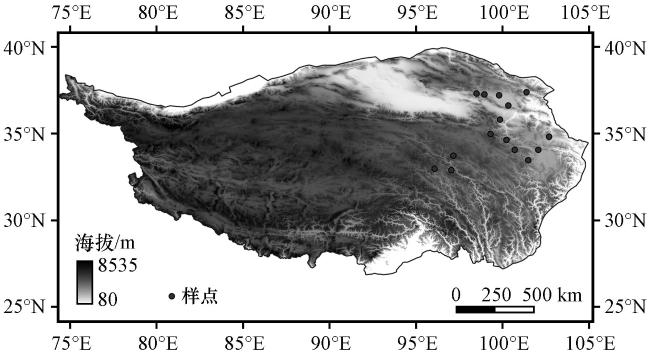
青藏高原平均海拔超过4000 m, 东西长约2800 km, 南北宽300~1500 km, 总面积约250×104 km2 (李鹏, 2017)。青藏高原植被类型较为丰富, 其西北部主要为荒漠和半荒漠植被类型, 高原腹地处绝大面积为高寒草原和高寒草甸; 东南部则为针叶林和阔叶林相互交织的山地森林(李鹏, 2017)。主要气候类型为高山高原气候, 其特点为海拔高、 气温低、 昼夜温差大。本研究选取15个典型的高寒草甸作为研究样地(图1), 样地选取依据为: (1)远离人类居住区域, 以确保样地尽量不受人类活动的影响; (2)选取植被生长相对均一的区域, 以确保关于多样性对土壤有机碳影响的评估不受局部异质性(如鼠丘斑块等)的干扰; (3)所有取样点均保持坡度、 坡向一致, 以规避由于微地形所导致的气候差异对土壤有机碳含量的影响。采样点覆盖不同的植物多样性和土壤理化特性, 植被盖度范围61%~98%, 生长季从5月持续到9月, 约90%的降水集中在生长季内。
图1 采样点分布

Fig.1 Distribution of sampling points

2.2 采样点基本信息

由表1可知, 本研究选取的研究样地地理位置跨度32°53′N -37°22′N、 96°4′E -102°42′E, 海拔3030~4357 m, 土壤pH变化6.07~8.61, 年平均温度(MAT)范围为-3.84~2.72 ℃, 平均年降水量(MAP)变化274~743 mm。
表1 采样点的基本信息

Table 1 General information of sampling sites

样地编号 经纬度 海拔/m 年平均温度/℃ 年平均降雨量/mm pH
0~20 cm 20~40 cm
1 102°42′14″E, 34°48′54″N 3030 2.72 585 7.24±0.08 7.97±0.36
2 102°04′52″E, 34°03′ 07″N 3560 0.93 690 8.41±0.04 8.35±0.16
3 101°29′37″E, 33°27′18″N 3630 0.54 743 6.04±0.11 6.40±0.06
4 100°42′59″E, 34°03′18″N 3770 0.66 618 7.81±0.18 8.56±0.04
5 100°14′30″E, 34°37′45″N 3750 0.73 507 7.8±0.33 8.42±0.10
6 99°19′01″E, 34°58′21″N 4000 -2.92 409 8.17±0.11 8.64±0.11
7 97°10′08″E, 33°43′10″N 4357 -3.84 515 7.77±0.55 8.33±0.05
8 97°03′26″E, 32°53′12″N 3810 2.48 509 8.21±0.22 8.50±0.24
9 96°04′56″E, 32°57′20″N 4290 0.54 533 8.13±0.15 8.43±0.25
10 99°51′36″E, 35°48′12″N 3610 0.27 366 8.43±0.09 8.73±0.15
11 98°30′15″E, 37°18′30″N 3495 -2.44 290 8.21±0.05 8.47±0.08
12 98°58′00″E, 37°15′31″N 3490 0.50 274 7.96±0.07 8.44±0.32
13 99°48′49″E, 37°12′14″N 3240 0.35 338 8.46±0.58 8.61±0.04
14 101°24′01″E, 37°22′48″N 3320 -1.38 487 5.78±0.08 5.94±0.11
15 100°20′42″E, 36°36′50″N 3260 0.84 372 8.05±0.05 8.26±0.06

2.3 样地设置及调查方法

2022年7月中旬至8月末, 选择尽量远离村落, 人为干扰因素小, 且坡度和坡向基本一致的15个典型高寒草甸样地。在每个样地内选择具有代表性的10 m×10 m的小区, 分别随机设置3个50 cm×50 cm的调查样方, 记录每个样方内草层高度、 植被盖度、 植物数。植物丰富度用出现在样方内的植物数表征(吴茜等, 2023; 方精云等, 2009)。
植被调查结束后, 用剪刀齐地面剪下植物的地上部分带回实验室105 ℃杀青并在65 ℃下烘干至恒重, 称重以计算地上生物量。在每个样方内随机选取2个采样点, 用内径8.5 cm的根钻, 按照深度为0~20 cm、 20~40 cm采集根系样品, 各重复同层混合为1个样品, 带回实验室用0.15 mm网筛反复清洗, 去除死根及黑色的腐殖质, 65 ℃下烘干至恒重, 称重, 用于计算地下生物量(牛钰杰等, 2018)。
以上采集完成后, 用内径为3.5 cm的土钻取0~20 cm、 20~40 cm的土样, 各样方内随机采集8钻, 各重复同层混合为1个样品, 将土壤样品装入自封袋带回实验室过2 mm筛后分成两份。一份置于4 °C冰箱中冷藏保存, 用于测定土壤微生物量碳(MBC)、 微生物量氮(MBN); 另一份置于实验室内自然风干, 用于测定土壤理化特性。

2.4 土壤样品分析

土壤有机碳(SOC)含量测定: 重铬酸钾硫酸氧化-外加热法。称取风干土样于试管中, 加入5 mL 0.8 mol·L-1的1/6 K2SO4溶液及5 mL浓H2SO4充分摇匀, 于180 ℃下消煮, 用FeSO4溶液滴定。
土壤全氮(TN)测定: 开氏定氮法。称取风干土样(过0.15 mm筛)于消煮管中, 加催化剂(CuSO4∶K2SO4∶CuSO4∶Se=100∶10∶1)2 g和5 mL浓H2SO4, 385 ℃下消煮2 h。消煮完成后用开氏定氮仪测定氮含量。
土壤全磷(TP)测定(符鲜等, 2018): 钼锑抗比色法。称取过0.15 mm筛风干土于消煮管中, 加入8 mL浓H2SO4和10滴高氯酸, 360 ℃下消煮1 h; 通过加入5 mL钼锑抗显色剂, 用712 nm波长的分光光度计进行比色, 读取吸收值并绘制工作曲线。
土壤微生物量碳氮(MBC, MBN)测定: 氯仿熏蒸浸提法。称取过2 mm的土壤15 g于50 mL的烧杯并放入真空干燥器中, 加入盛有去乙醇的氯仿, 在25 °C暗室里熏蒸72 h。将熏蒸和未熏蒸土壤用0.5 mol·L-1的 K2SO4 溶液浸提, 在200 r·min-1震荡1 h后过滤于50 ml的离心管中。土壤微生物量碳氮的测定用 TOC/TN 碳氮分析仪(Multi N/C3100, 德国)。
颗粒有机碳(POC)的测定方法(梁爱珍等, 2010): 称取30.00 g风干土样(过2 mm筛)于250 mL白色塑料瓶中, 加入60 ml 5%(w/v)的六偏磷酸钠溶液作为分散剂, 放入摇床振荡2 h, 摇床设定转速为200 r·min-1, 振荡结束后将土壤悬液过0.053 mm孔径的筛子, 所有残留在筛上的物质, 定义为颗粒有机质组分, 然后用蒸馏水将其洗入铝盒后, 在60 °C下烘干、 称量, 采用重铬酸钾硫酸氧化-外加热法测定有机碳含量。矿物结合态有机碳含量为土壤有机碳与颗粒有机碳含量之差。

2.5 数据统计分析

使用SPSS 26.0对实验数据进行整理和分析。经SPSS 26.0软件中的P-P图示法检验实验数据的正态分布情况, 采用Pearson相关性分析气候因素(年平均温度、 年平均降雨量)、 物种多样性与SOC及其组分等变量之间的关系, 并用Origin 2021绘制线性拟合图。

3 结果与分析

3.1 植物多样性和植被盖度及生物量的关系

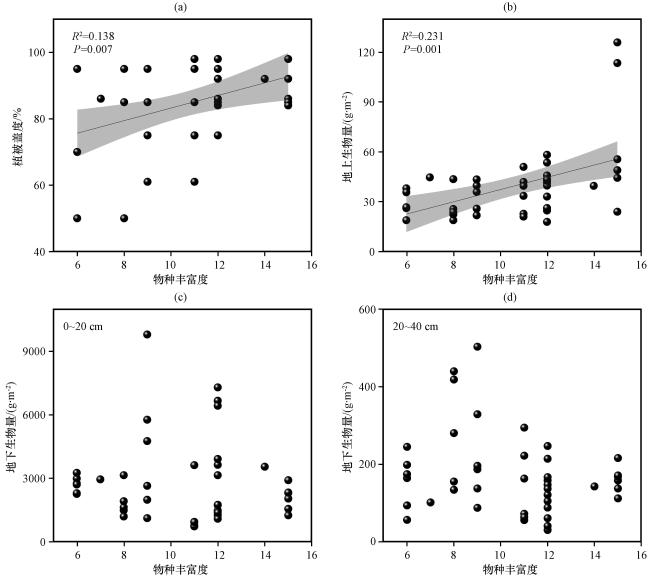
由图2可知, 植被盖度和地上生物量随植物丰富度的增加呈显著上升趋势[图2(a), P=0.007; 图2(b), P=0.001], 植物丰富度和0~20 cm(表层) 及20~40 cm(下层) 的地下生物量无显著相关性。
图2 植物物种丰富度与植被盖度(a)、 地上生物量(b)、 地下生物量(c, d)的关系

黑点为采样点实测数据, 线为拟合直线, 灰色范围为95%置信区间

Fig.2 Relationship between species richness and vegetation coverage (a), aboveground biomass (b) and belowground biomass (c, d).The black point is the measured data of the sampling point, the line is the fitting line, and the gray range is the 95% confidence interval

3.2 植物多样性和土壤微生物量碳氮含量的关系

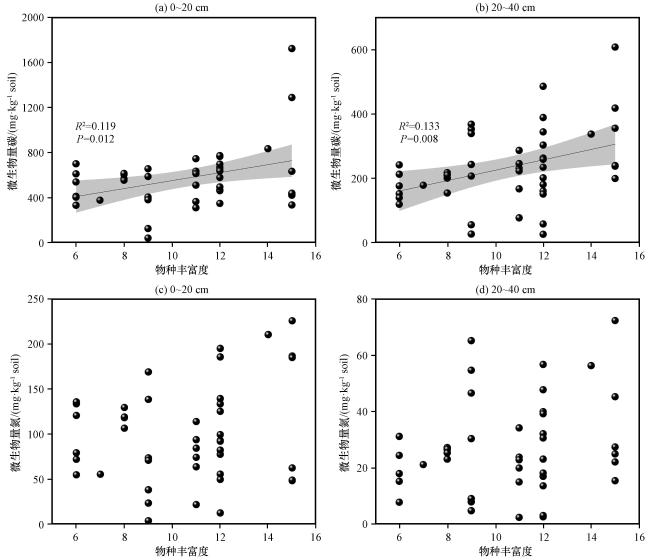
由图3可知, 0~20 cm(表层)与20~40 cm(下层)土壤的微生物量碳含量均随植物丰富度的增加呈显著上升的趋势[图3(a), P=0.012; 图3(b), P=0.008]。本研究中0~20 cm和20~40 cm土壤的微生物量氮含量与植物丰富度未有显著相关性[图3(c), (d)]。
图3 植物丰富度与土壤微生物量碳(a, b)、 土壤微生物量氮(c, d)含量的关系

黑点为采样点实测数据, 线为拟合直线, 灰色范围为95%置信区间

Fig.3 Relationship between plant abundance and soil microbial biomass carbon (a, b) and soil microbial biomass nitrogen (c, d).The black point is the measured data of the sampling point, the line is the fitting line, and the gray range is the 95% confidence interval

3.3 植物多样性与土壤有机碳及全氮、 全磷含量的关系

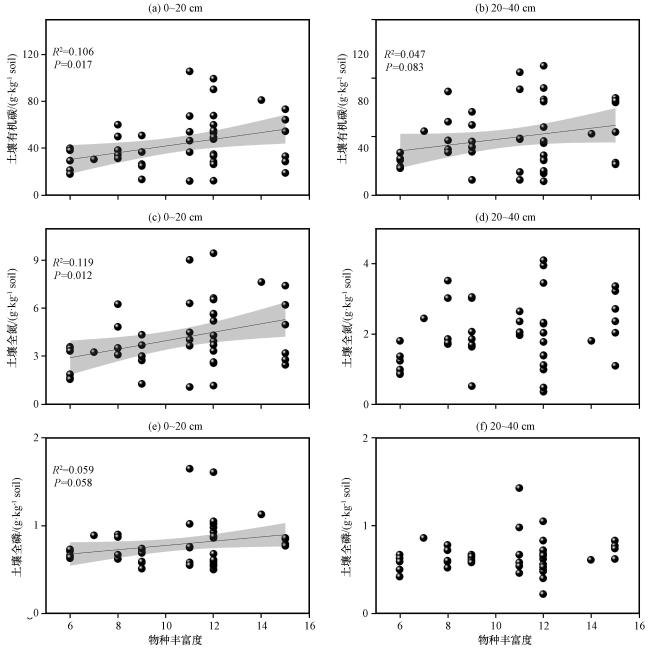
由图4的拟合结果可知, 0~20 cm土壤的土壤有机碳、 全氮含量与植物丰富度呈现出显著正相关关系[图4(a), P=0.017; 图4(c), P=0.012], 这表明随植物多样性水平增加, 0~20 cm土壤的土壤有机碳、 全氮含量也随之升高; 但在20~40 cm土壤中, 土壤有机碳、 全氮含量与植物丰富度无显著相关性[图4(b), (d)]。此外, 无论0~20 cm还是20~40 cm土壤, 土壤全磷含量与植物丰富度的变化均未表现出显著变化趋势[图4(e), (f)]。
图4 植物丰富度与土壤有机碳(a, b)、 全氮(c, d)、 全磷(e, f)含量的关系

黑点为采样点实测数据, 线为拟合直线, 灰色范围为95%置信区间

Fig.4 Relationship between species richness and soil organic carbon (a, b), total nitrogen (c, d) and total phosphorus (e, f) content.The black point is the measured data of the sampling point, the line is the fitting line, and the gray range is the 95% confidence interval

3.4 土壤有机碳组分随植物多样性的变化特征

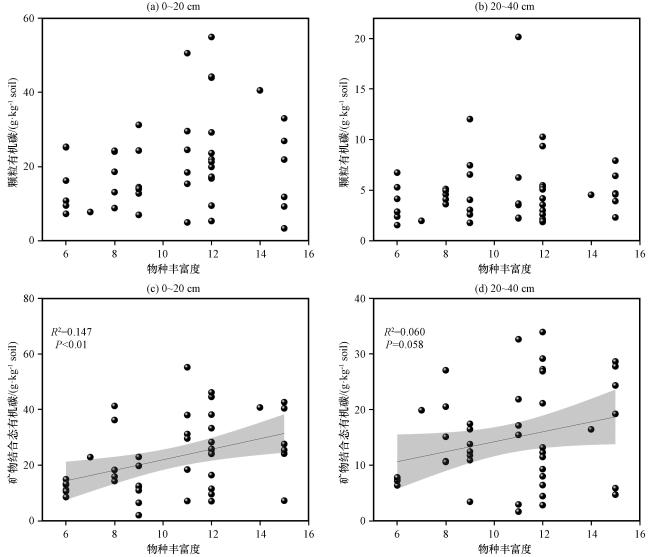
通过将土壤有机碳分级为颗粒有机碳、 矿物结合态有机碳两个组分。拟合结果表明, 在0~20 cm和20~40 cm土壤中, 颗粒有机碳含量随植物丰富度增加均无显著变化趋势[图5(a), (b)]。矿物结合态有机碳在0~20 cm土壤中的含量随植物丰富度增加呈显著上升的现象[图5(c), P<0.01]。植物丰富度对20~40 cm土壤中颗粒有机碳含量也产生了一定的正向影响, 但未达到显著性水平[图5(d), P=0.058]。这表明植物丰富度是通过影响矿物结合态有机碳含量从而促进土壤碳固存。
图5 植物丰富度与颗粒有机碳(a, b)、 矿物结合态有机碳(c, d)含量的关系

黑点为采样点实测数据, 线为拟合直线, 灰色范围为95%置信区间

Fig.5 Relationship between species richness and particulate organic carbon (a, b) and mineral-associated organic carbon (c, d) content.The black point is the measured data of the sampling point, the line is the fitting line, and the gray range is the 95% confidence interval

3.5 年平均温度和降雨量与土壤有机碳及其组分之间的关系

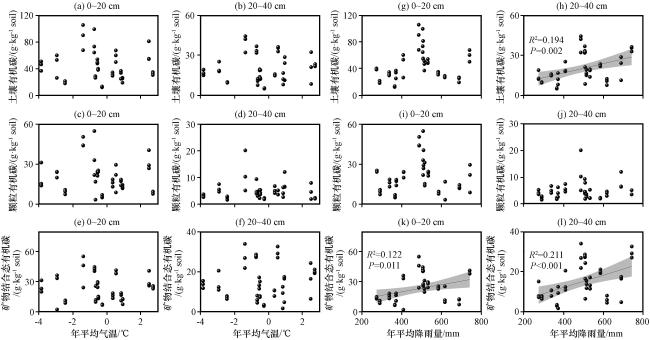
由图6可知, 年均降雨量与20~40 cm土壤的有机碳和矿物结合态有机碳含量, 及0~20 cm土壤矿物结合态有机碳含量存在显著的正相关关系[图6(k), P=0.011; 图6(h), P=0.002; 图6(l), P<0.001]; 年平均温度对土壤有机碳及其各组分均无显著关系。
图6 年平均气温对土壤有机碳(a, b)、 颗粒有机碳(c, d)、 矿物结合态有机碳(e, f)含量的关系及年平均降雨量对土壤有机碳(g, h)、 颗粒有机碳(i, j)、 矿物结合态有机碳(k, l)含量的关系

黑点为采样点实测数据, 线为拟合直线, 灰色范围为95%置信区间

Fig.6 The relationship between the annual mean air temperature and the contents of soil organic carbon (a, b), particulate organic carbon (c, d) and mineral-bound organic carbon (e, f) and the annual mean rainfall on the contents of soil organic carbon (g, h), particulate organic carbon (i, j) and mineral-bound organic carbon (k, l).The black point is the measured data of the sampling point, the line is the fitting line, and the gray range is the 95% confidence interval

4 讨论

4.1 植物多样性与植被生物量及盖度的关系

本研究发现植物多样性与植被地上生物量存在正相关关系。这可能是不同植物之间的功能差异性和资源利用方式的差异性使得植被群落更具有广泛的生态位宽度, 高植物多样性的植被群落通常能够更有效地利用生态系统中的资源, 提高植物的生长速率和生物量积累(Loreau et al, 2001; 周可等, 2022)。与Chen et al(2018)的结论一致, 本研究中高植物多样性可能会影响植被生产力, 具体表现为地上生物量的增加(Yang et al, 2019)。Lange et al(2015)研究发现植物多样性高的生态系统中植物地下生物量较发达, 而本研究中植被地下生物量与植物多样性并未发现显著关系, 这可能是不同植物的生长过程中对资源分配的差异所导致。此外, 植物多样性也与植被盖度存在正相关关系。这与Lange et al(2015)研究成果一致, 可能在高度多样化的植物群落中, 植被群落中不同种类植物的生长周期互补, 能够形成更为密集的植被覆盖(Lange et al, 2014); 地表植被覆盖的程度高, 减少了土壤水分的蒸发, 有利于保持土壤湿度, 从而进一步促进了植被的生长和繁殖。

4.2 植物多样性与土壤有机碳及养分的关系

微生物作为土壤中的“活性”部分, 其动态含量及活性对土壤碳固存至关重要。本研究中微生物量碳含量随植物多样性的升高显著升高(P<0.05), 这表明微生物量变化是影响土壤有机碳含量的重要因素之一, 与Chen et al(2020)在不同生态系统得出结论一致。植被多样性高的自然生态系统中植物相对密集, 0~20 cm土壤由于光照蒸发而损失的水分减少, 进而促进了微生物群落生长, 有利于有机碳固存(Lange et al, 2014, 2015)。Lange et al(2015)在植物多样性与微生物活性的研究中发现, 随着植物多样性的增加, 土壤中微生物的活性会转变为合成代谢, 这会导致微生物量及微生物残体的积累, 从而促进土壤有机碳含量增加。此外, 多样性高的植被群落地上生物量较高, 会促使更多的凋落物积累在土壤表面, 导致更多的有机碳输入到土壤(Chen et al, 2023; 鲍艳等, 2023; 张一然等, 2022)。在本研究中, 年降雨量与土壤有机碳含量显著正相关, 可能是较高的土壤含水率有利于植被的生长, 如Chen et al(2018)的研究中高降水量往往会导致生态系统的高植物多样性。降水可能会促进植被再生长, 同化过多CO2, 通过根系输送至土壤下层(徐文仕, 2022; Chen et al, 2018); 另外, 降水提高了土壤含水率, 有利于微生物生长繁殖, 从而促进土壤有机碳固存。但Valentini et al(2000)认为高植物丰富度也不一定导致更高的植物生物量和土壤固碳量, 在欧洲森林碳平衡的研究中, 决定土壤是碳源还是碳汇的根本原因是植物光合作用与土壤呼吸作用的平衡(Valentini et al, 2020)。对比本研究结果, 可能植物多样性通过改变植物生物量导致微生物的活性发生变化, 从而引起土壤有机碳含量的变化, 研究区域内由植物介导的对土壤碳输入的正效应大于土壤矿化速率。此外, 土壤氮含量被认为是限制植物地上和地下部分生产力的重要因子(Kang et al, 2013)。本研究表明, 植物丰富度对土壤氮含量起到正反馈作用, 这有可能是因为多样化程度高的植被群落地上生物量较高, 凋落物的养分输入增加, 从而提升土壤氮含量(Kang et al, 2013; Cong et al, 2014)。

4.3 土壤有机碳各组分的变化特征

将土壤有机碳分为颗粒有机碳和矿物结合态有机碳可以更好地理解土壤有机碳对于外源碳输入的响应(Ye et al, 2023; Zhang et al, 2022)。本研究发现植物多样性对土壤有机碳的促进作用体现在不同土壤碳组分, 植物多样性与0~20 cm土壤矿物结合态有机碳含量呈现显著正相关(P<0.01), 对颗粒有机碳的含量无显著影响, 表明高植物多样性促进土壤碳输入增加主要为矿物结合态有机碳贡献。这与前人研究证实土壤碳输入显著促进了土壤中颗粒有机碳含量的成果(Zhang et al, 2022; Cotrufo et al, 2013)有所差异。可能是植物多样性高的生态系统中碳输入量较高, 导致土壤基质中的碳和矿物质结合后, 土壤颗粒间发生耦合作用形成大团聚体(Gould et al, 2016), 这种物理保护作用可以防止微生物对有机碳的分解(Zhang et al, 2022)。颗粒有机碳主要是土壤中动植物残体向腐殖质转化的过渡产物, 其含量变化主要由植物凋落物和枯枝死根的含量决定(梁爱珍等, 2010; 李银科等, 2007; Golchin et al, 1994)。矿物结合态有机碳是与细粒矿物结合的有机碳, 与土壤中黏粒粉粒含量有关, 相对较稳定、 难分解(梁爱珍等, 2010; 李银科等, 2007; Ashagrie et al, 2007)。本研究表明, 无论是表层还是深层土壤, 矿物结合态有机碳均随降雨量显著升高, 这可能是因为降水加快了凋落物向土壤的迁移, 促使土壤有机碳与土壤矿物的结合, 从而提高稳定态有机碳的含量(Lehmann and Kleber, 2015)。

5 结论

植物多样性显著提升了植被地上生物量, 而对不同土层(0~20 cm和20~40 cm)地下生物量无显著影响。植物多样性的增加显著促进了土壤微生物量碳和土壤有机碳含量, 而对不同土层微生物量氮无影响。对于不同碳组分, 植物多样性显著促进矿物结合态有机碳, 而对土壤颗粒有机碳含量无影响; 可见, 在青藏高原高寒草甸中, 植物多样性通过促进矿物结合态有机碳的含量从而提升土壤有机碳含量。综上, 在草地生态系统管理中, 维持高水平的植物多样性可显著提升植物地上生物量和土壤有机碳含量。

References

null
Ashagrie Y, Zech W, Guggenberger G, et al, 2007.Soil aggregation, and total and particulate organic matter following conversion of native forests to continuous cultivation in Ethiopia[J].Soil and Tillage Research, 94(1): 101-108.DOI: 10.1016/j.still.2006.07.005 .
null
Chen S P, Wang W T, Xu W T, et al, 2018.Plant diversity enhances productivity and soil carbon storage[J].Proceedings of the National Academy of Sciences, 115(16): 4027-4032.DOI: 10. 1073/pnas.1700298114 .
null
Chen X L, Chen H Y H, Chen C, et al, 2020.Effects of plant diversity on soil carbon in diverse ecosystems: a global meta‐analysis[J].Biological Reviews, 95(1): 167-183.DOI: 10.1111/brv. 12554 .
null
Chen X L, Taylor A R, Reich P B, et al, 2023.Tree diversity increases decadal forest soil carbon and nitrogen accrual[J].Nature, 618(7963):94-101.DOI: 10.1038/s41586-023-05941-9 .
null
Cong W F, van Ruijven J, Mommer L, et al, 2014.Plant species richness promotes soil carbon and nitrogen stocks in grasslands without legumes[J].Journal of Ecology, 102(5): 1163-1170.DOI: 10.1111/1365-2745.12280 .
null
Cotrufo M F, Wallenstein M D, Boot C M, et al, 2013.The Microbial Efficiency‐Matrix Stabilization (MEMS) framework integrates plant litter decomposition with soil organic matter stabilization: do labile plant inputs form stable soil organic matter?[J].Global Change Biology, 19(4): 988-995.DOI: 10.1111/gcb.12113 .
null
De Deyn G B, Cornelissen J H C, Bardgett R D, 2008.Plant functional traits and soil carbon sequestration in contrasting biomes[J].Ecology Letters, 11(5): 516-531.DOI: 10.1111/j.1461-0248. 2008.01164.x
null
Golchin A, Oades J M, Skjemstad J O, et al, 1994.Soil structure and carbon cycling[J].Soil Research, 32(5): 1043-1068.DOI: 10. 1071/SR9941043 .
null
Gould I J, Quinton J N, Weigelt A, et al, 2016.Plant diversity and root traits benefit physical properties key to soil function in grasslands[J].Ecology Letters, 19(9): 1140-1149.DOI: 10.1111/ele.12652 .
null
Hooper D U, Adair E C, Cardinale B J, et al, 2012.A global synthesis reveals biodiversity loss as a major driver of ecosystem change[J].Nature, 486(7401): 105-108.DOI: 10.1038/nature11118 .
null
Kang M Y, Dai C, Ji W Y, et al, 2013.Biomass and its allocation in relation to temperature, precipitation, and soil nutrients in Inner Mongolia grasslands, China[J].PLoS One, 8(7): e69561.DOI: 10.1371/journal.pone.0069561 .
null
Lal R, 2004.Soil carbon sequestration impacts on global climate change and food security[J].Science, 304(5677): 1623-1627.DOI: 10.1126/science.1097396 .
null
Lange M, Eisenhauer N, Sierra C A, et al, 2015.Plant diversity increases soil microbial activity and soil carbon storage[J].Nature Communications, 6(1): 6707.DOI: 10.1038/ncomms7707 .
null
Lange M, Habekost M, Eisenhauer N, et al, 2014.Biotic and abiotic properties mediating plant diversity effects on soil microbial communities in an experimental grassland[J].PloS One, 9(5): e96182.DOI: 10.1371/journal.pone.0096182 .
null
Lehmann J, Kleber M, 2015.The contentious nature of soil organic matter[J].Nature 528(7580): 60-68.DOI: 10.1038/nature16069 .
null
Loreau M, Naeem S, Inchausti P, et al, 2001.Biodiversity and ecosystem functioning: current knowledge and future challenges[J].Science, 294(5543): 804-808.DOI: 10.1126/science.1064088 .
null
Malik A A, Puissant J, Buckeridge K M, et al, 2018.Land use driven change in soil pH affects microbial carbon cycling processes[J].Nature Communications, 9(1): 3591.DOI: 10.1038/s41467-018-05980-1 .
null
Prommer J, Walker T W, Wanek W, et al, 2020.Increased microbial growth, biomass, and turnover drive soil organic carbon accumulation at higher plant diversity[J].Global Change Biology, 26(2), 669-681.DOI: 10.1111/gcb.14777 .
null
Qian Z Y, Li Y N, Du H, et al, 2023.Increasing plant species diversity enhances microbial necromass carbon content but does not alter its contribution to soil organic carbon pool in a subtropical forest[J].Soil Biology and Biochemistry, 187:109183.DOI: 10.1016/j.soilbio.2023.109183 .
null
Spohn M, Bagchi S, Biederman L A, et al, 2023.The positive effect of plant diversity on soil carbon depends on climate[J].Nature Communications, 14(1): 6624.DOI: 10.1038/s41467-023-42340-0 .
null
Valentini R, Matteucci G, Dolman A J, et al, 2000.Respiration as the main determinant of carbon balance in European forests[J].Nature, 404(6780): 861-865.DOI: 10.1038/35009084 .
null
Xu M H, Du R, Li X L, et al, 2021.The mid‐domain effect of mountainous plants is determined by community life form and family flora on the Loess Plateau of China[J].Scientific Reports, 11(1): 10974.DOI: 10.1038/s41598-021-90561-4 .
null
Xu S, Eisenhauer N, Ferlian O, et al, 2020.Species richness promotes ecosystem carbon storage: evidence from biodiversity‐ecosystem functioning experiments[J].Proceedings of the Royal Society B, 287(1939): 20202063.DOI: 10.1098/rspb.2020.2063 .
null
Yang Y, Tilman D, Furey G, et al, 2019.Soil carbon sequestration accelerated by restoration of grassland biodiversity[J].Nature Communications, 10(1): 718.DOI: 10.1038/s41467-019-08636-w .
null
Yang Y H, Mohammat A, Feng J Y, et al, 2007.Storage, patterns and environmental controls of soil organic carbon in China[J].Biogeochemistry, 84: 131-141.DOI: 10.1007/s10533-007-9109-z .
null
Ye C L, Wu B, Bai T S, et al, 2023.Interannual variation in precipitation predominantly controls mineral‐associated organic carbon dynamics in a Tibetan alpine meadow[J].Geoderma, 433: 116432.DOI: 10.1016/j.geoderma.2023.116432 .
null
Zeng X M, Feng J, Yu D L, et al, 2022.Local temperature increases reduce soil microbial residues and carbon stocks[J].Global Change Biology, 28(21): 6433-6445.DOI: 10.1111/gcb.16347 .
null
Zhang F T, Chen X, Yao S H, et al, 2022.Responses of soil mineral‐associated and particulate organic carbon to carbon input: a meta‐analysis[J].Science of the Total Environment, 829: 154626.DOI: 10.1016/j.scitotenv.2022.154626 .
null
鲍艳, 魏宇晨, 南素兰, 等, 2023.全球2 ℃温升背景下青藏高原植被对气候变化的响应[J].高原气象, 42(1): 49-59.DOI: 10.7522/j.issn.1000-0534.2022.00074.Bao Y ,
null
Wei Y C, Nan S L, et al, 2023.Vegetation over the Qinghai‐Xizang Plateau in Response to Climate Change with a 2 ℃ Global Warming[J].Plateau Meteorology, 42(1): 49-59.DOI: 10.7522/j.issn.1000-0534.2022.00074 .
null
方精云, 王襄平, 沈泽昊, 等, 2009.植物群落清查的主要内容、 方法和技术规范[J].生物多样性, 17(6): 533-548.DOI: 10.3724/SP.J.1003.2009.09253.Fang J Y ,
null
Wang X P, Sheng Z H, et al, 2009.Methods and protocols for plant community inventory[J].Biodiversity Science, 17(6): 533-548.DOI: 10.3724/SP.J.1003.2009.09253 .
null
符鲜, 杨树青, 刘德平, 等, 2018.施氮水平对河套灌区套作小麦-玉米土壤微生物量碳、 氮的影响研究[J].生态环境学报, 27(9): 1652-1657.DOI: 10.16258/j.cnki.1674-5906.2018.09.010.Fu X ,
null
Yang S Q, Liu D P, et al, 2018.Effects of nitrogen application on soil microbial biomass carbon and nitrogen of intercropping wheat‐corn in Hetao irrigation area[J].Ecology and Environmental Sciences, 27(9): 1652-1657.DOI: 10.16258/j.cnki.1674-5906.2018.09.010 .
null
龚志莲, 李勇, 2015.川西南不同植被木本物种多样性与土壤有机碳积累[J].生态环境学报, 24(9): 1447-1452.DOI: 10.16258/j.cnki.1674-5906.2015.09.004.Gong Z L ,
null
Li Y, 2015.Woody species diversity and soil organic carbon accumulation in different vegetations in southwest of Sichuan Province[J].Ecology and Environmental Sciences, 24(9): 1447-1452.DOI: 10.16258/j.cnki.1674-5906.2015.09.004 .
null
李鹏, 2017.青藏高原植被枯黄期的时空变化及其对极端气候事件的响应[D].杨凌: 西北农林科技大学.Li P, 2017.Dynamics of vegetation autumn phenology and their response to extremely climate change in the Qinghai-Tibet Plateau[D].Yangling: Northwest Agriculture & Forestry University.
null
李银科, 李小刚, 张平良, 等, 2007.土地利用方式对荒漠土壤有机碳和养分含量的影响[J].甘肃农业大学学报, 42(2): 103-107.
null
Li Y K, Li X G, Zhang P L, et al, 2007.Effects of land use on organic carbon and nutrient contents in desert soil[J].Journal of Gansu Agricultural University, 42(2): 103-107.
null
梁爱珍, 张晓平, 杨学明, 等, 2010.黑土颗粒态有机碳与矿物结合态有机碳的变化研究[J].土壤学报, 47(1): 153-158.
null
Liang A Z, Zhang X P, Yang X M, et al, 2010.Dynamics of soil particulate organic carbon and mineral-incorporated organic carbon in black soils in northeast China[J].Acta Pedologica Sinica, 47(1): 153-158.
null
刘万弟, 师斌, 闫秀, 等, 2022.宁夏天然草原物种多样性和生物量对环境梯度响应研究[J].中国草地学报, 44(10): 10-19+115.DOI: 10.16742/j.zgcdxb.20220022.Liu W Y ,
null
Shi B, Yan X, et al, 2022.The response of species diversity and biomass to environmental gradients in Ningxia natural grassland[J].Chinese Journal of Grassland, 44(10): 10-19+115.DOI: 10.16742/j.zgcdxb.20220022 .
null
牛钰杰, 杨思维, 王贵珍, 等, 2018.放牧干扰下高寒草甸物种和生活型丰富度与地上及地下生物量的关系[J].生态学报, 38(8): 2791-2801.DOI: 10.5846/stxb201704130656.Niu Y J ,
null
Yang S W, Wang G Z, et al, 2018.Study on the relationships between plant species richness, lifeform richness, and above-and belowground biomass under grazing disturbance in an alpine meadow[J].Acta Ecologica Sinica, 38(8): 2791-2801.DOI: 10.5846/stxb201704130656 .
null
吴茜, 傅红, 郝建锋, 等, 2023.林分密度对云顶山柏木人工林林下植物优势种群生态位的影响[J].西北植物学报, 43(3): 491-502.DOI: 10.7606/j.issn.1000-4025.2023.03.0491.Wu Q ,
null
Fu H, Hao J F, et al, 2023.Effects of stand density on the niche of dominant populations of understory plants in Cupressus fineries plantation of Yunding Mountain[J].Acta Botanica Boreali-Occidentalia Sinica, 43(3): 491-502.DOI: 10.7606/j.issn.1000-4025.2023.03.0491 .
null
徐满厚, 赵梓彤, 2022.山西亚高山草地物种多样性与生物量空间变化数据集[J].全球变化数据学报(中英文), 6(4): 521-532+686
null
-688+690-697.DOI: 10.3974/geodp.2022.04.03.Xu M H , Zhao Z T, 2022.A dataset for spatial variation of species diversity and biomass of subalpine grasslands in Shanxi province, China[J].Journal of Global Change Data & Discovery, 6(4): 521-532+686-688+690-697.DOI: 10.3974/geodp.2022.04.03 .
null
徐文仕, 2022.植物多样性对亚热带森林土壤可溶性有机碳氮含量的影响[D].上海: 华东师范大学.Xu W S, 2022.Effects of plant diversity on soil labile carbon and nitrogen contents in a subtropical forest[D].Shanghai: East China Normal University.
null
杨红飞, 穆少杰, 李建龙, 2012.气候变化对草地生态系统土壤有机碳储量的影响[J].草业科学, 29(3): 392-400.
null
Yang H F, Mu S J, Li J L, 2012.Effects of climate change on soil organic carbon storage of grassland ecosystem[J].Pratacultural Science, 29(3): 392-400.
null
张义凡, 陈林, 杨新国, 等, 2016.草地生态系统土壤碳储量的影响因子[J].北方园艺(22): 188-193.DOI: 10.11937/bfyy.201622047.Zhang Y F ,
null
Chen L, Yang X G, et al, 2016.Influence factor of carbon storage in grassland ecosystem[J].Northern Horticulture(22): 188-193.DOI: 10.11937/bfyy.201622047 .
null
周可, 苏有琦, 张宇, 等, 2022.CMIP地球系统模型对植被根生物量模拟的评估研究[J].高原气象, 41(4): 945-952.DOI: 10.7522/j.issn.1000-0534.2021.00032.Zhou K ,
null
Su Y Q, Zhang Y, et al, 2022.Evaluation of CMIP earth system models on root biomass simulation[J].Plateau Meteorology, 41(4): 945-952.DOI: 10.7522/j.issn.1000-0534.2021.00032 .
null
张一然, 文小航, 罗斯琼, 等, 2022.近20 年若尔盖湿地植被覆盖变化与气候因子关系研究[J].高原气象, 41(2): 317-327.DOI: 10.7522/ j.issn.10000534.2021.00076.Zhang Y R ,
null
Wen X H, Luo S Q, et al, 2022.Study on the relationship between vegetation cover change and climate factors in Zoige Wetland in recent 20 years[J].Plateau Meteorology, 41(2): 317-327.DOI: 10.7522/ j.issn.10000534.2021.00076 .
Outlines

/

〈 〉