Characteristics of Summer Hourly Extreme Rainfall Events in the Region of Southeastern Xizang Plateau-Western Sichuan Basin

  • Ruoying LI ,
  • Xiuping YAO
Expand
  • 1. Chinese Academy of Meteorological Sciences,Beijing 100081,China
    2. China Meteorological Administration Training Centre,Beijing 100081,China

Received date: 2023-11-16

  Revised date: 2024-01-16

  Online published: 2024-01-16

Abstract

Based on 109 hourly rain-gauge stations from June to August during 2005 -2020, the spatial and temporal distribution of annual rainfall amount, occurrence, rainfall intensity, and duration of summer hourly extreme rainfall events in the region of Southeastern Xizang Plateau-Western Sichuan Basin (28°N -33°N, 90°E - 105°E) are analyzed.Additionally, the diurnal variation of rainfall amount, rainfall intensity, and rainfall frequency during hourly extreme rainfall events in the region of Southeastern Xizang Plateau-Western Sichuan Basin are also explored.Results show that the hourly extreme the rainfall threshold, the annual rainfall amount, the rainfall intensity, and the duration of summer hourly extreme rainfall events in the region of Southeastern Xizang Plateau are lower than those in the region of Western Sichuan Basin, with the occurrence showing the opposite pattern.The annual rainfall amount and occurrence, and duration of summer hourly extreme rainfall events in the region of Southeastern Xizang Plateau increase over time.The annual rainfall amount and occurrence of hourly extreme rainfall events in the region of Western Sichuan Basin also increase, while the duration of hourly extreme rainfall events in the region of Western Sichuan Basin change insignificant.The rainfall amount’, the rainfall intensity’ and the rainfall frequency’ peak time of the summer hourly extreme rainfall events in the region of Southeastern Xizang Plateau -Western Sichuan Basin exhibit the eastward delayed features, and their peak time in the region of Western Sichuan Basin are 3 h, 4 h and 2 h later than those in the region of Southeastern Xizang Plateau, respectively.The most evident delayed feature exists in the rainfall intensity in June, with the peak time in the region of Western Sichuan Basin being 11 hours later than that in the region of Southeastern Xizang Plateau.However, both the Southeastern Xizang Plateau and Western Sichuan Basin regions exhibit insignificant interannual variation in the peak time of the rainfall amount, the rainfall intensity, and the rainfall frequency during summer hourly extreme rainfall events.

Cite this article

Ruoying LI , Xiuping YAO . Characteristics of Summer Hourly Extreme Rainfall Events in the Region of Southeastern Xizang Plateau-Western Sichuan Basin[J]. Plateau Meteorology, 2024 , 43(5) : 1113 -1124 . DOI: 10.7522/j.issn.1000-0534.2024.00005

1 引言

青藏高原(以下简称高原)降水作为全球水平衡的关键组成部分, 受到了广泛的关注(Xu et al, 2008)。高原全年降水的60%~70%集中在夏季(Wang et al, 2018), 高原夏季年均雨量呈现自西北向东南递增的特征(韩熠哲等, 2017), 其中高原东南部是高原夏季降水的集中区(周顺武 等, 2000; 许建伟等, 2020), 不仅降水量最多, 夜雨频率也较高, 并且对流性降水也易于在高原东南部发生(余忠水等, 2011; Maussion et al, 2014)。
高原东南部及其下游的川西地区人口活动密集, 地形地质和气候条件复杂, 其中大、 中、 小尺度地形交错、 河谷纵横, 海拔落差超过4000 m(李川等, 2006)。高海拔、 复杂地形与山地天气系统相配合, 极易产生极端降水, 进而引发山崩、 滑坡、 泥石流、 洪水等地质灾害, 严重威胁人民的生命财产安全(Nie and Sun, 2021)。此外, 在20世纪80年代以来全球变暖加速的背景下, 全球范围内的极端降水频率和总量明显增加(Hegerl et al, 2019)。研究表明, 高原东南部和川西地区夏季极端降水量呈现增加趋势, 特别是极强降水量增加趋势较为显著(曹瑜等, 2019; 段汀等, 2022)。在RCP4.5(气候变化政策干预时的总辐射强迫在2100年后稳定在4.5 W·m-2)和RCP8.5(无气候变化政策干预时的总辐射强迫在2100年后的基线为8.5 W·m-2)的未来情景下, 21世纪后期高原东南部及川西地区夏季极端降水量均呈现显著增加趋势, 极端降水量的增率在RCP8.5的未来情景下明显高于RCP4.5的未来情景(Yang et al, 2020; Jiang et al, 2023)。结合历史和未来情景可以看出, 极端降水事件对高原东南部-川西地区的影响正在加剧。
随着观测日趋精细, 小时极端降水的强度、 持续时间及日变化等特征日益受到重视(李建等, 2013)。相较单次小时降水或小时极端降水, 小时极端降水事件能描述更完整的降水过程(Yu, 2007; Li, 2018)。然而, 受到观测资料的限制, 以往关于中国小时极端降水的研究主要集中在中国东部地区(Li et al, 2013; Luo et al, 2016; Wu et al, 2017; 李争辉, 2019; Zhao et al, 2020; Liu et al, 2022; Ng et al, 2022)。自1997年热带降水测量(TRMM)卫星发射后, 一些学者基于高分辨率的遥感资料对高原和盆地夏季极端降水展开研究, 发现高原夏季极端降水多在午夜出现峰值, 而四川盆地夏季极端降水多在清晨出现峰值(白爱娟等, 2008; Liu et al, 2009; Guo et al, 2014), 二者的相位差与地形热力强迫和惯性振荡有关(Huang et al, 2010; Xia et al, 2021; Wang et al, 2023)。与遥感资料相比, 站点资料能更真实地反映降水事件的发生、 增幅、 维持和减弱的过程(计晓龙等, 2017; Li, 2018)。因此, 利用站点小时降水资料来研究高原东南部-川西地区夏季小时降水事件有重要意义。
以往研究多单独讨论高原和川西地区的夏季极端降水(段丽君等, 2017; Li, 2018; 王钦和曾波, 2022)。例如, Li(2018)利用高原100个地面台站的降水资料, 对2007 -2013年高原夏季降水事件的小时频率、 小时强度、 小时频率强度结构、 日变化和持续时间等特征进行了细致分析。然而, 目前将地形复杂的高原东南部-川西地区作为一个整体来考虑的小时极端降水事件研究较少, 对高原东南部-川西地区夏季小时极端降水事件特征的认识有限, 对高原东南部与川西地区的小时极端降水事件特征差异的认识不足。基于以上论述, 本研究利用2005 -2020年6 -8月小时站点降水资料, 对高原东南部-川西地区夏季小时极端降水事件特征开展研究, 以深化青藏高原东南部-川西地区极端降水的认知。

2 资料来源与方法介绍

2.1 研究区域和资料

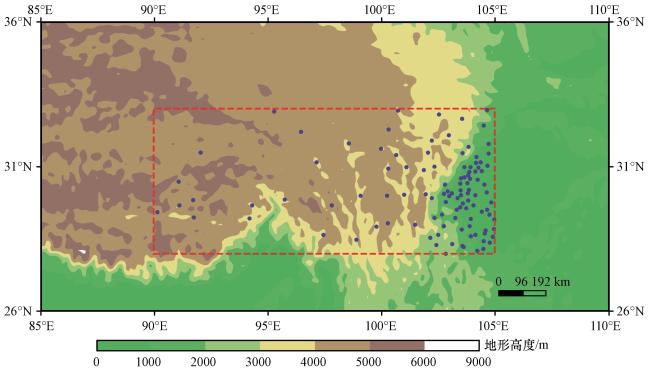
本研究选用了2005 -2020年6 -8月高原东南部-川西地区(28°N -33°N, 90°E -105°E)109个中国地面气象站(图1)的逐小时降水资料(18:00至次日18:00, 当地时, 下同)和青藏高原地形资料和边界资料来源于国家青藏高原科学数据中心(汤国安, 2019; 张镱锂等, 2019)。
图1 高原东南部-川西地区(红色矩形虚线框, 28°N -33°N, 90°E -105°E)的雨量站(蓝色圆点)及其地形高度的分布图(彩色区, 单位: m)

Fig.1 Distribution of 109 rain gauges (blue dots) and topography (color area, unit: m) in the region of Southeastern Xizang Plateau -Western Sichuan Basin (the red rectangular dashed box, 28°N -33°N, 90°E -115°E)

2.2 小时极端降水事件及其相关统计量定义

从各站点的第一个降水时次开始, 到连续两个或以上的非降水时次之前(最多包含1 h间断), 为此站点一次降水事件, 其中降水时次为小时降水量不小于0.1 mm的时次(Yu et al, 2007)。此站点的小时极端降水事件为至少发生一次小时降水量不小于小时极端降水阈值的降水事件(Li et al, 2013), 其中每个站点的第95百分位的小时降水量被定义为此站点的小时极端降水阈值(Zhang and Zhai, 2011)。
表1 小时极端降水事件的相关统计量

Table 1 Associated statistical parameters of summer hourly extreme rainfall events

统计量 定义 单位
持续时间 小时极端降水事件经历的小时数 h
发生次数 小时极端降水事件年平均的发生次数 a-1
降水量 小时极端降水事件产生的年均降水量 mm·a-1
降水强度 小时极端降水事件的降水量与持续时间的比值 mm·h-1
降水频率 小时极端降水事件的降水小时数与总观测小时数的比值 %

3 结果分析

3.1 高原东南部-川西地区夏季小时极端降水事件的空间分布特征

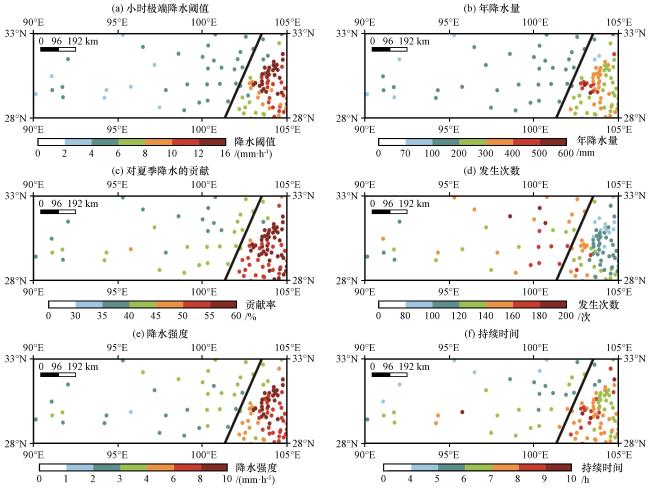
为了分析高原东南部-川西地区夏季小时极端降水事件的气候特征, 首先每个站点的小时极端降水事件进行识别, 并统计了它们的年降水量、 对夏季降水的贡献、 发生次数、 降水强度和持续时间的空间分布如图2所示。高原东南部-川西地区夏季小时极端降水事件平均小时极端降水阈值为8.5 mm·h-1, 呈自西部高原向东部盆地递增的趋势[图2(a)]。在高原东南部地区平均小时极端降水阈值为4.3 mm·h-1, 在川西地区的平均小时极端降水阈值为10.4 mm·h-1[图2(a)], 表明川西地区的小时极端降水事件更强烈。从图2(b)和图2(c)可以看出, 高原东南部-川西地区夏季小时极端降水事件的平均年降水量和对夏季降水的贡献分别为251.6 mm和50%, 也呈自西向东递增的趋势, 与小时极端降水阈值的分布相似, 其中在高原东南部地区, 平均年降水量和对夏季降水的贡献分别为129 mm和40%, 而在川西地区, 分别为316 mm和55%, 这说明小时极端降水事件对高原东南部-川西地区夏季降水的贡献很大, 尤其是在川西地区。高原东南部-川西地区夏季小时极端降水事件的平均发生次数为126次[图2(d)], 与其他指标不同, 呈自西向东递减的趋势; 其中在高原东南部地区, 平均发生次数为146次, 而在川西地区, 为118次, 这可能与高原东南部地区的地形更为复杂有关, 尤其是川西高原东侧, 此处急剧变化的地形诱发了更多的小时极端降水事件(李川等, 2006; Zhao et al, 2022)。高原东南部-川西地区夏季小时极端降水事件平均降水强度和持续时间为5.7 mm·h-1和7 h, 也呈自西向东递增的分布[图2(e)~(f)], 其中高原东南部地区夏季小时极端降水事件平均降水强度和持续时间分别为2.9 mm·h-1和6 h, 在川西地区分别为6.9 mm·h-1和7 h, 这表明川西地区夏季小时极端降水事件不仅强度更强, 也更持久。
图2 2005 -2020年高原东南部-川西地区夏季小时极端降水事件的降水阈值(a, 单位: mm·h-1)、 年降水量(b, 单位: mm)、 对夏季降水的贡献(c, 单位: %)、 发生次数(d, 单位: 次)、 降水强度(e, 单位: mm·h-1)和持续时间(f, 单位: h)的水平分布空间分布

Fig.2 Distribution of rainfall threshold (a, unit: mm·h-1), annual rainfall amount (b, unit: mm), the contribution of summer hourly extreme rainfall to the total summer precipitation (c, unit: %), occurrence (d, unit: times), rainfall intensity (e, unit: mm·h-1), and duration (f, unit: h) of summer hourly extreme rainfall in the region of Southeastern Xizang Plateau -Western Sichuan Basin from 2005 to 2020

综上, 高原东南部-川西地区夏季小时极端降水事件年降水量、 对夏季降水的贡献、 降水强度和持续时间呈现自西向东递增的特征, 川西地区夏季小时极端降水事件的总降水量大、 对夏季降水的贡献更大, 降水强度更强, 也更持久, 而高原东南部地区的小时极端降水事件则相对较弱, 但发生更频繁, 这可能与高原东南部地区地形的复杂性有关。

3.2 高原东南部-川西地区夏季小时极端降水事件的年际变化特征

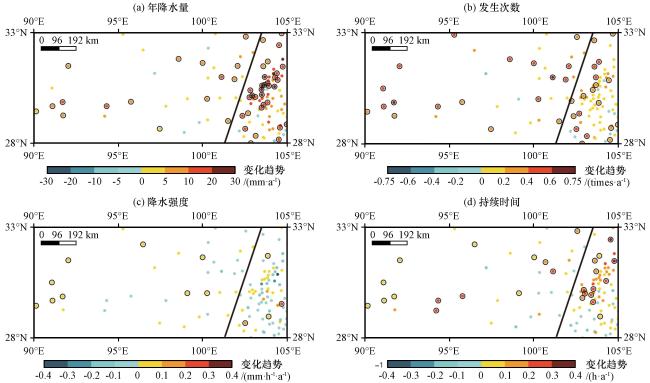
高原东南部-川西地区夏季小时极端降水事件年降水量、 发生次数、 降水强度、 持续时间年际变化的空间分布如图3所示。从图3(a)和(b)可以看出, 高原东南部-川西地区109个站点夏季小时极端事件的年降水量和发生次数总体均呈增加趋势, 平均每年分别约增加8.6 mm和0.2次, 并分别有48个和37个站点的增加趋势通过95%显著性检验。同时, 上述站点年降水量增率自西向东递增, 而发生次数增率的空间分布相反, 说明高原东南部地区和川西地区的年降水量增率和发生次数增率可能与西高东低的地形分布有关。高原东南部-川西地区109个站点夏季小时极端事件的降水强度总体的变化趋势并不显著, 仅有13个站点的变化趋势通过95%显著性检验[图3(c)]。高原东南部-川西地区夏季小时极端事件的持续时间呈增加趋势, 平均每年增加0.06 h, 有27个站点的增加趋势通过95%显著性检验[图3(d)]。
图3 2005 -2020年高原东南部-川西地区夏季小时极端降水事件的年降水量(a, 单位: mm·a-1)、 发生次数(b, 单位: time·a-1)、 降水强度(c, 单位: mm·h-1·a-1)和持续时间(d, 单位: h·a-1)的年际变化趋势的空间分布 黑色圆圈表示通过95%显著性检验的站点

Fig.3 Distribution of the interannual variations of annual rainfall amount (a, unit: mm·a-2), occurrence (b, unit: time·a-1), rainfall intensity (c, unit: mm h-1·a-1), and duration (d, unit: h·a-1) of summer hourly extreme rainfall in the region of Southeastern Xizang Plateau -Western Sichuan Basin from 2005 to 2020.Black circles indicate the stations that passed the 95% significance test

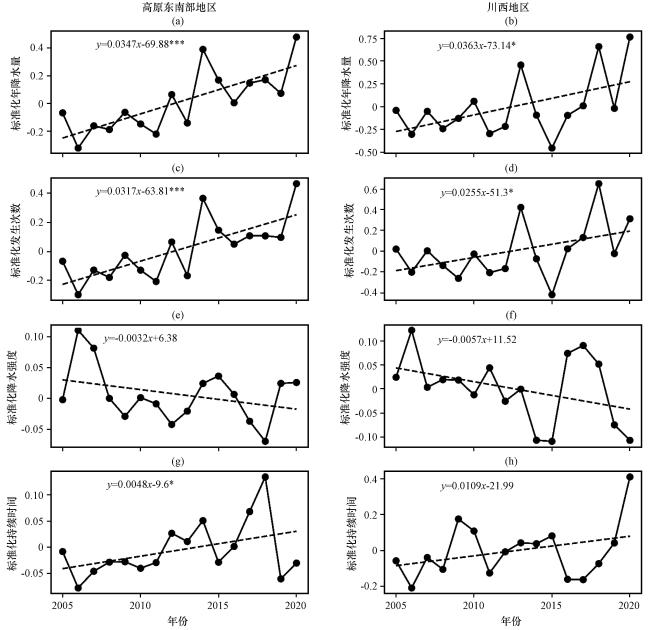
高原东南部地区和川西地区的年降水量增率和发生次数增率的东西差异明显, 进一步讨论高原东南部地区和川西地区经过标准化处理(年距平除以2005 -2020年的平均值)的夏季小时极端降水事件年降水量和发生次数的站点平均年际变化(图4)。高原东南部地区和川西地区夏季小时极端降水事件的标准化年降水量、 发生次数都呈现显著增加的趋势[图4(a), (b)], 其中川西地区小时极端降水事件标准化年降水量的增率大于高原东南部地区, 而小时极端降水事件标准化发生次数的增率则相反。高原东南部地区和川西地区夏季小时极端降水事件标准化降水强度均呈减小趋势, 但变化并不显著[图4(c), (d)]。在持续时间方面, 高原东南部地区夏季小时极端降水事件的标准化持续时间显著增加, 而川西地区的标准化持续时间的增加趋势并未通过显著性检验。
图4 2005 -2020年高原东南部地区(左)和川西地区(右)夏季小时极端降水事件经过标准化处理的年降水量(a, b)、 发生次数(c, d)、 降水强度(e, f)和持续时间(g, h)的年际变化 *、 **、 ***分别表示通过95%、 99%和99.9%的显著性检验

Fig.4 Interannual variations of regionally averaged annual rainfall amount (a~b), occurrence (c~d), rainfall intensity (e~f), and duration by normalized (g~h) of summer hourly extreme rainfall in the region of Southeastern Xizang Plateau (left panels) and Western Sichuan Basin (right panels) from 2005 to 2020.*, **, *** indicate that the equations passed the 95%, 99% and 99.9% significance tests, respectively

总之, 高原东南部-川西地区夏季小时极端降水事件年降水量、 发生次数和持续时间呈增加趋势, 年降水量和发生次数的增率与地形的分布有一定关系, 其中川西地区夏季小时极端降水事件的年降水量增率更大, 而高原东南部地区夏季小时极端降水事件的发生次数的增率更大, 且高原东南部地区持续时间的增加也更为显著。

3.3 高原东南部-川西地区夏季小时极端降水事件的日变化特征

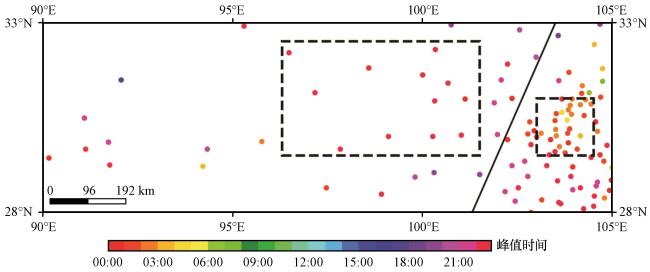
降水日变化是小时极端降水事件的重要特征(白爱娟等, 2011; 宇如聪等, 2014)。为了分析高原东南部-川西地区夏季小时极端降水事件的日变化特征, 计算了高原东南部-川西地区109个站点夏季小时极端降水事件降水量的日峰值时间如图5所示。从图5(a)可以看出, 高原东南部-川西地区夏季小时极端降水事件降水量峰值主要在夜间达到峰值, 降水量峰值时间在空间上呈现自西向东延迟的特征[图5(b)], 其中高原东南部地区夏季小时极端降水事件降水量的峰值时间多发生在前半夜, 峰值发生在前半夜的站点主要集中在高原东南部-川西地区海拔较高的康定-昌都段附近(29.5°N - 32.5°N, 96.3°E -101.5°E), 而川西地区夏季小时极端降水事件降水量峰值多出现在后半夜, 峰值时间发生在后半夜的站点主要集中在高原东南部-川西地区海拔较低的成都-雅安段附近(29.5°N -31°N, 103°E -104.5°E), 说明高原东南部-川西地区夏季小时极端降水事件降水量的日变化特征具有明显区域性差异。
图5 高原东南部-川西地区夏季小时极端降水事件降水量的日变化的峰值时间分布, 虚线框为高原东南部地区(左)和川西地区(右)夏季小时极端降水事件日变化峰值时间的代表区域(29.5°N -32.5°N, 96.3°E -101.5°E)和(29.5°N -31°N, 103°E -104.5°E)

Fig.5 Spatial distribution of the diurnal variations of the rainfall amount of summer hourly extreme rainfall events in the KR (The colors of scatter dots denote the peak time of the rainfall amount, and the left and right rectangular dashed box denote the representative areas of the daily variation characteristics of summer hourly extreme rainfall events in the region of Southeastern Xizang Plateau and Western Sichuan Basin, respectively

本文分别选取区域(29.5°N -32.5°N, 96.3°E - 101.5°E)和(29.5°N -31°N, 103°E -104.5°E)作为高原东南部地区和川西地区夏季小时极端降水事件日变化特征的代表区域, 进一步探讨高原东南部地区和川西地区夏季小时极端降水事件的区域性日变化特征。
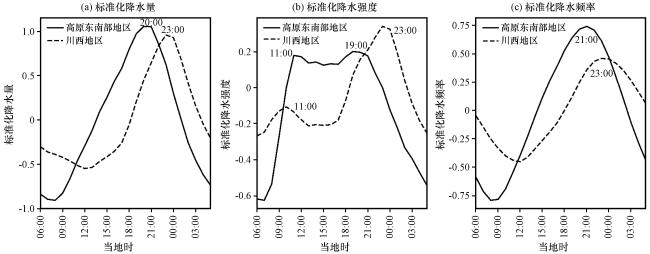
高原东南部地区和川西地区代表区域小时极端降水事件发生期间区域平均的降水量、 降水强度和降水频率的日变化特征如图6所示。高原东南部地区和川西地区夏季小时极端降水事件的降水量的日变化特征均呈单峰型分布, 峰值分别出现在20:00和23:00; 高原东南部地区和川西地区降水强度的日变化特征则均呈双峰型分布, 主峰值分别出现在19:00和23:00, 次峰值均出现在11:00; 高原东南部地区和川西地区降水频率的日变化特征均呈单峰型分布, 峰值分别出现在21:00和23:00, 相比高原东南部地区, 川西地区夏季小时极端降水事件在降水量、 降水强度和降水频率上峰值的出现时间分别延迟3 h、 4 h和2 h。
图6 高原东南部地区(实线)和川西地区(虚线)夏季小时极端降水事件区域平均的标准化降水量(a)、 标准化降水强度(b)和标准化降水频率(c)的日变化特征图中曲线是三点滑动平均的结果

Fig.6 The normalized (by the daily mean) diurnal variations of regionally averaged rainfall amount (a) rainfall intensity (b) and rainfall frequency (c) of summer hourly extreme rainfall in the region of Southeastern Xizang Plateau (solid line) and Western Sichuan Basin (dashed line).The curves are the three-point moving average results

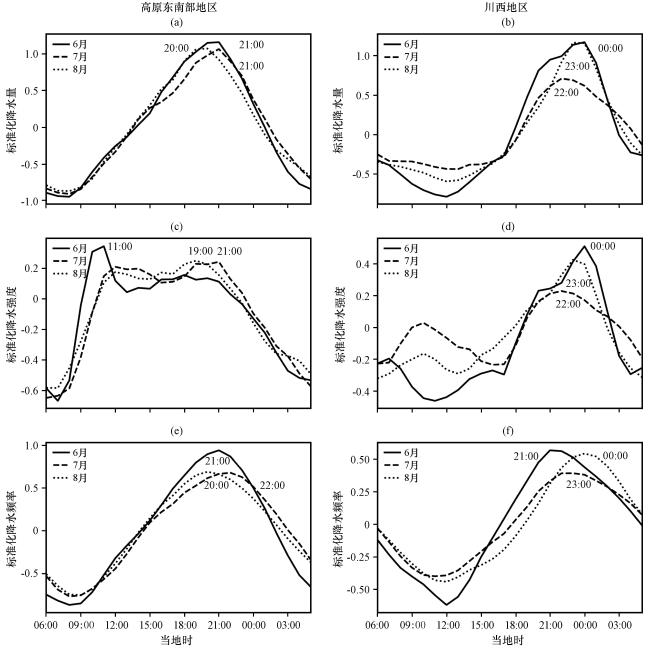
高原东南部地区和川西地区代表区域夏季小时极端降水事件经过标准化(用日均值标准化)的降水量、 降水强度和降水频率在6、 7、 8月的日变化特征如图7所示。高原东南部地区和川西地区夏季小时极端降水事件的降水量呈单峰型, 高原东南部地区在8月出现最早的峰值(20:00), 6月和7月峰值时间相同, 均比8月延迟1 h[图7(a)]; 川西地区峰值在7月最早(22:00), 8月次之(23:00), 6月最晚(00:00); 与高原东南部地区相比, 川西地区分别延迟1 h、 3 h、 2 h[图7(b)]。在降水强度的日变化方面, 高原东南部地区在6、 7月和8月呈双峰型, 6月主峰值在11:00, 7、 8月主峰值在19:00和21:00[图7(c)]; 川西地区6月呈单峰型, 峰值在00:00, 7、 8月在夜间和上午达到主次峰值, 主峰值分别在22:00和23:00[图7(d)], 这表明高原东南部地区和川西地区降水强度的峰值时间在6月差异最大, 相差11 h, 而在7月和8月的主峰值时间分别延迟3 h和2 h。在降水频率的日变化方面, 高原东南部地区和川西地区均呈单峰型, 高原东南部地区在7月最早出现峰值(20:00), 6月次之(21:00), 8月最晚(22:00)[图7(e)]; 川西地区6月在21:00最早出现峰值, 7月在23:00次之, 8月最晚(00:00)[图7(f)]; 与高原东南部地区相比, 川西地区6月无延迟, 7月和8月延迟了3 h和2 h。
图7 高原东南部地区(左)和川西地区(右)夏季小时极端降水事件区域平均6月(实线)、 7月(虚线)、 8月(点线)的标准化降水量(a~b)、 降水强度(c~d)和降水频率(e~f)的日变化特征曲线是三点滑动平均结果

Fig.7 The normalized (by the daily mean) diurnal variations of regionally averaged rainfall amount(a~b), rainfall intensity(c~d), and rainfall frequency(e~f) of summer hourly extreme rainfall in June (solid line), July (dashed line), and August (dotted line) in the region of Southeastern Xizang Plateau (left panels) and Western Sichuan Basin (right panels).The curves are the three-point moving average results

总之, 高原东南部-川西地区夏季小时极端降水事件降水量、 降水强度和降水频率在6、 7、 8月的日变化特征也具有自西向东延迟的特征, 在6月的降水强度差异最大, 高原东南部地区呈现双峰型且在11:00出现主峰值, 川西地区呈现单峰型且在00:00出现峰值。
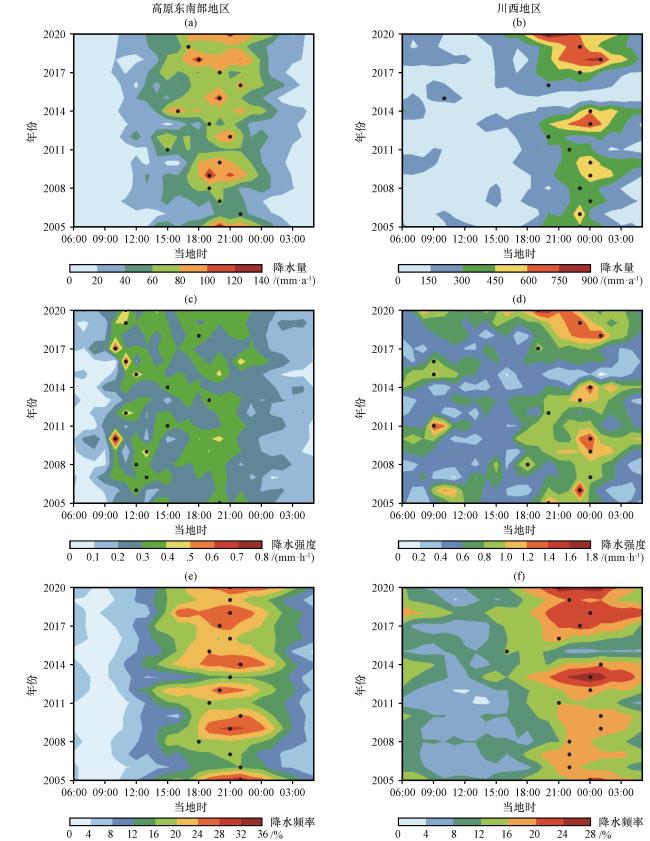
高原东南部地区和川西地区代表区域夏季小时极端降水事件区域平均降水量、 降水强度和降水频率日变化的逐年演变如图8所示。从图8可以看出, 高原东南部地区夏季小时极端降水事件的降水量日变化的年际变化与降水频率一致, 峰值时间波动变化, 在2009年、 2014年和2018年呈现峰值范围加宽的特征; 川西地区夏季小时极端降水事件的降水量日位相的年际变化同时受到降水强度和降水频率的影响, 在峰值时间的年际变化上与降水强度一致, 峰值时间波动变化, 而在峰值范围宽度的年际变化上与降水频率一致, 峰值范围在2007年、 2010年、 2013年和2018年加宽。利用Mann-Kendall检验(Kendall, 1975; Mann, 1945)进一步分析高原东南部地区和川西地区夏季小时极端降水事件的降水量、 降水强度和降水频率的峰值时间的波动变化趋势, 发现降水量、 降水强度和降水频率峰值时间的年际变化均不显著。
图8 2005 -2020年高原东南部地区(左)和川西地区(右)夏季小时极端降水事件区域平均的降水量(a~b, 单位: mm·a-1)、 降水强度(c~d, 单位: mm·h-1)和降水频率(e~f, 单位: %)日变化的逐年演变

黑色散点为日变化峰值的位置

Fig.8 Diurnal variations of regionally average drainfall amount (a~b, unit: mm·a-1), rainfall intensity (c~d, unit: mm·h-1), and rainfall frequency (e~f, unit: %) of summer hourly extreme rainfall from 2005 to 2020 in the region of Southeastern Xizang Plateau(left panels) and Western Sichuan Basin (right panels).Black dots indicate the position of the diurnal peak

高原东南部地区和川西地区夏季小时极端降水事件在降水量、 降水强度和降水频率的日变化上呈现出一定的年际变化特征, 但这些变化的趋势并不显著。
综上, 高原东南部地区夏季小时极端降水事件降水量和降水频率的日变化呈单峰型分布, 分别在20:00和21:00出现峰值, 川西地区呈现相似的日变化特征, 峰值时间分别比高原东南部地区延迟3 h和2 h。在降水强度上, 高原东南部地区和川西地区呈双峰型, 主峰值分别出现在19:00和23:00, 次峰值均出现在11:00。高原东南部与川西地区6月小时极端降水事件的降水强度日变化的东西差异最大, 高原东南部地区主峰出现在11:00, 川西地区峰值出现在00:00。在峰值时间的年际变化上, 高原东南部地区和川西地区的变化趋势均不显著。

4 讨论

本研究基于站点资料探讨了高原东南部-川西地区夏季小时极端降水事件的气候特征和日变化特征, 然而高原东南部地区的小时自动雨量站仍较为稀疏, 基于稀疏站点的区域平均结果对高原东南部地区夏季小时极端降水事件的代表性有限。因此, 未来可结合高分率的卫星数据对高原东南部夏季小时极端降水事件的时空变化特征开展研究。此外, 高原东南部-川西地区夏季小时极端降水事件的成因尚未关注, 高原东南部-川西地区小时极端降水事件受到不同层次的多个尺度天气系统的影响, 如南亚季风, 东伸的南亚高压、 西伸的西太平洋副热带高压、 高原切变线、 高原低涡及西南涡的强度和位置等(Wu et al, 2015; Yao et al, 2021; Lin et al, 2022; 裴宇菲等, 2023; 张青梅等, 2022)。未来可选择典型站点从大气环流角度对高原东南部-川西地区夏季小时极端降水事件的气候特征和日变化特征的成因进行探讨。

5 结论

本研究基于2005 -2020年6 -8月高原东南部-川西地区109个测站的小时降水资料, 围绕小时极端降水事件的年降水量、 发生次数、 降水强度和持续时间的时空分布特征进行分析, 并且深入探讨了高原东南部-川西地区夏季小时极端降水事件的降水量、 降水强度和降水频率的日变化特征及其日变化特征的月际变化和年际变化, 得到以下主要结论:
(1) 高原东南部-川西地区夏季小时极端降水事件的年降水量、 对夏季降水的贡献、 降水强度和持续时间呈现自西向东递增的特征, 但发生次数则相反, 这可能与高原东南部地区地形的复杂性有关。
(2) 高原东南部-川西地区夏季小时极端降水事件年降水量、 发生次数和持续时间呈增加趋势, 川西地区夏季小时极端降水事件的年降水量增率更大, 而高原东南部地区夏季小时极端降水事件的发生次数的增率更大且持续时间显著增加, 但川西地区夏季小时极端降水事件的持续时间增加不显著。
(3) 高原东南部地区和川西地区夏季小时极端降水事件降水量、 降水强度和降水频率的日变化分别呈单峰型、 双峰型和单峰型, 单峰型分布的峰值均在夜间出现, 双峰型的峰值分别出现中午和夜间。峰值时间存在自西向东延迟的特征, 川西地区降水量、 降水强度和降水频率的峰值时间分别比高原东南部地区延迟3 h、 4 h、 2 h, 其中峰值时间的延迟特征在6月降水强度方面最明显, 川西地区比高原东南部地区延迟了11 h。在峰值时间的年际变化方面, 高原东南部地区和川西地区夏季小时极端降水事件均无显著趋势。

References

null
Guo J P, Zhai P M, Wu L, et al, 2014.Diurnal variation and the influential factors of precipitation from surface and satellite measurements in Tibet[J].International Journal of Climatology, 34(9): 2940-2956.DOI: 10.1002/joc.3886
null
Hegerl G C, Broennimann S, Cowan T, et al, 2019.Causes of climate change over the historical record[J].Environmental Research Letters, 14: 123006.DOI: 10.1088/1748-9326/ab4557 .
null
Huang H L, Wang C C, Chen G T J, et al, 2010.The role of diurnal solenoidal circulation on propagating rainfall episodes near the Eastern Tibetan Plateau[J].Monthly Weather Review, 138(7): 2975-2989.DOI: 10.1175/2010MWR3225.1
null
Jiang J, Zhou T, Qian Y, et al, 2023.Precipitation regime changes in High Mountain Asia driven by cleaner air[J].Nature, 623(7987): 544-549.DOI: 10.1038/s41586-023-06619-y .
null
Kendall M G, 1975.Rank correlation methods[M].San Francisco, CA: The Jewish News of Northern California.
null
Li J, Yu R C, Sun W, 2013.Duration and seasonality of hourly extreme rainfall in the Central Eastern China[J].Journal of Meteorological Research, 27(6): 799-807.DOI: 10.1007/s13351-013-0604-y .
null
Li J, 2018.Hourly station-based precipitation characteristics over the Tibetan Plateau[J].International Journal of Climatology, 38(3): 1560-1570.DOI: 10.1002/joc.5281 .
null
Lin Z Q, Yao X P, Guo W D, et al, 2022.Extreme precipitation events over the Tibetan Plateau and its vicinity associated with Tibetan Plateau vortices[J].Atmospheric Research, 280: 106433.DOI: 10.1016/j.atmosres.2022.106433 .
null
Liu H S, Huang X G, Fei J F, et al, 2022.Spatiotemporal features and associated synoptic patterns of extremely persistent heavy rainfall over China[J].Journal of Geophysical Research: Atmospheres, 127(15): e2022JD036604.DOI: 10.1029/2022JD036604 .
null
Liu X D, Bai A J, Liu C H, 2009.Diurnal variations of summertime precipitation over the Tibetan Plateau in relation to orographically-induced regional circulations[J].Environmental Research Letters, 4(4): 045203.DOI: 10.1088/1748-9326/4/4/045203 .
null
Luo Y L, Wu M W, Ren F M, et al, 2016.Synoptic situations of extreme hourly precipitation over China[J].Journal of Climate, 29(24): 8703-8719.DOI: 10.1175/JCLI-D-16-0057.1 .
null
Mann H B, 1945.Nonparametric tests against trend[J].Journal of the Econometric Society, 13(3): 245-259.DOI: 10.2307/1907187 .
null
Maussion F, Scherer D, M?lg T, et al, 2014.Precipitation seasonality and variability over the Tibetan Plateau as resolved by the high Asia reanalysis[J].Journal of Climate, 27(5): 1910-1927.DOI: 10.1175/JCLI-D-13-00282.1 .
null
Ng C P, Zhang Q H, Li W H, et al, 2022.Contribution of thunderstorms to changes in hourly extreme precipitation over China from 1980 to 2011[J].Journal of Climate, 35(14): 4485-4498.DOI: 10.1175/JCLI-D-21-0701.1 .
null
Nie Y, Sun J, 2021.Synoptic-scale circulation precursors of extreme precipitation events over southwest China during the rainy season[J].Journal of Geophysical Research: Atmospheres, 126(13): e2021JD035134.DOI: 10.1029/2021JD035134 .
null
Wang X J, Pang G J, Yang M X, 2018.Precipitation over the Tibetan Plateau during recent decades: a review based on observations and simulations[J].International Journal of Climatology, 38(3): 1116-1131.DOI: 10.1002/joc.5246 .
null
Wang J Y, Yuan H L, Wang X K, et al, 2023.Impact of thermally forced circulations on the diurnal cycle of summer precipitation Over the Southeastern Tibetan Plateau[J].Geophysical Research Letters, 50(6): e2022GL100951.DOI: 10.1029/2022GL100951 .
null
Wu G X, Duan A M, Liu Y M, et al, 2015.Tibetan Plateau climate dynamics: recent research progress and outlook[J].National Science Review, 2(1): 100-116.DOI: 10.1093/nsr/nwu045 .
null
Wu M W, Wu C C, Yen T H, et al, 2017.Synoptic analysis of extreme hourly precipitation in Taiwan during 2003-12[J].Monthly Weather Review, 145(12): 5123-5140.DOI: 10.1175/MWR-D-17-0230 .
null
Xu X D, Lu C G, Shi X H, et al, 2008.World water tower: an atmospheric perspective[J].Geophysical Research Letters, 35: L20815.DOI: 10.1029/2008GL035867.Xia R D , LuoYL, ZhangDL, et al, 2021.On the diurnal cycle of heavy rainfall over the Sichuan Basin during 10-18 August 2020[J].Advances in Atmospheric Sciences, 38(12): 2183-2200.DOI: 10.1007/s00376-021-1118-7 .
null
Yao X P, Liu Q H, Zhang S, et al, 2021.Mechanism of atmospheric diabatic heating effect on the intensity of zonal shear line over the Tibetan Plateau in boreal summer[J].Journal of Geophysical Research: Atmospheres, 126(18): e2021JD034840.DOI: 10. 1029/2021JD034840 .
null
Yang X Y, Zhang S B, Lyu Y Q, et al, 2020.Characteristics and future projections of summer extreme precipitation in Sichuan Province, China[J].Journal of Mountain Science, 17(7): 1696-1711.DOI: 10.1007/s11629-019-5841-9 .
null
Yu R C, Zhou T J, Xiong A Y, et al, 2007.Diurnal variations of summer precipitation over contiguous China[J].Geophysical Research Letters, 34(1): L01704.DOI: 10.1029/2006GL028129 .
null
Zhang H, Zhai P M, 2011.Temporal and spatial characteristics of extreme hourly precipitation over eastern China in the warm season[J].Advances in Atmospheric Sciences, 28(5): 1177-1183.DOI: 10.1007/s00376-011-0020-0 .
null
Zhao Y, Huang A N, Kan M Y, et al, 2020.Characteristics of hourly extreme precipitation along the Yangtze River Basin, China during warm season[J].Scientific Reports, 10(1): 5613 DOI: 10.1038/s41598-020-62535-5 .
null
Zhao Z Z, Huang A N, Ma W Q, et al, 2022.Effects of Lake Nam Co and surrounding terrain on extreme precipitation over Nam Co basin, Tibetan Plateau: A case study[J].Journal of Geophysical Research: Atmospheres, 127: e2021JD036190.DOI: 10.1029/2021JD036190 .
null
白爱娟, 刘晓东, 刘长海, 2011.青藏高原与四川盆地夏季降水日变化的对比分析[J].高原气象, 30(4): 852-859.
null
Bai A J, Liu X D, Liu C H, et al, 2011.Contrast of diurnal variations of summer precipitation between the Tibetan Plateau and Sichuan Basin[J].Plateau Meteorology, 30(4): 852-859.
null
曹瑜, 游庆龙, 马茜蓉, 2019.青藏高原中东部夏季极端降水年代际变化特征[J].气象科学, 39(4): 437-445.DOI: 10.3969/2018jms.0077.Cao Y ,
null
You Q L, Ma Q R, 2019.Interdecadal characteristics of the summer extreme precipitation in the central and eastern Tibetan Plateau[J].Journal of the Meteorological Sciences, 39(4): 437-445.DOI: 10.3969/2018jms.0077 .
null
段丽君, 段安民, 胡文婷, 等, 2017.2014年夏季青藏高原狮泉河与林芝降水低频振荡及陆-气过程日变化特征[J].大气科学, 41 (4): 767-783.DOI: 10.3878/j.issn.1006-9895.1701.16205.Duan L J ,
null
Duan A M, Hu W T, et al, 2017.Low frequency oscillation of precipitation and daily variation characteristic of air-land process at Shiquanhe Station and Linzhi Station in Tibetan Plateau in the summer of 2014[J].Chinese Journal of Atmospheric Sciences, 41(4): 767-783.DOI: 10.3878/j.issn.1006-9895.1701.16205 .
null
段汀, 陈权亮, 王悦, 等, 2022.2007-2020年四川省极端降水的时空演变特征[J].云南大学学报(自然科学版), 44(2): 317-327.DOI: 10.7540/j.ynu.20210290.Duan T ,
null
Chen Q L, Wang Y, et al, 2022.Spatial and temporal variations of extreme precipitation in Sichuan Province from 2007 to 2020[J].Journal of Yunnan University: Natural Sciences Edition, 44(2): 317-327.DOI: 10.7540/j.ynu.20210290 .
null
韩熠哲, 马伟强, 王炳赟, 等, 2017.青藏高原近30年降水变化特征分析[J].高原气象, 36(6): 1477-1486.DOI: 10.7522/j.issn.1000-0534.2016.00125.Han Y Z ,
null
Ma W Q, Wang B Y, et al, 2017.Climatic characteristics of rainfall change over the Qinghai-Tibetan Plateau from 1980 to 2013[J].Plateau Meteorology, 36(6): 1477-1486.DOI: 10.7522/j.issn.1000-0534.2016.00125 .
null
计晓龙, 吴昊旻, 黄安宁, 等, 2017.青藏高原夏季降水日变化特征分析[J].高原气象, 36(5): 1188-1200.DOI: 10.7522/j.issn.1000-0534.2016.00119.Ji X L ,
null
Wu H M, Huang A N, et al, 2017.Characteristics of the precipitation diurnal variation over Qinghai-Tibetan Plateau in summer[J].Plateau Meteorology, 36(5): 1188-1200.DOI: 10.7522/j.issn.1000-0534.2016.00119 .
null
李川, 陈静, 何光碧, 2006.青藏高原东侧陡峭地形对一次强降水天气过程的影响[J].高原气象, 25(3): 442-450.
null
Li C, Chen J, He G B, 2006.Impact of the steep terrain of Eastern Qinghai-Xizang Plateau on the genesis and development of extreme heavy rainfall event[J].Plateau Meteorology, 25(3): 442-450.
null
李建, 宇如聪, 孙溦, 2013.中国大陆地区小时极端降水阈值的计算与分析[J].暴雨灾害, 32(1): 11-16.DOI: 10.3969/j.issn.1004-9045.2013.01.002.Li J ,
null
Yu R C, Sun W, 2013.Calculation and analysis of the thresholds of hourly extreme precipitation in mainland China[J].Torrential Rain and Disasters, 32(1): 11-16.DOI: 10.3969/j.issn.1004-9045.2013.01.002 .
null
李争辉, 2019.华南前汛期降水及其天气背景的统计特征[D].北京: 中国气象科学研究院.Li Z H, 2019.Statistical characteristics of presummer rainfall over South China and associated synoptic conditions[D].Beijing: Chinese Academy of Meteorological Sciences.
null
裴宇菲, 宋敏红, 张少波, 2023.强弱南亚季风不同发展期对青藏高原垂直环流的影响[J].高原气象, 42(6): 1402-1415.DOI: 10.7522/j.issn.1000-0534.2023.00022.Pei Y F ,
null
Song M H, Zhang S B, 2023.Influence of different development periods of the strong and weak South Asian Monsoon on the vertical circulation over the Qinghai-Xizang (Tibetan) Plateau[J].Plateau Meteorology, 42(6): 1402-1415.DOI: 10.7522/j.issn.1000-0534.2023.00022 .
null
汤国安, 2019.中国数字高程图(1KM)[OL].国家青藏高原数据中心.https: //data.tpdc.ac.cn/zh-hans/data/12e91073-0181-44bf-8308-c50e5bd9a734.Tang G A, 2019.China digital elevation map (1KM)[OL].National Data Center for Qinghai-Tibet Plateau Science.
null
王钦, 曾波, 2022.四川盆地两类区域持续性暴雨的环流物理量场特征及成因分析[J].高原气象, 41(5): 1175-1189.DOI: 10.7522/j.issn.1000-0534.2021.00038.Wang Q ,
null
Zheng B, 2022.Analysis of circulations and physical variables in multi-levels associated with two types of regional persistent heavy rainfall events[J].Plateau Meteorology, 41(5): 1175-1189.DOI: 10.7522/j.issn.1000-0534.2021.00038 .
null
许建伟, 高艳红, 彭保发, 等, 2020.1979-2016年青藏高原降水的变化特征及成因分析[J].高原气象, 39(2): 221-224.DOI: 10.7522/j.issn.1000-0534.2019.00029.Xu J W ,
null
Gao Y H, Peng B F, et al, 2020.Change characteristics of precipitation and its cause during 1979-2016 over the Qinghai-Tibetan Plateau[J].Plateau Meteorology, 39(2): 234-244.DOI: 10.7522/j.issn.1000-0534.2019.00029 .
null
宇如聪, 李建, 陈昊明, 等, 2014.中国大陆降水日变化研究进展[J].气象学报, 72(5): 948-968.DOI: 10.11676/qxxb2014.047.Yu R C ,
null
Li J, Chen H M, et al, 2014.Progress in studies of the precipitation diurnal variation over contiguous China[J].Acta Meteorologica Sinica, 72(5): 948-968.DOI: 10.11676/qxxb2014.047
null
余忠水, 康世昌, 蒋建莹, 2011.青藏高原夏季夜雨率空间分布及其变化特征[J].山地学报, 29(5): 627-632.DOI: 10/gsd5b8.Yu Z S ,
null
Kang S C, Jiang J Y, 2011.Spatial and temporal variations of the night-rain rate during summer over the Tibetan Plateau[J].Mountain Research, 5: 627.DOI: 10/gsd5b8 .
null
张青梅, 李生辰, 苏永玲, 等, 2022.青海高原短时强降水时空分布及天气学概念模型[J].高原气象, 41(2): 515-525.DOI: 10.7522/j.issn.1000-0534.2021.00068.Zhang Q M ,
null
Li S C, Su Y L, et al, 2022.Temporal-spatial distribution characteristics and synoptic conceptual models of short-time heavy rainfall over the Qinghai Plateau[J].Plateau Meteorology, 41(2): 515-525.DOI: 10.7522/j.issn.1000-0534.2021.00068
null
周顺武, 王传辉, 杜军, 等, 2011.青藏高原汛期降水的时空分布特征[J].气候与环境研究, 16(6): 723-732.DOI: 10.3878/j.issn. 1006-9585.2011.06.06.Zhou S W ,
null
Wang C H, Du J, et al, 2011.Characteristics of spatial and temporal distribution of precipitation in flood season over the Tibetan Plateau[J].Climatic and Environmental Research, 16(6): 723-732. DOI: 10. 3878/j.issn.1006-9585.2011.06.06 .
null
张镱锂, 2019.青藏高原边界数据总集[OL].国家青藏高原数据中心.DOI: 10.11888/Geogra.tpdc.270099.Zhang Y L, 2019.Integration dataset of Tibet Plateau boundary[OL].National Tibetan Plateau/Third Pole Environment Data Center.DOI: 10.11888/Geogra.tpdc.270099 .
Outlines

/

〈 〉