Characteristics of the Main Factors Affecting Prolonged Spring-summer Extreme Drought Events in Northern Drought-prone Belt

  • Xiaojuan LU ,
  • Yiping LI ,
  • Jinsong WANG
Expand
  • Institute of Arid Meteorology,China Meteorological Administration,Gansu Key Laboratory of Arid Climatic Change and Reducing Disaster,Key Laboratory of Arid Climatic Change,Lanzhou 730020,Gansu,China

Received date: 2024-01-17

  Revised date: 2024-04-02

  Online published: 2024-04-02

Abstract

Purposes Methods Extreme weather and climate events have been exhibiting an intensification under global warming.This intensified extremity thus augments the damaging impacts on both society and the economy.In the Northern Drought-prone Belt (NDPB), extreme drought events are becoming more frequent and more intense with a broader distribution.In this study, by using statistical analysis and composite analysis, characteristics of the main factors affecting prolonged spring-summer extreme drought events in NDPB are analyzed based on the meteorological drought composite index, precipitation and near-surface air temperature data observed by meteorological stations, reanalysis dataset, sea surface temperature, snow cover, and the sea ice concentration data.Findings Conclusions Results show that the main circulation factors are as follows: the eastward propagating wave trains from Baffin Bay in March, a “positive-negative-positive-negative-positive-negative” geopotential height anomaly from the south of Hudson Bay to the east of Lake Baikal in May, an eastward wave train near the 60°N latitude, the Silk Road wave train and the eastward, weak Western Pacific Subtropical High in June; the main external forcing factors are listed below: the phase transition from La Ni?a to El Ni?o, warmer sea surface temperature over the Indian Ocean basin and the central North Atlantic; the shrinking snow cover in the mid-to-high latitudes of Eurasia and between 40°N and 60°N of North America, a snow cover reversal from abnormally high to abnormally low over the Qinghai-Tibet Plateau, a “negative-positive” sea ice concentration anomaly with less near Baffin Bay and Davis Strait but more near Greenland Sea, and a “positive-negative-positive” sea ice concentration anomaly from the Barents Sea to the Kara Sea.

Cite this article

Xiaojuan LU , Yiping LI , Jinsong WANG . Characteristics of the Main Factors Affecting Prolonged Spring-summer Extreme Drought Events in Northern Drought-prone Belt[J]. Plateau Meteorology, 2025 , 44(1) : 67 -82 . DOI: 10.7522/j.issn.1000-0534.2024.00053

1 引言

干旱对农业、 水利、 能源、 生态等方面有重要影响(Barriopedro et al, 2012Chen et al, 2020张强等, 2024)。极端干旱造成的危害具有影响范围更广、 持续时间更长和损失更严重等特点, 中国历史上曾发生的极端干旱事件, 不仅造成农业减产, 还导致经济危机、 人口锐减, 甚至朝代更迭(屈艳萍等, 2018)。在全球变暖和社会经济水平不断发展的背景下, 干旱的发生频率、 影响范围和灾害损失呈明显增加的趋势(翟盘茂和刘静, 2012Dai and Zhao, 2017), 而频发的极端干旱事件更是对不同领域造成了严重威胁(Douville et al, 2021), 其触发机制、 影响因子的演变和相互作用过程等是亟待解决的前沿科学问题。
东亚副热带夏季风对我国天气气候产生重要影响, 由于其年际波动, 它的影响区域斜贯我国东北至西南地区(李栋梁等, 2013), 该区域通常被称为夏季风北边缘带(汤绪等, 2006), 也可称为夏季风过渡带; 在过渡带附近, 夏季风影响的不确定性很大, 干旱极易发生, 年均干旱日数在40天以上, 部分地区甚至超过60天, 而且在全球变暖背景下, 该地区发生干旱的频率和强度有增加趋势(Yu et al, 2014Chen and Sun, 2015Zhang et al, 2019王晓丹等, 2022)。为此有研究将其定义为中国北方干旱多发带(Northern Drought-prone Belt, NDPB)(张强等, 2020)。NDPB大多属于半干旱半湿润区, 也是气候敏感区、 生态脆弱带以及重要的农牧交错带(符淙斌等, 2005史正涛, 1996程序, 1999), 水资源短缺问题和生态脆弱问题非常突出, 因此, 对于该地区干旱特别是极端干旱成因的研究十分必要。
从单因子影响干旱的角度来看, 北方干旱与北极涛动(Arctic Oscillation)、 北大西洋涛动(North Atlantic Oscillation, NAO)、 欧亚遥相关型(Eurasian teleconnection pattern, EU)、 丝路波列(Silk Road Pattern, SRP)、 东亚太平洋遥相关(East Asia-Pacific teleconnection pattern, EAP)等环流异常以及海温、 积雪、 海冰等外强迫有关。AO正位相, 通过导致北半球中高纬地区的偏暖和伴随波列出现的局地异常高压, 进而导致华北干旱化的加剧(琚建华等, 2006Park et al, 2020), NAO在春季为正位相、 夏季为负位相时, 北方夏季容易发生干旱(Hu et al, 2022Du et al, 2020), EU和SRP通过贝加尔湖附近的高压异常和东亚沿岸的低压异常抑制北方降水(Wang et al, 2023Zhang et al, 2019), EAP对北方盛夏降水异常有重要贡献(Wang and He, 2015Dai et al, 2020)。5月北太平洋涛动(North Pacific Oscillation, NPO)与华北夏季旱涝有较好的正相关, NPO指数负异常年, 华北地区夏季干旱(郑秋月等, 2014)。ENSO作为热带太平洋海温年际变化的主模态, 对北方干旱也有重要影响: 拉尼娜通过增大亚洲大陆与印度洋-太平洋之间的温度差和气压差, 增强东亚冬季风, 同时加强副热带上空对流层高层急流的上游部分和经向环流的下沉分支, 导致急流入口北侧出现负辐散异常, 不利于中国北方冬季降水(Gao and Yang, 2009); 厄尔尼诺发展阶段, 北方更容易干旱(Li et al, 2015Wen et al, 2019Liu et al, 2021); 拉尼娜到厄尔尼诺位相的转变驱动了北方春夏连旱(Zhang et al, 2018Li et al, 2018b)。北大西洋海温异常也是北方干旱产生的重要原因: 东北地区(包括东三省和内蒙古东部)春季降水的年际变化受赤道大西洋北部(0° -24°N, 75°W -10°W)海温的影响, 当海温偏暖时, 一个东北亚上空为气旋中心的中高纬波列形成, 导致东北地区降水偏多, 反之则偏少(Lu et al, 2020); 东北4月和5月降水反(同)位相的变化与中纬度北大西洋(赤道大西洋北部)的海温变化有关, 且海温异常在前冬就已出现(Zhang et al, 2022); 北大西洋三级子型海温异常对季风过渡区雨季撤退有重要影响(Zhao et al, 2019)。此外, 积雪和海冰异常的作用也不能忽视: 4月巴伦支海(78°N -83°N, 20°E -60°E)海冰减少导致接下来的5月海温显著增加, 激发东南传的波列, 东北在反气旋式环流异常的影响下, 干旱更易形成(Hu et al, 2023b); 西伯利亚春季融雪量增加导致东亚夏季风减弱, 促使中国夏季降水的异常经向偶极子模态, 即华南大部分地区降水过多, 东北和华北地区降水不足(Xu et al, 2021); 夏季风北边缘带的降水在2000年之前与青藏高原春季雪盖成正相关, 2000年之后与西伯利亚春季雪盖呈正相关(Wu et al, 2023)。
对于极端干旱事件的发生, 上述影响因子的组合起着非常重要的作用。比如2010年秋、 冬季发生在华北地区的持续性干旱, 是受到同期较强的北极涛动负位相和拉尼娜事件共同的影响(沈晓琳等, 2012)。2014年北方夏季严重干旱是太平洋海温异常、 北极海冰异常以及欧洲大陆和里海偏暖共同作用的结果(Wang and He, 2015)。2015年华北极端夏旱取决于厄尔尼诺发展和欧亚大陆春季积雪覆盖减少的同时出现(Wang et al, 2017b)。同时, 众多影响因子也不是独立的, 比如北极海冰和欧亚大陆积雪是夏季EU的显著外强迫源(Li et al, 2018a张若楠等, 2018)。冬季巴伦支海海冰密集度增加、 戴维斯海峡海冰密集度减少可以引起春季NAO正位相(Tian and Fan, 2022)。春季正位相NAO增加了中西伯利亚的积雪深度, 进而导致夏季中西伯利亚表层土壤变湿, 中西伯利亚感热减少, 近地面温度降低, 中纬和高纬经向温度梯度增大, 60°N西风增强, 随后在贝加尔湖附近产生位势高度正异常, 利于东北干旱持续(Hu et al, 2022); 春季负位相NAO强迫出的北大西洋“正-负-正”的三级子型海温异常, 可以持续到夏季, 并激发欧亚大陆北部的波列, 升高乌拉尔山(乌山)和鄂霍次克海的气压, 东北和内蒙古地区受异常偏北风影响, 利于干旱形成(Wu et al, 2009陈海山和陈健康, 2017)。厄尔尼诺型海温异常通过减弱沃克环流抑制印度夏季降水, 激发SRP波列, 从而抑制北方降水(Zhang et al, 2018Wen et al, 2019)。可以看到, 对于北方干旱的成因已经有大量研究, 但是对引发该区域极端干旱事件因子的研究仍以对个例的分析为主(沈晓琳等, 2012Wang and He, 2015Wang et al, 2017b), 这势必难以从宏观上获得对导致北方极端干旱这类事件的主导因子的清晰认知, 难以揭示影响极端干旱事件的因子演变的普遍规律。所以, 从批量个例的角度来开展研究有其必要性。
我国北方大多数干旱发生在春季和夏季, 特别是跨季节的春夏连旱在极端干旱事件中所占的比重较大(Zhang et al, 2018Oh et al, 2014)。春末夏初是北方地区农作物需水量大的时期, 而此时北方地区蒸发量由于太阳直射点的北移迅速增大, 但我国主雨带还位于长江以南, 这使得北方地区水资源供需严重不平衡, 干旱加剧。鉴于此, 本文以NDPB极端春夏连旱为研究对象, 分析造成该区域春夏连旱的环流和外强迫因子的特征, 以加深对NDPB极端干旱形成的认识。

2 研究区域及资料和方法

2.1 研究区域

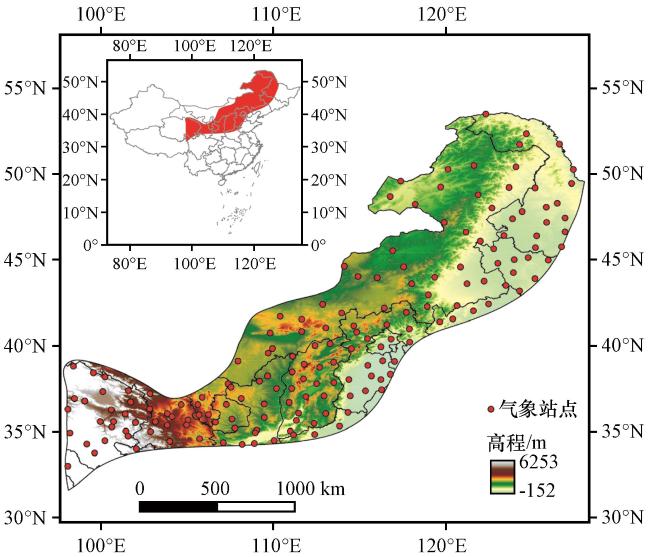
NDPB如图1所示, 包括我国西北地区东部、 华北以及东北大部的广大地区, 其地理环境复杂, 包含青藏高原、 黄土高原、 山地等地貌单元。作为季风区和非季风区的过渡区域, 其区域降水对夏季风的活动非常敏感, 夏季风活动的不确定性导致该区域降水的时空变率极大, 极易造成干旱的发生(张强等, 2020)。此外, 该区域陆面能量和边界层特征梯度大, 陆气耦合强, 陆面过程和大气环流在干旱形成发展过程中都扮演着重要角色, 与其他地区相比, 其干旱成因具有一定的特殊性(曾剑等, 2016张强等, 2019)。文中附图所涉及地图基于中华人民共和国自然资源部地图技术审查中心标准地图服务系统下载的审图号为GS(2016)1591的中国地图和审图号为GS(2016)1666的世界地图制作, 底图无修改。
图1 研究区地形(彩色区, 单位: m)与气象站点(红色圆点)分布

附图中红色区域为NDPB

Fig.1 The distribution of topography (color area, Unit: m) and meteorological stations (red dots) in research areaRed area in attached figure is the NDPB

2.2 资料来源

本文用气象干旱综合指数(Meteorological drought Composite Index, MCI)来表征干旱。MCI综合考虑了近60天、 90天、 150天的降水异常和近30天的降水和温度异常, 对中国的干旱有很好的监测能力(王素萍等, 2015; 中华人民共和国国家质量监督检验检疫总局和中国国家标准化管理委员会, 2017; 廖要明和张存杰, 2017), 目前被应用于国家气候中心的干旱监测和预警业务, MCI数据由国家气候中心提供。
研究区168个气象站点的逐日降水、 近地面气温数据来源于国家气象信息中心。
大气再分析资料来自美国环境预测中心/国家大气研究中心(National Centers for Environmental Prediction/National Center for Atmospheric Research, NCEP/NCAR)(Kalnay et al, 1996), 包括位势高度(单位: gpm)、 水平风场(单位: m·s-1)、 比湿(单位: g·kg-1)、 地表气压(单位: hPa), 水平分辨率为2.5°×2.5°, 垂直方向上比湿有8层, 地表气压为单层, 其余变量均有17层。
逐月海表温度数据为美国国家海洋和大气管理局(National Oceanic and Atmospheric Administration, NOAA)的第五代扩展重建海表温度(Extended Reconstructed Sea Surface Temperature, Version 5, ERSSTv5)(Huang et al, 2017), 空间分辨率为2°×2°。该数据结合了5 m以上的浮标观测、 HadISST2和NCEP的海冰密集度, 局地海温的时空变化和高纬度的海温更为真实, 拉尼娜和厄尔尼诺的强度偏差得到纠正, 已在气候模式和海温变率分析中得到了广泛应用(Danabasoglu et al, 2020Ding et al, 2021Truchelut et al, 2022Zhang et al, 2023b)。
积雪数据为美国国家冰雪数据中心(National Snow and Ice Data Center, NSIDC)第四版逐周北半球的EASE-Grid 2.0积雪范围, 该数据从1966年10月开始, 空间分辨率25 km, 是将AVHRR, GOES还有其他可见光波段的卫星数据进行人工解释得到。由于其可用时段长且不确定性区间较小(Brown and Robinson, 2011), 在气候研究中被经常使用(Chen et al, 2014Guan et al, 2020)。借鉴前人的方法(Zhang et al, 2021Bamzai and Shukla, 1999Zhang et al, 2023a), 本文使用积雪覆盖率表示空间某点上某月积雪出现的频率, 具体计算方法为: 该月有积雪覆盖的周数除以该月总周数。
海冰密集度数据来自英国哈德利中心海冰和海表温度数据集(Hadley Centre Sea Ice and Sea Surface Temperature data set, HadISST1), 空间分辨率1°×1°(Rayner et al, 2003)。该数据在北极关键区的海冰密集度变化和NSIDC的一致(Hu et al, 2023a), 因为后者时段较短(从1978年开始), 因此本文选择前者做进一步分析。
除积雪数据为1967—2012年外, 其余数据范围均为1961—2012年。

2.3 方法介绍

2.3.1 波作用通量的计算

为进一步诊断北美积雪对北方干旱的影响机理, 本文计算了在假定Wentael-Kramers-Brillouin(WKB)近似的纬向基流中可以反映波动能量频散的波作用通量(Takaya and Nakamura, 2001), 公式如下:
W = p 0 2 U ¯ u ¯ ψ x ' 2 ψ x ' 2 - ψ ' ψ x x ' + v ¯ ψ x ' ψ y ' - ψ ' ψ x y ' u ¯ ψ x ' ψ y ' - ψ ' ψ x y ' + v ¯ ψ y ' 2 - ψ ' ψ y y '
式中: W表示波作用通量; p 0 = p 1000为标准化后的气压; U = u , v为水平风场; ψ为准地转流函数(单位: m2·s-1)。字母上方加‘ -’表示气候平均态, 右上方加‘′’表示异常, 右下方的 x y分别表示在纬向、 经向求偏导。

2.3.2 春夏连旱年的挑选

利用前人研究成果(Ren et al, 2012), 挑选出1961 -2012年主要发生在中国北方的12个区域性极端干旱事件, 再根据这些干旱事件在NDPB维持的时间, 按照春旱(3 -5月)、 春夏连旱(横跨5月和6月)、 夏旱(6-8月)、 夏秋连旱(横跨8月和9月)等9个时段来划分不同时段的干旱事件(下文中1 -8月以及12月的英文缩写分别为Jan.、 Feb.、 Mar.、 Apr.、 May、 Jun.、 Jul.、 Aug.以及Dec.), 共计获得24个不同时段的干旱事件, 其中春旱占33.3%(8/24), 春夏连旱占29.2%(7/24), 其余时段的干旱事件占比均不到10%, 可见春旱和春夏连旱占比较高, 这与前人发现的规律一致(Zhang et al, 2018Chen and Yang, 2013)。进一步统计发现7次春夏连旱的极端干旱事件发生在1962、 1965、 1968、 1972、 1995、 2000、 2001年这7年, 且除1965年外, 其余6年春夏连旱的持续时间均超过120天。之后挑选这7年为春夏连旱年, 并通过合成分析方法分析其影响因子特征。

3 结果分析

3.1 降水和温度对干旱的贡献

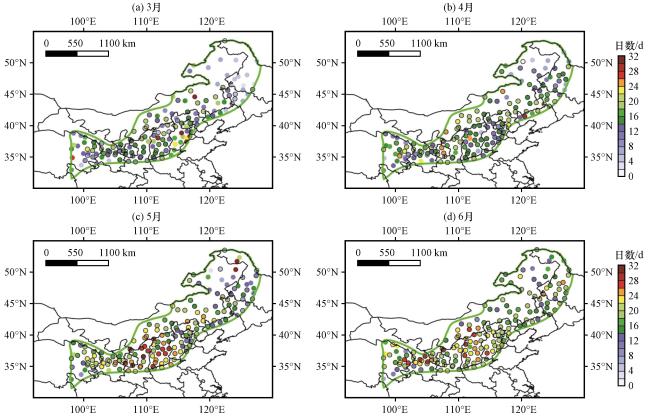
依据中旱及以上强度干旱的气象干旱等级标准(逐日MCI指数小于等于-1.0), 给出春夏连旱年合成的3 -6月干旱日数空间分布(图2)。3月, 西北地区东部和华北地区大部分站点的中旱及以上强度干旱日数就超过14天; 4月西北地区东部和华北地区的干旱维持且持续时间略有延长, 东北地区和内蒙古东部干旱迅速发展, 东北三省北部站点中旱及以上日数超过16天, 内蒙古东部超过8天; 5月西北地区东部和华北地区干旱明显加重, 中旱及以上强度干旱持续时间延长至20天以上, 其中甘肃东部、 陕西北部以及山西中部持续时间超过24天, 东北地区和内蒙古东部干旱维持、 持续时间略有缩短; 6月除甘肃东部、 陕西北部以及山西中部的干旱持续时间有所缩短外, 整个NDPB的干旱时长均明显增加。总之, 春夏连旱年显著干旱区范围较大, 如西北地区东部和华北地区、 东北地区和内蒙古东部, 且持续时间较长, 西北地区东部和华北地区的干旱从3月持续到6月, 东北地区和内蒙古东部干旱从4月开始, 持续3个月。
图2 春夏连旱年3月(a)、 4月(b)、 5月(c)、 6月(d)中旱及以上强度干旱日数空间分布(单位: d)

圆点黑色圈表示通过90%信度检验, 绿色轮廓线为NDPB

Fig.2 Spatial distribution of days of moderate drought and above in prolonged spring-summer drought years in March(a), April (b), May (c) and June (d).Unit: d.Dot with black circle denotes passing 90% confidence level, green contour line is the NDPB

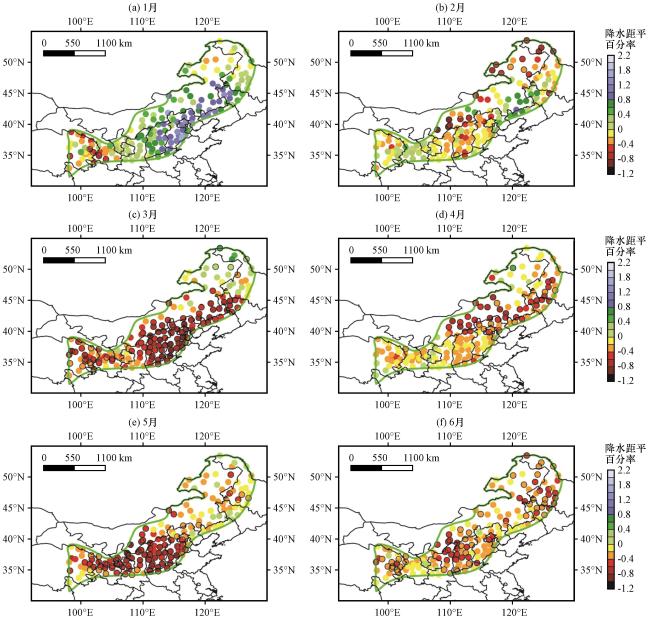
降水和温度异常是气象干旱产生的直接贡献者, 为探究两者的相对贡献, 以下给出降水距平百分率和近地面气温距平的逐月分布。由于降水有累积效应, 故分析1 -6月的降水异常(图3)。1月, 甘肃和青海交界地带的降水偏少40%左右, 其余地区降水正常或偏多; 2月山西大部分区域、 内蒙古中部、 内蒙古东部和黑龙江北部降水显著偏少40%左右, 西北地区东部正常, 河北略微偏少, 内蒙古、 辽宁和吉林交界处略微偏多; 3月除内蒙古东部和黑龙江西部、 北部外, NDPB降水偏少40%以上, 华北以及内蒙古、 辽宁和吉林交界处甚至偏少60%以上; 4月华北北部和东北北部降水显著偏少大于40%, 部分站点偏少大于60%, 其他区域略微偏少; 5月NDPB整体降水偏少, 西北地区东部和华北南部偏少60%左右; 6月NDPB降水仍然整体偏少, 偏少20%以上的站点主要位于青海东部、 陕西北部、 华北以及内蒙古东部、 黑龙江西部和北部、 吉林北部。总之, 1月和2月降水偏少区域面积较小, 降水距平小于等于-30%的站点比例分别为7.2%和22.3%, 3 -6月NDPB整体降水持续偏少, 特别是3月、 5月、 6月降水显著偏少区包括了西北地区东部、 华北, 4 -6月东北三省北部始终为降水显著偏少区, 3 -6月降水距平不超过-30%的站点比例分别为68.7%、 31.9%、 54.2%以及36.1%, 大范围的降水偏少有利于NDPB春旱向夏旱的发展。
图3 春夏连旱年1 -6月降水距平百分率空间分布

圆点黑色圈表示通过90%信度检验, 绿色轮廓线为NDPB

Fig.3 Spatial distribution of percentage of precipitation anomalies in prolonged spring-summer drought years from January to June.Dot with black circle denotes passing 90% confidence level, green contour line is the NDPB

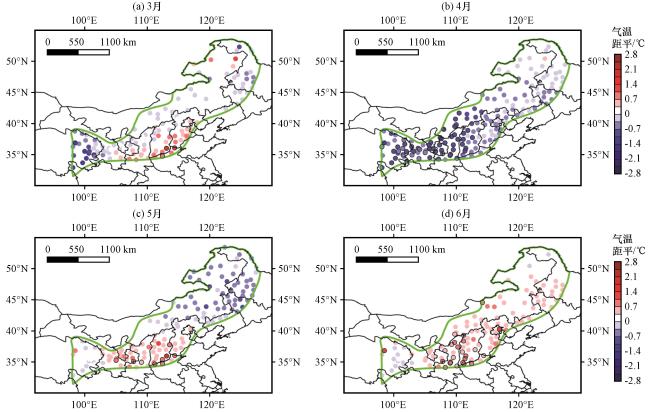
近地面高温也会通过增加蒸散加剧气象干旱, 合成的近地面温度距平如图4所示。春夏连旱年3月和5月温度偏高的站点主要位于河北大部、 山西及其与河南交界处, 其他区域温度偏低; 4月NDPB整体温度偏低, 西北地区东部和华北西部偏低1 ℃以上; 6月气温显著偏高的区域集中在陕西和山西, 其他区域温度变化不大。从图4可以看到, 高温对干旱的正贡献区在陕西、 山西及其与河南的交界区域(图4), 范围偏小, 远不及降水异常的贡献(图3)。
图4 春夏连旱年3 -6月近地面气温距平空间分布(单位: ℃)

圆点黑色圈表示通过90%信度检验, 绿色轮廓线为NDPB

Fig.4 Spatial distribution of near surface air temperature anomalies in prolonged spring-summer drought years from March to June.Unit: ℃.Dot with black circle denotes passing 90% confidence level, green contour line is the NDPB

表1给出干旱日数和降水、 温度的定量关系, 可以看到2月、 3月降水与3月干旱日数相关系数分别为-0.43、 -0.39, 3月、 4月降水与4月干旱日数的相关系数分别为-0.57、 -0.33, 4月、 5月降水与5月干旱日数的相关系数分别为-0.30、 -0.52, 3月、 4月、 5月、 6月降水与6月干旱日数的相关系数分别为-0.30、 -0.30、 -0.54、 -0.56。3-6月干旱日数与3月、 4月、 5月和6月降水的相关系数分别为-0.48、 -0.29、 -0.52、 -0.47, 且超过了95%的信度检验, 其中, 与3月、 5月和6月降水的相关性均超过了99%的信度检验。温度与干旱日数的相关均不显著, 这进一步表明降水异常是NDPB春夏连旱的主要贡献者。
表1 1961 -2012NDPB平均的中旱及以上强度干旱日数与降水或温度的相关系数

Table 1 The correlation coefficient between the average number of days of moderate drought and above and precipitation or temperature in the NDPB from 1961 to 2012

中旱及以上强度干旱日数 降水 温度
1月 2月 3月 4月 5月 6月 3月 4月 5月 6月
3月 -0.06 -0.43** -0.39** - - - 0.04 - - -
4月 -0.18 -0.09 -0.57** -0.33* - - -0.18 -0.1 - -
5月 0.13 0.04 -0.16 -0.3* -0.52** - 0.06 -0.08 0.08 -
6月 0.09 -0.04 -0.3* -0.3* -0.54** -0.56** 0.06 -0.13 -0.13 0.18
3-6月 -0.002 -0.19 -0.48** -0.29* -0.52** -0.47** 0.01 -0.09 -0.06 0.14

**表示通过99%信度检验, *表示通过95%信度检验, -表示无数据(** denotes data passing 99% confidence level, * denotes data passing 95% confidence level, - indicates without data)

综上所述, 春夏连旱年通过显著性检验的干旱区范围较大, 持续时间较长。相较温度而言, 3 -6月的降水在干旱发展过程中扮演更重要的角色, 特别是3月、 5月、 6月这3个月降水偏少区面积较大, 对干旱的贡献也更大。

3.2 环流特征

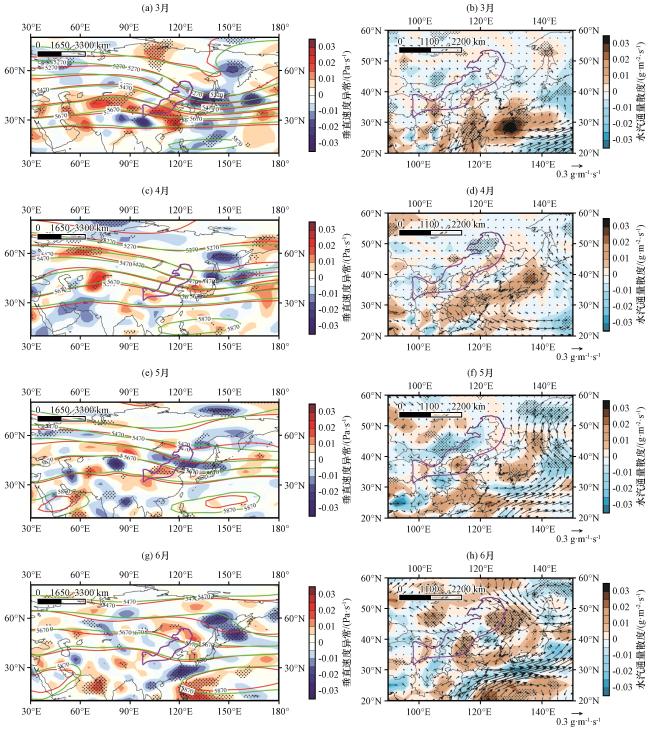
上升运动和充足的水汽是降水形成的两大要素。如图5所示, 春夏连旱年3月贝加尔湖(贝湖)附近等高线抬升而东亚沿岸等高线降低, NDPB处于高压脊前, 其上空为负涡度平流和冷平流, 空气下沉[图5(a)], 降水不易形成, 这种环流型与以往研究结论一致(Li et al, 2018bZeng et al, 2019); 而水汽仅在西北地区东部有辐散[图5(b)], 相对来说对降水的影响较弱。4月下沉运动和水汽辐散均不明显[图5(c), (d)], 这和4月较小范围的降水偏少区对应。5月东亚大槽加深, NDPB位于槽后下沉气流中[图5(e)], 山西、 河北等地水汽有明显辐散[图5(f)], 不利于降水。6月乌拉尔山和鄂霍次克海附近的位势高度偏低, 西北太平洋副热带高压(以下简称西太副高)脊点偏东、 强度有所减弱[图5(g)], 鄂霍次克海和日本附近的低压使得南下冷空气偏东, 再加上偏东偏弱的西太副高, 水汽难以在NDPB汇聚[图5(h)], 干旱得以维持。
图5 500 hPa垂直速度异常(彩色区, 单位: Pa·s-1, )和位势高度(等值线, 单位: gpm, 红色线为春夏连旱年合成, 绿色线为气候态)(左)以及整层水汽通量异常(矢量, 单位: g·m-1·s-1)及其散度(彩色区, 单位: g·m-2·s-1)(右)

紫色等值线表示NDPB, 打点表示通过90%信度检验

Fig.5 Vertical velocity anomaly at 500 hPa (color area, unit: Pa·s-1) and geopotential height (isoline, unit: gpm, red line denotes the synthesis of prolonged spring-summer drought years, green line denotes the climatological state) (left); integrated water vapor flux anomaly (arrow, unit: g·m-1·s-1) and its divergence (color area, unit: g·m-2·s-1) (right).Purple isoline denotes the NDPB, dot denotes passing 90% confidence level

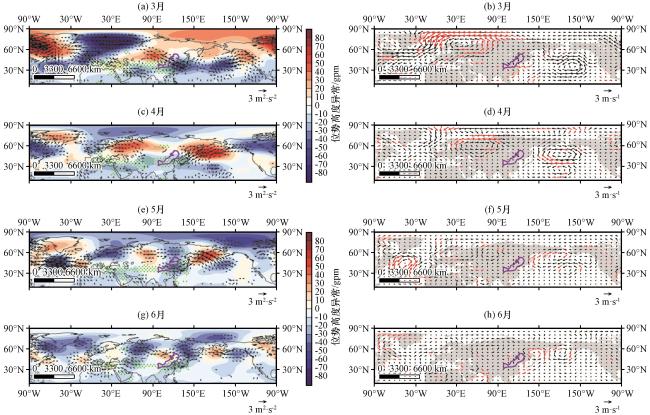
进一步看对流层高层和低层的环流异常(图6)。3月对流层高层存在自巴芬湾东传的波列[图6(a)], 其中巴芬湾和贝湖以西为高压异常, 欧洲北部和东亚沿岸为低压异常, 波动引起贝湖脊加强和东亚大槽加深[图5(a)], 处于贝湖脊和东亚大槽之间的NDPB降水受到抑制; 而对流层低层的流场和高层的一致[图6(b)], 表明波列为准正压结构, 且低层NDPB受偏北风控制, 水汽条件不足; 另外, 波列的能量来源为巴芬湾、 北大西洋以及欧洲北部, 这可能和海温等外强迫有关, 之后再做讨论。4月从北美东传的能量在贝湖附近中断, 日本附近有能量向东北频散, 导致乌山和鄂霍次克海附近都为反气旋式环流异常, 而研究区环流异常不明显[图6(c), (d)], 下沉气流和水汽异常也不显著[图5(c), (d)]。5月波列的波长变短, 从哈德逊湾南部到贝湖以东为“正-负-正-负-正-负”的位势高度异常分布[图6(e), (f)], 东亚大槽加深导致位于槽后的NDPB气流下沉[图5(e)]; 罗斯贝波能量主要来自哈得逊湾南部和北大西洋[图6(e)]。6月除了60°N附近东传的波列外, 在30°N -40°N也有一支波列[图6(g)], 且主要表现为西亚至中亚和日本附近的两个低压异常, 类似丝路波列的负位相(Ding and Wang, 2005Wang et al, 2023Wen et al, 2019), 鄂霍次克海和日本附近的低压异常有利于南下冷空气路径偏东[图6(h), 图5(h)], 不利于冷暖空气交汇。
图6 300 hPa位势高度异常(彩色区, 单位: gpm, 绿色打点区域表示通过90%信度检验)和波作用通量(矢量, 单位: m2·s-2)(左)以及850 hPa风场异常(右)(矢量, 单位: m·s-1, 红色矢量表示通过90%信度检验)

紫色等值线表示NDPB

Fig.6 Geopotential height anomaly (color area, unit: gpm, green dot denotes passing 90% confidence level) and wave activity flux (arrow, unit: m2·s-2) at 300 hPa (left); wind anomaly at 850 hPa (right) (arrow, unit: m·s-1, red arrow denotes passing 90% confidence level).Purple isoline denotes the NDPB

3.3 外强迫特征

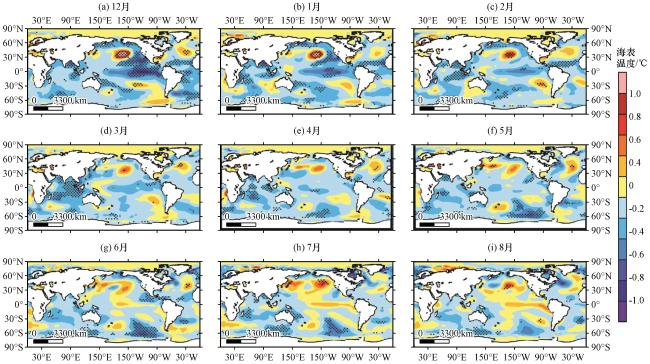
作为大气重要的强迫源之一, 海温异常对环流变化有重要影响(吴志文等, 2022)。图7是春夏连旱年前一年12月至当年8月的海温距平分布, 首先可以看到前一年冬季至次年夏季拉尼娜向厄尔尼诺的位相转变, 已有研究表明, 赤道东太平洋海温偏冷有利于NPO负位相结构的产生, 前冬负位相的NPO可以冷却黑潮延伸区的海温而加热赤道太平洋, 进而使厄尔尼诺发展; 厄尔尼诺型海温异常通过减弱沃克环流抑制印度夏季降水, 激发丝路波列维持东亚对流层冷却, 还通过加强赤道中太平洋降水激发西北太平洋低层的气旋环流(Zhang et al, 2018Li et al, 2018b)。NPO的负位相结构[图6(a)~(d)]、 西北太平洋气旋环流伴随的西太副高减弱[图5(g)]以及丝路波列[图6(g)]在春夏连旱年的合成图上有很好的反映, 这表明拉尼娜向厄尔尼诺的位相转变是NDPB春夏连旱的重要原因之一。另外, 3 -6月印度洋海盆温度一致偏低, 可能通过“Matsuno-Gill”响应导致西北太平洋地区出现气旋式异常环流(Yang et al, 2007Xie et al, 2009), 减少偏南水汽的输送进而导致研究区干旱[图5(h)]。还有北大西洋中部海温偏暖(图7), 可能通过中高纬波列影响北方降水(Lu et al, 2020Zhang et al, 2022)。
图7 春夏连旱年海表温度异常分布(单位: ℃)

12月表示春夏连旱年前一年的12月, 打点表示通过90%信度检验

Fig.7 Distribution of sea surface temperature anomaly in prolonged spring-summer drought years.Unit: ℃.The December denotes December of the year before prolonged spring-summer drought year, dot denotes passing 90% confidence level

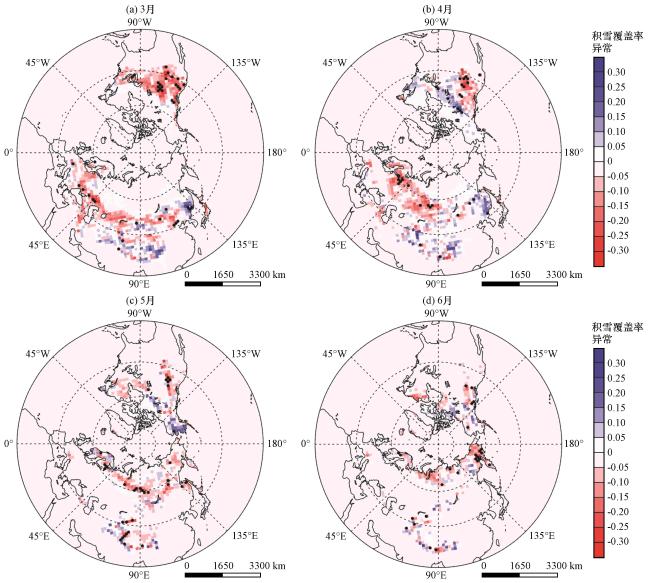
积雪异常可以通过反照率效应和水文效应影响地表水热平衡, 进而激发异常环流, 影响中国降水(Wang et al, 2017bXu et al, 2021曹言超和王晓春, 2022Wu et al, 2023)。春夏连旱年积雪覆盖率异常的分布如图8所示, 可以看到3 -6月欧亚大陆中高纬始终有显著的积雪偏少区, 3月主要分布在在黑海、 里海、 咸海以北, 4月在北欧和西西伯利亚, 5月在西西伯利亚和中西伯利亚一带, 6月在欧亚大陆东部。3月和4月欧亚大陆上积雪偏少区能通过减小地表反照率从而增加地表吸收的太阳辐射, 进而增加地表向上的热通量, 加热大气, 其北侧温度梯度增大, 西风增强[图6(b), (d)], 东传的波列在此获得能量, 继续传播到下游影响NDPB降水。此外, 北美大陆40°N -60°N之间有明显的积雪偏少区, 其西部从3 -5月一直积雪偏少, 但东部呈现“偏少-偏多-偏少”的变化。图8中青藏高原也有积雪异常, 3月、 4月以偏多为主, 5月西部和北部转为显著偏少。北美大陆的积雪异常可能通过纬向波列影响中国降水(Dong et al, 2023), 而青藏高原西部和北部冬春积雪偏少导致西风急流位置偏南, 中国北方夏季降水偏少(Wang et al, 2017a)。
图8 春夏连旱年积雪覆盖率异常

打点表示通过90%信度检验

Fig.8 Snow cover fraction anomaly in prolonged spring-summer drought years.Dot denotes passing 90% confidence level

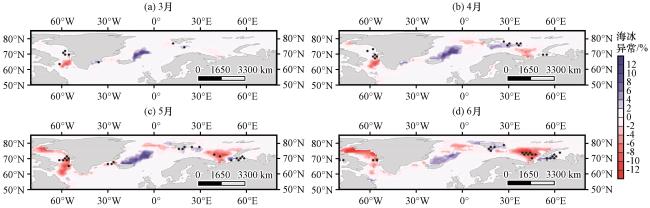
北极海冰异常也是北方干旱的重要影响因子, 如4月巴伦支海海冰偏少使得5月东北降水偏少(Hu et al, 2023b), 3 -6月格陵兰-巴伦支海海冰偏多导致局地海表温度偏高, 进而激发EU波列, 导致北方干旱(Wang and He, 2015), 前期春季巴伦支海北部和巴芬湾海冰偏少, 同年夏季巴伦支海北部海冰会持续偏少, 我国东北北部降水也偏少(张若楠等, 2018)。为此给出春夏连旱年北极海冰异常分布(图9)。可以看到, 巴芬湾和戴维斯海峡附近海冰偏少, 3月分布在戴维斯海峡且面积较小, 4月面积稍有扩大, 5月巴芬湾和戴维斯海峡海冰均明显偏少, 6月海冰密集度进一步减小。而格陵兰海附近海冰偏多, 且3 -5月海冰密集度不断增加、 范围也不断扩张, 6月偏多幅度有所下降。此外, 4 -6月, 从巴伦支海西北到巴伦支海东部, 再到喀拉海呈现出的“正-负-正”的海冰密集度异常分布特征也值得关注。
图9 春夏连旱年北极关键区海冰异常(单位: %)

打点表示通过90%信度检验

Fig.9 Sea ice anomaly in Arctic key area in prolonged spring-summer drought years.Unit: %.Dot denotes passing 90% confidence level

4 讨论

已有研究表明春季NAO对中国北方地区春季和夏季降水也有重要影响, 主要通过贝加尔湖附近的高压异常直接影响、 海气相互作用激发波列、 陆气耦合诱导环流异常等途径。比如: 3月NAO正位相利于下沉增温, 冷空气不易南下, 导致东北地区降水不足(Zeng et al, 2019); 中国东北春季和夏季同位相变化的干旱与春季正位相的NAO有关(Hu et al, 2022), 春季通过来自北大西洋的纬向波列直接影响贝加尔湖附近的高压异常, 进而导致东北春旱, 而夏旱是由于春季正位相NAO增加了中西伯利亚的积雪深度, 进而导致夏季中西伯利亚表层土壤变湿, 中纬和高纬经向温度梯度增大, 60°N西风增强, 随后在贝加尔湖附近产生位势高度正异常, 利于干旱持续; 春季负(正)位相的NAO可以强迫出北大西洋“正-负-正”(“负-正-负”)的海温三级子模态, 后者可以持续到夏季, 激发欧亚大陆北部的波列, 增大(减小)乌山和鄂霍次克海的气压, 增强(减弱)东亚夏季风, 长江流域降水增多而东北和内蒙古地区降水减少(Wu et al, 2009)。但是在本文的环流合成图上NAO的特征却不明显(图6), NAO是否是NDPB干旱的影响因子以及在什么时间尺度上比较重要需要进一步研究。

5 结论

本文利用MCI指数、 站点降水和近地面气温数据、 NCEP/NCAR再分析资料以及NOAA的第五代扩展重建海表温度、 美国国家冰雪数据中心第四版逐周北半球的EASE-Grid 2.0积雪范围、 英国哈德利中心的海冰密集度资料, 通过统计方法和合成方法找出NDPB极端春夏连旱事件主要的影响因子特征, 结果表明:
(1) 相较温度而言, 3 -6月的降水在NDPB春夏连旱发展过程中扮演更重要的角色, 特别是3、 5、 6月这三个月降水偏少区面积较大, 与3 -6月干旱日数的相关系数分别为-0.48、 -0.52、 -0.47, 均超过了99%的显著性检验, 对春夏连旱有重要贡献。
(2) 春夏连旱年, 3月在自巴芬湾东传的波列的影响下, NDPB处于加强的贝湖脊和加深的东亚大槽之间, 其上空为负涡度平流和冷平流, 气流下沉, 且低层受偏北风控制, 水汽条件不足, 降水受到抑制; 4月乌山和鄂霍次克海附近都为反气旋式环流异常, 而研究区环流异常不明显, 下沉气流和水汽异常也不显著, 与4月较小范围的降水偏少区对应; 5月波列的波长变短, 从哈德逊湾南部到贝湖以东为“正-负-正-负-正-负”的位势高度异常分布, 东亚大槽加深导致位于槽后的NDPB空气下沉, 水汽辐散, 不利于降水; 6月60°N附近东传的波列以及30°N -40°N的丝路波列同时存在, 导致鄂霍次克海和日本附近出现低压异常, 使得南下冷空气路径偏东, 再加上偏东偏弱的西太副高, 水汽难以在NDPB汇聚, 干旱得以维持。
(3) 春夏连旱年, 海温异常特征为: 前一年冬季至次年夏季拉尼娜向厄尔尼诺的位相转变、 3 -6月印度洋海盆温度一致偏低、 北大西洋中部海温偏暖; 积雪异常特征为: 3 -6月欧亚大陆中高纬的积雪持续偏少、 北美大陆40°N -60°N之间积雪明显偏少, 青藏高原3、 4月积雪以偏多为主, 5月转为偏少; 北极海冰异常特征为: 3 -6月巴芬湾和戴维斯海峡附近海冰偏少而格陵兰海附近海冰偏多, 4 -6月从巴伦支海西北到巴伦支海东部, 再到喀拉海呈现出“正-负-正”的海冰密集度异常分布特征。
本文探究了NDPB极端春夏连旱事件的影响因子特征, 而这些影响因子的相互作用及其对NDPB极端干旱的协同影响机制, 将在今后的工作中进行更深入的研究。

References

null
Bamzai A S Shukla J1999.Relation between Eurasian snow cover, snow depth, and the Indian summer monsoon: an observational study[J].Journal of Climate12(10): 3117-3132.DOI: 10. 1175/1520-0442(1999)012<3117: RBESCS>2.0.CO; 2 .
null
Barriopedro D Gouveia C M Trigo R M, et al, 2012.The 2009/10 drought in China: possible causes and impacts on vegetation[J].Journal of Hydrometeorology13(4): 1251-1267.DOI: 10. 1175/JHM-D-11-074.1 .
null
Brown R D Robinson D A2011.Northern Hemisphere spring snow cover variability and change over 1922-2010 including an assessment of uncertainty[J].The Cryosphere5(1): 219-229.DOI: 10.5194/tc-5-219-2011 .
null
Chen H P Sun J Q2015.Changes in drought characteristics over China using the standardized precipitation evapotranspiration index[J].Journal of Climate28(13): 5430-5447.DOI: 10.1175/JCLI-D-14-00707.1 .
null
Chen N C Li R H Zhang X, et al, 2020.Drought propagation in Northern China Plain: a comparative analysis of GLDAS and MERRA-2 datasets[J].Journal of Hydrology, 588: 125026.DOI: 10.1016/j.jhydrol.2020.125026 .
null
Chen Z H Yang G F2013.Analysis of drought hazards in North China: distribution and interpretation[J].Natural Hazards65(1): 279-294.DOI: 10.1007/s11069-012-0358-3 .
null
Chen Z Wu R G Chen W2014.Impacts of autumn Arctic sea ice concentration changes on the East Asian winter monsoon variability[J].Journal of Climate27(14): 5433-5450.DOI: 10.1175/JCLI-D-13-00731.1 .
null
Dai A G Zhao T B2017.Uncertainties in historical changes and future projections of drought.Part I: estimates of historical drought changes[J].Climatic Change144(3): 519-533.DOI: 10.1007/s10584-016-1705-2 .
null
Dai L Wright J S Fu R2020.Moisture and energy budget perspectives on summer drought in North China[J].Journal of Climate33(23): 10149-10167.DOI: 10.1175/JCLI-D-20-0176.1 .
null
Danabasoglu G Lamarque J F Bacmeister J, et al, 2020.The Community Earth System Model Version 2 (CESM2)[J].Journal of Advances in Modeling Earth Systems12(2): e2019MS001916.DOI: 10.1029/2019MS001916 .
null
Ding Q H Wang B2005.Circumglobal teleconnection in the Northern Hemisphere summer[J].Journal of Climate18(17): 3483-3505.DOI: 10.1175/JCLI3473.1 .
null
Ding Y H Liu Y Y Hu Z Z2021.The record-breaking mei-yu in 2020 and associated atmospheric circulation and tropical SST anomalies[J].Advances in Atmospheric Sciences38(12): 1980-1993.DOI: 10.1007/s00376-021-0361-2 .
null
Dong Z Z Yang R W Cao J, et al, 2023.A strong high-temperature event in late-spring 2023 in Yunnan province, Southwest China: characteristics and possible causes[J].Atmospheric Research, 295: 107017.DOI: 10.1016/j.atmosres.2023.107017 .
null
Douville H Raghavan K Renwick J, et al, 2021.Water cycle changes∥IPCC.Climate change 2021: the physical science basis.Contribution of Working Group Ⅰ to the Sixth Assessment Report of the Intergovernmental Panel on Climate Change[M]//Cambridge: Cambridge University Press: 1055-1210.DOI: 10.1017/9781009157896.010 .
null
Du Y B Zhang J Zhao S W, et al, 2020.Impact of the eastward shift in the negative-phase NAO on extreme drought over northern China in summer[J].Journal of Geophysical Research: Atmospheres125(16): e2019JD032019.DOI: 10.1029/2019JD032019 .
null
Gao H Yang S2009.A severe drought event in northern China in winter 2008-2009 and the possible influences of La Ni?a and Tibetan Plateau[J].Journal of Geophysical Research: Atmospheres114(D24): D24104.DOI: 10.1029/2009JD012430 .
null
Guan C Yu L X Yan F Q, et al, 2020.Teleconnections between snow cover change over Siberia and crop growth in Northeast China[J].Sustainability12(18): 7632.DOI: 10.3390/su12187632 .
null
Hu R Zhang J Chen L, et al, 2023a.Strengthened connections between Arctic sea ice and thermal conditions over the Tibetan Plateau in May after the 2000s[J].Journal of Geophysical Research: Atmospheres128(20): e2023JD039122.DOI: 10.1029/2023JD039122 .
null
Hu Y P Zhou B T Han T T, et al, 2022.In-phase variations of spring and summer droughts over Northeast China and their relationship with the North Atlantic Oscillation[J].Journal of Climate35(21): 6923-6937.DOI: 10.1175/JCLI-D-22-0052.1 .
null
Hu Y P Zhou B T Li H X, et al, 2023b.Enhanced intensity of interannual variability of May drought in Northeast China after 2000 and its connection with the Barents Sea ice[J].Journal of Geophysical Research: Atmospheres128(20): e2023JD039617.DOI: 10.1029/2023JD039617 .
null
Huang B Y Thorne P W Banzon V F, et al, 2017.Extended Reconstructed Sea Surface Temperature, version 5 (ERSSTv5): upgrades, validations, and intercomparisons[J].Journal of Climate30(20): 8179-8205.DOI: 10.1175/JCLI-D-16-0836.1 .
null
Kalnay E Kanamitsu M Kistler R, et al, 1996.The NCEP/NCAR 40-year reanalysis project[J].Bulletin of the American Meteorological Society77(3): 437-472.DOI: 10.1175/1520-0477(1996)077<0437: TNYRP>2.0.CO; 2 .
null
Li H X Chen H P Wang H J, et al, 2018a.Can Barents Sea ice decline in spring enhance summer hot drought events over northeastern China?[J].Journal of Climate31(12): 4705-4725.DOI: 10.1175/JCLI-D-17-0429.1 .
null
Li X Z Zhou W Chen Y Q D2015.Assessment of regional drought trend and risk over China: a drought climate division perspective[J].Journal of Climate28(18): 7025-7037.DOI: 10.1175/JCLI-D-14-00403.1 .
null
Li X Li D L Li X, et al, 2018b.Prolonged seasonal drought events over northern China and their possible causes[J].International Journal of Climatology38(13): 4802-4817.DOI: 10.1002/joc.5697 .
null
Liu S J Wen N Li L2021.Dynamic and thermodynamic contributions to Northern China dryness in El Ni?o developing summer[J].International Journal of Climatology41(4): 2878-2890.DOI: 10.1002/joc.6995 .
null
Lu R Zhu Z W Li T, et al, 2020.Interannual and interdecadal variabilities of spring rainfall over northeast China and their associated sea surface temperature anomaly forcings[J].Journal of Climate33(4): 1423-1435.DOI: /10.1175/JCLI-D-19-0302.1 .
null
Oh S B Byun H R Kim D W2014.Spatiotemporal characteristics of regional drought occurrence in East Asia[J].Theoretical and Applied Climatology117(1-2): 89-101.DOI: /10.1007/s00704-013-0980-3 .
null
Park C K Ho C H Park D S R, et al, 2020.Interannual variations of spring drought-prone conditions over three subregions of East Asia and associated large-scale circulations[J].Theoretical and Applied Climatology142(3-4): 1117-1131.DOI: 10.1007/s00704-020-03371-5 .
null
Rayner N A Parker D E Horton E B, et al, 2003.Global analyses of sea surface temperature, sea ice, and night marine air temperature since the late nineteenth century[J].Journal of Geophysical Research: Atmospheres108(D14): 4407.DOI: 10.1029/2002JD002670 .
null
Ren F M Cui D L Gong Z Q, et al, 2012.An objective identification technique for regional extreme events[J].Journal of Climate25(20): 7015-7027.DOI: 10.1175/JCLI-D-11-00489.1 .
null
Takaya K Nakamura H2001.A formulation of a phase-independent wave-activity flux for stationary and migratory quasigeostrophic eddies on a zonally varying basic flow[J].Journal of the Atmospheric Sciences58(6): 608-627.DOI: 10.1175/1520-0469(2001)058<0608: AFOAPI>2.0.CO; 2 .
null
Tian B Q Fan K2022.New downscaling prediction models for spring drought in China[J].International Journal of Climatology42(13): 6960-6975.DOI: 10.1002/joc.7623 .
null
Truchelut R E Klotzbach P J Staehling E M, et al, 2022.Earlier onset of North Atlantic hurricane season with warming oceans[J].Nature Communications13(1): 4646.DOI: 10.1038/s41467-022-31821-3 .
null
Wang C H Yang K Li Y L, et al, 2017a.Impacts of spatiotemporal anomalies of Tibetan Plateau snow cover on summer precipitation in eastern China[J].Journal of Climate30(3): 885-903.DOI: 10.1175/JCLI-D-16-0041.1 .
null
Wang H J He S P2015.The north China/northeastern Asia severe summer drought in 2014[J].Journal of Climate28(17): 6667-6681.DOI: 10.1175/JCLI-D-15-0202.1 .
null
Wang Q L Wang L Huang G, et al, 2023.Mechanism of the summer rainfall interannual variability in transitional climate zone in East Asia: roles of teleconnection patterns and associated moisture processes[J].Climate Dynamics61(3-4): 1177-1192.DOI: 10.1007/s00382-022-06618-1 .
null
Wang S S Yuan X Li Y H2017b.Does a strong El Ni?o imply a higher predictability of extreme drought?[J].Scientific Reports, 7: 42962.DOI: 10.1038/srep40741 .
null
Wen N Liu Z Y Li L2019.Direct ENSO impact on East Asian summer precipitation in the developing summer[J].Climate Dynamics52(11): 6799-6815.DOI: 10.1007/s00382-018-4545-0 .
null
Wu S Y Zhang J Li J J, et al, 2023.The reduced Siberian spring snow cover modulation on southward northernmost margin of East Asia summer monsoon[J].Climate Dynamics61(5-6): 2949-2964.DOI: 10.1007/s00382-023-06732-8 .
null
Wu Z W Wang B Li J P, et al, 2009.An empirical seasonal prediction model of the east Asian summer monsoon using ENSO and NAO[J].Journal of Geophysical Research: Atmospheres114(D18): D18120.DOI: 10.1029/2009JD011733 .
null
Xie S P Hu K M Hafner J, et al, 2009.Indian Ocean Capacitor Effect on Indo-Western Pacific Climate during the summer following El Ni?o[J].Journal of Climate22(3): 730-747.DOI: 10.1175/2008JCLI2544.1 .
null
Xu B Chen H S Gao C J, et al, 2021.Abnormal change in spring snowmelt over Eurasia and its linkage to the East Asian summer monsoon: the hydrological effect of snow cover[J].Frontiers in Earth Science, 8: 594656.DOI: 10.3389/feart.2020.594656 .
null
Yang J L Liu Q Y Xie S P, et al, 2007.Impact of the Indian Ocean SST basin mode on the Asian summer monsoon[J].Geophysical Research Letters34(2): L02708.DOI: 10.1029/2006GL028571 .
null
Yu M X Li Q F Hayes M J, et al, 2014.Are droughts becoming more frequent or severe in China based on the standardized precipitation evapotranspiration index: 1951-2010?[J].International Journal of Climatology34(3): 545-558.DOI: 10.1002/joc. 3701 .
null
Zeng D W Yuan X Roundy J K2019.Effect of teleconnected land-atmosphere coupling on Northeast China persistent drought in spring-summer of 2017[J].Journal of Climate32(21): 7403-7420.DOI: 10.1175/JCLI-D-19-0175.1 .
null
Zhang J Chen H S Zhang Q2019.Extreme drought in the recent two decades in northern China resulting from Eurasian warming[J].Climate Dynamics52(5-6): 2885-2902.DOI: 10.1007/s00382-018-4312-2 .
null
Zhang L X Wu P L Zhou T J, et al, 2018.ENSO transition from La Ni?a to El Ni?o drives prolonged spring-summer drought over north China[J].Journal of Climate31(9): 3509-3523.DOI: 10.1175/JCLI-D-17-0440.1 .
null
Zhang M Q Sun J Q Gao Y Q2022.Impacts of North Atlantic sea surface temperature on the predominant modes of spring precipitation monthly evolution over Northeast China[J].Climate Dynamics58(5-6): 1383-1401.DOI: 10.1007/s00382-021-05966-8 .
null
Zhang T T Feng Y Y Chen H S2023a.Revealing the formation of the dipole mode of Eurasian snow cover variability during late autumn[J].Journal of Geophysical Research: Atmospheres128(6): e2022JD038233.DOI: 10.1029/2022JD038233 .
null
Zhang T T Wang T Zhao Y T, et al, 2021.Drivers of Eurasian spring snow-cover variability[J].Journal of Climate34(6): 2037-2052.DOI: 10.1175/JCLI-D-20-0413.1 .
null
Zhang X Y Wang Y T Hou S G, et al, 2023b.Significant west Antarctic cooling in the past two decades driven by tropical Pacific forcing[J].Bulletin of the American Meteorological Society104(6): E1154-E1165.DOI: 10.1175/BAMS-D-22-0153.1 .
null
Zhao W Chen S F Chen W, et al, 2019.Interannual variations of the rainy season withdrawal of the monsoon transitional zone in China[J].Climate Dynamics53(3-4): 2031-2046.DOI: 10. 1007/s00382-019-04762-9 .
null
曹言超, 王晓春, 2022.青藏高原春季积雪对北半球夏季季节内振荡的影响[J].高原气象41(6): 1384-1398.DOI: 10.7522/j.issn.1000-0534.2021.00087.Cao Y C
null
Wang X C2022.Influence of the Qinghai-Xizang Plateau spring snow cover variation on the boreal summer intraseasonal oscillation[J].Plateau Meteorology41(6): 1384-1398.DOI: 10.7522/j.issn.1000-0534.2021.00087 .
null
曾剑, 张强, 王春玲, 2016.东亚夏季风边缘摆动区陆面能量时空分布规律及其与气候环境的关系[J].气象学报 (6): 876-888.DOI: 10.11676/qxxb2016.064.Zeng J
null
Zhang Q Wang C L2016.Spatial-temporal pattern of surface energy fluxes over the East Asian summer monsoon edge area in China and its relationship with climate[J].Acta Meteorologica Sinica(6): 876-888.DOI: 10.11676/qxxb2016.064 .
null
陈海山, 陈健康, 2017.东亚夏季风指数的分类及物理特征分析[J].大气科学学报40(3): 299-309.DOI: 10.13878/j.cnki.dqkxxb.20160323001.Chen H S
null
Chen J K2017.Classification of East Asian summer monsoon indices and their basic physical features[J].Transactions of Atmospheric Sciences40(3): 299-309.DOI: 10.13878/j.cnki.dqkxxb.20160323001 .
null
程序, 1999.农牧交错带研究中的现代生态学前沿问题[J].资源科学21(5): 3-10.
null
Cheng X1999.Frontier issue of modern ecology in the study of ecotone between agriculture and animal husbandry[J].Resources Science21(5): 3-10.
null
翟盘茂, 刘静, 2012.气候变暖背景下的极端天气气候事件与防灾减灾[J].中国工程科学14(9): 55-63.DOI: 10.3969/j.issn.1009-1742.2012.09.007.Zhai P M
null
Liu J2012.Extreme weather/climate events and disaster prevention and mitigation under global warming background[J].Engineering Sciences14(9): 55-63.DOI: 10.3969/j.issn.1009-1742.2012.09.007 .
null
符淙斌, 安芷生, 郭维栋, 2005.我国生存环境演变和北方干旱化趋势预测研究(Ⅰ): 主要研究成果[J].地球科学进展20(11): 1157-1167.DOI: 10.11867/j.issn.1001-8166.2005.11.1157.Fu C B
null
An Z S Guo W D2005.Evolution of life-supporting environment in our nation and the predictive study of aridification in northern China (Ⅰ): main scientific issues and achievements[J].Advances in Earth Science20(11): 1157-1167.DOI: 10.11867/j.issn.1001-8166.2005.11.1157 .
null
琚建华, 吕俊梅, 任菊章, 2006.北极涛动年代际变化对华北地区干旱化的影响[J].高原气象25(1): 74-81.
null
Ju J H J M Ren J Z2006.The effect of interdecadal variations of Arctic Oscillation on aridization in North China[J].Plateau Meteorology25(1): 74-81.
null
李栋梁, 邵鹏程, 王慧, 等, 2013.中国东亚副热带夏季风北边缘带研究进展[J].高原气象32(1): 305-314.DOI: 10.7522/j.issn.1000-0534.2012.00030.Li D L
null
Shao P C Wang H, et al, 2013.Advances in research of the north boundary belt of East Asia subtropical summer monsoon in China[J].Plateau Meteorology32(1): 305-314.DOI: 10.7522/j.issn.1000-0534.2012.00030 .
null
廖要明, 张存杰, 2017.基于MCI的中国干旱时空分布及灾情变化特征[J].气象43(11): 1402-1409.DOI: 10.7519/j.issn.1000-0526.2017.11.009.Liao Y M
null
Zhang C J2017.Spatio-temporal distribution characteristics and disaster change of drought in China based on meteorological drought composite index[J].Meteorological Monthly43(11): 1402-1409.DOI: 10.7519/j.issn.1000-0526.2017.11.009 .
null
屈艳萍, 吕娟, 张伟兵, 等, 2018.中国历史极端干旱研究进展[J].水科学进展29(2): 283-292.DOI: 10.14042/j.cnki.32.1309.2018.02.016.Qu Y P
null
J Zhang W B, et al, 2018.Progress in research on historical extreme drought in China[J].Advances in Water Science29(2): 283-292.DOI: 10.14042/j.cnki.32.1309.2018.02.016 .
null
沈晓琳, 祝从文, 李明, 2012.2010年秋、 冬季节华北持续性干旱的气候成因分析[J].大气科学36(6): 1123-1134.DOI: 10.3878/j.issn.1006-9895.2012.11192.Shen X L
null
Zhu C W Li M2012.Possible causes of persistent drought event in North China during the cold season of 2010[J].Chinese Journal of Atmospheric Sciences36(6): 1123-1134.DOI: 10.3878/j.issn.1006-9895.2012.11192 .
null
史正涛, 1996.中国季风边缘带自然灾害的区域特征[J].干旱区资源与环境10(4): 1-7.
null
Shi Z T1996.Regional characters of natural disaster in marginal monsoon belt of China[J].Journal of Arid Land Resources and Environment10(4): 1-7.
null
汤绪, 钱维宏, 梁萍, 2006.东亚夏季风边缘带的气候特征[J].高原气象25(3): 375-381.
null
Tang X Qian W H Liang P2006.Climatic features of boundary belt for east Asian summer monsoon[J].Plateau Meteorology25(3): 375-381.
null
王素萍, 王劲松, 张强, 等, 2015.几种干旱指标对西南和华南区域月尺度干旱监测的适用性评价[J].高原气象34(6): 1616-1624.DOI: 10.7522/j.issn.1000-0534.2014.00089.Wang S P
null
Wang J S Zhang Q, et al, 2015.Applicability evaluation of drought indices in monthly scale drought monitoring in southwestern and southern China[J].Plateau Meteorology34(6): 1616-1624.DOI: 10.7522/j.issn.1000-0534.2014.00089 .
null
王晓丹, 张勃, 马彬, 等, 2022.基于日值SPEI东北地区近58a干旱时空演变特征[J].高原气象41(3): 721-732.DOI: 10.7522/j.issn.1000-0534.2021.00015.Wang X D
null
Zhang B Ma B, et al, 2022.Spatial and temporal evolution of drought in Northeast China in recent 58 years based on daily SPEI[J].Plateau Meteorology41(3): 721-732.DOI: 10.7522/j.issn.1000-0534.2021.00015 .
null
吴志文, 秦正坤, 林朝晖, 2022.中西亚极端干旱特征及其与热带海温的联系[J].高原气象41(5): 1141-1152.DOI: 10.7522/j.issn.1000-0534.2021.00074.Wu Z W
null
Qin Z K Lin Z H2022.Characteristics of extreme drought in central and western Asia and its relationship with tropical sea surface temperature[J].Plateau Meteorology41(5): 1141-1152.DOI: 10.7522/j.issn.1000-0534.2021.00074 .
null
张强, 李栋梁, 姚玉璧, 等, 2024.干旱形成机制与预测理论方法及其灾害风险特征研究进展与展望[J].气象学报82(1): 1-21.DOI: 10.11676/qxxb2024.20230095.Zhang Q
null
Li D L Yao Y B, et al, 2024.Progress and prospect of the research on drought formation, prediction, and related risk assessment[J].Acta Meteorologica Sinica82(1): 1-21.DOI: 10.11676/qxxb2024.20230095 .
null
张强, 姚玉璧, 李耀辉, 等, 2020.中国干旱事件成因和变化规律的研究进展与展望[J].气象学报78(3): 500-521.DOI: 10.11676/qxxb2020.032.Zhang Q
null
Yao Y B li Y H, et al, 2020.Progress and prospect on the study of causes and variation regularity of droughts in China[J].Acta Meteorologica Sinica78(3): 500-521.DOI: 10.11676/qxxb2020.032 .
null
张强, 岳平, 张良, 等, 2019.夏季风过渡区的陆-气相互作用: 述评与展望[J].气象学报77(4): 758-773.DOI: 10.11676/qxxb2019.038.Zhang Q
null
Yue P Zhang L, et al, 2019.Land-atmosphere interaction over the summer monsoon transition zone in China: A review and prospects[J].Acta Meteorologica Sinica77(4): 758-773.DOI: 10.11676/qxxb2019.038 .
null
张若楠, 孙丞虎, 李维京, 2018.北极海冰与夏季欧亚遥相关型年际变化的联系及对我国夏季降水的影响[J].地球物理学报61(1): 91-105.DOI: 10.6038/cjg2018K0755.Zhang R N
null
Sun C H Li W J2018.Relationship between the interannual variations of Arctic sea ice and summer Eurasian teleconnection and associated influence on summer precipitation over China[J].Chinese Journal of Geophysics61(1): 91-105.DOI: 10.6038/cjg2018K0755 .
null
郑秋月, 沈柏竹, 龚志强, 等, 2014.5月北太平洋涛动与华北夏季旱涝的关系[J].高原气象33(3): 775-785.DOI: 10.7522/j.issn.1000-0534.2012.00040.Zhen Q Y
null
Shen B Z Gong Z Q, et al, 2014.Relationship between North Pacific Oscillation in May and drought/flood in Summer in North China[J].Plateau Meteorology33(3): 775-785.DOI: 10.7522/j.issn.1000-0534.2012.00040 .
null
中华人民共和国国家质量监督检验检疫总局, 中国国家标准化管理委员会, 2017. GB/T 20481-2017 气象干旱等级 [S].北京: 中国标准出版社.General Administration of Quality Supervision, Inspection and Quarantine of the People's Republic of China, Standardization Administration of the People's Republic of China, 2017. GB/T 20481-2017 Grades of meteorological drought[S].Beijing: China standard Press.
Outlines

/