Impact of Lake Effect on the Autumn Regional Extreme Precipitation Events over Central Qinghai-Xizang Plateau under Different Dominant Synoptic Patterns

  • Sinan GU , 1, 3 ,
  • Anning HUANG , 2 ,
  • Zhizhan ZHAO 2
Expand
  • 1. Ningbo Ecological Environment Meteorological Center,Ningbo 315012,Zhejiang,China
  • 2. School of Atmospheric Science,Nanjing University,Nanjing 210023,Jiangsu,China
  • 3. Zhejiang Institute of Meteorological Sciences,Hangzhou 310052,Zhejiang,China

Received date: 2024-09-18

  Revised date: 2025-01-17

  Online published: 2025-07-18

Copyright

© Editorial Department of Plateau Meteorology (CC BY-NC-ND)

Abstract

The central Qinghai-Xizang Plateau is located in the transition zone between the mid-latitude westerlies and the Asian monsoon, with complex circulation systems and water vapor sources.In the studies of lake-atmosphere interaction in the Qinghai-Xizang Plateau, little attention has been paid to the dependence of lake effect on background circulation to understand the mechanism of lake affecting extreme precipitation.To further understand the mechanism of lake influence on extreme precipitation, this study objectively classifies the dominant synoptic patterns responsible for the regional extreme precipitation events in autumn over the central Qinghai-Xizang Plateau with lakes densely distributed to analyze the characteristics and differences of lake effects under different dominant synoptic patterns.Based on the CMFD precipitation data and ERA5 reanalysis data during 1979 to 2018, 1358 regional extreme precipitation events were detected in autumn over the central Qinghai-Xizang Plateau, and it was found that the regional extreme precipitation events contributed more than 40% of the total autumn precipitation in most parts of the central Qinghai-Xizang Plateau with the large centers of regional extreme precipitation amount mainly concentrated in the Nam co basin and the small lakes in the north, that is also the region with high occurrence probability of extreme precipitation when regional extreme precipitation event occurs.Then, the spectral clustering method was used to analyze the atmospheric circulation over the central Qinghai-Xizang Plateau during the regional extreme precipitation events and identified three dominant synoptic patterns responsible for the regional extreme precipitation events in autumn over the central Qinghai-Xizang Plateau: precipitation in the southern mountainous areas caused by weak convergence airflow (P1 type), precipitation in the northeast downstream under the control of monsoonal southwest airflow (P2 type), and precipitation near lakes under the influence of southwest airflow in front of the westerly trough (P3 type).They lead to 48.8%, 42.3% and 8.8% of the total occurrences of regional extreme precipitation events in autumn, respectively.P1 and P2 types mainly occur in September, and P3 type mainly occurs in October.The physical mechanism of the regional extreme precipitation occurrences is explained by analyzing the high and low level configuration of large-scale circulation fields and their anomalies under different synoptic patterns.Furthermore, multiple sensitivity experiments were conducted to reveal the relative importance of the influence of lake clusters in the central Qinghai-Xizang Plateau on regional extreme precipitation events under different synoptic patterns, and found that the lake clusters can lead to the precipitation amount averaged over the central Qinghai-Xizang Plateau reduced by 2.37%, increased by 12.11% and increased by 138.37% under the P1, P2 and P3 types, respectively.The lake effect under the P3 type is the most significant among the three synoptic types, making it a synoptic pattern prone to lake effect.Further mechanistic analysis shows that the enhancement of low-level instability and water vapor convergence over the lake and surroundings areas induced by the heating and moistening effect of lake play an important role in the formation of the regional extreme precipitation under the synoptic pattern P3.This research has identified the dominant synoptic patterns responsible for the regional extreme precipitation events over the central Qinghai-Xizang Plateau in autumn and revealed the relative importance of lake effects on regional extreme precipitation under different dominant synoptic patterns, providing necessary reference for further improving the prediction level of regional extreme precipitation.

Cite this article

Sinan GU , Anning HUANG , Zhizhan ZHAO . Impact of Lake Effect on the Autumn Regional Extreme Precipitation Events over Central Qinghai-Xizang Plateau under Different Dominant Synoptic Patterns[J]. Plateau Meteorology, 2025 , 44(5) : 1189 -1206 . DOI: 10.7522/j.issn.1000-0534.2025.00013

1 引言

青藏高原中部地区地形地貌复杂, 平均海拔超过5000 m, 拥有整个高原最为密集的大型湖泊群, 面积超过100 km2的大湖多达19个。作为陆表下垫面的重要组成部分, 湖泊相较于陆地而言是天然的水汽源地。因具有比热容高、 透射率高、 反照率低、 表面粗糙度低等特性, 湖泊通过湖-陆-气相互作用调控地-气水分和能量交换, 影响局地和区域天气气候(MacKay et al, 2009Su et al, 2020Wang et al, 2020)。相较于世界其他地区, 青藏高原的高海拔、 低气压、 低气温和强辐射等气候特征, 使高原湖泊在湖-气相互作用和湖泊天气气候效应方面表现得更为强烈(Wen et al, 2016Wonsick and Pinker, 2014)。特别在秋季, 湖表与上层大气间的巨大温差导致湖泊与边界层大气间产生异常活跃的热量和水分交换, 与之伴随的巨量蒸发深刻改变了区域水分循环格局, 在特定的大气环流条件下为极端强降水的发生创造了有利条件(Wang et al, 2020杜娟等, 2020)。由秋季极端事件导致的降水量激增, 容易引发湖泊溃决、 洪涝泥石流和大规模雪灾(Cui and Jia, 2015Dai et al, 2020Pei et al, 2019)。过去20年间, 青藏高原中部部分湖泊冰期缩短甚至消失, 大大增加了秋冬季的湖面蒸发量, 给湖效应降水变化引入了潜在驱动力(Cai et al, 2019唐鸿等, 2024), 可能对湖泊面积和水量、 冰川位置和厚度产生影响, 进而影响青藏高原中部地区水循环过程(朱立平等, 2020张威等, 2021)。
青藏高原降水受到多类天气形势和环流系统的影响, 姚秀萍等(2021)归纳了影响高原夏季降水的天气系统和地形强迫机制, 包括南亚高原压、 高原高压、 高原低涡和切变线以及高原本身的动力-热力作用。青藏高原不同区域降水主要表现为季风、 西风、 辐射强迫和地形强迫等多类降水类型(Curio and Scherer, 2016王灏等, 2023李双行等, 2024)。Sun et al(2021)研究了高原夏季区域性强降水事件, 将其归类为高原槽、 高原切变线和高原涡旋影响型。高原低涡、 切变线等中尺度系统是直接影响强降水形成的重要因素(姚秀萍等, 2021李国平和张万诚, 2019彭才焕, 1990王熙曌等, 2023), 而大尺度环流系统不仅是这些系统形成的基础, 同时制约着中尺度天气系统的结构、 强度、 组织程度和演变过程(陶诗言等, 1979), 大尺度环流和降水系统引起的潜热释放能够主导高原涡旋的昼夜变化, 大尺度水汽输送伴随高原涡引发的强对流常常导致区域性极端降水的发生(Li et al, 2014李若莹和姚秀萍, 2024)。
不同的环流条件和水汽输送状况会导致降水的强度和落区发生变化, 同时也会影响湖泊天气、 气候效应的表现, 如在某些环流背景下湖泊可能会诱发更高强度的降水(Su et al, 2020Gerken et al, 2013Wu et al, 2019)。然而, 在高原湖-气相互作用研究中, 很少有学者关注湖泊效应影响极端降水对背景环流的依赖关系(Suriano and Leathers, 2017)。青藏高原中部地区地处中纬度西风带和亚洲季风影响的过渡地带, 环流系统和水汽来源十分复杂(Yang et al, 2023Yao et al, 2013), 为深入理解湖泊影响极端降水的作用机制, 有必要对高原中部秋季区域性极端降水事件的主导大尺度大气环流进行客观分类, 便于分析不同主控天气型下湖泊效应的特征及其差异。
综上, 揭示不同主控天气型下湖泊效应对青藏高原中部秋季区域性极端降水影响的相对重要性, 有助于深化对青藏高原中部区域性极端降水特征、 发生机制的理解和认识。此外, 加强青藏高原中部区域性极端降水的研究对于提升站点稀疏区极端事件预报预警水平, 以及增强青藏高原中部水资源可持续利用、 生态环境保护、 防灾减灾等现实问题的决策和应对能力具有重大意义。

2 研究区地理概况

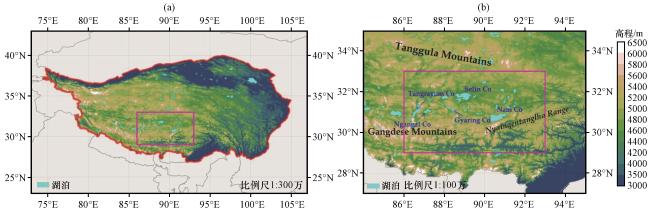
根据前人的研究(Wu et al, 2019Zhang et al, 2021), 本文定义青藏高原中部地区范围为86°E - 93°E, 29°N -33°N(如图1紫色方框所示区域), 其地处西藏自治区中南部的高原内流区, 受到南亚季风、 东亚季风、 西风带等多类环流系统的控制。该区域地形地貌十分复杂, 南部是雅鲁藏布江谷地, 冈底斯山和念青唐古拉山横贯东西, 中部是地势较低的河湖水系地带, 北部则是唐古拉山脉。高原中部湖泊密集, 面积超过100 km2的湖泊多达19个, 其中色林错和纳木错湖分别位居青藏高原湖泊面积排名第2位和第3位。
图1 青藏高原(a)和高原中部地区(b)的地形高度(单位: m)

紫色方框为高原中部地区的范围(下同)

Fig.1 The topographic height of the Qinghai-Xizang Plateau (a) and central Qinghai-Xizang Plateau (b).Unit: m.The purple box is the range of the central Qinghai-Xizang Plateau (the same as after)

3 数据资料、 数值模式和方法

3.1 数据资料

(1) 降水数据
本文使用的降水数据包括气象站点观测数据和格点数据。气象站点观测数据来源于青藏高原纳木错流域的多圈层综合观测研究站的气象要素日值数据集(站点位置为30°45′N, 90°56′E), 包含2005年10月至2016年12月的气温、 气压、 相对湿度、 风速、 降水和辐射6个变量(Wang and Wu, 2018, http: //data.tpdc.ac.cn)。
格点数据源自青藏高原研究所开发的中国区域地面要素驱动数据集(CMFD), 其具有逐3 h和0.1°的时空分辨率, 融合了包括卫星遥感、 再分析以及中国气象局站点观测资料等多源数据信息。CMFD提供了1979 -2018年中国地区的7类气象要素, 即地表气压、 2 m气温、 2 m比湿、 10 m风速、 地表向下长波和短波辐射, 以及降水率(He et al, 2020; Yang and He, 2019, http: //data.tpdc.ac.cn)。对比评估多类格点降水资料发现CMFD在青藏高原地区具有更高的精度(栾澜和翟盘茂, 2022; 温婷婷等, 2022), 目前CMFD已广泛应用于青藏高原水循环、 陆面过程等多项研究中(Wu et al, 2022Zhu et al, 2020)。本文使用CMFD降水数据对高原中部秋季区域性极端事件降水的特征进行分析并评估WRF模式对降水的模拟性能。
(2) 再分析数据
欧洲中期天气预报中心(ECMWF)第五代大气再分析数据ERA5, 该数据是其前身ERA-Interim的最新一代产品, 时间分辨率为1 h(https: //www.ecmwf.int/en/forecasts/datasets/search/ERA5), 提供了包括37层气压、 温度、 湿度和风速等气象要素在内的全球大气和陆地表面数据信息, 大气数据水平分辨率为0.25°×0.25°, 地表数据水平分辨率为0.1°×0.1°, 覆盖时间从1950年至今(Hersbach et al, 2020)。本文采用ERA5对青藏高原中部秋季区域性极端降水事件发生时的大气环流进行聚类分析, 厘清区域性极端降水事件的主控天气型, 并利用该资料驱动湖-气耦合模式开展不同主控天气型下多个例敏感性试验。
(3) 陆面温度数据
搭载中分辨率成像光谱仪(MODIS)的Terra卫星平台在10:30(地方时, 下同)和22:30过境, 生成每天两次的1 km分辨率地表温度和辐射率数据产品MOD11A1(有关该数据的详细信息可以在https: //modis.gsfc.nasa.gov/data/ dataprod/mod11.php获取)。本研究采用MODIS卫星观测的陆表温度数据进行WRF模式的湖表温度校正, 以减小因湖泊温度失真而对试验结果造成的偏差。
文中涉及的地图是基于国家测绘地理信息局标准地图服务网站下载的审图号为GS(2016)1600号的中国地图制作, 底图无修改。

3.2 湖-气耦合模式

本文采用耦合了一维湖泊模型的WRF模式3.9.1版本(以下简称WRF-Lake), 它是由美国国家大气研究中心开发用于大气研究业务预报应用的中尺度模式(Powers et al, 2017)。WRF-Lake中的湖泊方案是一个一维质量和能量守恒模型, 用来描述湖泊辐射传输、 水体垂直混合、 湖表热通量交换、 湖泊冻融等过程(Subin et al, 2012)。其最先被应用于陆面模式CLM, 之后被Gu et al(2015)耦合进WRF模式, 具有多达5层的积雪、 25层湖水(冰)以及10层湖底土壤。该湖泊模型可以较好地重现湖面温度的变化趋势和纳木错湖的热力层结现象(Huang et al, 2019)。与未耦合湖泊模型的WRF模式输出结果相比, WRF-Lake湖-气耦合模式可以显著提高湖泊及周边地区气温和降水等气象要素的模拟效果(Ma et al, 2019)。本文采用与Wu et al(2020)相同的湖泊模型关键参数设置, 并在WRFv3.9.1中对湖泊分量模型进行了很好的校准。

3.3 方法

3.3.1 极端降水和区域性极端降水事件的定义

本文采用95百分位法(Xu et al, 2023Zeng et al, 2023)定义了单点极端降水和区域性极端降水。基于CMFD资料1979 -2018年间40个秋季(9 - 11月)的逐3 h降水数据, 首先计算青藏高原中部地区(86°E -93°E, 29°N -33°N)每个站点强度≥0.1 mm·(3h)-1的所有历史降雨记录按升序排列的第95百分位阈值, 当在给定时间某一格点的降水记录超过该格点的第95百分位阈值时, 则判定该格点在这一时间发生了一次单点极端降水。
在单点极端降水的基础上, 进一步定义了区域性极端降水, 首先统计1979 -2018年间40个秋季青藏高原中部地区每3 h同时出现极端降水的格点数量, 继而将同时出现极端降水的格点数(≥1)按升序排列, 进而取第95百分位数的格点数作为判定该地区是否发生区域性极端降水事件的阈值, 当同时发生极端降水的格点数超过这一阈值时则判定发生了一次区域性极端降水事件。根据上述方法, 统计出1979 -2018年间40个秋季青藏高原中部地区共发生了1358次区域性极端降水事件。
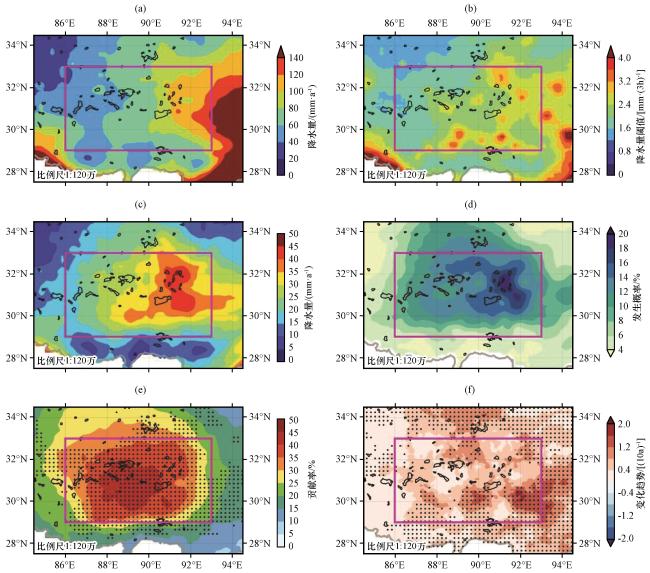
图2给出了1979 -2018年高原中部秋季降水和极端降水的基本特征。从秋季降水量的气候平均态[图2(a)]来看, 高原中部降水量存在较大的空间差异, 整体表现为自东向西逐步减少, 秋季降水量超过100 mm的地区主要分布在纳木错湖以东, 而色林错湖以西的大部分地区秋季降水量都不足60 mm。值得注意的是, 在纳木错湖东部有一孤立的降水高值中心(120 mm)。图2(b)给出了秋季极端降水95百分位阈值的空间分布, CMFD开发过程需要融合部分站点降水数据(He et al, 2020), 导致区域内出现零星的阈值中心, 不过这对于再现降水整体分布影响不大。弓形降水阈值大值区自研究区东北部延伸至南部雅鲁藏布江谷地, 极端降水阈值超过2.4 mm·(3h)-1, 部分地区达到3.2 mm·(3h)-1以上。
图2 1979 -2018年高原中部多年平均秋季降水量(a, 单位: mm·a-1), 极端降水95百分位阈值[b, 单位: mm·(3h)-1], 区域性极端事件引发的多年平均秋季降水量(c, 单位: mm·a-1), 区域性极端事件下极端降水的发生概率(d, 单位: %), 区域性极端事件降水量对秋季总降水的贡献率(e, 单位: %), 区域性极端事件引发的极端降水频次变化趋势[f, 单位: (10a)-1]的空间分布

图(e)和(f)中的打点区域表示信度通过0.05的显著性检验

Fig.2 Spatial distribution of autumn precipitation averaged (a, unit: mm·a-1), 95 percentile threshold of extreme precipitation in autumn [b, unit: mm·(3h)-1], autumn precipitation induced by regional extreme rainfall events averaged (c, unit: mm·a-1), occurrence probability of extreme precipitation under regional extreme rainfall events (d, unit: %), contribution rate of regional extreme event precipitation to the total precipitation in autumn (e, unit: %), and long term trends of the occurrences of extreme precipitation under regional extreme rainfall events [f, unit: (10a)-1] during 1979 -2018.The dots in (e) and (f) indicate the statistical significance of 0.05 level

图2(c)~(f)主要展示了与区域性极端降水事件相关的降水特征。图2(c)和(d)给出了区域性极端降水事件所引发降水量的气候平均态以及区域性极端降水事件发生时每个格点发生极端降水的概率, 每个格点发生极端降水的概率定义为区域性极端降水事件发生时该格点发生极端降水的总次数占区域性极端降水事件总次数的比例(Tang et al, 2021)。可以看出, 发生区域性极端降水时研究区东部尤其是纳木错流域及以北小湖泊群附近为极端降水的高发地带, 极端降水发生概率超过14%, 小湖泊群附近最高可达18%以上, 沿此区域向外极端降水发生概率逐步降低。区域性极端事件引发的降水量分布也呈现相似的特征, 纳木错湖以东以北降水量超过40 mm, 在区域南部冈底斯山脉和念青唐古拉山脉上也出现了35 mm以上的降水量大值区。
图2(e)给出了区域性极端事件引发的降水量占总降水量的比例, 区域性极端事件虽然发生频次较少, 却贡献了高原中部40%左右的秋季总降水量。贡献率的空间分布差异较小, 在纳木错湖以西、 色林错湖以南部分地区的贡献率超过45%, 并由中心向外围依次递减。
图2(f)给出了区域性极端事件引发的极端降水发生频次的长期变化趋势。整体上来看, 区域性极端事件引发的极端降水发生频次在整个高原中部地区均呈现出上升趋势, 在东北部小湖泊群区、 东南部地区为增速大值区且变化趋势显著, 这也是区域性极端降水发生时极端降水发生概率较高的地区[图2(d)]。

3.3.2 环流分型算法

在上述检测出的区域性极端降水事件基础上, 进一步采用python中scikit-learn机器学习库内置的谱聚类算法(spectral clustering)对区域性极端降水发生时的大气环流进行分型, 该方法是一类无监督的机器学习聚类算法, 与k-means等传统聚类算法相比, 谱聚类算法具有对数据分布的适应性强、 计算量小等特点, 且能适应任意形状的样本空间, 聚类效果更为优越(Von, 2007)。近年来, 谱聚类算法已逐步应用于中国不同气候区的极端降水天气分型研究(Tang et al, 2021Xu et al, 2023Zeng et al, 2023)。
参考前人的研究(Xu et al, 2023Zeng et al, 2023), 本文利用谱聚类算法对识别出的1979 - 2018年间40个秋季1358次区域性极端事件发生时青藏高原中部地区(86°E -93°E, 29°N -33°N)上空ERA5的500 hPa和200 hPa水平风场进行分析, 首先分别对各层次每个格点的uv分量的1358个时间序列进行归一化处理, 继而将每个变量归一化结果的三个空间维度(经向格点数、 纬向格点数和垂直层数)展平为一维数组。然后将每一次区域性极端降水事件发生时的v分量展平的一维数组接在u分量展平的一维数组之后, 形成一个二维数组(经向格点数×纬向格点数×2垂直层×2变量, 1358次区域性极端降水)作为谱聚类分析的输入数据, 在设置聚类组数时, 通过Calinski-Harabas评分比较不同聚类组数的聚类效果, 经多轮调试确定了最优聚类组数为3组, 最后得到青藏高原中部地区秋季区域性极端降水事件的三类主控天气型。

4 结果分析

4.1 青藏高原中部地区秋季区域性极端降水事件的主控天气型

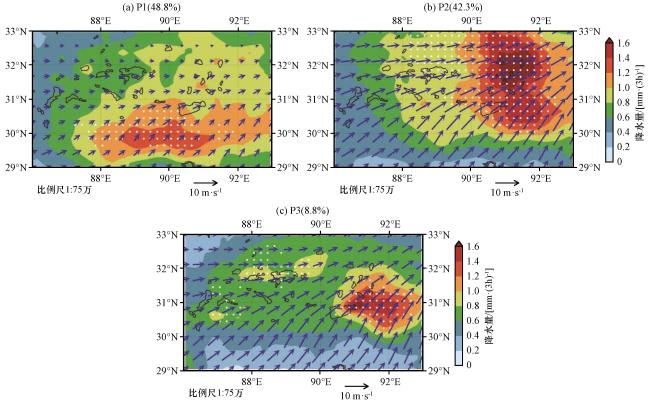
图3给出了青藏高原中部地区秋季区域性极端降水事件的三类主控天气型: 弱辐合气流引发的南部山区降水(P1型)、 季风西南气流控制下的东北部下游降水(P2型)以及西风槽前西南气流影响下的湖泊附近降水(P3型), 它们分别贡献了秋季区域性极端降水事件发生总数的48.8%、 42.3%和8.8%。从图3(a)发现, P1天气型下区域内的平均风速较弱, 南部的西南风和中部的偏西风产生一个较弱的汇合, 产生的极端降水量(区域性极端降水发生时的降水总量/区域性极端降水发生总次数)较大区域主要集中在区域南部的冈底斯山和念青唐古拉山脉, 极端降水发生概率大值区与降水量大值区相对应。该型下区域性极端降水事件的发生可能与区域南部复杂山地地形有关。从图3(b)可以发现, 伴随强西风和强西南风在区域东北部的汇聚, P2型下极端降水量大值区占据了区域东部念青唐古拉山以北的大部分范围, 在三类天气型中强度最大且范围最广, 纳木错北部小湖泊群上的极端降水量达到1.6 mm·(3h)-1, 在纳木错-色林错湖沿线下游出现极端降水发生概率大值区。从图3(c)发现, P3型虽然具备同P2型[图3(b)]类似的区域尺度环流特征, 但极端降水量的分布却存在较大差异, 极端降水易发地集中于纳木错湖东部及临近地区, 湖泊东北角的极端降水量超过1.6 mm·(3h)-1。此外, 在色林错、 当惹雍错、 昂孜错等湖附近也检测到了较高的极端降水发生概率, 从落区分布推测P3型下区域性极端降水可能与湖泊效应联系密切, 需要后续数值模拟试验的进一步验证。
图3 各主控天气型下的降水量[填色, 单位: mm·(3h)-1]和500 hPa 风场(矢量, 单位: m·s-1)空间分布

白色打点区域表示在不同天气型下极端降水发生概率超过15%, 各子图图题中括号内的数字为各天气型发生频次占总区域性极端事件发生频次的比例, 黑线表示湖泊的边界

Fig.3 Spatial distribution of precipitation amount [colored, unit: mm·(3h)-1] and 500 hPa wind field (vector, unit m·s-1) under different dominant synoptic patterns.The white dots indicate the regions where the probability of extreme precipitation occurrence exceeds 15% under each synoptic pattern.The number in parentheses in each subgraph is the proportion of the occurrences of each weather type to the total occurrences of regional extreme precipitation events.Black lines identify the boundary of lakes

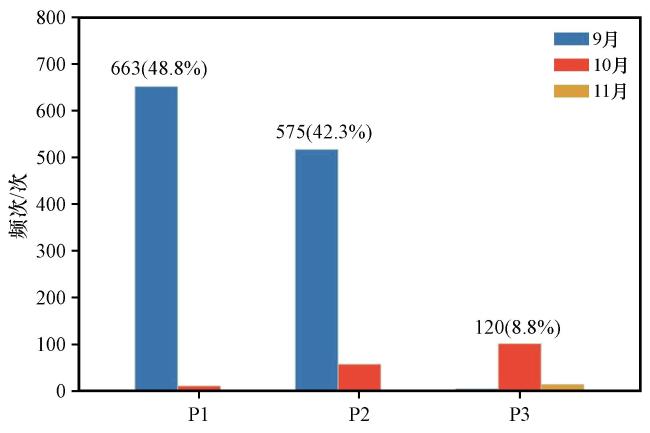
图4给出了区域性极端降水事件各主控天气型在秋季各月的发生情况, 集中发生在9月的P1和P2型对秋季区域性极端降水事件总发生频次的贡献率分别为48.8%和42.3%, 而P3型则主要发生在10月, 其对秋季区域性极端降水事件总发生频次的贡献率为8.8%。P1和P2型与秋季气候态降水偏多的季风后期相关联, P3型与脱离南亚季风控制的其他系统相关联(You et al, 2015)。
图4 1979 -2018年青藏高原中部秋季区域性极端降水事件的主控天气型在各月的出现频次

括号中的数值表示各主控天气型发生频次占总区域性极端降水事件发生频次的比例

Fig.4 The occurrence number of the regional extreme precipitation events in the central Qinghai-Xizang Plateau during the Autumns of 1979 to 2018.The numbers in parentheses indicate the proportion of the occurrence of each synoptic pattern to the total occurrence of regional extreme precipitation events

4.2 各主控天气型下大尺度环流场及其异常的高低层配置

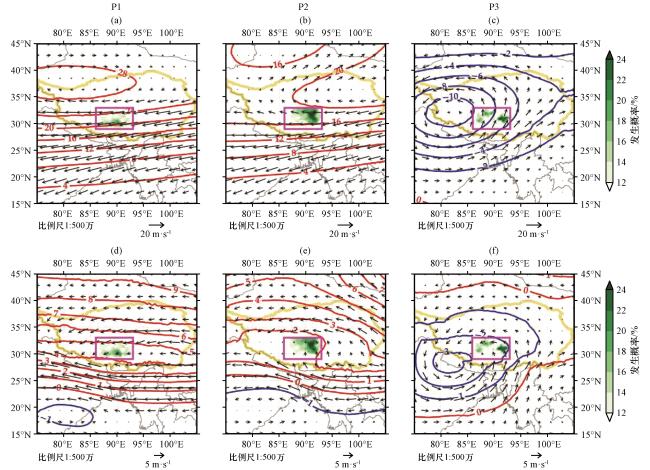
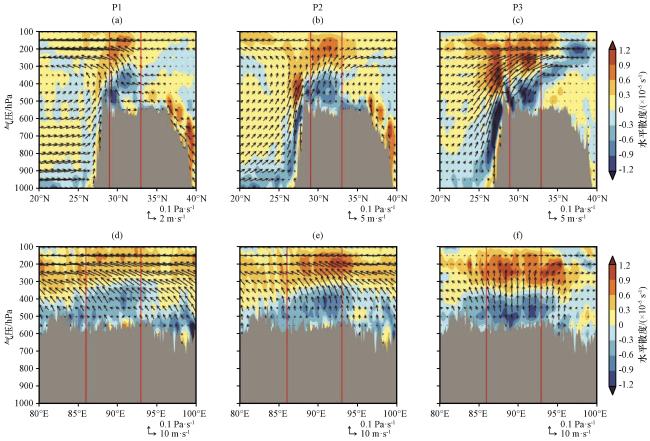
为了分析和解释各主控天气型导致区域性极端降水的大尺度动力机制, 本文在图5~7中分别展示了各个天气型下大尺度环流场的高低层配置、 不同层次环流场相对于秋季气候平均态的异常以及沿经向-高度和纬向-高度的垂向环流场相对于秋季气候平均态的异常。水平空间范围涵盖了青藏高原主体和孟加拉湾海域, 垂直范围涵盖了1000~100 hPa的大气。
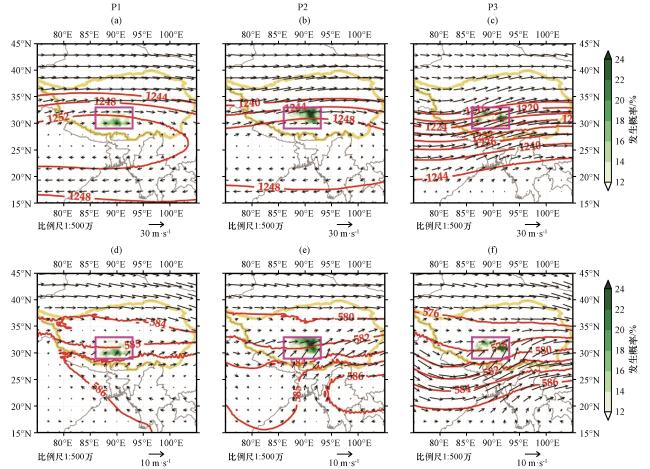
图5 各主控天气型下的200 hPa和500 hPa大尺度环流配置, 位势高度(等值线, 单位: dagpm)、 风场(矢量, 单位: m·s-1)和极端降水发生概率(填色, 单位: %)

(a) P1 200 hPa, (b) P2 200 hPa, (c) P3 200 hPa, (d) P1 500 hPa, (e) P2 500 hPa, (f) P3 500 hPa, 紫色方框为高原中部范围, 黄色粗实线为青藏高原边界

Fig.5 Large-scale circulation configuration of 200 hPa and 500 hPa under each synoptic pattern of regional extreme precipitation, geopotential height (contour line, unit: dagpm), wind field (vector, unit: m·s-1) and extreme precipitation occurrence probability (shadings, unit: %).(a) P1 200 hPa, (b) P2 200 hPa, (c) P3 200 hPa, (d) P1 500 hPa, (e) P2 500 hPa, (f) P3 500 hPa.Purple box indicates the range of the central Qinghai-Xizang Plateau, and yellow thick solid line shows the boundary of the Qinghai-Xizang Plateau

图6 各主控天气型下200 hPa和500 hPa大尺度环流场相对于1979 -2018年秋季气候态的差异

位势高度差值(等值线,单位:dagpm)、风场差值(矢量)和极端降水发生概率差异(填色), (a) P1 200 hPa, (b) P2 200 hPa, (c) P3 200 hPa, (d) P1 500 hPa, (e) P2 500 hPa, (f) P3 500 hPa, 紫色方框为高原中部范围,黄色粗实线为青藏高原边界

Fig.6 The differences between the composite mean large-scale circulation of 200 hPa and 500 hPa under each synoptic pattern responsible for the regional extreme rainfall events in autumn and the climatic mean of 1979 -2018.The differences of geopotential height (contour line, unit: dagpm), wind field (vector,unit:m·s-1) and extreme precipitation occurrence probability (shadings,unit: %).(a) P1 200 hPa, (b) P2 200 hPa, (c) P3 200 hPa, (d) P1 500 hPa, (e) P2 500 hPa, (f) P3 500 hPa.Purple box indicates the range of the central Qinghai-Xizang Plateau, and yellow thick solid line shows the boundary of the Qinghai-Xizang Plateau

图7 各主控天气型下沿86°E -93°E平均的纬向(a~c)及29°N -33°N平均的经向(d~f)环流(矢量)和水平散度(填色, 单位: ×10-5 s-1)相对于1979 -2018年秋季气候态差异的垂直剖面

(a, d) P1, (b, e) P2, (c, f) P3, 灰色填色表示青藏高原地形, 各图中两条红色竖线之间的区域表示高原中部范围

Fig.7 The vertical profile of the differences between the circulation (vectors) and horizontal divergence (shaded, unit: ×10-5 s-1) of the zonally averaged (a~c) along 86°E -93°E and meridionally averaged (d~f) along 29°N -33°N and the climatic mean during autumn of 1979 -2018.(a, d ) P1, (b, e) P2, (c, f) P3.The gray color fillings indicate the topography of the Qinghai-Xizang Plateau, and areas between the two red vertical lines in each sub-figure indicate the range of the central Qinghai-Xizang Plateau

P1天气型下200 hPa南亚高压中心位置位于研究区西南侧, 覆盖包含降水落区在内的高原南部和印度缅甸北部的大部分地区[图5(a)], 500 hPa副热带高压西伸扩张至80°E的尼泊尔边境[图5(d)], 阻塞了孟加拉湾海域向青藏高原的南风输送, 削弱了副热带高压北侧向高原内陆的西南气流, 同时区域北部气压梯度较小, 产生的弱西北气流与西南气流势力相当, 导致极端降水落区偏向区域南部山区。与秋季气候平均态相比, P1天气型下200 hPa风速显著减弱, 位势高度异常自南向北呈一致增加态势, 且增加幅度逐步加大, 在青藏高原东北部出现位势高度正异常大值区, 激发出异常反气旋环流[图6(a)]; 500 hPa同样存在向极的异常位势高度梯度, 并在印度上空出现一弱的气旋性异常[图6(d)]。高低层大尺度环流异常共同导致了高原中部区域范围内整层的西南风异常, 在原始场上表现为区域南部弱的西北西南气流辐合, 与200 hPa高层风辐散带来的抽吸作用协同促进垂直抬升运动, 造成极端降水发生概率大值区分布位置偏南。
从沿纬向-高度的垂直剖面可以确定P1天气型下降水发生的动力来源, 来自青藏高原以南的大气低层平直偏南气流上升越过喜马拉雅山脉, 与来自高原北坡的表面爬升流在区域南部冈底斯山和念青唐古拉山一带汇聚抬升, 较弱的南支气流越山后动力不足, 与北支气流汇聚抬升后于区域南边界对流层高层发生南向偏转。南北两支气流的交汇与流出分别在区域南部500 hPa和200 hPa附近产生了辐合和辐散中心[图7(a)], 这种与辐合辐散相关的强上升运动对P1天气型极端降水事件的形成具有重要意义。沿经向-高度的垂直剖面上表现为200 hPa以下整层一致的东风异常, 区域内350 hPa以下整层辐合、 350 hPa以上整层辐散, 垂直运动、 高低层辐合辐散中心相对于其他两类天气型强度均偏弱[图7(d)], 这可能与降水强度南北分布不均有关。
P2天气型下200 hPa虽然没有明显的南亚高压, 但仍有1248 dagpm等位势线的闭合高压控制孟加拉湾北部、 印度北部、 缅甸及中国西南部分地区, 区域内对流层高层为较强的偏西风[图5(b)]。但相比秋季气候平均态而言, 区域内对流层高层仍表现为偏东风异常, 青藏高原东北部向西延伸一条异常位势高度脊线, 研究区北部东风在脊点处向东北偏转[图6(b)]。在500 hPa上, 副热带高压相对P1型东撤且缩小, 控制我国西南一带; 南亚大陆上空的585 dagpm等高线向赤道弯曲, 形成合成场上的“深槽”, 异常场上表现为青藏高原南坡到孟加拉湾北岸上空较为平直的西风减速带[图6(e)], 印度大陆和孟加拉湾上空的环流异常有助于印度夏季风和东亚夏季风输送大量低纬水汽至高原中东部。通过对该型下各降水时刻的筛查, 发现移至印度次大陆的孟加拉湾气旋和南支槽是该地低值系统的重要组成部分, 系统东侧较强的偏南气流直接导致高原中部西南风偏强, 伴随区域东部500 hPa等位势线的异常弯曲和风场切变, 造成区域东北部成为极端降水发生概率较高的地区[图6(e)]。
P3天气型下, 200 hPa高空受西风急流控制, 无明显的大尺度闭合等位势高度线, 南亚高压位于印度洋海面[图5(c)]。500 hPa高原低层风场由来自印度西风槽前的西南气流和来自中亚的平直西风气流组成, 印度槽前偏西风在经高原南坡地形摩擦作用后向东北偏转并影响高原中部地区。低层大气存在一深入区域西部的浅槽(578 dagpm等位势线), 导致位于槽线附近南北气流汇合[图5(f)]。环流异常合成场显示[图6(c), (f)], 从低层到高层均有位置一致的气旋性环流异常, 负异常的范围随着高度的增加而扩大, 形成了覆盖南亚大陆北部和青藏高原整个区域的深厚系统。高原中部位于高层负异常中心东南侧、 低层负异常中心东北侧, 区域内高层大气呈现强烈的南风异常, 低层则出现类似P2天气型的弱气旋式切变。
得益于大尺度异常低值系统对区域南侧整层西南风的加速, P3型下高原南坡出现三类天气型中最为显著的垂直上升运动, 气流在越过喜马拉雅山后继续向北入侵并抬升, 在青藏高原南坡附近、 雅鲁藏布江谷地和高原中部腹地低空形成三个辐合中心, 并在高原南坡和中部腹地高空形成两个明显的辐散中心, 最终在跨过区域北边界后汇入高层大气偏南风中[图7(c)]。低层500 hPa和高层250 hPa附近分别存在两个辐合辐散中心, 空间上与纳木错和色林错湖附近的极端降水发生概率大值区位置相吻合, 散度中心所在高度相较于其他两型略低约50 hPa[图7(f)], 且高低层辐合辐散中心的强度为三类天气型中最大。

4.3 青藏高原中部秋季区域性极端降水事件形成中的湖泊效应

4.3.1 模式配置和试验方案设计
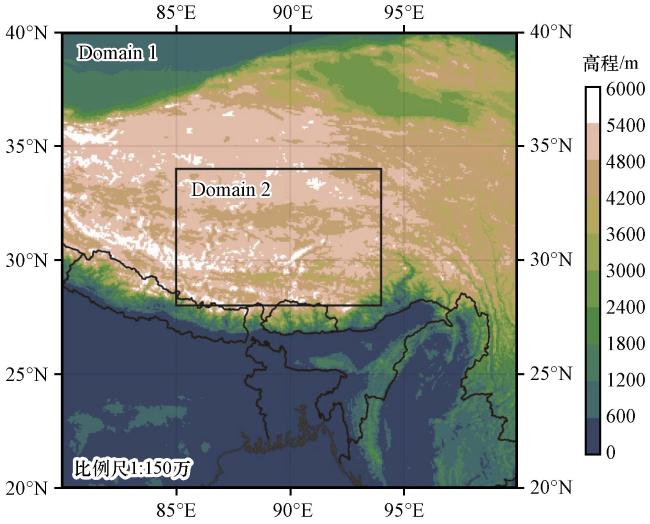
WRF-Lake模式采用双层双向嵌套网格(图8), 外层网格格点数146×146, 分辨率15 km; 内层网格格点数199×133, 分辨率5 km, 区域中心点为(90°E, 30°N)。垂直层数33层, 模式顶为50 hPa。WRF模式格点上的土地覆盖类型来源于MODIS 10弧秒分辨率的土地利用数据集(Friedl et al, 2010), 每个格点的湖泊类型占比(子网格湖泊面积/网格面积)和湖深信息来自1 km分辨率的GLDBv2湖泊位置和深度数据(Kourzeneva, 2010), 湖泊深度设定为50 m。为了消除湖泊温度初始化对模式结果的影响, 采用MODIS的陆表温度数据对初始湖表温度进行校正(Zhang et al, 2016)。湖泊模型的主要参数设置与Wu et al(2020)研究中一致, 其他物理过程参数化方案选择如表1所示。
图8 WRF-Lake模式嵌套区域设置及地形高度(单位: m)

Fig.8 Nesting area and topographic height of WRF-Lake model.Unit: m

表1 WRF-Lake模式的参数化方案设置

Table 1 Model configurations of parameterization schemes in WRF-Lake model

物理过程 参数化方案
微物理 WRF single-moment 6-class scheme
积云参数化 Grell-Devenyi ensemble scheme
长波辐射 RRTM scheme
短波辐射 Dudhia scheme
边界层 Noah scheme
陆面 YSU scheme
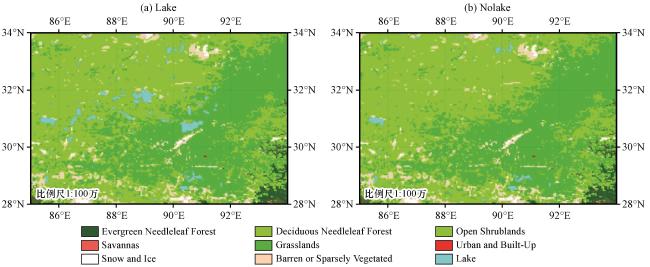
在保持模式区域网格和物理过程参数化方案设置一致的基础上, 对青藏高原中部湖泊下垫面进行修改, 设计有湖(Lake)和无湖(Nolake)试验, Lake试验采用实际湖泊分布, 而Nolake试验将内层区域(86°E -93°E, 29°N -33°N)的湖泊水体替换为临近地区的典型陆面覆盖类型(主要是草地和灌木), 图9给出了Lake和Nolake试验中WRF-Lake模式内层区域的陆面覆盖类型, 两试验除了湖泊覆盖类型有差异外, 其他模式设置完全相同, 因而两试验结果的差异可以认为是湖泊下垫面的影响所致。
图9 Lake试验(a)和Nolake试验(b)中WRF-Lake模式内层区域的陆面覆盖类型

Fig.9 Land cover types of the inner area of WRF-Lake model in the Lake (a) and Nolake experiments (b)

为揭示不同主控天气型下湖泊效应对区域性极端降水的影响, 在每类主控天气型下分别选择3个个例, P1型下: 1991年9月1日21:00至2日21:00, 2003年9月10日18:00至11日18:00, 2006年9月11日21:00至12日21:00; P2型下:1989年9月25日12:00至26日12:00, 2000年9月8日21:00至9日21:00, 2006年9月23日00:00至24日00:00; P3型下: 2004年10月25日18:00至26日18:00; 2005年10月30日12:00至31日12:00; 2006年10月23日21:00至24日21:00。继而利用WRF-Lake湖-气耦合模式对各个例分别开展Lake和Nolake模拟, WRF-Lake模式的初始条件和侧边界条件均由ERA5再分析数据提供, 各试验分别从各个例开始前的12 h开始积分, 积分时长均为2天, 前12 h作为模式spin-up时间, Lake与Nolake试验结果在各区域性极端降水事件发生时间段内的差异即为湖泊效应对区域性极端降水的影响。

4.3.2 模式结果验证

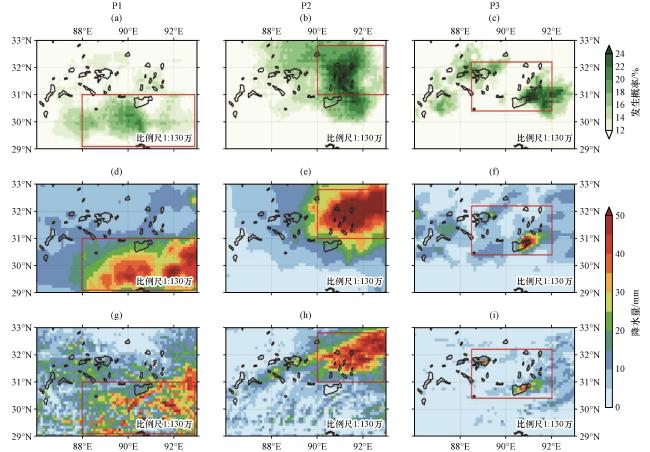
通过将各主控天气型多个例模拟结果进行集合可以一定程度上降低模拟结果的不确定性。图10分别展示了各主控天气型下极端降水发生概率的空间分布及所选择的3个区域性极端降水事件发生时段内CMFD观测和Lake试验模拟的总累积降水量。
图10 各主控天气型下极端降水发生概率(a~c, 单位: %), CMFD(d~f)观测和Lake试验模拟(g~i)的多个例区域性极端降水事件的累积降水量(单位: mm)

红色方框表示模拟与观测对应的降水集中区域

Fig.10 The occurrence probability of extreme precipitation (a~c,unit: %), the cumulative precipitation amount of multi-cases of regional extreme precipitation events from CMFD observation (d~f) and simulations Lake experiment (g~i).The red box indicates the precipitation concentration area corresponding to the simulation and observation

本文选取Lake试验模拟结果的多个例集合[图10(g)~(i)]能够较好地反映降水落区与极端降水频发区域位置[图10(a)~(c)]的对应关系, 说明试验所选个例具有一定代表性, 可以作为各主控天气型下区域性极端降水事件的典型案例。WRF-Lake模式可以较为准确地再现这三类天气型下累积降水量的空间分布和强度特征[图10(d)~(f)], 但总体上存在对降水量的低估现象。其余的模拟误差主要表现在: P1型下模拟的南部山区降水落区不够集中[图10(d), (g)], P2型下区域西部湖泊群上空出现高估的带状降水[图10(e), (h)], 以及P3型下色林错湖周围降水被过高估计[图10(f), (i)]。考虑到CMFD融合资料本身对实际降水率的刻画能力(He et al, 2020), 可以认为模拟结果与CMFD观测相当。综上所述, WRF-Lake模式能够合理再现不同天气型下典型个例集合的降水强度和空间分布特征, 模式运行参数和模拟结果可以用于后续Nolake试验以及湖效应影响的对比研究。

4.3.3 各主控天气型下湖泊效应对区域性极端降水的影响及差异

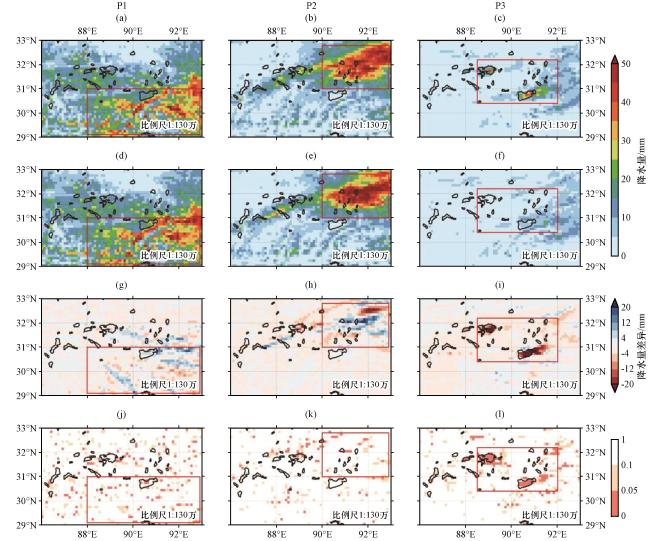
湖泊效应大小可以通过替换湖泊下垫面前后特定物理量的变化程度来进行衡量, 为此, 将4.3.1中设计的Lake和Nolake试验模拟得到的累积降水量差值及其变化率作为各天气型下湖泊效应的量化因子。图11给出了各天气型下Lake和Nolake试验模拟的多个例区域性极端降水发生时的累积降水量及差异。对比Lake[图11(a)~(c)]和Nolake[图11(e)~(f)]试验的模拟结果可以发现, 湖泊替换为周围下垫面类型并未对P1和P2型下的强降水区域产生本质影响, 而在P3型下则基本抑制了区域性极端降水事件的形成。
图11 各主控天气型下Lake(a~c)和Nolake试验(d~f)模拟的多个例累积降水量及其差异(Nolake-Lake)(g~i)的空间分布, 以及差异显著性超过90%的区域(j~l)

Fig.11 Spatial distribution of multi-cases cumulative precipitation simulated by the Lake (a~c) and Nolake experiments (d~f) under each synoptic pattern and their differences between Nolake and Lake (g~i), and the areas with the difference significance exceeding 90% (j~l)

进一步分析替换湖泊下垫面前后降水量的差异[图11(g)~(i)], 发现降水量变化大值区主要出现在湖泊的下风向地区, 说明在不同主控天气型下, 湖泊均具备影响下游气象要素的基本特点, 且在秋季较强的背景环流场中湖效应传播范围可能更广(Su et al, 2020Dai et al, 2020)。在P3型下, 各个湖泊尤其是纳木错和色林错湖及周边地区均出现了降水量的大幅减少[图11(i)红色方框]; 而在P1型和P2型下, 降水量变化大值区主要集中在试验模拟的强降水落区内而非湖泊临近地区, 且湖泊效应并非呈一致性的降水增强或者抑制, 在P1型下湖泊效应降水表现为自西向东的微弱增加、减少和增加[图11(g)红色方框], 在P2型下湖泊效应降水表现为自纳木错湖向北的减少、 增加和减少[图11(h)红色方框]。结合垂直运动和外界水汽输送条件判断(图略), P1和P2型下区域性极端降水事件的发生对湖泊群局地水分供应的依赖程度远不如P3型。
各主控天气型下Lake和Nolake试验模拟的降水均存在一定差异, 为了确定这类差异是否显著, 对两试验在各格点的降水量差值进行单样本t检验, 并给出了各主控天气型下湖泊效应影响的统计显著性(p值)的空间分布[图11(j)~(l)]。P3型下存在成片的湖泊效应显著区域, 主要分布在色林错和纳木错湖及下风向临近地区[图11(l)]; P1和P2型下湖效应显著区多以散点形式分布在整个高原中部 ,降水量变化大值区并未与变化显著区相匹配, 但可以发现P1型下色林错和纳木错湖下游以及P2型下色林错湖下游有相对集中但范围很小的湖效应显著带[图11(j), (k)]。
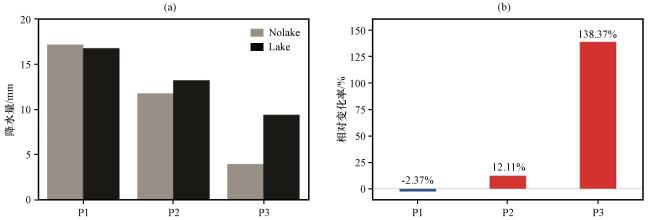
对Nolake试验模拟的累积降水量相对于Lake试验结果变化显著的格点进行统计, 并给出Lake和Nolake试验模拟得到这些存在显著变化的格点的累积降水量平均结果[图12(a)]以及Lake试验模拟结果相对于Nolake试验模拟结果的相对变化率[图12(b)]。总的来说, 在三类主控天气型下, 两试验模拟的降水量依次减少[图12(a)]。在P1、 P2和P3型下, Lake试验模拟的降水量相对于Nolake试验模拟结果的变化率分别为-2.37%、 12.11%和138.37%[图12(b)], 说明在P3型下, 湖泊的存在对区域性极端降水量具有巨大的增强效应, 因而, 在三类天气型中, P3型为湖效应易发天气型, 在这类天气型下, 湖泊更易导致区域性极端降水事件的发生。
图12 各主控天气型下Lake和Nolake试验模拟的多个例累积降水量在变化显著区的区域平均(a)以及Lake试验模拟的累积降水量相对于Nolake试验的相对变化率(b)

Fig.12 The cumulative precipitation of multi-cases simulated by the Lake and Nolake experiments under each typical synoptic pattern regionally averaged over the regions where the differences between the Lake and Nolake experiments are significant (a), and the relative change rate of cumulative precipitation simulated by the Lake experiment compared to the Nolake experiment (b)

前人研究(Shi and Xue, 2019Umek and Gohm, 2016)发现, 湖泊表面与上覆边界层大气之间的温度差是湖效应降水(雪)形成的关键因素。在地表潜热和感热通量的计算中, 湖表和2 m气温的差值是直接影响通量数值大小的重要参数, 杜娟等(2020)对纳木错湖的通量观测研究发现, 9月湖泊热储由正转负, 开始向大气持续输送热通量, 湖-气温差于湖泊结冰期来临之前的秋末达到峰值, 为湖效应降雪提供了充足的热力学条件。
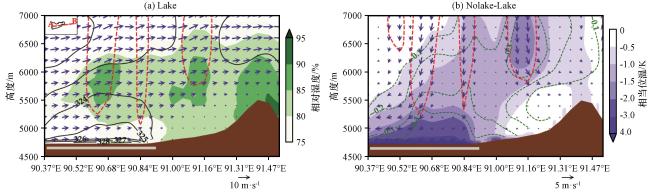
为进一步理解P3型下湖泊影响区域性极端降水变化的物理过程, 图13给出了P3天气型下Lake试验模拟的相当位温、 比湿和经向环流及Nolake与Lake试验间的差异。从图13(a)发现, 秋季湖泊表面相对上覆大气和周围陆地的温湿度较高, 通过调控湖-气温差进而影响地表感热和潜热释放(Shi and Xue, 2019)。纳木错湖的存在会大幅增加湖-气温差、 近地面湿度和风速, 通过感热和潜热过程向大气输送物质和能量, 形成强烈的低空不稳定层, 为极端降水的发生提供水热条件。相对于Lake试验, Nolake试验模拟的地表以上1500 m内的大气湿度明显降低, 在纳木错湖东部湖陆交界上空比湿减少最为明显, 达0.4 g·kg-1, 下游地区上空比湿减少0.1~0.2 g·kg-1。同时发现, 与Lake试验结果相比, Nolake试验模拟的湖区上空大气的相当位温减弱, 且减弱程度随高度递减, 继而使得低层大气稳定度增强并引起上升运动减弱, 进而导致在湖泊及临近地区大气的异常干下沉, 因此Nolake试验不能模拟出P3型下纳木错湖东部及临近地区的降水中心[图11(c), (i)]。通过上述分析发现, 在P3天气型下, 湖泊通过增温和增湿湖区上空大气并增强低层大气不稳定性和水汽辐合进而导致区域性极端降水的产生, 在该天气型下的湖泊效应在三类主控天气型中最为明显。
图13 P3天气型下Lake试验模拟的相对湿度(填色,单位:%)、相当位温(黑色等值线,单位:K)、垂直速度(红色等值线,单位:m·s-1)和经向环流(矢量,垂直分量被放大10倍)的高度-经度剖面 (a), Nolake与Lake试验模拟的相当位温(填色,单位:K)、比湿(绿色等值线,单位:g·kg-1)、经向环流(矢量,垂直分量被放大10倍)的差异和垂直速度差异极值区(≤-0.25 m·s-1,红色等值线,单位: m·s-1)(b)

剖面位置沿图左上角小图A-B红色虚线,灰色粗实线代表纳木错湖位置,棕色为地形

Fig.13 The height-longitude profile of the modeled relative humidity (shadings, unit: %), equivalent potential temperature (black contour, unit: K), vertical velocity (red contour, unit: m·s-1) and zonal circulation (vector, vertical component magnified 10 times) by the Lake experiment under the synoptic pattern P3 (a).Differences of equivalent potential temperature (shadings, unit: K), specific humidity (green contour, unit: g·kg-1), zonal circulation (vector, vertical component magnified 10 times) and the extreme value area of vertical velocity difference (≤-0.25 m·s-1, red contour, unit: m·s-1) between Nolake and Lake experiments, (b) The profile location is along the dashed red line A-B in the upper left corner of the figure (a), gray thick solid line represents the location of Nam co Lake and the brown shows the terrains

5 结论

本文基于1979 -2018年CMFD降水和ERA5再分析资料, 首先识别出秋季青藏高原中部发生的1358个区域性极端降水事件, 并发现其对高原中部大部分地区秋季总降水量的贡献超过40%, 区域性极端降水量的大值中心主要集中在纳木错流域及以北小湖泊群附近地区, 且这些地区也是区域性极端降水事件发生时极端降水发生概率高的地区。然后利用谱聚类方法对区域性极端降水事件发生时青藏高原中部上空的大气环流进行分析, 识别出导致青藏高原中部地区秋季区域性极端降水事件发生的三类主控天气型: 弱辐合气流引发的南部山区降水(P1型)、 季风西南气流控制下的东北部下游降水(P2型)以及西风槽前西南气流影响下的湖泊附近降水(P3型)。同时发现, P1和P2型集中出现在9月, 它们分别导致了青藏高原中部地区秋季48.8%和42.3%的区域性极端降水事件的发生, 而P3型主要出现在10月, 其对秋季区域性极端降水事件总发生频次的贡献为8.8%。
基于WRF-Lake湖-气耦合模式开展区域性极端降水不同主控天气型下的多个例模拟, 对比有湖和无湖试验结果间的差异发现, 三类主控天气型下湖泊效应对降水影响的强度在空间分布上存在明显差异。P1和P2型下, 湖泊效应降水在空间分布上非常零散且强度非常弱, 而P3型下湖泊效应导致的降水差异显著的区域相比其它两型更为集中且强度更大。在P1、 P2和P3型下湖泊群可分别导致青藏高原中部平均降水量减少2.37%、 增加12.11%和增加138.37%。在三类天气型中, P3型下湖效应对降水的增强作用最为明显。机制分析表明, 湖泊增暖、 增湿效应引起的湖泊及周边地区低层大气不稳定性和水汽辐合的增强在P3天气型下区域性极端降水的形成中起着重要作用。
由于青藏高原地区数值模拟的复杂性以及计算资源和时间的限制, 每类天气型只能选取有限个例进行试验, 可能会影响P1和P2型下湖效应降水的显著性水平。在未来的研究中需要增加试验个例数量, 提高统计结果的稳健性。
Cai Y Ke C Q Li X D, et al, 2019.Variations of lake ice phenology on the Tibetan Plateau from 2001 to 2017 based on MODIS data[J].Journal of Geophysical Research: Atmospheres124(2): 825-843.DOI: 10.1029/2018JD028993 .

Cui P Jia Y2015.Mountain hazards in the Tibetan Plateau: research status and prospects[J].National Science Review2(4): 397-399.DOI: 10.1093/nsr/nwv061 .

Curio J Scherer D2016.Seasonality and spatial variability of dynamic precipitation controls on the Tibetan Plateau[J].Earth System Dynamics7(3): 767-782.DOI: 10.5194/esd-7-767-2016 .

Dai Y F Yao T D Wang L, et al, 2020.Contrasting roles of a large alpine lake on Tibetan Plateau in shaping regional precipitation during summer and autumn[J].Frontiers in Earth Science8(358).DOI: 10.3389/feart.2020.00358 .

Friedl M A Sulla-Menashe D Tan B, et al, 2010.MODIS Collection 5 global land cover: Algorithm refinements and characterization of new datasets[J].Remote Sensing of Environment114(1): 168-182.DOI: 10.1016/j.rse.2009.08.016 .

Gerken T Biermann T Babel W, et al, 2013.A modelling investigation into lake-breeze development and convection triggering in the Nam Co Lake basin, Tibetan Plateau[J].Theoretical and Applied Climatology117(1): 149-167.DOI: 10.1007/s00704-013-0987-9 .

Gu H P Jin J M Wu Y H, et al, 2015.Calibration and validation of lake surface temperature simulations with the coupled WRF-lake model[J].Climatic Change129(3): 471-483.DOI: 10.1007/s10584-013-0978-y .

He J Yang K Tang W J, et al, 2020.The first high-resolution meteorological forcing dataset for land process studies over China[J].Scientific Data7(1): 25.DOI: 10.1038/s41597-020-0369-y .

Hersbach H Bell B Berrisford P, et al, 2020.The ERA5 global reanalysis[J].Quarterly Journal of the Royal Meteorological Society146(730): 1999-2049.DOI: 10.1002/qj.3803 .

Huang A N, Lazhu, Wang J B, et al, 2019.Evaluating and improving the Performance of three 1-D Lake models in a large deep Lake of the central Tibetan Plateau[J].Journal of Geophysical Research: Atmospheres124(6): 3143-3167.DOI: 10.1029/2018JD029610 .

Kourzeneva E2010.External data for lake parameterization in Numerical Weather Prediction and climate modeling[J].Boreal Environment Research15(2): 165-177.

Li L Zhang R H Wen M2014.Diurnal variation in the occurrence frequency of the Tibetan Plateau vortices[J].Meteorology and Atmospheric Physics125(3): 135-144.DOI: 10.1007/s00703-014-0325-5 .

Ma Y Y Yang Y Qiu C J, et al, 2019.Evaluation of the WRF-Lake model over two major freshwater lakes in China[J].Journal of Meteorological Research33(2): 219-235.DOI: 10.1007/s13351-019-8070-9 .

MacKay M D Neale P J Arp C D, et al, 2009.Modeling lakes and reservoirs in the climate system[J].Limnology and Oceanography54(2): 2315-2329.DOI: 10.4319/lo.2009.54.6_part_2.2315 .

Pei J Wang L Xu W J, et al, 2019.Recovered Tibetan antelope at risk again[J].Science366(6462): 194.DOI: 10.1126/science.aaz290 .

Powers J G Klemp J B Skamarock W C, et al, 2017.The weather research and forecasting model: overview, system efforts, and future directions[J].Bulletin of the American Meteorological Society98(8): 1717-1737.DOI: 10.1175/BAMS-D-15-00308.1 .

Shi Q Xue P2019.Impact of lake surface temperature variations on lake effect snow over the Great Lakes Region[J].Journal of Geophysical Research: Atmospheres124(23): 12553-12567.DOI: 10.1029/2019JD031261 .

Su D S Wen L J Gao X Q, et al, 2020.Effects of the largest lake of the Tibetan Plateau on the regional climate[J].Journal of Geophysical Research: Atmospheres125(22): e2020JD033396.DOI: 10.1029/2020JD033396 .

Subin Z M Riley W J Mironov D2012.An improved lake model for climate simulations: Model structure, evaluation, and sensitivity analyses in CESM1[J].Journal of Advances in Modeling Earth Systems4(1).DOI: 10.1029/2011MS000072 .

Sun J Yao X P Deng G W, et al, 2021.Characteristics and synoptic patterns of regional extreme rainfall over the central and eastern Tibetan Plateau in boreal summer[J].Atmosphere12(3): 379.DOI: 10.3390/atmos12030379 .

Suriano Z J Leathers D J2017.Synoptic climatology of lake-effect snowfall conditions in the eastern Great Lakes region[J].International Journal of Climatology37(12): 4377-4389.DOI: 10.1002/joc.5093 .

Tang Y Huang A N Wu P L, et al, 2021.Drivers of summer extreme precipitation events over East China[J]. Geophysical Research Letters48(11): e2021GL093670.DOI: 10.1029/2021GL093670 .

Umek L Gohm A2016.Lake and orographic effects on a snowstorm at Lake Constance[J].Monthly Weather Review, 2016, 144(12): 4687-4707.DOI: 10.1175/MWR-D-16-0032.1

Von Luxburg U2007.A tutorial on spectral clustering[J].Statistics and Computing17(4): 395-416.DOI: 10.1007/s11222-007-9033-z .

Wang B B Ma Y Y Su Z B, et al, 2020.Quantifying the evaporation amounts of 75 high-elevation large dimictic lakes on the Tibetan Plateau[J].Science Advances6(26): eaay8558.DOI: 10.1126/sciadv.aay8558 .

Wang Y Wu G, 2018.Meteorological observation data from the integrated observation and research station of multiple spheres in Namco (2005-2016)[Z].National Tibetan Plateau Data Center.DOI: 10.11888/AtmosPhys.tpe.00000049.file.

Wen L L Lyu S H Kirillin G, et al, 2016.Air-lake boundary layer and performance of a simple lake parameterization scheme over the Tibetan highlands[J].Tellus A: Dynamic Meteorology and Oceanography68(1): 31091.DOI: 10.3402/tellusa.v68.31091 .

Wonsick M M Pinker R T2014.The radiative environment of the Tibetan Plateau[J].International Journal of Climatology34(7): 2153-2162.DOI: 10.1002/joc.3824 .

Wu P Liu Y J Wang J, et al, 2022.Revisiting the variations of precipitation and water vapor budget from current reanalysis over the Tibetan Plateau[J].Advances in Climate Change Research14(1): 77-84.DOI: 10.1016/j.accre.2022.12.002 .

Wu Y Huang A N, Lazhu, et al, 2020.Improvements of the coupled WRF-Lake model over Lake Nam Co, Central Tibetan Plateau[J].Climate Dynamics55(9-10): 2703-2724.DOI: 10.1007/s00382-020-05402-3 .

Wu Y Huang A N Yang B, et al, 2019.Numerical study on the climatic effect of the lake clusters over Tibetan Plateau in summer[J].Climate Dynamics53(9-10): 5215-5236.DOI: 10.1007/s00382-019-04856-4 .

Xu X K Huang A N Huang D Q, et al, 2023.What are the dominant synoptic patterns leading to the summer regional hourly extreme precipitation events over central-eastern Tibetan Plateau and Sichuan Basin[J].Geophysical Research Letters, 50, e2022GL102342.DOI: 10.1029/2023GL102342 .

Yang K Chen Y Y, Lazhu, et al, 2023.Cross-sectional rainfall observation on the central-western Tibetan Plateau in the warm season: System design and preliminary results[J].Science China Earth Sciences66(5): 1015-1030.DOI: 10.1007/s11430-022-1081-4 .

Yang K He J, 2019.China meteorological forcing dataset (1979-2018)[Z].National Tibetan Plateau Data Center.DOI: 10.11888/AtmosphericPhysics.tpe.249369.file.

Yao T D Masson-Delmotte V Gao J, et al, 2013.A review of climatic controls on δ 18O in precipitation over the Tibetan Plateau: Observations and simulations[J].Reviews of Geophysics51(4): 525-548.DOI: 10.1002/rog.20023 .

You Q L Min J Z Zhang W, et al, 2015.Comparison of multiple datasets with gridded precipitation observations over the Tibetan Plateau[J].Climate Dynamics45(3): 791-806.DOI: 10.1007/s00382-014-2310-6 .

Zeng J W Huang A N Wu P L, et al, 2023.Typical synoptic patterns responsible for summer regional hourly extreme precipitation events over the middle and lower Yangtze River Basin, China[J].Geophysical Research Letters, 50, e2023GL104829.DOI: 10.1029/2023GL104829 .

Zhang J Hu Q W Li Y K, et al, 2021.Area, lake-level and volume variations of typical lakes on the Tibetan Plateau and their response to climate change, 1972-2019[J].Geo-spatial Information Science, 24(3): 458-473.DOI: 10.1080/10095020.2021.1940318 .

Zhang X Duan K Q Shi P H, et al, 2016.Effect of lake surface temperature on the summer precipitation over the Tibetan Plateau[J].Journal of Mountain Science13(5): 802-810.DOI: 10.1007/s11629-015-3743-z .

Zhu L J Jin J M Liu Y M2020.Modeling the effects of lakes in the Tibetan Plateau on diurnal variations of regional climate and their seasonality[J].Journal of Hydrometeorology21(11): 2523-2536.DOI: 10.1175/JHM-D-20-0091.1 .

杜娟, 文莉娟, 苏东生, 2020.青藏高原不同深度湖泊无冰期湖气温差及湖表辐射与能量平衡特征模拟分析[J].高原气象39(6): 1181-1194.DOI: 10.7522/j.issn.1000-0534.2019.00133.Du J

Wen L J Su D S2020.Analysis of simulated temperature difference between lake surface and air and energy balance of three alpine lakes with different depths on the Qinghai-Xizang Plateau during the ice-free period[J].Plateau Meteorology39(6): 1181-1194.DOI: 10.7522/j.issn.1000-0534.2019.00133 .

李国平, 张万诚, 2019.高原低涡、 切变线暴雨研究新进展[J].暴雨灾害38(5): 464-471.DOI: 10.3969/j.issn.1004-9045.2019.05.008.Li G P

Zhang W C2019.Recent advances in the research of heavy rain associated with vortices and shear lines come from the Tibetan Plateau[J].Torrential Rain and Disasters38(5): 464-471.DOI: 10.3969/j.issn.1004-9045.2019.05.008 .

李若莹, 姚秀萍, 2024.青藏高原东南部-川西地区夏季小时极端降水事件特征研究[J].高原气象43(5): 1113-1124.DOI: 10.7522/j.issn.1000-0534.2024.00005.Li R Y

Yao X P2024.Characteristics of summer hourly extreme rainfall events in the region of Southeastern Xizang Plateau-Western Sichuan Basin[J].Plateau Meteorology43(5): 1113-1124.DOI: 10.7522/j.issn.1000-0534.2024.00005 .

李双行, 王慧, 李栋梁, 等, 2024.青藏高原中东部暖季极端降水的区域特征及其典型环流[J].高原气象43(6): 1364-1379.DOI: 10.7522/j.issn.1000-0534.2024.00030.Li S X

Wang H Li D L, et al, 2024.Regional characteristics and typical circulation of extreme precipitation in the warm season over the Central and Eastern Qinghai-Xizang Plateau[J].Plateau Meteorology43(6): 1364-1379.DOI: 10.7522/j.issn.1000-0534.2024.00030 .

栾澜, 翟盘茂, 2023.基于多源数据的青藏高原雨季降水特征变化分析[J].气候变化研究进展19(2): 173-190.DOI: 10.12006/j.issn.1673-1719.2022.046.Luan L

Zhai P M2023.Changes in rainy season precipitation properties over the Qinghai-Tibet Plateau based on multi-source datasets[J].Climate Change Research19(2): 173-190.DOI: 10.12006/j.issn.1673-1719.2022.046 .

彭才焕, 1990.近年来我国暴雨中尺度系统研究的某些进展[J].气象科技5(5): 24-29.DOI: 10.19517/j. 1671-6345.1990. 05.005.Peng C H , 1990.Some advances in the study of mesoscale rainstorm systems in China in recent years[J].Meteorological Science and Technology, 5(5): 24-29.DOI: 10.19517/j. 1671-6345. 1990.05.005 .

唐鸿, 赵仪欣, 牛瑞佳, 等, 2024.基于分析模型的青海湖近40年湖冰演变特征研究[J].高原气象43(5): 1152-1162.DOI: 10.7522/j.issn.1000-0534.2024.00015.Tang H

Zhao Y X Nju R J, et al, 2024.A study on the evolution characteristics of Qinghai Lake Ice in recent 40 years based on an analytical model[J].Plateau Meteorology43(5): 1152-1162.DOI: 10.7522/j.issn.1000-0534.2024.00015 .

陶诗言, 丁一汇, 周晓平, 1979.暴雨和强对流天气的研究[J].大气科学3(3): 227-238.

Tao S Y Ding Y H Zhou X P1979.Study on heavy rain and convective weather[J].Chinese Journal of Atmospheric Sciences3(3): 227-238.

王灏, 胡泽勇, 杨耀先, 等, 2023.近60 年青藏高原季风期降水的南北变化特征及机理研究[J].高原气象42(4): 848-857.DOI: 10.7522/j.issn.1000-0534.2023.00034.Wang H

Hu Z Y Yang Y X, et al, 2023.The changing features and the mechanism of the precipitation in Southern-Northern Qinghai-Xizang Plateau during monsoon period in last 60 years[J].Plateau Meteorology42(4): 848-857.DOI: 10.7522/j.issn.1000-0534.2023.00034 .

王熙曌, 张宇, 宋敏红, 等, 2023.青藏高原夏季旱涝年降水准双周振荡及低频环流特征分析[J].高原气象42(2): 320-332.DOI: 10.7522/j.issn.1000-0534.2022.00039.Wang X Z

Zhang Y Song M H, et al, 2023.Analysis of biweekly oscillation and low-frequency circulation characteristics of summer precipitation in drought-flood years over the Qinghai-Xizang Plateau[J].Plateau Meteorology42(2): 320-332.DOI: 10.7522/j.issn.1000-0534.2022.00039 .

温婷婷, 郭英香, 董少睿, 等, 2022.1979-2017年CRU、 ERA5、 CMFD格点降水数据在青藏高原适用性评估[J].干旱区研究39(3): 684-697.DOI: 10.13866/j.azr.2022.03.03.Wen T T

Guo Y X Dong S R, et al, 2022.Assessment of CRU, ERA5, CMFD grid precipitation data for the Tibetan Plateau from 1979 to 2017[J].Arid Zone Research39(3): 684-697.DOI: 10. 13866/j.azr.2022.03.03 .

姚秀萍, 马嘉理, 刘俏华, 等, 2021.青藏高原夏季降水研究进展[J].气象科技进展11(3): 66-74.DOI: 10.3969/j.issn.2095-1973.2021.03.009.Yao X P

Ma J L Liu Q H, et al, 2021.Research progress on summer precipitation over the Tibetan Plateau[J].Advances in Meteorological Science and Technology11(3): 66-74.DOI: 10.3969/j.issn.2095-1973.2021.03.009 .

张威, 李亚鹏, 柴乐, 等, 2021.1990-2020年间念青唐古拉山中段北坡边坝地区冰川变化及气候响应[J].地理科学进展40(12): 2073-2085.DOI: 10.18306/dlkxjz.2021.12.008.Zhang W

Li Y D Chai L, et al, 2021.Glacier change and response to climate in the northern slope of the middle Nyainqêntanglha Mountains during 1990-2020[J].Progress in Geography40(12): 2073-2085.DOI: 10.18306/dlkxjz.2021.12.008 .

朱立平, 彭萍, 张国庆, 等, 2020.全球变化下青藏高原湖泊在地表水循环中的作用[J].湖泊科学32(3): 597-608.DOI: 10.18307/2020.0301.Zhu L P

Peng P Zhang G Q, et al, 2020.The role of Tibetan Plateau lakes in surface water cycle under global changes[J].Journal of Lake Sciences32(3): 597-608.DOI: 10.18307/2020.0301 .

Outlines

/