Characteristics and Preliminary Investigation of the Variations in the Activity of Tibetan Plateau Vortex in Summer under the Climate Warming

  • Zepeng TANG ,
  • Feimin ZHANG ,
  • Chenghai WANG
Expand
  • Key Laboratory of Climate Resource Development and Disaster Prevention of Gansu Province,Research and Development Center of Earth System Model (RDCM),college of Atmospheric Sciences,Lanzhou University,Lanzhou 730000,Gansu,China

Received date: 2024-09-12

  Revised date: 2025-03-10

  Online published: 2025-12-08

Copyright

© Editorial Department of Plateau Meteorology (CC BY-NC-ND)

Abstract

Using an objectively identified dataset of Tibetan Plateau Vortex (TPV) based on three reanalysis datasets and observations, combined with the Yearbook of TPV, this study analyzes the spatiotemporal variations of TPV activity from 1979 to 2022 and their possible relation with climate warming over the Tibetan Plateau.Results indicate that the genesis and moving off numbers of TPV have mutations in 1997 and 2002, respectively.In the past 20 years, although genesis and moving off numbers of TPV have significantly decreased, the intensity of individual TPV, presents a significant increasing trend.After removing the effects of climate warming, the genesis number of TPV in the past 20 years has exhibited a significant negative correlation with the daily temperature range and a significant positive correlation with atmospheric heat sources over the entire layer in the Tibetan Plateau.The significant weakening of the averaged atmospheric heat source over the entire layer in the Tibetan Plateau over the past two decades is the main reason for the reduction in the numbers of TPV.In contrast, the significant increase in the intensity of individual TPV is significantly positively correlated with the significant increase of the precursor accumulated atmospheric heat sources before TPV genesis.Results of this study suggest that although the TPVs have decreased under the climate warming, the extremes of individual TPV and their impacts on precipitation over the Tibetan Plateau and its surrounding regions, have been strengthening.

Cite this article

Zepeng TANG , Feimin ZHANG , Chenghai WANG . Characteristics and Preliminary Investigation of the Variations in the Activity of Tibetan Plateau Vortex in Summer under the Climate Warming[J]. Plateau Meteorology, 2025 , 44(6) : 1452 -1463 . DOI: 10.7522/j.issn.1000-0534.2025.00034

1 引言

青藏高原降水对东亚气候、 水循环、 生态系统等具有重要的影响(Wang et al, 2013)。20世纪60年代之后, 青藏高原呈现出了“暖湿化”趋势(Huang et al, 2023包文等, 2024), 而夏季降水是青藏高原年总降水的主要来源, 比例可达60%~70%(卢鹤立等, 2007冯晓莉等, 2020)。作为影响青藏高原夏季降水的主要天气系统, 青藏高原低涡(以下简称“高原涡”)一般活跃于500 hPa, 水平尺度400~500 km, 垂直厚度2~3 km, 是一种典型的中α尺度的边界层低压涡旋系统(钱正安等, 1984罗四维和杨洋, 1992Curio et al, 2019)。部分高原涡移出青藏高原后会导致下游地区出现强降水并可引发山洪、 滑坡和泥石流等次生灾害(燕若彤等, 2023何钰等, 2024屠妮妮等, 2024)。因此, 深化认识高原涡活动(如生成和移出青藏高原)的时空变化特征, 对理解青藏高原及其周边地区夏季降水的变化具有重要意义。
研究表明, 高原涡主要出现在夏季, 生成源地一般位于30°N -35°N的青藏高原中西部地区(钱正安等, 1984罗四维和杨洋, 1992刘晓冉和李国平, 2006李国平等, 2014林志强等, 2023)。然而, 已有研究使用不同资料、 不同识别方法得出的高原涡生成个数及其趋势有所不同。例如, 基于1980 -2004年的天气图, 王鑫等(2009)通过人工识别方法分析了5 -9月高原涡的活动特征, 发现20世纪90年代之后高原涡生成个数呈减少趋势; 基于NCEP(National Center for Environmental Prediction)再分析资料, 通过人工识别方法统计的1981 - 2010年间的夏季高原涡生成个数呈明显增加的趋势(李国平等, 2014); 基于《青藏高原低涡切变线年鉴》的研究表明, 夏季高原涡生成个数在1998 - 2011年间呈增多趋势(唐信英等, 2014); 使用CFSR(Climate Forecast System Reanalysis)再分析资料, 通过客观识别方法得出夏季高原涡生成个数占全年的80%以上, 夏季高原涡变化趋势与全年的变化情况相同, 都表现出在1997年前后发生突变, 生成个数在突变前呈增多趋势, 突变之后转变为减少趋势(关良和李栋梁, 2019); 基于天气图, 通过人工识别方法统计的1981 -2010年的夏季高原涡生成个数在1998年前后发生突变, 突变后高原涡生成个数呈减少趋势(张恬月和李国平, 2018); 使用多套再分析资料和客观识别方法, 林志强(2021)得出高原涡的年代际变化主要以暖季高原涡变化为主, 夏季生成个数在20世纪90年代中期之前呈减少趋势, 之后呈增加趋势。高原涡在夏季最容易移出青藏高原, 移出青藏高原的低涡占高原涡的比例约为10%(郁淑华和高文良, 2006)。研究表明, 5 -9月移出青藏高原的低涡个数在20世纪90年代后呈减少趋势(王鑫等, 2009李国平等, 2014Lin, 2015)。综上, 已有研究关于高原涡生成源地在高原中西部, 夏季高原涡生成个数在20世纪90年代发生突变的结论基本一致, 但是, 受观测资料不足、 模式产品、 研究时段和高原涡识别方法等差异的影响, 不同研究关于夏季高原涡个数的时间变化趋势的认识存在一定差异。此外, 尽管一些研究表明20世纪90年代之后青藏高原夏季降水增多反映了高原涡生成的增多趋势(林志强, 2021), 但是, 与高原涡有关的降水只占夏季降水的60%(Curio et al, 2019), 即青藏高原夏季降水不一定全都与高原涡有关, 因此, 总降水增多并不能说明高原涡增多。高原涡活动过程中一般伴随有对流性降水(郁淑华和高文良, 2006), 因而有必要考虑与高原涡时空尺度相匹配的降水、 云顶亮温等高分辨率卫星遥感观测资料, 进一步深化认识高原涡生成和移出青藏高原(简称“移出”)的时空变化特征。
高原涡的生成、 移出与青藏高原热源存在密切的关系(Shen et al, 1986a1986b; Dell'osso and Chen, 1986; 罗四维等, 1991李国平和赵邦杰, 2002; Sugimoto and Ueon, 2010; Wu et al, 2018Zhang et al, 2019a2019b)。在全球变暖背景下, 青藏高原的变暖趋势尤为显著, 升温幅度高于全球平均值, 且呈加速变暖趋势(Duan and Xiao, 2015陈德亮等, 2015Huang et al, 2023)。研究表明, 气候变暖背景下青藏高原热源在近40年发生了显著的变化(段安民等, 2016)。例如, 20世纪80年代至21世纪初, 青藏高原热源总体上呈显著的减弱趋势, 这主要与青藏高原地表感热、 大气净辐射的显著减弱有关(Duan and Wu, 2009a2009bYang et al, 2011Zhu et al, 2012程蓉等, 2023); 最近使用更长时间序列资料的研究表明, 青藏高原热源的减弱趋势并没有持续, 而是在21世纪初之后转变为显著增强的趋势, 这与青藏高原地表感热的显著增强有关(李国平等, 2016Zhu et al, 2017Sun et al, 2021王树舟等, 2023)。上述研究表明, 气候变暖背景下, 夏季青藏高原热源发生了显著变化。由于青藏高原热源与高原涡的生成、 移出密切相关, 这意味着气候变暖背景下的高原涡也可能发生变化。综上讨论, 本文关心的科学问题是: 气候变暖背景下, 夏季高原涡的生成、 移出个数等的年际变化趋势如何?高原涡活动的变化与青藏高原气温以及地表和大气热源变化的关系是什么?

2 资料来源与方法介绍

2.1 资料来源

为了避免使用单一资料带来的不确定性, 本文选用在青藏高原模拟能力较好的、 时空分辨率较高的三套再分析资料, 以及基于卫星观测的云顶亮温和降水资料开展研究。具体是: 欧洲中期预报中心(ECMWF, European Centre for Medium-Range Weather Forecasts)提供的1979 -2022年夏季(6 -8月, 下同)ERA5再分析资料, 时间和空间分辨率分别为6 h和0.25°×0.25°; 美国国家航空航天局(NASA, National Aeronautics and Space Administration)提供的1980 -2022年夏季MERRA2(The second Modern-Era Retrospective analysis for Research and Applications)再分析资料, 时间和空间分辨率分别为6 h和0.5°×0.625°; 美国环境预报中心(NCEP, National Centers for Environmental Prediction)提供的1979 -2022年夏季CFSR(Climate Forecast System Reanalysis)再分析资料, 时间和空间分辨率分别为6 h和0.5°×0.5°; NASA提供的2000 - 2022年夏季GPM(Global Precipitation Measurement mission)卫星降水和云顶亮温资料, 时间和空间分辨率分别为0.5 h和0.1°×0.1°; 中国气象数据(http: //data.cma.cn)提供的1979 -2022年夏季逐日CN05.1格点化观测数据集, 空间分辨率为0.25°×0.25°。其中, 用于客观识别高原涡的资料来自于ERA5、 MERRA2和CFSR中的500 hPa位势高度、 纬向风和经向风; 用于计算大气热源的资料来自于ERA5中的500、 450、 400、 350、 300、 300、 250、 225和200 hPa的温度、 垂直速度和比湿; 用于计算高原涡引导风的资料来自于ERA5中的500 hPa和200 hPa纬向风和经向风。本文使用成都高原气象所编著的1998 -2021《青藏高原低涡与切变线年鉴》(简称“《年鉴》”)数据, 以及GPM卫星降水和云顶亮温, 对客观识别方法得到的高原涡进行验证。本文使用CN05.1资料计算青藏高原的日平均气温、 日最高气温、 日最低气温和气温日较差。

2.2 高原涡客观识别方法

本文参考张博和李国平(2017)李国平等(2014)麦哲宁等(2024)的研究, 分三个步骤开展高原涡的客观识别。(1)高原涡特征点提取: 在包含青藏高原及其周边地区的范围内(17.5°N -47.5°N, 72.5°E -122.5°E), 将位势高度、 纬向风、 经向风进行九点平滑后, 自北向南, 自西向东遍历研究区域内的所有格点, 若遍历到的格点满足: 某点周围5°×5°范围内的风向满足逆时针旋转, 即南侧纬向风速平均值大于 0、 北侧纬向风速平均值小于0、 东侧经向风速平均值大于0、 西侧经向风速平均值小于0, 该格点位势高度值小于且相对涡度值大于周围5°×5°的区域平均值, 则认为该格点是高原涡的特征点。(2)识别高原涡中心: 使用DBSCAN(Density-Based Spatial Clustering of Applications with Noise)聚类算法, 对步骤(1)得到的高原涡特征点进行聚类分析, 确定出高原涡中心的经纬度; 经反复试验, DBSCAN算法中的邻域半径和最小邻域点数分别取1.0和10.0。(3)高原涡追踪: 在步骤(2)基础上, 对于相邻两个时次 t t +1而言(即假设高原涡生命史 12 h), 若均存在高原涡且相邻两个时次高原涡中心的距离 300 km, 则视这两个高原涡为同一高原涡在不同时刻的移动, 否则视为不同时刻生成的高原涡; 依次类推到 t + 2等时刻, 即可得到高原涡生成个数及高原涡移动轨迹; 本文定义高原涡的强度为整个生命史期间, 高原涡中心5°×5°范围内相对涡度、 累积降水、 220 K的云顶亮温的平均值。反复执行以上三个步骤, 即可得到研究时段内生成和移出的高原涡的特征, 其中, 移出高原涡包含在生成高原涡内。

2.3 大气热源计算方法

为了分析高原涡活动的变化与青藏高原热源的关系, 本文使用倒算法计算青藏高原大气热源(Yanai et al, 1973):
Q 1 = c p p p 0 k θ t + V · θ + ω θ p
Q 2 = - L ( q t + V · q + ω q p
Q 1 = - 1 g p s p t Q 1 d p
Q 2 = - 1 g p s p t Q 2 d p
式中: Q 1 Q 2分别表示各等压面层的大气视热源和视水汽汇; Q 1 Q 2分别表示整层大气的视热源和视水汽汇; c p是定压条件下的比热(单位: J·K-1·kg-1); p是气压(单位: Pa); p 0为常数、 取1000 hPa; κ为常数、 取0.286; θ是位温(单位: K); t是积分时间(单位: s); V 是水平速度矢量(单位: m·s-1); 是水平梯度算子; ω是垂直速度(单位: Pa·s-1); L是零摄氏度时的凝结潜热(单位: J·kg-1); q是比湿(单位: kg·kg-1); g是重力加速度、 取9.8 m·s-2 p s代表地面气压; p t代表大气层顶气压、 取200 hPa。
文中涉及的地图是基于中华人民共和国自然资源部地图技术审查中心标准地图服务系统下载的审图号为GS(2016)2948号的世界地图制作, 底图无修改。

3 夏季高原涡活动的时空变化特征

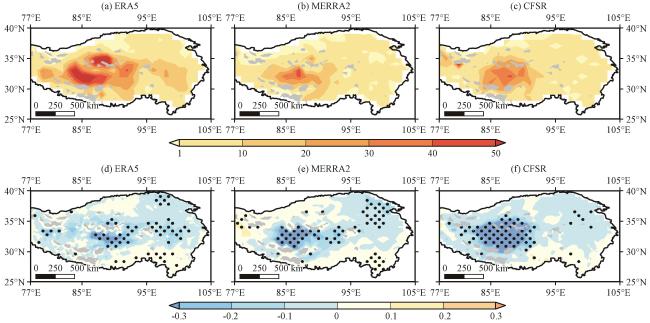
图1(a)~(c)给出了基于三种再分析资料客观识别出的年平均高原涡生成个数的空间分布。从图1(a)~(c)中可以看出, 三种再分析资料识别出的高原涡生成位置的空间分布较为一致, 主要在30°N -5°N, 82°E-94°E的高原中西部地区, 大致位于唐古拉山以南、 以北部地区, 在30°N -35°N, 95°E -100°E的高原东部也有部分低涡生成。这与已有研究基本一致(王鑫等, 2009Lin, 2015Li et al, 2018)。三种再分析资料识别出的高原涡生成个数的变化趋势表明[图1(d)~(f)], 近20年来高原涡生成个数的显著减少主要发生在青藏高原中、 西部地区, 尤其是在唐古拉山以南地区, 这与青藏高原南部地区降水呈减小趋势的结论一致(王灏等, 2023)。
图1 基于ERA5(a, d)、 MERRA2(b, e)和CFSR(c, f)的1979 -2022年间夏季高原涡(a~c)生成个数(单位: 个)及其1998 -2022年间线性变化趋势的空间分布(d~f)

灰色阴影代表地形, 打点表示通过p=0.1的显著性水平(下同)

Fig.1 Spatial distribution of the genesis number of TPVs (a~c, unit: pieces) and their linear trend in summer during 1998 -2022(d~f) based on ERA5(a, d), MERRA2 (b, e) and CFSR (c, f).The gray shaded color denotes terrain, black dots denote the linear trend passes the significance level at p= 0.1 (hereafter)

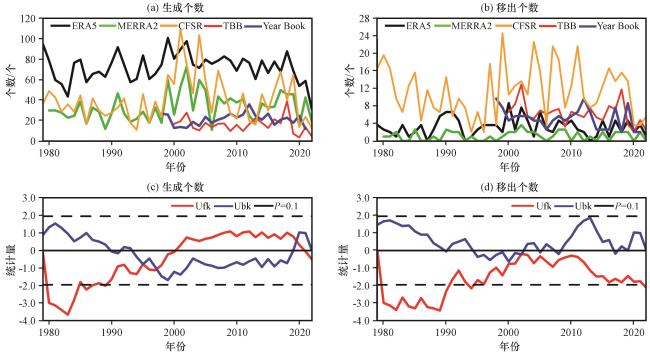
图2(a)~(b)给出了三种再分析资料和观测资料中高原涡生成和移出个数的年际变化及其变化趋势。结果表明, 高原涡的生成和移出具有明显的年际变化特征, 不同资料得到的高原涡生成和移出的年际变化具有较好的一致性。图2(c)~(d)对基于ERA5再分析资料得到的高原涡生成和移出个数时间序列的MK突变检验(Mann-Kendall; Mann, 1945Kendall, 1975)结果表明, 高原涡生成个数在1997年发生了突变, 而高原涡移出个数在2003年发生了突变。表1给出了突变年份前后高原涡生成和移出个数的线性变化趋势, 结合图2(a)~(b)的结果可知, 三种再分析资料识别的高原涡生成个数在1997年之前的线性变化趋势均不显著, 而在1997年之后, 无论是再分析资料还是观测资料, 高原涡生成个数均呈显著的减少趋势(p=0.1); 高原涡移出个数具有类似的特征, 即在2002年之前变化趋势不显著, 而在2003年之后呈显著的减少趋势; 特别是在2010年之后, 观测和再分析资料中的高原涡生成和移出的显著减少趋势更强。换言之, 进入21世纪之后, 尤其是近10年来, 高原涡的生成和移出个数均显著减少。需要注意的是, 《年鉴》中高原涡的生成在1998 -2011年呈现增多的趋势, 与唐信英等(2014)的结果一致, 但近10年以来, 《年鉴》中高原涡的生成也呈现出了显著的减少趋势; 《年鉴》中高原涡的移出在近20年一直呈显著的减少趋势, 这与其他观测资料和再分析资料的结果一致。图1图2也表明, 尽管受不同资料分辨率差异等的影响, 不同资料中高原涡个数存在差异, 但不同资料中高原涡个数的时间变化趋势以及空间分布基本一致。考虑到ERA5再分析资料的空间分辨率较高, 因此, 本文将使用ERA5识别的高原涡和气象要素场开展后续的分析。
图2 高原涡生成个数(a)和移出个数(b)的年际变化以及高原涡生成个数(c)和移出个数(d)的MK突变检验

黑色虚线表示 p=0.1的显著性水平

Fig.2 Standardized inter-annual variations of genesis number (a) and moving off number (b) of TPVs, and the MK test for genesis number (c) and moving off number (d) of TPVs.The black dashed line denotes the significance level at p=0.1

表1 高原涡生成和移出个数在突变年份前、 后以及近10年的线性变化趋势

Table 1 Linear trends of the genesis and moving off number of TPVs during different periods

变量 时段 ERA5 MERRA2 CFSR TBB Year Book
生成个数 1979 -1997年 -0.14 -0.15 -0.66
1998 -2022年 -1.27* -0.51* -1.64* -0.07* -0.09
2010 -2022年 -2.13* -1.89* -0.01 -2.52* -1.24*
移出个数 1979 -2002年 0.76* 0.08* -0.11
2003 -2022年 -1.21* -0.07 -0.41* -0.07* -0.01*
2010 -2022年 -1.9* -1.6* -0.67* -2.4* -0.9*

*表示趋势通过 p=0.1的显著性水平(*denotes the linear trend passes the significance level at p= 0.1)

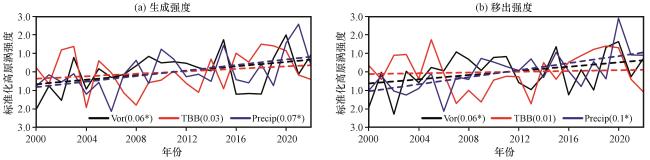
高原涡的强度与青藏高原降水的强度密切相关。由于卫星降水和云顶亮温资料只包含2000年后的数据, 因此, 图3进一步分析了2000 -2022年间高原涡强度的变化趋势。从图3中可以看出, 使用相对涡度、 云顶亮温和降水表征的高原涡生成强度和移出强度变化的线性趋势基本一致, 即生成和移出的高原涡强度在突变年份之后均呈增强趋势, 尤其是高原涡对应的相对涡度和降水的增强趋势通过了p=0.1的显著性水平。这表明, 单次高原涡的生成强度和移出强度在近20年均显著增强, 这意味着, 单次高原涡及其造成的降水的极端性在近20年可能呈增强的趋势。
图3 标准化的单次高原涡的生成强度(a)和移出强度(b)的年际变化

单次高原涡的强度定义为每年所有高原涡强度的平均值, 标准化表示距平与标准差的比值; 黑色、 红色和蓝色实线分别表示与高原涡对应的相对涡度(Vor)、 云顶亮温(TBB)和降水(Precip); 虚线代表不同变量的线性趋势; *表示线性趋势通过p=0.1的显著性水平

Fig.3 Standardized inter-annual variations of genesis intensity (a) and moving off intensity (b)of a TPV.The intensity of TPV is defined as the annual mean intensity of all TPVs, and standardization means the ratio of the anomaly to the standard deviation.The black, red and blue solid lines represent relative vorticity (Vor), black body temperature (TBB) and precipitation (Precip) corresponding to the TPV, respectively; the dashed lines represent the linear trend of the different variables; * denotes the linear trend passes the significance level at p=0.1

上述分析表明, 在气候变暖背景下, 高原涡生成和移出的个数以及生成和移出的单次高原涡的强度均发生了显著的变化。高原涡生成个数在1997年之后显著减少, 尤其在2010年之后的近10年减少趋势尤为显著, 高原涡的显著减少主要在青藏高原唐古拉山以南的中西部地区; 高原涡移出个数在2002年之后也呈显著减少的趋势; 生成和移出的单次高原涡强度在突变年份之后均显著增强。这表明, 21世纪初之后高原涡的活动发生了显著的变化, 表现为生成和移出的个数显著减少、 但单次高原涡生成和移出的强度显著增强。由于高原涡是影响青藏高原及其周边地区夏季降水的主要天气系统, 这意味着, 在青藏高原加速变暖且升温幅度高于全球平均值的背景下(Duan and Xiao, 2015陈德亮等, 2015Huang et al, 2023), 虽然高原涡活动的频率在减少, 但由于单次高原涡的强度在增强, 可能会使高原涡对青藏高原及其周边地区降水强度的影响增强。

4 高原涡个数、 强度变化的原因

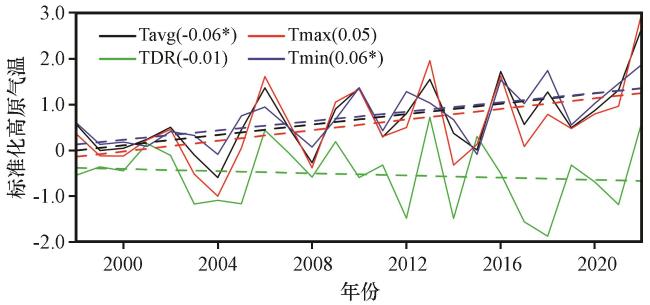
本节将基于ERA5再分析资料识别的高原涡并结合CN05等资料, 讨论气候变暖背景下近20年高原涡变化的可能原因, 并重点分析高原涡特征变化与青藏高原地表及大气热源的关系。图4使用CN05资料, 给出了1998 -2022年间青藏高原日平均气温、 日最高气温、 日最低气温和气温日较差的年际变化。从图4中可以看出, 青藏高原日最高、 最低气温以及日平均气温均呈显著的升高趋势, 由于日最低气温增温幅度大于日最高气温, 导致气温的日较差呈减小趋势但不显著。表2给出了高原涡生成个数与青藏高原气温的关系。从表2中可以看出, 未去趋势的高原涡生成个数的年际变化与青藏高原气候变暖过程中日平均气温、 日最高气温和日最低气温的年际变化呈显著的负相关; 去除气温和高原涡的线性趋势后, 近20年高原涡生成个数的年际变化仅与气温的日较差呈显著负相关, 这表明青藏高原的气候变暖对高原涡的活动具有显著的影响; 去除变暖的影响后, 高原涡的生成与青藏高原气温日较差的关系最为密切。
图4 1998 -2022年间标准化的青藏高原日平均气温(Tavg)、 日最高气温(Tmax)、 日最低气温(Tmin)和气温日较差(TDR)的年际变化

*表示线性趋势通过p=0.1的显著性水平

Fig.4 Inter-annual variability of standardized daily mean temperature (Tavg), daily maximum temperature (Tmax), daily minimum temperature (Tmin), and daily range of temperature (TDR) over the Tibetan Plateau from 1998 to 2022.* denotes linear trend passes the significance level at p=0.1

表2 1998 -2022年间原值和去趋势的高原涡生成个数与去趋势和原值的青藏高原日平均气温、 日最高气温、 日最低气温和气温日较差的相关系数

Table 2 Correlation coefficients between the original and detrended genesis number of TPVs and detrended and original daily mena temperaturedaily maximum temperaturedaily minimum temperatureand daily temperature range over the Tibetan Plateau during 1998 -2022

生成个数 Tavg TDR Tmax Tmin
原值 去趋势值 原值 去趋势值 原值 去趋势值 原值 去趋势值
原值 -0.53* -0.19 -0.23 -0.28 -0.53* -0.25 -0.46* -0.04
去趋势值 -0.21 -0.26 -0.36* -0.37* -0.28 -0.32 -0.04 -0.05

*表示相关系数通过p=0.1的显著性水平(* denotes linear trend passes the significance level at p= 0.1)

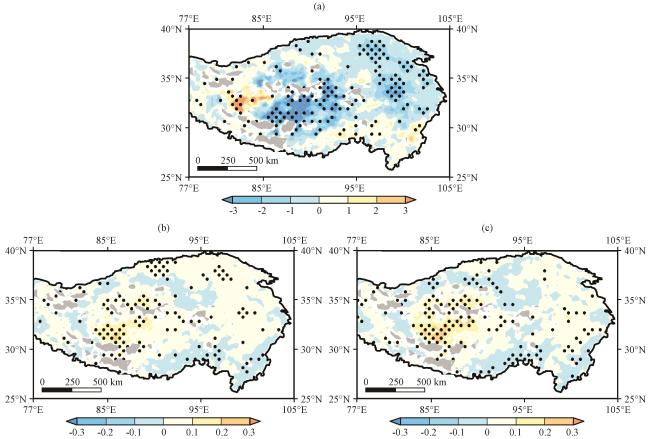
为了分析近20年高原涡生成个数显著减少的原因, 图5(a)给出了去趋势的日较差回归去趋势的高原涡生成个数的结果。从图5(a)中可以看出, 去除青藏高原变暖的影响后, 日较差与高原涡的生成在空间上具有显著的负相关关系, 且负相关关系与图1中的高原涡生成位置、 显著变化趋势的空间分布基本一致, 这表明高原日较差的增大(减小)会导致高原涡减少(增多)。进一步分析去趋势的 Q 1 Q 2回归去趋势的高原涡生成个数的结果可知[图5(b)~(c)], 去除青藏高原变暖的影响后, 青藏高原整层大气热源对高原涡生成的影响主要在高原唐古拉山以南、 以北的中西部地区。青藏高原夏季整层大气热源与高原涡的生成呈显著的正相关, 且去趋势的 Q 1 Q 2回归去趋势的高原涡生成个数具有一致的空间分布。Yanai and Tomita(1998)的研究表明, 较强的地表感热或蒸发会导致 Q 1 Q 2的水平分布存在明显的差异, 这表明高原中西部地区整层大气热源的减弱是近20年来高原涡生成个数减少的主要原因。对比图5(a)~(c)的结果可知, 青藏高原日较差的变化与整层大气热源的变化相反。
图5 1998 -2022年夏季去趋势的气温日较差(a)、 Q 1 ( b ) Q 2 ( c )回归去趋势的高原涡生成个数的线性回归系数

打点表示回归系数通过p=0.1的显著性水平

Fig.5 Linear regression coefficients of the detrended daily range of temperature(a),   Q 1   ( b ), and   Q 2 (c)regress on the detrended genesis number of TPVs during summer from 1998 to 2022.The black dots denote the regression coefficients pass significance level at p=0.1

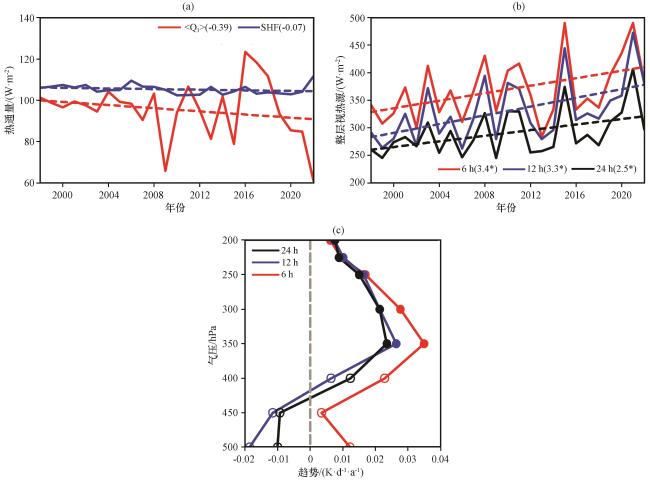
图6(a)是青藏高原夏季整层大气热源和地表加热的年际变化。从图6(a)中可以看出, 近20年来夏季高原整层大气热源与地表加热均呈减弱趋势, 但整层大气热源的减弱趋势更明显, 这与已有研究一致(孙小婷, 2022)。此外, 近20年青藏高原整层大气热源与高原涡生成个数年际变化的相关系数通过了 p=0.01的显著性检验, 这表明, 近20年来高原涡生成个数的显著减少主要与高原夏季整层大气热源的减弱有关。为了分析近20年单次高原涡强度显著增强的原因, 图6(b)给出了高原涡生成前期累积的 Q 1的年际变化, 结果表明, 近20年来高原涡生成前期 Q 1呈现出显著的增强趋势, 尤其是前6 h的 Q 1, 与单次高原涡强度的显著增强趋势一致, 前6 h、 12 h、 24 h的 Q 1与降水表征的高原涡强度的相关系数分别为0.81、 0.84、 0.85, 与相对涡度表征的高原涡强度的相关系数分别为0.56、 0.51、 0.44, 均通过了 p=0.1的显著性检验。图6(c)是近20年高原涡生成前期各层加热率的线性趋势, 结果表明, 前6 h的 Q 1在各个高度层均呈增强趋势, 前12 h、 24 h的 Q 1在400 hPa以下呈减弱趋势, 而在400 hPa及以上呈增强趋势。此外, 高原涡生成前期不同阶段, 400 hPa及以下的 Q 1的变化趋势均不显著, 而在400 hPa以上均呈显著的增加趋势, 这表明近20年来高原涡生成前期大气凝结潜热释放的显著增强是单次高原涡强度显著增强的重要原因, 这与汤艺琼(2022)使用高原涡生成前24 h相当位温增量得出的前期更强大气热源导致位涡异常偏强, 从而有利于高原涡涡度增强的结论一致。
图6 高原夏季平均的整层大气热源( Q 1)与地表加热(SHF)的年际变化及线性趋势(a), 高原涡生成前期不同阶段累积的 Q 1的年际变化及线性趋势(b), 高原涡生成前期不同阶段累积的大气加热率 Q 1的年际变化趋势的垂直廓线(c)

*和实心圆点表示线性趋势通过p=0.1的显著性检验, 空心圆点表示趋势未通过p=0.1的显著性检验

Fig.6 The inter-annual variations and trends of the summer mean Q 1 and surface heat flux over Tibetan Plateau (a), (b) the inter-annual variations and trends of the Q 1 accumulated during different precursor periods of TPV (b) and vertical profile of the accumulated Q 1 during different precursor periods of TPV (c).* and solid dots denote the linear trend passes significance level at p  = 0.1, while hollow dots indicate the linear trend does not pass significance level at p= 0.1

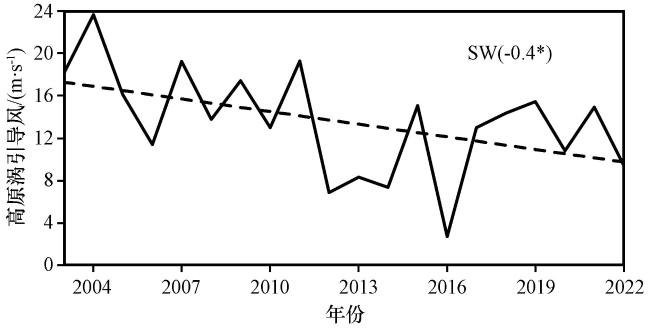
高原涡移出个数变化的可能原因有两方面, 一是高原涡生成个数减少, 二是影响高原涡移动的引导风减弱。为解释移出高原涡个数显著减少的原因, 本文参考Wu and Kurihara(1996)Zhang et al(2019a)关于引导风的计算方法, 定义高原涡中心10°×10°范围内, 200 hPa平均风与500 hPa平均风的差值为引导风。图7给出了近20年移出高原涡对应的引导风的变化。从图7中可以看出, 突变年份(2002年)之后, 移出高原涡的平均引导风呈显著的减弱趋势。结合图2可知, 移出高原涡的显著减少不仅与高原涡生成个数的显著减少有关, 也与移出高原涡的引导气流的显著减弱有关。
图7 2003 -2022年间伴随移出高原涡的平均引导风的年际变化及其线性变化趋势

Fig.7 Inter-annual variation of mean steering winds associated with moving off TPVs and its linear trend during 2003 -2022

5 结论

本文基于三套再分析资料、 卫星降水和云顶亮温观测资料以及高原涡《年鉴》资料, 分析了1979 - 2022年间高原涡生成、 移出青藏高原等特征的时空变化, 并探讨了高原涡特征的变化与青藏高原气候变暖之间的可能联系。主要结论如下:
(1) 在气候变暖背景下, 高原涡的生成、 移出和强度均发生了显著的变化。高原涡的生成个数和移出个数分别在1997年和2002年发生了突变。突变年份之后的近20年来, 高原涡生成个数和移出个数均显著减少, 近10年减少尤为显著; 生成和移出的单次高原涡的强度(如降水、 相对涡度等)均呈显著增强的趋势。高原涡的显著减少主要在青藏高原唐古拉山以南的中西部地区。这表明, 近20年来, 虽然高原涡活动的频率在减少, 但单次高原涡引起的青藏高原及其周边地区降水强度可能在增强。
(2) 青藏高原的气候变暖对高原涡的活动具有显著的影响。去除变暖影响后, 近20年来, 高原涡的生成个数与青藏高原夏季气温日较差呈显著的负相关, 而与青藏高原夏季整层大气热源呈显著的正相关。近20年来青藏高原夏季整层大气热源的减弱是高原涡生成个数减少的主要原因, 单次高原涡强度的显著增强与高原涡生成前期累积的大气热源的显著增强密切相关。
(3) 近20年来, 与移出青藏高原的高原涡对应的引导气流呈显著的减弱趋势, 这表明移出高原涡个数的显著减少不仅与高原涡生成个数的显著减少有关, 也与移出高原涡的引导气流的显著减弱有关。
本文使用统计方法得出了高原涡活动与气候变暖之间的关系, 关于气候变暖背景下, 青藏高原气温日较差、 大气热源对高原涡生成个数和强度的影响机理, 将使用数值模拟敏感性试验进一步深化认识。此外, 受不同资料分辨率等差异的影响, 本文的结果仍然存在一定的不确定性, 未来将考虑对不同资料进行误差分析和订正, 以进一步验证本文结论的可靠性。
数据来源声明:
高原涡数据集(Lin et al, 2020)下载网址: https: //www.scidb.cn/en/detail?dataSetId=633694461032923137; MERRA2再分析资料下载网址: https: //goldsmr5.gesdisc.eosdis.nasa.gov/daac-bin; ERA5再分析资料下载网址: https: //cds.climate.copernicus.eu/cdsapp#!/dataset/reanalysis-era5-pressure-levels?tab=form; CFSR再分析资料下载网址: https: //climatedataguide.ucar.edu/climate-data/climate-forecast-system-reanalysis-cfsr; GPM卫星数据下载网址: https: //gpm1.gesdisc.eosdis.nasa.gov/opendap/GPM_L3/GPM_3IMERGHH.07; CN05.1格点化观测资料下载网址: http: //data.cma.cn
Curio J Schiemann R Hodges K I, et al, 2019.Climatology of Tibetan Plateau vortices in reanalysis data and a high-resolution global climate model[J].Journal of Climate32(6), 1933-1950.DOI: 10.1175/JCLI-D-18-0021.1 .

Dell'Osso L Chen S1986.Numerical experiments on the genesis of vortices over the Qinghai Tibet plateau[J].Tellus A38(3), 236-250.DOI: 10.1111/j.1600-0870.1986.tb00468.x .

Duan A M Wu G X2009a.Weakening trend in the atmospheric heat source over the Tibetan plateau during recent decades.part i: observations[J].Journal of Climate21(13), 3149-3164.DOI: 10.1175/2009JCLI2699.1 .

Duan A M Wu G X2009b.Weakening trend in the atmospheric heat source over the Tibetan plateau during recent decades.part ii: connection with climate warming[J].Journal of Climate22(15): 4197-4212.DOI: 10.1175/2009JCLI2699.1 .

Duan A M Xiao Z X2015.Does the climate warming hiatus exist over the Tibetan Plateau?[J].Scientific Reports, 5, 13711.DOI: 10.1038/srep13711 .

Huang J P Zhou X J Wu G X, et al, 2023.Global climate impacts of land surface and atmospheric processes over the Tibetan Plateau[J].Reviews of Geophysics, 61: e2022RG000771.DOI: 10. 1029/2022RG000771 .

Kendall M G1975.Rank correlation methods[M].4th Edition, Charles Griffin, London.

Li L Zhang R H Wen M2018.Modulation of the atmospheric quasi-biweekly oscillation on the diurnal variation of the occurrence frequency of the Tibetan Plateau vortices[J].Climate Dynamics, 50: 4507-4518.DOI: 10.1007/s00382-017-3887-3 .

Lin Z Q2015.Analysis of Tibetan Plateau vortex activities using ERA-Interim data for the period 1979-2013[J].Journal of Meteorological Research29(5): 720-734.DOI: 10.1007/s13351-015-4273-x .

Lin Z Q Guo W D Jia L, et al, 2020.Climatology of Tibetan Plateau vortices derived from multiple reanalysis datasets[J].Climate Dynamics55(7-8): 2237-2252.DOI: 10.1007/s00382-020-05380-6 .

Mann H B1945.Nonparametric test against trend[J].Econometrica13(3): 245-259.DOI: 10.2307/1907187 .

Shen R J Reiter E R Bresch J F1986a.Numerical simulation of the development of vortices over the Qinghai-Xizang Plateau[J].Meteorology and Atmospheric Physics, 35: 70-95.DOI: 10.1007/BF01029526 .

Shen R J Reiter E R Bresch J F1986b.Some aspects of the effects of sensible heating on the development of summer weather systems over the Tibetan Plateau[J].Journal of the Atmospheric Sciences, 43: 2241-2260.DOI: 10.1175/1520-0469(1986)0432. 0.CO; 2 .

Sugimoto S Ueno K2010.Formation of mesoscale convective systems over the eastern Tibetan Plateau affected by plateau-scale heating contrasts[J].Journal of Geophysical Research Atmospheres, 115, D16105.DOI: 10.1029/2009JD013609 .

Sun X T Ding Y H Li Q Q2021.Interdecadal variation of the atmospheric heat source over the Tibetan Plateau and surrounding Asian Monsoon Region: impact on the Northern Hemisphere summer circulation[J].Journal of Meteorological Research35 (2): 238.DOI: 10.1007/s13351-021-0101-7 .

Wang Z Q Duan A M Wu G X2013.Time-lagged impact of spring sensible heat over the Tibetan Plateau on the summer rainfall anomaly in East China: case studies using the WRF model[J].Climate Dynamics42(11-12): 2885-2898.DOI: 10.1007/s00382-013-1800-2 .

Wu C C Kurihara Y1996.A numerical study of the feedback mechanisms of hurricane-environment interaction on hurricane movement from the potential vorticity perspective[J].Journal of Atmospheric Sciences, 53: 2264-2282.DOI: 10.1175/1520-0469(1996)053<2264: ANSOTF>2.0.CO; 2 .

Wu D Zhang F M Wang C H2018.Impacts of diabatic heating on the genesis and development of an Inner Tibetan Plateau Vortex[J].Journal of Geophysical Research: Atmospheres123(20): 11691-11704.DOI: 10.1029/2018JD029240 .

Yanai M Esbensen S Chu J1973.Determination of bulk properties of tropical cloud clusters from large-scale heat and moisture budgets[J].Journal of Atmospheric Sciences30(4): 611-627.DOI: 10.1175/1520-0469(1973)030<0611: DOBPOT>2.0.CO; 2 .

Yanai M Tomita T1998.Seasonal and interannual variability of atmospheric heat sources and moisture sinks as determined from NCEP-NCAR reanalysis[J].Journal of Climate11(3): 463-482.DOI: 10.1175/1520-0442(1998)0112.0.CO; 2 .

Yang K Guo X F He J, et al, 2011.On the climatology and trend of the atmospheric heat source over the Tibetan Plateau: an experiments-supported revisit[J].Journal of Climate24(5): 1525-1541.DOI: 10.1175/2010JCLI3848.1 .

Zhang F M Pu Z X Wang C H2019a.Impacts of soil moisture on the numerical simulation of a post-landfall storm[J].Journal of Meteorological Research33(2): 206-218.DOI: 10.1007/s13351-019-8002-8 .

Zhang F M Wang C H Pu Z X2019b.Genesis of Tibetan Plateau Vortex: roles of surface diabatic and atmospheric condensational latent heating[J].Journal of Applied Meteorology and Climatology58(12): 2633-2651.DOI: 10.1175/jamc-d-19-0103.1 .

Zhu L H Huang G Fan G Z, et al, 2017.Evolution of surface sensible heat over the Tibetan Plateau under the recent global warming hiatus[J].Advance in Atmospheric Sciences, 34: 1249-1262.DOI: 10.1007/s00376-017-6298-9 .

Zhu X Y Liu Y M Wu G X2012.An assessment of summer sensible heat flux on the Tibetan Plateau from eight data sets[J].Science China Earth Sciences, 55: 779-786.DOI: 10.1007/s11430-012-4379-2 .

包文, 段安民, 游庆龙, 等, 2024.青藏高原气候变化及其对水资源影响的研究进展[J].气候变化研究进展20(2): 158-169.DOI: 10.12006/j.issn.1673-1719.2023.247.Bao W

Duan A M You Q L, et al, 2024: Research progress on climate change in the Tibetan Plateau and its impact on water resources[J].Advances in Climate Change Research20(2): 158-169.DOI: 10.12006/j.issn.1673-1719.2023.247 .

陈德亮, 徐柏青, 姚檀栋, 等, 2015.青藏高原环境变化科学评估: 过去、 现在与未来[J].科学通报, 60: 3025-3035.DOI: 10.1360/n972014-01370.Chen D L

Xu B Q Yao T D, et al, 2015.Assessment of past, present and future environmental changes on the Tibetan Plateau[J].Chinese Science Bulletin, 60: 3025-3035.DOI: 10.1360/n972014-01370 .

程蓉, 王澄海, 杨凯, 等, 2023.近40 年来青藏高原非绝热加热变化特征[J].气象与环境科学46(4): 38-48.DOI: 10.16765/j.cnki.1673-7148.2023.04.005.Cheng R

Wang C H Yang K, et al, 2023.Characteristics of changes in non-adiabatic heating on the Tibetan Plateau over the past 40 years[J].Meteorological and Environmental Sciences46(4): 38-48.DOI: 10.16765/j.cnki.1673-7148.2023.04.005 .

段安民, 肖志祥, 吴国雄, 2016.1979-2014年全球变暖背景下青藏高原气候变化特征[J].气候变化研究进展12(5): 374-381.DOI: 10.12006/j.issn.1673-1719.2016.039.Duan A M

Xiao Z X Wu G X2016.Characteristics of climate change over the Tibetan Plateau under the global warming during 1979-2014[J].12(5): 374-381.DOI: 10.12006/j.issn.1673-1719.2016.039 .

冯晓莉, 申红艳, 李万志, 等, 2020.1961-2017 年青藏高原暖湿季节极端降水时空变化特征[J].高原气象39(4): 694-705.DOI: 10.7522/j.issn.1000-0534.2020.00029.Feng X

Shen H Li W, et al, 2020.Spatiotemporal changes for extreme precipitation in wet season over the Qinghai-Tibetan Plateau and the surroundings during 1961-2017[J].Plateau Meteorology39(4): 694-705.DOI: 10.7522/j.issn.1000-0534.2020.00029 .

关良, 李栋梁, 2019.青藏高原低涡的客观识别及其活动特征[J].高原气象38(1): 55-65.DOI: 10.7522/j.issn.1000-0534.2018.00067.Guan L

Li D L2019.Objective identification and activity characteristics of Tibetan Plateau vortices[J].Plateau Meteorology38(1): 55-65.DOI: 10.7522/j.issn.1000-0534.2018.00067 .

何钰, 朱莉, 李国平, 等, 2024.青藏高原东坡地形对影响云南降水的高原涡的作用机理[J].高原气象43(1): 42-58.DOI: 10.7522/j.issn.1000-0534.2023.00037.He Y

Zhu L Li G P, et al, 2024.Action mechanism of Tibetan Plateau’s Eastern slope topography on the PLV affecting Yunnan Precipitation[J].Plateau Meteorology43(1): 42-58.DOI: 10.7522/j.issn.1000-0534.2023.00037 .

李国平, 卢会国, 黄楚惠, 等, 2016.青藏高原夏季地面热源的气候特征及其对高原低涡生成的影响[J].大气科学40 (1): 131- 141.DOI: 10.3878/j.issn.1006-9895.1504.15125.Li G P

Lu H G Huang C H, et al, 2016.A climatology of the surface heat source on the Tibetan Plateau in summer and its impacts on the formation of the Tibetan Plateau vortex[J].Chinese Journal of Atmospheric Sciences40(1): 131-141.DOI: 10.3878/j.issn.1006-9895.1504.15125 .

李国平, 赵邦杰, 2002.地面感热对青藏高原低涡流场结构及发展的作用[J].大气科学26(4): 519-525.DOI: 10.3878/j.issn.1006-9895.2002.04.09.Li G P

Zhao B J2002.Effect of surface sensible heat on the structure and development of low eddy current field over the Tibetan Plateau[J].Chinese Journal of Atmospheric Sciences26(4): 519-525.(in Chinese).DOI: 10.3878/j.issn.1006-9895.2002.04.09 .

李国平, 赵福虎, 黄楚惠, 等, 2014.基于NCEP资料的近30年夏季青藏高原低涡的气候特征[J].大气科学38(4): 14.DOI: 10.3878/j.issn.1006-9895.2013.13235.Li G P

Zhao F H Huang C H, et al, 2014.Climatic characteristics of summer Tibetan Plateau vortices over the past 30 years based on NCEP Data[J].Chinese Journal of Atmospheric Sciences38(4): 14.DOI: 10.3878/j.issn.1006-9895.2013.13235 .

林志强, 2021.青藏高原低涡年际年代际变化特征、 机理及其未来预估[D].南京: 南京大学, 1-178.

Lin Z Q2021.The inter‐annual and inter-decadal characteristics and mechanisms of Tibetan Plateau vortex and the future projections[D].Nanjing: Nanjing University, 1-178.

林志强, 郭维栋, 姚秀萍, 等, 2023.基于多源资料的高原低涡源地研究[J].大气科学47(3), 837-852.DOI: 10.3878/j.issn.1006-9895.2211.21262.Lin Z Q

Guo W D Yao X P, et al, 2023.Study on the Source Area of Plateau Vortices based on Multi-Source Data[J].Chinese Journal of Atmospheric Sciences47(3), 837-852.DOI: 10.3878/j.issn.1006-9895.2211.21262 .

刘晓冉, 李国平, 2006.青藏高原低涡研究的回顾与展望[J].干旱气象24(1): 60-66.DOI: 10.3969/j.issn.1006-7639.2006.01.013.Liu X R

Li G P2006.Review and prospect of research on the Tibetan Plateau vortex[J].Journal of Arid Meteorology24(1): 60-66.DOI: 10.3969/j.issn.1006-7639.2006.01.013 .

卢鹤立, 邵全琴, 刘纪远, 等, 2007.近44 年来青藏高原夏季降水的时空分布特征[J].地理学报62(9): 946-958.DOI: 10.3321/j.issn: 0375-5444.2007.09.006.Lu H L

Shao Q Q Liu J Y, et al, 2007.Spatial and temporal distribution Characteristics of Summer Precipitation on the Tibetan Plateau in the Past 44 Years[J].Acta Geographica Sinica62(9): 946-958.DOI: 10.3321/j.issn: 0375-5444.2007.09.006 .

罗四维, 杨洋, 1992.一次青藏高原夏季低涡的数值模拟研究[J].高原气象11(1): 39-48.

Luo S W Yang Y1992.Numerical simulation of a summer low vortex over the Tibetan Plateau[J].Plateau Meteorology11(1): 39-48.

罗四维, 杨洋, 吕世华, 1991.一次青藏高原夏季低涡的诊断分析研究[J].高原气象10(1): 1-12.

Luo S W Yang Y S H1991.Diagnostic analyses of a summer vortex over Qinghai-Xizang Plateau for 29-30 June 1979[J].Plateau Meteorology10(1): 1-12.

麦哲宁, 许东蓓, 孙继松, 等, 2024.基于ERA-5高分辨率资料的高原低涡客观识别方法研究[J].大气科学48(5): 1-13.DOI: 10.3878/j.issn.1006-9895.2208.22119.Mai Z N

Xu D B Sun J S, et al, 2024.Study on an objective identification method for Tibetan Plateau vortices based on ERA-5 high-resolution data[J].Chinese Journal of Atmospheric Sciences48(5): 1-13.DOI: 10.3878/j.issn.1006-9895.2208.22119 .

钱正安, 单扶民, 吕君宁, 等, 1984.1979年夏季青藏高原低涡的统计及低涡产生的气候因子探讨[M]//青藏高原气象科学实验文集编辑组.青藏高原气象科学实验文集(二).北京: 科学出版社, 182-194.

Qian Z A Shan F M J N, et al, 1984.The statistics of the Tibetan Plateau low vortex in summer 1979 and the discussion on the climate factors of the low vortex [M]//Editorial Group of the Tibetan Plateau Meteorological Science Experiment Collection.Meteorological experiments on the Tibetan Plateau(II).Beijing: Science Press, 182-194.

孙小婷, 2022.青藏高原夏季大气热源年代际变化及其对北半球环流的影响[D].南京: 南京信息工程大学.Sun X T, 2022.Interdecadal variation of the atmospheric heat sources over the Tibetan Plateau: impact on the Northern Hemisphere summer circulation[D].Nanjing: Nanjing University of Information Science and Technology.

汤艺琼, 2022.初夏青藏高原低涡生成的动力学机理研究[D].南京: 南京信息工程大学.Tang Y Q, 2022.Study on the dynamic mechanism of the formation of Tibetan Plateau vortices in early summer[D].Nanjing: Nanjing University of Information Science and Technology.

唐信英, 周长艳, 王鸽, 2014.青藏高原低涡活动特征统计分析[J].高原山地气象研究34(3): 41-44.DOI: 10.3969/j.issn.1674-2184 ·2014.03.007.

Tang X Y Zhou C Y Wang G2014.Statistical analysis on the Plateau Low Vortex Activity characteristics[J].Plateau and Mountain Meteorology Research34(3): 41-44.DOI: 10.3969/j.issn.1674-2184 ·2014.03.007.

屠妮妮, 郁淑华, 李跃清, 2024.两次不同生命史东移高原涡的动力结构与成因分析[J].高原气象43(1): 73-87.DOI: 10.7522/j.issn.1000-0534.2023.00048.Tu N N

Yu S H Li Y Q2024.Analysis of the dynamical structure and genesis of two different life-history eastward moving plateau[J].Plateau Meteorology43(1): 73-87.DOI: 10.7522/j.issn.1000-0534.2023.00048 .

王灏, 胡泽勇, 杨耀先, 等, 2023.近60 年青藏高原季风期降水的南北变化特征及机理研究[J].高原气象42(4): 848-857.DOI: 10.7522/j.issn.1000-0534.2023.00034.Wang H

Hu Z Y Yang Y X, et al, 2023.Study on the North-South variation characteristics and mechanism of precipitation during the monsoon season on the Qinghai-Tibet Plateau over the Past 60 Years[J].Plateau Meteorology42(4): 848-857.DOI: 10.7522/j.issn.1000-0534.2023.00034 .

王树舟, 马耀明, 吴文玉, 2023.基于 Noah-MP 陆面模式的青藏高原地表感热和潜热通量分布及变化特征[J].高原气象42(1): 25-34.DOI: 10.7522/j.issn.1000-0534.2022.00036.Wang S Z

Ma Y M Wu W Y2023.Characteristics of distributions and changes of surface sensible and latent heat fluxes on the Qinghai-Xizang Plateau based on the Noah-MP Land Surface Model[J].Plateau Meteorology42(1): 25-34.DOI: 10.7522/j.issn.1000-0534.2022.00036 .

王鑫, 李跃清, 郁淑华, 等, 2009.青藏高原低涡活动的统计研究[J].高原气象28(1): 64-71.

Wang X Li Y Q Yu S H, et al, 2009.Statistical study on the activities of tibetan plateau vortices[J].Plateau Meteorology28(1): 64-71.

燕若彤, 许东蓓, 孙继松, 等, 2023.一次高原涡东移引发江淮强降水的动热力机制分析[J].高原气象42(3): 701-710.DOI: 10.7522/j.issn.1000-0534.2022.00090.Yan R T

Xu D B Sun J S, et al, 2023.Analysis of dynamic and thermal mechanism of heavy precipitation over the Yangtze-Huaihe River Basin caused by a Qinghai-Xizang Plateau vortex moving eastward[J].Plateau Meteorology42(3): 701-710.DOI: 10.7522/j.issn.1000-0534.2022.00090 .

郁淑华, 高文良, 2006.高原低涡移出高原的观测事实分析[J].气象学报64(3): 392-399.DOI: 10.3321/j.issn: 0577-6619. 2006.03.014.Yu S H

Gao W L2006.Observational analysis of Tibetan Plateau vortices moving out of the Plateau[J].Acta Meteorologica Sinica64(3): 392-399.DOI: 10. 3321/j.issn: 0577-6619.2006.03.014 .

张博, 李国平, 2017.基于CFSR资料的青藏高原低涡客观识别技术及应用[J].兰州大学学报(自然科学版)53(1): 106-111+ 118.DOI: 10.13885/j.issn.0455-2059.2017.01.016.Zhang B

Li G P2017.An objective identification of the Tibetan plateau vortex based on climate forecast system reanalysis data[J].Journal of Lanzhou University(Natural Sciences)53(1): 106-111+ 118.DOI: 10.13885/j.issn.0455-2059.2017.01.016 .

张恬月, 李国平, 2018.青藏高原夏季地面感热通量与高原低涡生成的可能联系[J].沙漠与绿洲气象12(2): 1-6.DOI: 10.12057/j.issn.1002-0799.2018.02.001.Zhang T Y

Li G P2018.Possible connection between surface sensible heat flux in summer and the generation of Tibetan Plateau Vortices[J].Desert and Oasis Meteorology12(2): 1-6.DOI: 10.12057/j.issn.1002-0799.2018.02.001 .

Outlines

/