

1 引言
土壤温、 湿度的准确模拟能够改善模式对近地面气温和湿度的预报效果(Trier et al, 2008;Dy and Fung, 2016;Zhong et al, 2020;杨袁慧等, 2013), 并对边界层的对流产生影响, 从而影响大尺度环流和降水(Fan, 2009;Xue et al, 2017;廖慧仁等, 2024;叶宇辰等, 2024)。由于土壤本身特性, 土壤温、 湿度比大气的“记忆”时间更长(Dirmeyer et al, 2009), 在不同时间尺度的数值模拟中, 土壤温度和土壤湿度对大气过程的影响具有持续性(Chen and Dudhia, 2001;Xue et al, 2017)。气候尺度上, 土壤湿度变化对南亚季风区降水强度、 频率产生影响(Sugimoto and Takahashi, 2017), 准确的土壤湿度有利于夏季地表气温的准确预测, 并在热浪期间维持稳定的异常环流方面发挥了重要作用(Seo et al, 2019)。对于短期数值天气预报, 准确的土壤温、 湿度有助于改善降水、 高温天气的模拟预报(Fan, 2009;易翔等, 2016), 较湿的土壤有利于增加边界层的湿静力能, 降低边界层高度, 增加潜在对流活动, 影响中尺度对流系统和降水(Min et al, 2016)。
在短期数值天气预报中, 由不同初始土壤湿度引起的模拟结果差异, 比由不同陆面参数或土壤湿度本身演变引起的模拟结果差异, 更为重要(Trier et al, 2008)。初始土壤湿度通过蒸发和温室效应影响能量收支、 调节地表能量分配(Zhang et al, 2020)。对于地形复杂、 模式网格分辨率小于1 km的大涡模拟, 准确的土壤湿度初始场对于风向转变、 风速预报有明显改善(Chow et al, 2006;张珊等, 2023)。此外, 初始土壤湿度对热浪事件的模拟也有所影响, 初始土壤偏干, 加剧了局地的地表变暖, 对流层中部的位势高度出现正异常, 低层出现负异常, 大气厚度增加, 对流层中部的异常高压系统加强, 导致热浪的振幅、 范围和强度均增加(Wang et al, 2019)。Xue et al(2017)综合考虑了初始土壤温度和土壤湿度对数值模拟结果的影响, 使用观测数据校正了气候预报系统再分析资料(Climate Forecast System Reanalysis, CFSR)中的土壤温、 湿度, 并将CFSR作为初、 边值开展数值模拟, 结果显示, 中国大部分地区的相对湿度和2 m气温的模拟效果均有所改善, 模拟的降水在湿润地区得到加强, 在干旱地区得到抑制。
针对快速循环更新同化的业务模式, Zhong et al(2020)基于北京城市气象研究院的RMAPS-ST(现更名为CMA-BJ), 使用高分辨率陆面数据同化系统(High-Resolution Land Data Assimilation System, HRLDAS)土壤湿度数据作为模式初始场, 在2016/2017年冬季展开数值模拟, 显著改善了华北地区气温和绝对湿度的预报效果, 减小了模式预报的日最高、 最低气温偏差和湿度正偏差, 表示改变土壤水分会影响土壤导热系数, 从而影响地表感热通量、 地表土壤热通量和潜热通量之间的能量分配, 并将此成果应用于CMA-BJ业务模式中。
陆面数据同化系统(CMA Land Data Assimilation System, CLDAS)产品(Shi et al, 2011)作为业务可获取的近实时数据, 由中国气象局自主研发, 融合了地面观测、 卫星观测、 数值模式产品等多源资料, 作为模式驱动场的质量优于数值模式产品, 模拟效果更接近观测(龚伟伟, 2014)。在中国区域内, 相比于欧洲中期天气预报中心的ERA-Interim和美国国家航空航天局的GLDAS数据, CLDAS土壤温度数据在不同深度的综合表现最佳(Zhao et al, 2022)。目前, CLDAS产品多用于农业气象研究、 区域适用性评估以及驱动陆面模式等(韩帅等, 2017;李磊等, 2021;杨富燕等, 2023;吴诗梅等, 2024;李浙华等, 2024)。CLDAS土壤湿度作为初始场的应用效果初有尝试, 张珊等(2023)将土壤湿度初始场由ERA5替换为CLDAS, 改善了风向和2 m气温的模拟效果, 但CLDAS土壤温、 湿度初始场在快速更新循环同化模式系统中, 对短临、 短期预报效果的影响还少有研究, 尤其是针对0~12 h短时临近预报。
本研究将基于WRF (Weather Research and Forecasting)中尺度模式4.2版本, 使用全球同化预报系统(CMA Global Forecast System, CMA-GFS)(Shen et al, 2020)产品作为初、 边值条件, 使用CLDAS数据作为土壤温、 湿度的初始场, 在短临、 短期预报的时间尺度上, 分析初始土壤温、 湿度对模式近地面温湿要素预报效果的影响, 并针对初始土壤偏冷或偏暖、 偏干或偏湿分组讨论, 进一步探究初始土壤温、 湿度的不同组合对预报效果的影响, 为业务上普遍采用的逐小时快速循环更新同化的模式系统中, 应用CLDAS土壤温、 湿度数据为模式初始场的效果提供参考。
2 数据来源与方法介绍
2.1 CMA-GFS
本研究使用CMA-GFS 4.0版本的业务产品作为模式初始场, 分辨率为0.125°×0.125°(约12.5 km), 每天起报4次, 分别是02:00(北京时, 下同)、 08:00、 14:00、 20:00, 逐3 h预报, 预报时长为240 h(08:00和20:00起报)或120 h(02:00和14:00起报)。CMA-GFS在北半球可用预报天数超过8天(张进等, 2023), 并已广泛应用于科学研究中(祁春娟和潘留杰, 2023;孙康慧等, 2024;Shen et al, 2023;Li et al, 2024)。
2.2 CLDAS
本研究使用CLDAS的土壤温、 湿度产品作为模式初始场, 垂直方向有5层(0.05、 0.10、 0.40、 1.0和2.0 m), 空间分辨率为 , 时间分辨率为逐小时。
2.3 观测数据
使用国家气象信息中心提供的中国地面逐小时观测数据, 包括国家站和区域站每小时的气压、 气温、 相对湿度等要素观测。本研究使用观测站点的2 m气温和相对湿度作为观测值。
2.4 检验指标
为定量评估试验结果在时间序列上的预报效果, 通过计算均方根误差(Root Mean Square Error, RMSE)、 预报值与观测值之间偏差(bias)来对预报结果进行检验, 各统计量的计算公式如下:
式中: 下角标i表示第i个观测站点; 和 分别表示第i个观测站的模式预报值和观测值;N表示样本总数(观测站的总数为N)。
3 模式设置与试验方案
3.1 模式设置
本文采用双层网格嵌套, 外层网格数为391×289, 分辨率为15 km, 覆盖整个中国区域, 内层网格数为331×386, 分辨率为3 km, 覆盖华北区域(包括北京市、 天津市、 河北省、 山西省、 山东省、 河南省北部、 内蒙古中部、 辽宁省西部), 中心坐标为(105°E, 37°N), 垂直层数为45层。主要物理过程包括Morrison 2-moment微物理过程, RRTMG长短波辐射方案, Noah陆面过程, Mellor-Yamada-Janjic (Eta) TKE边界层方案。
模拟时间为2023年12月10 -25日, 开展连续16天的数值预报, 每天20:00起报, 预报84 h。模式初、 边值条件分别来自于CMA-GFS的分析场和预报场, 其中, 初始场为当天20:00起报、 预报时长为0 h的CMA-GFS分析场, 边值条件由预报时长为0~84 h的CMA-GFS预报场提供。
文中涉及的地图是基于中华人民共和国自然资源部地图技术审查中心标准地图服务系统下载的审图号为GS(2020)4619的标准地图制作, 底图无修改。
3.2 试验方案
根据模式初始场中土壤温、 湿度的数据来源不同, 设计了控制试验和对照试验, 其中, 控制试验中, 土壤温、 湿度的初值与模式初始场的数据来源相同, 均采用CMA-GFS数据, 称为CMA组;对照试验中, 土壤温、 湿度的初值采用CLDAS数据, 初值中的其他要素仍采用CMA-GFS数据, 称作CLDAS组。CMA组和CLDAS组除了土壤温度和土壤湿度初始场的数据来源不同, 其余初、 边值条件以及模式设置等均相同。
本研究采用Noah陆面方案(Chen et al, 1996, 1997;Chen and Dudhia, 2001), 根据Noah陆面方案中土壤温度和土壤湿度的计算公式, 土壤温度和土壤湿度均通过一维单点预报模型计算而得, 在模式积分过程中, 只需给出土壤温度和土壤湿度的初始场, 模式便可自行逐步计算出未来时刻的土壤温、 湿度, 无需再提供土壤温度和土壤湿度的侧边界条件。
3.3 土壤温、 湿度初值
3.3.1 土壤温度
在模拟时间内(2023年12月10 -25日), 华北地区经历了两次降温天气过程(图1), 分别是12月10 -17日和18 -21日。12月10日, 华北地区日平均气温为0.2 ℃, 12月10 -17日, 气温从0.2 ℃下降至-11.5 ℃, 12月18日, 气温短暂回升至-8.2 ℃, 12月18 -21日, 气温再次下降至-12.7 ℃, 随后再次回升, 25日气温达-4 ℃。经过两次降温后, 气温在12月21日达到最低, 为-12.7 ℃。
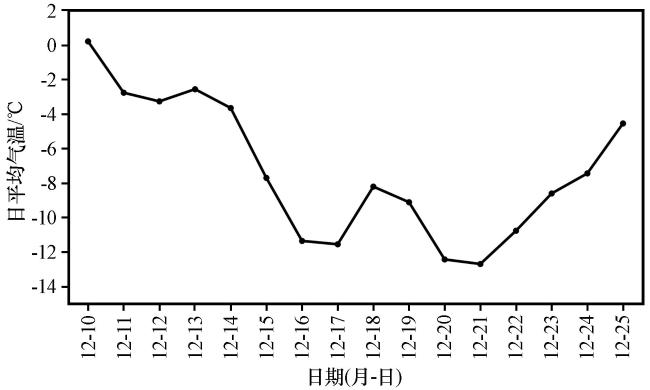
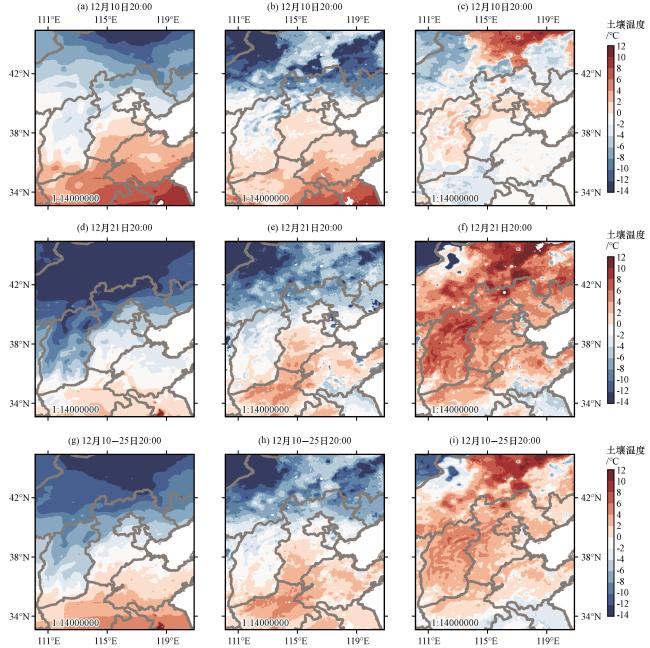
从12月10 -21日, 华北地区日平均气温下降了12.9 ℃, CMA-GFS的土壤温度也有明显下降[图2(a), (d)], 内蒙古、 河北北部的土壤温度从-8 ℃下降至-14 ℃以下, 最低可达-17.6 ℃, 河北南部、 山东省的土壤温度从2 ℃下降至-2 ℃, 华北区域的土壤温度整体下降了4~8 ℃; CLDAS土壤温度[图2(b), (e)]在山东南部和江苏北部的下降幅度较大, 可达7 ℃, 其他地区的土壤温度变化幅度在5 ℃以内。两者土壤温度差值[图2(c), (f)]反映出CMA-GFS和CLDAS的土壤温度下降程度不同, 12月10日, 除内蒙古中部、 山西、 河北中部以外, 其他地区, CLDAS土壤温度低于CMA-GFS;12月21日, 除江苏北部, CLDAS土壤温度均高于CMA-GFS, 两者相差最高可达12 ℃。由此可见, CMA-GFS土壤温度变化更容易受到气温的影响, 当气温下降幅度较大时, 在整个降温区域内, CMA-GFS土壤温度相应下降, 相较而言, CLDAS土壤温度的变化受气温影响较小。
3.3.2 土壤湿度
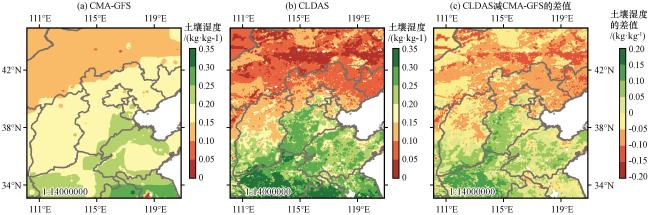
在模拟时间内, CMA-GFS和CLDAS土壤湿度的逐日变化均较小, 在华北区域内, 整体变化幅度在0.1 kg·kg-1以内(图略)。可见, 与土壤温度不同, CMA-GFS和CLDAS的土壤湿度受气温影响较小, 土壤湿度值较为稳定。CMA-GFS和CLDAS均可反映出南湿北干的特征(图3), CMA-GFS数据的空间分辨率为0.125°×0.125°, CLDAS的空间分辨率为0.0625°×0.0625°, CMA-GFS受限于较低的空间分辨率, 未能体现土壤湿度在各省内部的空间差异性, 在相邻地区, 如内蒙古境内、 山西和河北, 均呈现相同的土壤湿度值[图3(a)]。CLDAS数据的空间分辨率较高, 其土壤湿度的空间分布展现出更多细节[图3(b)]。整体而言, CLDAS土壤湿度的南北差异更大, CLDAS在山西北部、 河北北部及其以北地区的土壤比CMA-GFS的干, 在山西南部、 河北南部及其以南地区的土壤比CMA-GFS的湿[图3(c)], 且由于其较高空间分辨率, CLDAS所提供的土壤湿度初值包含更多细节, 空间差异较大。
4 结果分析
4.1 相对湿度
相对湿度(Relative Humidity, RH)的观测值随预报时长呈现波浪式的起伏变化(图4柱状图), 在预报时长12 h、 36 h、 60 h、 84 h出现极大值, 在18 h、 42 h、 66 h出现极小值, 并呈现日变化特征: 相对湿度在每日08:00开始减小(即20:00+12 h、 20:00+36 h、 20:00+60 h、 20:00+84 h, 对应每日08:00。其中, 20:00为起报时次, 12 h、 36 h、 60 h、 84 h为预报时长), 在每日14:00达到最低值(即20:00+18 h、 20:00+42 h、 20:00+66 h), 随后开始增长, 直至次日08:00, 相对湿度再次减小, 以此循环。
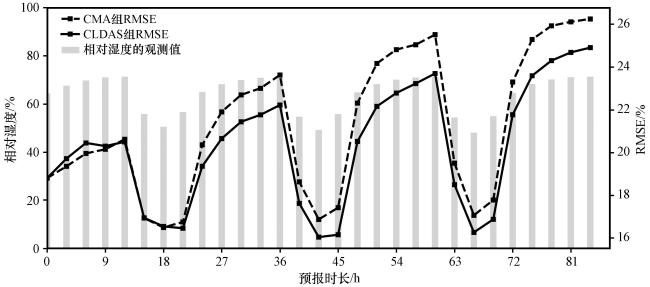
图4两条曲线表现出与柱状图起伏一致的波浪式变化, 相对湿度较大, 预报的RMSE也较大;相对湿度较小时, RMSE也较小。相比于CMA组, 在0~18 h, CLDAS组预报的相对湿度RMSE更大;在21 h之后, CLDAS组预报的RMSE更小, 尤其相对湿度出现极大值时, 即每日08:00, CLDAS组与CMA组的相对湿度RMSE差距更大, CLDAS组预报的相对湿度更优于CMA组, 其RMSE降低了8.3%。
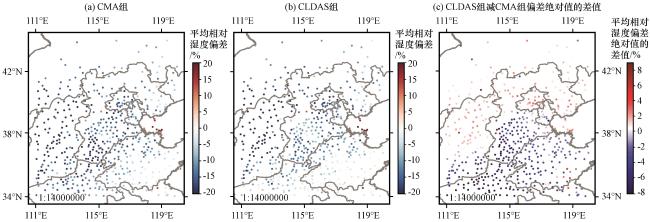
图5反映出CMA组和CLDAS组预报的相对湿度在山西、 河北以南和以北地区存在差异, 这与两者初始土壤湿度分布呈现出一致的特征(见图3)。在山西中部、 河北北部及其以北地区, CLDAS组的土壤湿度初值比CMA组的更干[见图3(c)], CLDAS组预报的相对湿度也比CMA组的更干, 负偏差更大[图5(c)];在山西南部、 河北中南部及其以南地区, CLDAS组的土壤湿度初值更湿[见图3(c)], 其预报也更湿, 负偏差较小[图5(c)], 在这些区域, 采用CLDAS数据作为模式土壤湿度初值, 相对湿度的预报效果会明显提升, 尤其在河南。由此可见, 模式对相对湿度的预报效果, 与土壤湿度初值关系密切, 若预报的相对湿度偏干, 可尝试将土壤湿度初始场更换为更湿的土壤湿度数据, 可能会对相对湿度的预报有所改善。
4.2 2 m气温
与相对湿度相似, 2 m气温也有日变化特征(图6柱状图): 在每日08:00出现日最低气温(即20:00+12 h、 20:00+36 h、 20:00+60 h、 20:00+84 h), 为-10.5 ℃左右;在每日14:00出现日最高气温(即20:00+18 h、 20:00+42 h、 20:00+66 h), 为-3.5 ℃左右。CMA组和CLDAS组预报的2 m气温RMSE也存在日变化特征(图6虚线和实线), 并且与日最低、 最高气温相对应。在每日08:00, 出现日最低气温, CMA组和CLDAS组预报的2 m气温RMSE最大;每日14:00出现日最高气温, CMA组和CLDAS组预报的2 m气温RMSE最小。
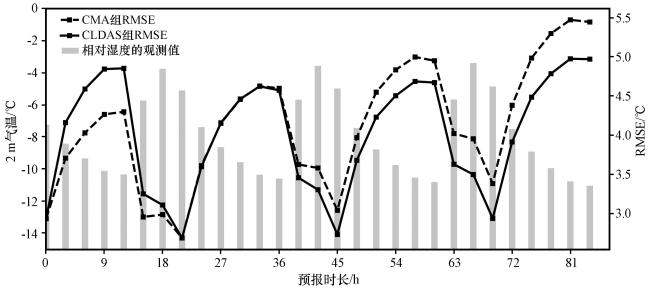
当预报时长在21 h之前, 相较于CMA组, CLDAS组的RMSE更大;在21 h之后, CLDAS组预报的2 m气温开始优于CMA组, 对日高温和日低温的预报误差均更小。随着预报时长的增加, CMA组的2 m气温RMSE也逐步上升, RMSE从3(对应日最高气温, 下同)~4 ℃(对应日最低气温, 下同)上升至3.4~5.5 ℃, 表明CMA组对2 m气温的预报效果逐渐变差;CLDAS组的2 m气温RMSE却一直趋于稳定, 始终处于2.9~4.9 ℃之间, CLDAS组对2 m气温的预报效果随预报时长保持稳定。从图6中可以看出, 随预报时长增加, CLDAS组和CMA组的2 m气温RMSE之间的差异逐步扩大, CLDAS组的2 m气温RMSE比CMA组的最多降低了10%。
由此可见, CMA组和CLDAS组虽然只是土壤温、 湿度初值不同, 但是由于土壤特性以及陆面-地表之间的相互作用, 所预报的相对湿度、 2 m气温在预报时长84 h仍差异巨大, 可见初始土壤温、 湿度对模式预报结果的影响可延伸至84 h及以后。
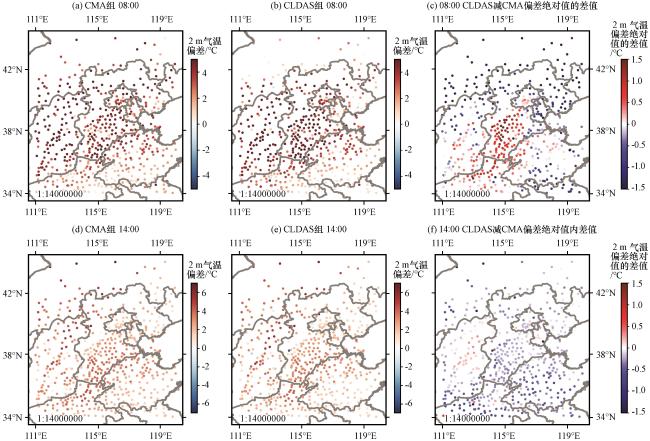
在每日14:00, 2 m气温最高, 所预报的RMSE最低, 在华北区域内也呈现暖偏差[图7(d)~(f)], 在山西中部, CLDAS组的暖偏差大于CMA组;在除山西中部以外的华北区域, 相比于CMA组, CLDAS组的暖偏差更小, 尤其是在山东的西南部、 河南中部、 河北南部和山西南部, CLDAS组2 m气温暖偏差减少了1.5 ℃。
总体来说, 在山西北部、 河北北部及其以北地区, 以及山东东部和南部, CLDAS组预报的2 m气温始终优于CMA组, 尤其是对于日最低气温的预报效果更优;在山西南部、 河北中南部、 河南以及山东省西北部, CLDAS组预报的日最低气温暖偏差更大, 日最高气温的预报偏差小于CMA组。针对CLDAS组日最高、 最低气温的预报偏差, 将探讨其区域差异的原因。
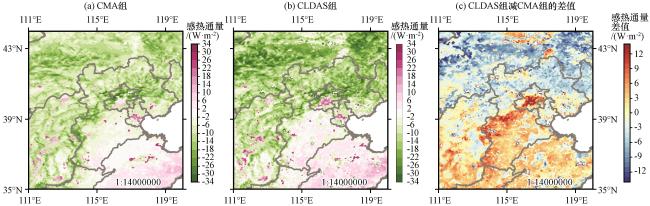
研究表明, 地表的热通量变化是土壤影响气温的直接因子(易翔等, 2016)。感热通量和潜热通量作为陆-气间能量交换的主要方式, 能够充分反映温度对土壤扰动的响应, 并影响地表气温的变化(蔡福等, 2011)。CLDAS数据作为模式驱动场, 能显著改善感热通量和潜热通量的模拟效果(龚伟伟, 2014)。在08:00, CMA组和CLDAS组在山西、 河北、 河南、 内蒙古、 辽宁等大部地区均为负感热通量[图8(a), (b)], 表现为大气向地表输送热量, 大气失去热量, 2 m气温下降, 达到每日最低。在山西北部、 河北北部及其以北地区, 相比于CMA组, CLDAS组的负感热通量更大[图8(c)], 即大气向地表输送的热量更多, 近地面大气失去的热量更多, 导致2 m气温更低, CLDAS组的暖偏差更小;在山西南部、 河北中南部及其以南地区, CLDAS组与CMA组的感热通量之差为正数[图8(c)], 相比于CMA组, CLDAS组的负感热通量更小, 近地面大气失去的热量更少, 导致2 m气温更高, 暖偏差更大。
4.3 大气与土壤温、 湿度初值的相互适应
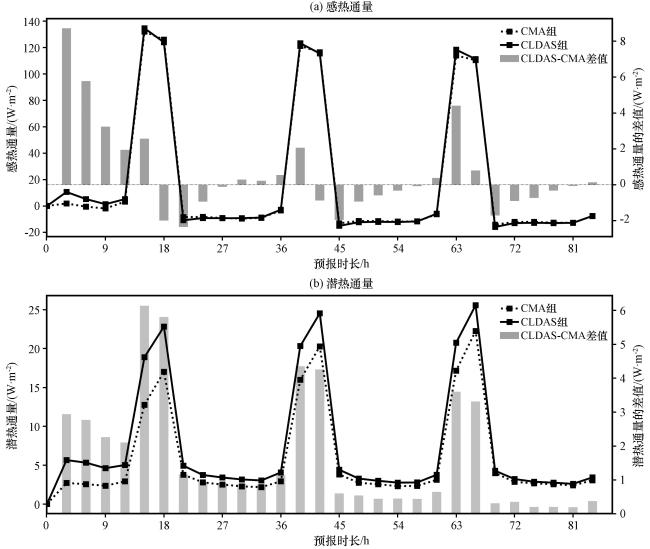
在0 h, 两组试验的感热、 潜热通量均为0;在0~15 h, CLDAS组与CMA组的感热、 潜热通量之差为正值[图9(a), (b)柱状图, 差值为CLDAS组减CMA组], 表示CLDAS组的负感热通量更少、 正潜热通量更多, 大气向地表输送的热量更少、 地表向大气输送的热量更多;在18~21 h, CLDAS组的正潜热通量更大;21 h之后, CLDAS组和CMA组的感热、 潜热通量之差呈现有规律的波动。
依据试验设计, CMA组和CLDAS组除土壤温、 湿度的初值不同以外, 其余初、 边值条件相同, 均来自于CMA-GFS。对于CMA组, 大气场和土壤温、 湿度均来自于同一模式产品CMA-GFS, 该模式产品中大气和土壤状态彼此相互平衡, 以该模式产品作为初始场, 经由WRF模式计算而得的感热通量在前12 h约为0, 潜热通量在0~84 h均为正, 随预报时长呈现有规律的波动变化[图9(a), (b)虚线]。对于CLDAS组, 其初始场中的大气场与CMA组一致, 来自于CMA-GFS, 初始场中的土壤温、 湿度来自于CLDAS数据, 相比CMA组, 在预报时长0~15 h有更大的正感热通量, 在0~84 h有更大的正潜热通量, 且两者潜热通量的差值在0~21 h更大[图9(a), (b)实线和柱状图]。这表示在预报时长0~21 h, CLDAS组中地表与大气之间的热量交换更多。
模式的spin-up表示模式达到能量平衡状态的过程, spin-up期间伴随着剧烈波动, 进行动态和热调整, 随后逐渐稳定, 达到模式中的统计平衡状态(Ma et al, 2021), 刘树华等(2008)也证实了初始土壤水、 热参数和土壤水分对模式spin-up期间的重要作用。对于CLDAS组, 初始场中来自于CMA-GFS的大气状态和来自于CLDAS的土壤温、 湿度彼此还未相互适应、 平衡, 在预报时长0~21 h通过更多的地表-大气的感热、 潜热通量, 进行热调整, 在21 h达到模式中的统计平衡状态, 0~21 h可作为模式初始场中大气和土壤温、 湿度相互调整的spin-up过程。在21~84 h, 模式中的大气和土壤温、 湿度已相互平衡, 地表-大气的感热、 潜热通量也呈现有规律的波动变化[图9实线]。
在0~21 h, CLDAS组有更多地表向上输送的感热、 潜热通量, 加热近地面大气, 因此在0~21 h, CLDAS组预报的相对湿度和2 m气温偏高, RMSE较大。在21 h之后, CLDAS组经过spin-up过程, 大气和土壤温、 湿度已达到平衡状态, 预报的相对湿度和2 m气温效果更好。
4.4 不同土壤温、 湿度初值对2 m气温的影响
为进一步探究土壤温、 湿度初值的不同组合对2 m气温的影响差异, 得出一组2 m气温预报效果最优的土壤温、 湿度初值组合, 对模拟区域内所有国家站进行分组, 对于每一个起报时次、 每一个国家站, 按照初始场采用的CLDAS数据的土壤湿度偏高/偏低(即土壤偏湿/偏干)、 土壤温度偏高/偏低(即土壤偏暖/偏冷), 进行分组(这里的“偏高/偏低”是CLDAS相比于CMA-GFS而言), 共分为四组(表1), 分别称作G1, G2, G3和G4。
表1 根据土壤温、 湿度初值差异的分组情况与成员数Table 1 Grouping and members of differences in initial soil temperature and soil moisture |
| 分组 | 第一组(G1) | 第二组(G2) | 第三组(G3) | 第四组(G4) |
|---|---|---|---|---|
| 土壤湿度 | CLDAS偏湿 | CLDAS偏干 | CLDAS偏湿 | CLDAS偏干 |
| 土壤温度 | CLDAS偏暖 | CLDAS偏暖 | CLDAS偏冷 | CLDAS偏冷 |
| 成员个数/个 | 3995 | 2911 | 1874 | 1265 |
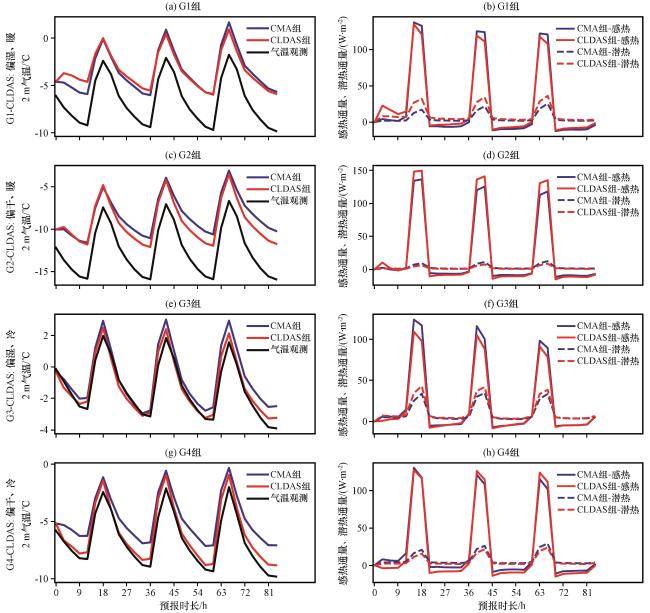


在初始土壤温度偏低时[G3和G4, 图10(e), (g)], CLDAS组对2 m气温的预报效果明显优于CMA组, 尤其是日最低气温, 几乎接近于气温观测值。其中, 偏湿的土壤初始场(G3)预报的日最高、 最低气温效果均较优;偏干的土壤初始场(G4)预报的日最高气温与CMA组效果相当。此外, 不同土壤状态对相对湿度的预报效果也与之相似, 对于偏湿、 偏冷的初始土壤(G3), 预报的相对湿度效果最优;偏干、 偏冷的土壤初值(G4)预报的日最高湿度较优。当初始土壤偏干、 偏暖时(G2), CLDAS组和CMA组预报的相对湿度效果相当(图略)。相较于土壤温度初值, 土壤湿度初值对2 m气温的预报效果影响更大(图10)。这与Chen and Dudhia(2001)的研究结果一致: 土壤湿度很大程度上会影响渗透系数和扩散率, 尤其当土壤较干时, 土壤湿度对地表热通量的影响最大(Min et al, 2016)。当初始土壤偏干时[G2和G4, 图10(c), (g)], CLDAS组预报的2 m气温效果更好、 与CMA组差异更大, 尤其针对日最低气温, CLDAS组在21~36 h、 45~60 h、 69~84 h有更大的负感热通量[图10(d), (h)], 表示有更多热量由大气向地表输送, 大气失去更多热量, 并在大气与地表之间的热量传输结束后, 2 m气温达到极小值, 在36 h、 60 h、 84 h预报的日最低气温效果更好[图10(c), (g)]。对于日最高气温, CLDAS组感热、 潜热通量呈现“一高一低”的互补形式, 即当其感热高时, 潜热低;感热低时, 潜热高, 总的热通量与CMA组并无明显差异, 故CLDAS组与CMA组对日最高气温的预报效果相当。
总的来说, 当初始场中的土壤状态是偏湿、 偏冷时(G3), CLDAS组预报的2 m气温和相对湿度效果最好, 预报气温几乎接近于观测值;当土壤初值偏湿、 偏暖时(G1), CLDAS组与CMA组预报2 m气温的效果相当。大气与地表之间的感热和潜热通量变化与初始土壤湿度密切相关。当初始场中的土壤状态偏湿时(G1和G3), 相比于CMA组, CLDAS组的感热通量更小、 潜热通量更大;当初始场中的土壤状态偏干时(G2和G4), CLDAS组的感热通量更大、 潜热通量更小, 引起地面向上感热通量增加, 加热地表和低层大气, 同时由于蒸发、 蒸腾等过程的减弱, 会导致水汽相变释放的潜热通量减少(易翔等, 2016)。
5 结论
采用CMA-GFS数据作为初、 边值条件, 并分别使用CMA-GFS和CLDAS作为土壤温、 湿度初始场, 在2023年12月10 -25日华北地区开展了连续16天的数值试验, 分析了不同土壤温、 湿度初值预报相对湿度和2 m气温的效果差异, 并探究了初始土壤偏暖/偏冷、 偏湿/偏干对2 m气温预报效果的影响, 得到以下主要结论:
(1) CMA-GFS和CLDAS的土壤温、 湿度存在显著差异。在山东中北部、 河南北部及其以北地区, CLDAS的平均土壤温度高于CMA-GFS, CMA-GFS土壤温度变化受气温影响较大。对于土壤湿度, CLDAS土壤在山西北部、 河北北部及其以北地区, 比CMA-GFS的更干;在山西南部、 河北南部及其以南地区更湿, CLDAS土壤湿度的空间分布更精细、 南北差异更大。
(2) 从预报时长上, 相比于CMA-GFS土壤温湿度初值, 在21~84 h, 以CLDAS为土壤温湿度初始场对相对湿度/2 m气温的预报效果更好, RMSE最多降低8.3% / 10%;在0~21 h, CLDAS土壤温湿度初值预报的相对湿度/2 m气温RMSE较大, 这是由于其初始场中, 来自于CMA-GFS的大气状态和来自于CLDAS的土壤温、 湿度彼此还未相互适应、 平衡, 在0~21 h通过更多地表向上输送的感热、 潜热通量, 进行热调整, 加热近地面大气, 故预报的相对湿度和2 m气温偏高, RMSE较大。在21 h之后, 大气和土壤温、 湿度已达到平衡状态, 以CLDAS为土壤温湿度初始场预报的相对湿度和2 m气温效果更好。
(3) 从空间上, 在山西南部、 河北中南部及其以南地区, CLDAS土壤温湿度初值预报的相对湿度负偏差更小、 日最高气温暖偏差更小、 日最低气温暖偏差更大, 在河南的预报效果更好, 其相对湿度偏差降低了8%, 日最高气温偏差减少了1.5 ℃。在山西北部、 河北北部及其以北地区, CLDAS土壤温湿度初值预报的相对湿度负偏差更大, 日最高、 最低气温均更优, 在内蒙古、 河北东北部、 以及辽宁西部, 其暖偏差降到2 ℃以内。
(4) 当初始土壤状态偏湿、 偏冷时, 2 m气温和相对湿度的预报效果最好, 预报的气温几乎接近于观测值;当初始土壤偏湿、 偏暖时, 以CLDAS和CMA-GFS为初始土壤温湿度对2 m气温的预报效果相差不大。相比土壤温度, 土壤湿度初值对2 m气温影响更大, 尤其当初始土壤偏干时, 对地表热通量的影响最大, 感热通量更大, 潜热通量更小, 日最低气温的预报效果更好。
由此可见, 在华北地区, 将初始场中的土壤温、 湿度替换为更精细、 更准确的CLDAS实况融合产品, 在预报时长21 h之后, 能够提升对相对湿度和2 m气温的预报效果, 虽然只改变了初始土壤温湿度, 但是由于土壤特性和大气-地表之间的相互作用, 其影响可延伸至84 h。在0~21 h, 由于大气和土壤温湿度之间相互调整的spin-up过程, 预报的相对湿度和2 m气温较差。但是, 本文只模拟了2023年12月华北地区这一个个例, 而且只分析了冬季的个例, 所得结论的普适性仍需要更多个例加以证实, 且本文结论对其他季节是否适用也需更多研究。此外, 对大气与土壤温湿度之间的相互作用只进行了初步探究, 其深层原因还需进一步分析。