

1 引言
对流层臭氧(O3)浓度主要与平流层O3向下输送(Chen et al, 2024)和大气光化学反应生成有关(Dewan and Lakhani, 2022)。与平流层O3不同, 对流层O3不仅对人类健康构成威胁, 还会对植物生长造成不同程度的损害(Zhang et al, 2019a)。近年来, 中国大气污染防治工作取得显著成效, 观测结果表明中国主要区域以细颗粒物为代表的污染物浓度显著下降(Zhang et al, 2019b)。然而, 我国对流层O3柱含量增加(杨景怡等, 2025), O3污染日益突出, 主要区域近地面O3浓度呈上升趋势(刘莹等, 2025; 卢宁生等, 2023; 郑小华等, 2021), 且O3污染成因更为复杂(Zhang et al, 2023), 给大气污染防治工作带来严峻挑战。因此, 解析近地面O3的来源及影响因素, 可为未来进一步开展O3污染防治, 改善空气质量提供重要的科技支撑。
影响近地面O3浓度的因素主要包括三个方面: 氮氧化物(NOx)和挥发性有机物(VOCs)发生光化学反应生成O3(Ma et al, 2022); O3及前体物的区域输送(Xue et al, 2014); 对流层和平流层物质交换引起O3向近地面输送(陈鹏等, 2023)。边界层内O3的光化学生成主要发生在300~1500 m高度, 边界层湍流混合使O3由边界层中上层向地面输送, 是近地面O3浓度升高的重要原因之一(Li et al, 2012)。研究指出京津冀地区的O3形成受化学过程、 垂直混合及输送等影响, 并呈现明显的季节性差异(唐颖潇等, 2022)。例如, 夏季午后的光化学过程是北京、 天津和石家庄O3浓度升高的主要驱动因素, 而垂直混合导致天津和石家庄的O3浓度上升, 但导致北京O3浓度降低。在对2015 -2021年长三角地区O3传输和源区的研究中发现, 海上气团对O3的影响最显著, 夏季的传输路径与其他季节存在明显差异(Yao et al, 2023)。上海南部和西部的跨区域输送对城区O3浓度有显著影响(Wang et al, 2020; Guan et al, 2023)。此外, 平流层O3向下输送也是导致近地面O3浓度升高的重要原因。研究指出北美地区平流层向对流层输送过程是对流层O3的重要来源, 且活动强度在春季和冬季节更为活跃(Tarasick et al, 2019)。同时, 基于CMIP6模式模拟发现西北太平洋较低的海温导致北太平洋中部下沉运动强烈(郑帅等, 2024)。在我国东部和华北平原, 夏季平流层向对流层输送对O3浓度同样具有重要贡献, 在特定气象条件下会显著提升地面O3浓度, 对区域O3污染过程具有重要影响(Meng et al, 2022)。沿海地区在太平洋副热带高压与台风背景下, 受到下沉气流的影响会导致近地面O3浓度升高(Ouyang et al, 2022)。综合而言, 不同区域O3污染成因存在显著差异, 系统分析O3污染的理化过程及潜在源区, 对制定科学的防治措施至关重要。
自2010年以来, 海南省积极推进国际旅游岛、 自由贸易试验区和中国特色自由贸易港建设, 促进了社会经济的快速发展。作为海南的省会, 海口O3污染问题日益凸显(符传博等, 2021b)。已有研究指出: 海口市O3浓度受气象要素影响显著, O3浓度与日照时间呈正相关, 与相对湿度呈负相关(符传博等, 2020); 同时, 海口O3污染与生物源挥发性有机物(BVOC)排放密切相关(曹小聪等, 2021); 基于潜在源贡献因子和浓度权重轨迹发现, 珠三角地区是海口O3污染的主要潜在贡献源区(符传博等, 2021a)。尽管现有的研究从气象条件、 前体物排放变化及O3污染潜在源区探究了海口O3浓度变化的特征和来源, 但局地光化学反应及大气理化过程对O3浓度的贡献仍缺乏系统认识。本文基于WRF-Chem模式(Weather Research and Forecasting model coupled with Chemistry)和FLEXPART模式(FLEXible PARTicle dispersion model), 量化不同理化过程对海口O3浓度变化的贡献, 解析O3污染的成因及来源。首先, 利用WRF-Chem模式模拟海口的O3浓度, 基于观测资料评估模式模拟效果, 结合过程分析方法量化理化过程对海口O3浓度变化的贡献; 其次, 利用FLEXPART-WRF模式模拟研究O3污染的潜在源区及不同源区的O3生消的理化过程差异; 最后, 利用后向轨迹结合潜在源贡献因子算法和权重轨迹分析法分析海口O3的主要潜在源区及贡献浓度。研究结果为海口市O3污染防治策略的制定提供重要理论支撑。
2 数据与方法
2.1 模式设置
观测分析发现海口O3污染在秋季较严重(符传博等, 2023)。本文采用WRF-Chem模式(V4.4)模拟2016年秋季(9 -11月)海口O3浓度, 并利用模式的过程分析功能量化不同理化过程对海口O3浓度变化的贡献。模式采用三层嵌套, 模拟区域如图1所示。文中涉及的地图是基于国家测绘地理信息局标准地图服务网站下载的审图号为GS(2024)0650号的中国地图制作, 底图无修改。投影方式采用Lambert投影, 各区域的网格数量分别为249×190(区域1)、 195×286(区域2)和229×247(区域3), 水平分辨率分别为27 km、 9 km和3 km, 区域3主要覆盖了海南岛及周边海域。垂直方向上设置51层, 顶层气压为50 hPa。WRF-Chem模式气象初始场和侧边界条件来自美国国家环境预测中心(NCEP)的FNL(Final Reanalysis Data)全球再分析资料, 空间分辨率为1°×1°, 时间间隔为6 h。化学初始场采用模式默认浓度廓线。人为排放采用清华大学研制的2016年中国多尺度排放清单模型(MEIC)资料(http: //meicmodel.org.cn/), 分辨率为0.25°×0.25°; 植被的生物源挥发性有机物(BVOC)排放使用MEGAN模型模拟得到(Tie et al, 2013)。模式采用分段积分, 每月模拟1次[即8月27日08:00至10月1日08:00; 9月26日08:00至11月1日08:00; 10月27日08:00至2月1日08:00, 时间为北京时(下同)], 前5天模拟结果作为模式启动时间, 不参与后续分析。采用分析nudging减小气象场模拟偏差。WRF-Chem模式逐时输出一次结果, 具体的参数化方案如表1所示。模式分辨率超过5 km时, 一般能模拟出积云动力过程, 因此只有区域1采用积云参数化方案。
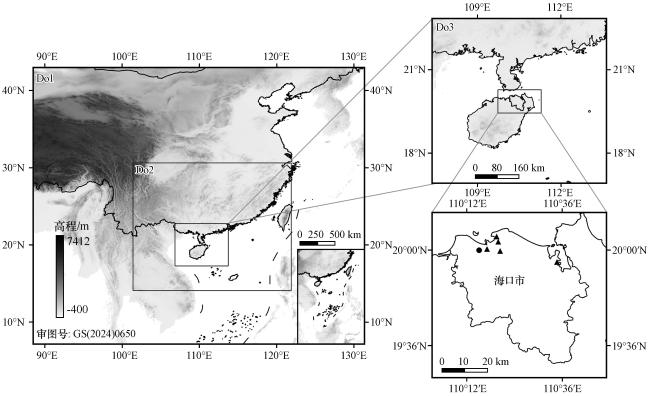
图1 WRF-Chem模拟区域(填色, 单位: m)黑色点表示国家基准气候站, 黑色三角表示国控环境空气质量监测站 Fig.1 WRF-Chem simulation area (color represents elevation, unit: m).The black dots indicate the national benchmark climate stations, and the black triangles indicate the state-controlled ambient air quality monitoring stations |
表1 WRF-Chem模式的物理和化学参数化方案Table 1 Physicochemical parameterization scheme of WRF-Chem mode |
| 参数类型 | 物理/化学模块名称 | 参数化方案 |
|---|---|---|
| 物理参数化方案 | 微物理方案 | Purdue Lin(Lin et al, 1983) |
| 边界层方案 | MYJ(Hong et al, 2006) | |
| 积云参数化方案 | GF(Grell and Dévényi, 2002) | |
| 长波辐射 | Goddard(Iacono et al, 2008) | |
| 短波辐射 | Goddard(Iacono et al, 2008) | |
| 陆面过程 | Noah(Chen et al, 2001; Ek et al, 2003) | |
| 化学参数化方案 | 气相化学方案 | RADM2(Stockwell et al, 1990) |
| 气溶胶方案 | SORGAM(Schell et al, 2001) | |
| 光解方案 | F-TUV(Madronich and Flocke, 1999) | |
| 气溶胶反馈 | 开启 |
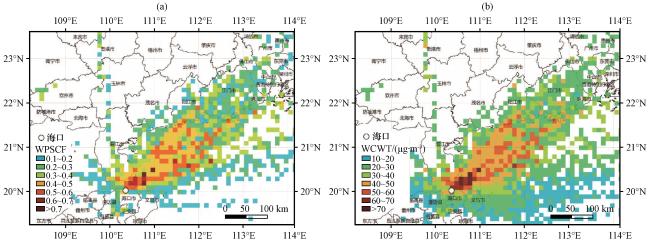
此外, 本文利用FLEXPART模式开展后向轨迹模拟, 基于后向轨迹, 采用潜在源贡献因子算法(Potential source analysis function, PSCF)和权重轨迹分析法(Concentration weight trajectory, CWT)分析海口O3污染的潜在源区(Seibert et al, 2004; Wang et al, 2009)。WRF-Chem模式模拟区域3的气象场作为FLEXPART模式气象驱动场。FLEXPART模式参数设定如下: 以海口主城区(19.96°N, 110.27°E)为粒子释放点, 采用小时级连续释放机制, 模拟期间累计释放2183个示踪粒子, 单粒子生命周期设定为48 h。该配置有效平衡了时空分辨率与计算效率, 确保对污染物输送路径的动态捕捉能力。
2.2 过程分析方法
过程分析方法将影响O3的物理化学过程单独输出, 通过对单独变量的分析研究O3浓度变化的成因。模式中的污染物浓度的变化主要由以下几个部分构成:
式中: 、 和 分别代表化学过程、 物理过程和排放变化引起的污染物浓度的变化。物理过程包括平流、 垂直混合和干湿沉降, 化学过程主要为气相化学, 通过将理化过程影响的O3浓度变化单独输出, 分析O3浓度变化的原因。本文中理化过程变量包括: (1)光化学反应过程净贡献(Chem_O3), 该过程与温度、 辐射等气象因子有关; (2)垂直混合与干沉降过程净贡献(Vmix_O3), 该过程与边界层高度和相对湿度等气象因子有关; (3)平流输送过程净贡献(ADVT_O3= Advh_O3+ Advz_O3), 该过程受风场的影响。式(1) 中的 是dt时刻的O3直接排放量, 而O3作为大气中典型的二次污染物, 实际并不存在直接排放, 因此这里的 值为0。
2.3 潜在源区
本文利用FLEXPART模拟后向轨迹, 并结合Meteoinfo软件中的trajstat工具计算海口O3的PSCF和CWT, 探究秋季O3的潜在来源区域(Wang et al, 2009)。以区域2(图1)作为研究范围模拟24 h后向轨迹, 模拟高度参考以往研究设定为500 m, 以更准确反映边界层的平均流层特征(蒲茜等, 2022)。
为了降低 较少带来计算结果不确定性, 引入权重函数 :
式中: 为研究区域内的平均轨迹端点数。
CWT是一种计算潜在源气团轨迹权重浓度, 并用于反映不同轨迹的污染程度的方法(Hsu et al, 2003)。计算如下:
式中: 是网格(i, j)上的平均权重浓度; 是轨迹k经过网格时对应的O3浓度; 为停留在网格点的时间。
2.4 模式评估
考虑站点观测有效数据的比率(>90%), 选用海口2个自动气象站和3个空气质量监测站(图1)的观测资料评估WRF-Chem模式模拟气象场和O3浓度的效果, 气象和空气质量观测资料的时间分辨率为1 h。采用的气象要素包括2 m温度(T2)、 2 m相对湿度(RH2)、 地表气压(Psur)和10 m风速(WS10)。
本文采用相关系数(R)、 平均偏差(MB)、 标准化平均偏差(NMB)、 标准化平均误差(NME)和均方根误差(RMSE)评价模型的性能(Zhang et al, 2006; Song et al, 2017)。统计公式如下:
式中: 为模型在第 时刻的模拟值; 为第 时刻站点观测值; 与 为模拟与观测的平均值; 为样本总数。R值的高低代表了两个变量之间线性关系的强弱, 其值越高代表模拟与观测的相关性越强。MB是模拟值和观测值之间的偏差, 用于评估模拟和观测值之间的误差。NMB用于判断模式的系统性高估或低估问题, 其值越小表示模拟值与观测值的相对偏差越小。NME用于定量评价模式的整体误差水平, 其值越小, 表示模拟值与观测值之间的误差越小, 模式性能越好。RMSE用于衡量模拟值和观测值之间的差异, 其值越小表示模拟值和观测值越接近, 模拟效果越好。
3 结果与讨论
3.1 气象场和臭氧模拟评估
气象场(风向、 风速、 温度等)是影响化学场模拟的重要因素之一, 本文WRF-Chem模式能较准确的模拟近地面气象场(表2), 模拟T2、 RH2、 WS10和Psur与观测值的R分别为0.93、 0.78、 0.83、 0.99, RMSE分别为1.2 ℃、 6.8%、 2.1 m·s-1和1.6 Pa。与T2和Psur相比, 模式模拟RH2和WS10的误差相对较大。模式模拟WS10的MB和NMB分别为1.4 m·s-1和43.2%, 表明模式高估了WS10模拟。WRF-Chem模式受模拟分辨率和地形特征的影响, 不同地区模拟结果的误差有差异(Feng et al, 2022; Song et al, 2017; 吴迪等, 2023)。对比以往中国中部(Min et al, 2022; Yan et al, 2020)、 中国东部(Gao et al, 2020)和珠三角地区(赖安琪等, 2017)的气象场模拟评估结果显示, T2的R和RMSE范围分别为0.87~0.93和1.31~2.57 ℃, RH2的R和RMSE范围分别为0.73~0.92和13.95%~18.77%, WS10的R和RMSE范围分别为0.36~0.78和1.26~1.74 m·s-1。本文对气象场的模拟精度与前人研究相比相当, 且WS10的相关性更好(Min et al, 2022; Mar et al, 2016; 王秀智等, 2024)。
表2 2016年9 -11月WRF-Chem模式气象场和O3 评估结果Table 2 Evaluation of meteorological and ozone simulation of WRF-Chem model from September to November 2016 |
| R | MB | NMB | NME | RMSE | |
|---|---|---|---|---|---|
| T2 | 0.93 | 0.3 °C | 1.0% | 3.3% | 1.2 °C |
| RH2 | 0.78 | -0.8% | -1.0% | 6.4% | 6.8% |
| WS10 | 0.83 | 1.4 m·s-1 | 43.2% | 48.9% | 2.1 m·s-1 |
| Psur | 0.99 | 1.4 Pa | 0.1% | 0.1% | 1.6 Pa |
| O3 | 0.67 | 24.1 µg·m-3 | 0.4% | 0.5% | 39.2 µg·m-3 |
相关性系数均通过95%置信区间的显著性检验(The correlation coefficients passed the significance test at the 95% confidence intervals) |
WRF-Chem模式模拟O3的R、 MB、 NMB、 NME和RMSE分别为0.67、 24.1 µg·m-3、 0.4%、 0.5%和39.2 µg·m-3(表2)。虽然模拟结果高于站点观测值, 但与观测站O3浓度的波动趋势基本一致, 对比中国中部和珠三角地区的评估结果(R为0.61~0.85, RMSE为30~40 µg·m-3), 本文中WRF-Chem模式较准确模拟了海口O3浓度的变化特征(Min et al, 2022; 赖安琪等, 2017)。
3.2 臭氧浓度变化过程分析
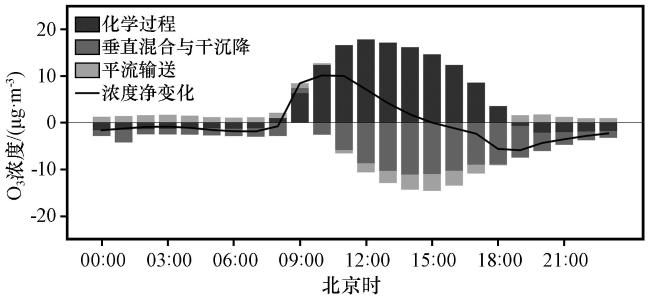
采用WRF-Chem模式的过程分析方法, 定量评估了2016年秋季海口市不同理化过程对O3浓度变化的影响, 解析O3的形成机制, 并计算各理化过程对近地面O3浓度的贡献。研究结果表明, 不同理化过程对海口市O3浓度的驱动作用存在显著的日变化特征, 其中白天O3浓度波动较大, 夜间变化幅度较小(图2)。具体表现为, 在每日的08:00 -18:00, 化学过程对O3浓度呈现正贡献, 平均贡献值为11.5 μg·m-3, 其中12:00贡献值达到最大, 为17.8 μg·m-3。这一时段内, 日照逐渐增强, 使得O3生成的光化学反应逐步加强(Wang et al, 2016)。夜间由于缺乏太阳辐射, 光化学反应基本停止, O3生成过程趋于停滞, 而化学消耗过程增强, 导致化学过程对O3浓度的贡献值转换为负值, 平均贡献值为-1.5 μg·m-3。综上, 化学过程白天促进O3浓度的升高, 夜间则对O3具有微弱的清除作用。垂直混合与干沉降过程对海口O3浓度主要起到清除作用。先前观测发现清晨残留层内存储了大量O3(Zhu et al, 2020), 09:00随着地面温度的逐步上升, 湍流逐渐增强, 边界层内混合程度随之加大, 使残留层O3向近地面输送, 此时垂直混合与干沉降过程对近地面O3贡献为正。同时, 随着太阳辐射增强, 近地面通过光化学反应生成O3明显增加, 湍流加剧了O3在垂直方向的扩散, 导致随后的垂直混合与干沉降过程对近地面O3贡献为负。这种现象与大部分地区的研究结果一致, 即边界层湍流活动增强, 垂直混合加强, 使得低层O3向上扩散, 从而降低近地面O3浓度(Kulmala et al, 2023; He et al, 2021)。夜间, 地面温度下降, 边界层稳定性增强, 湍流活动显著减弱, 垂直混合过程对O3浓度的削弱效应也相应减弱, 沉降作用消耗近地面O3。此外, 白天大部分时段, 平流输送消耗了海口近地面O3, 夜间平流输送对海口近地面O3贡献为正。与其他地区相比, 海口市O3理化过程的日变化特征存在显著差异。华北及华东地区的模拟研究表明, 化学过程对近地面O3主要表现为负贡献, 而垂直混合则促进O3浓度升高(唐颖潇等, 2022; Gao et al, 2020)。相比之下, 海口白天的化学过程呈正贡献, 夜间转为负值, 垂直混合则主要起到削减近地面O3的作用。
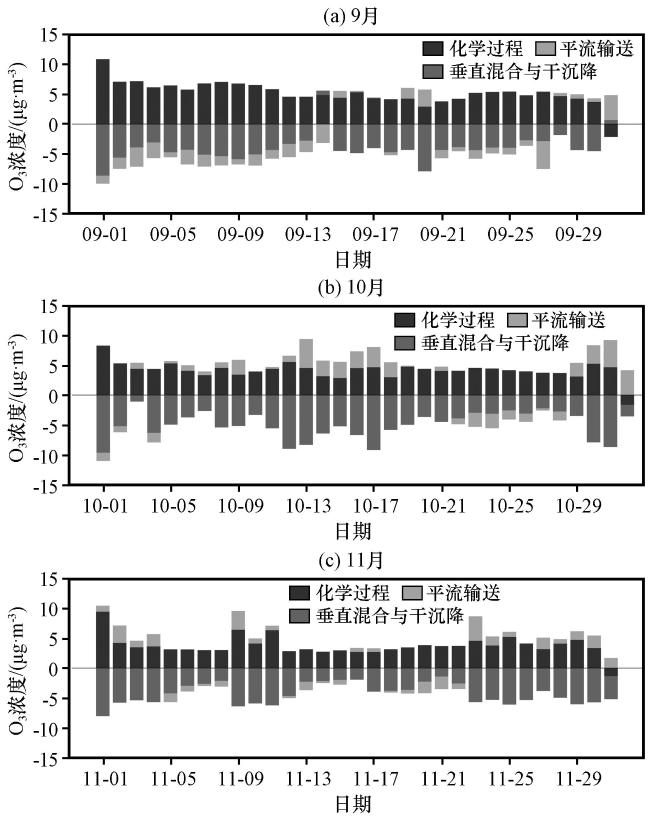
从不同过程对海口O3浓度影响的逐日变化来看(图3), 化学过程、 垂直混合与干沉降过程对O3浓度的影响较大, 平流输送影响相对较小。这一特征与中国大陆地区O3浓度受化学过程影响的研究结果有所不同(沈劲等, 2019)。化学过程是海口市O3浓度的主要来源, 其对O3浓度的日均贡献约为4.0 μg·m-3。随着太阳直射点逐渐南移, 单位面积接收到的太阳辐射能量逐渐减少, 化学过程对O3浓度变化的贡献在9 -11月呈现下降趋势, 平均贡献值分别为5.3 μg·m-3、 4.2 μg·m-3和3.8 μg·m-3。垂直混合在O3的扩散过程中发挥了重要作用, 导致O3浓度减少约4.1 μg·m-³。主要通过将地面O3及前体物向高空输送, 降低地面O3浓度, 其负贡献在高风速和高温条件下尤为显著, 随着气温的逐渐下降, 垂直混合的强度减弱, 负贡献有所减小。平流输送的日均贡献表现出较大的波动性, 既有负贡献也有部分正贡献。海口地理位置特殊, 来自东南方向的气团一方面有助于将污染物和O3从观测区域输送出去, 另一方面带来相对清洁的空气从而降低海口O3浓度, 通常增强了平流输送的负贡献; 而来自东北方向的气团将高浓度O3从大陆输送到海口, 导致平流输送对O3浓度正贡献。综合而言, 海口O3浓度的变化主要受化学过程、 垂直混合与干沉降过程影响, 化学过程导致O3浓度升高, 而垂直混合与干沉降导致O3浓度下降。与化学过程、 垂直混合与干沉降过程影响相比, 平流输送的影响相对较小, 但波动较大。
3.3 臭氧来源分析
基于FLEXPART-WRF模式模拟的海口市48 h后向轨迹进行聚类, 分析发现2016年秋季海口市气流主要来自两广交界地区(CT1和CT3)、 珠三角地区(CT2和CT6)、 海口以南区域(CT5)和东南海域(CT4)(图4)。基于空气质量观测分析显示海口秋季O3平均浓度为45.5 μg·m-3, O3_8h平均浓度为72.1 μg·m-3。方差分析发现不同气团来源, 海口O3平均浓度差异显著(p<0.05)(表3)。不同气团来源时, 化学过程对海口O3浓度贡献均为正, 垂直混合与干沉降过程对海口O3浓度贡献均为负, 而平流输送的影响则存在显著的差异(表3)。当气团来自两广交界地区时对海口O3污染贡献最大, O3日均浓度最高为71.4 μg·m-3, 平流输送过程的日均贡献为1.5 μg·m-3; 来自东南海域的清洁气团对应的O3浓度最低为28.7 μg·m-3。此外, CT2和CT6虽然平流输送为负, 但本地化学反应贡献较高, 分别为4.1 μg·m-3和4.4 μg·m-3, 说明这些气团虽未携带大量O3, 但在本地具备较强的O3生成潜力。海口市秋季O3污染的形成受多种气团路径共同影响, 既有外来区域输送, 也有本地生成与扩散条件的共同作用。
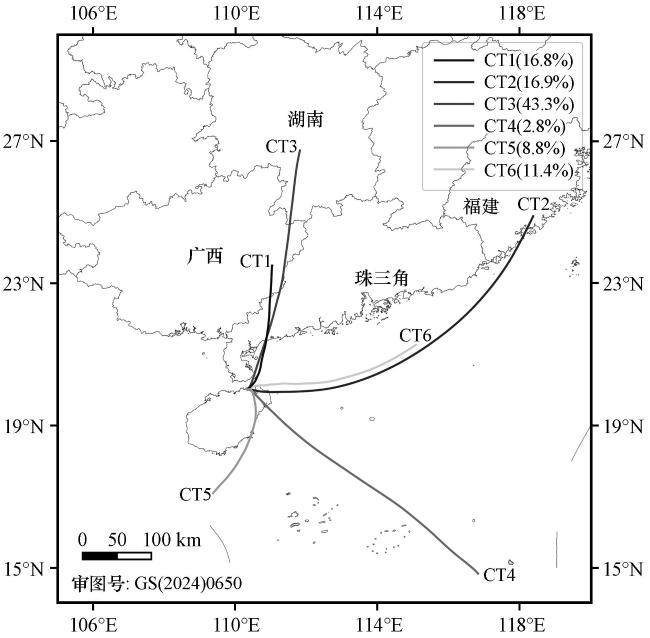
图4 2016年秋季海口市48 h后向轨迹Fig.4 The 48 h backward trajectory of Haikou in the autumn of 2016 |
表3 不同来源气团下平均O3 浓度和理化过程贡献Table 3 Average O3 concentration and physicochemical process contribution under different source air masses |
| CT1 | CT2 | CT3 | CT4 | CT5 | CT6 | |
|---|---|---|---|---|---|---|
| 发生频率/% | 16.8 | 16.9 | 43.3 | 2.8 | 8.8 | 11.4 |
| O3浓度/(μg·m-3) | 56.1 | 42.3 | 71.4 | 28.7 | 31.9 | 42.9 |
| 化学过程/(μg·m-3) | 5.1 | 4.1 | 4.2 | 3.6 | 6.4 | 4.4 |
| 垂直混合与干沉降过程/(μg·m-3) | -3.7 | -3.2 | -5.7 | -3.1 | -5.0 | -2.7 |
| 平流输送过程/(μg·m-3) | -1.3 | -1.4 | 1.5 | -1.1 | -1.4 | -0.7 |
本文以60 μg·m-3作为污染轨迹的标准, 计算O3潜在源区贡献因子, 其中PSCF值越大, 表示该区域对海口O3的影响越大。CWT法对O3进行浓度权重轨迹分析, 可以反映污染网格具体的浓度贡献, CWT值与PSCF共同分析对海口O3污染的主要来源及贡献浓度。图5表明海口主要的来源贡献位于东北方向, 其中临海区域对O3的月均贡献高达70 μg·m-3, PSCF的值高于0.6, 表明海口受到临海船舶等海上交通排放的影响, 对O3高值有明显贡献。来自珠江三角洲远距离传输的气团对海口O3的影响较大, 贡献为20~50 μg·m-3, PSCF>0.4。来时两广交界地区对海口O3的月均贡献高于20 μg·m-3, 可能主要受贵港市的影响。海口以南区域对站点影响较小, 受海上清洁气团的影响, O3的PSCF<0.2。CWT的结果与PSCF的结果接近。


4 结论
本文基于WRF-Chem和FLEXPART模式, 结合PSCF和CWT等方法, 模拟研究了不同理化过程对2016年秋季海口市O3浓度变化的影响因素, 分析了海口O3污染的潜在源区, 得出了如下主要结论:
(1) 过程分析揭示了化学过程是秋季海口市O3浓度变化的主导因素, 其对海口市秋季O3浓度日变化的贡献最大。而垂直混合过程在日变化中主要发挥清除作用。随着9 -11月太阳辐射的减弱, 化学过程对O3浓度的正贡献逐月下降, 而垂直混合过程的负贡献也随气温降低和湍流活动减弱而有所减小。
(2) 基于FLEXPART-WRF模式的轨迹聚类分析表明, 平流输送对O3浓度的影响取决于气团的来源方向, 当气团来自海口市北部与东北部时, 平流贡献较高, 而来自东南部和南部的海洋气团相对清洁, 有助于降低当地O3浓度。结合PSCF和CWT分析发现海口临近东北方向海域对O3的月均贡献达到70 μg·m-3, 广东东南区域是海口O3污染主要的贡献源区。