The Relationship Between Springtime Surface Sensible Heat Enhancement over the Qinghai-Xizang Plateau and Spring Rainfall in Southern China

  • Yuxia LU , 1, 2 ,
  • Hui WANG , 1, 2 ,
  • Yu CHEN 1, 2 ,
  • Shuangxing LI 1, 2 ,
  • Zitao WANG 1, 2 ,
  • Dongliang LI 1, 2
Expand
  • 1. State Key Laboratory of Climate System Prediction and Risk Management/Key Laboratory of Meteorological Disaster,Ministry of Education/Collaborative Innovation Center on Forecast and Evaluation of Meteorological Disasters,Nanjing University of Information Science and Technology,Nanjing 210044,Jiangsu,China
  • 2. School of Atmospheric Sciences,Nanjing University of Information Science and Technology,Nanjing 210044,Jiangsu,China

Received date: 2025-02-03

  Revised date: 2025-05-14

  Online published: 2026-01-26

Copyright

© Editorial Department of Plateau Meteorology (CC BY-NC-ND)

Abstract

Based on daily surface sensible heat flux (SH) data from 73 meteorological stations across the central-eastern Qinghai-Xizang Plateau, daily precipitation data from 402 stations in southern China, and ERA5 reanalysis data, this study investigates the springtime enhancement characteristics of SH over the central-eastern Qinghai-Xizang Plateau, its influence on spring rainfall in southern China, and the associated physical mechanisms.The results indicate that: (1) The springtime surface sensible heat peak time (T) and enhancement intensity (Q) over the central-eastern Qinghai-Xizang Plateau exhibit significant interannual and decadal variability, with a strong positive correlation between them.Specifically, a later occurrence of the peak sensible heat in spring is associated with a stronger enhancement intensity.(2) Both T and Q exhibit significant positive correlations with spring rainfall in southern China.To evaluate their combined effects, a composite index termed the Surface Sensible Heat Enhancement Index (ISH ) is introduced.This index demonstrates a strong positive correlation with spring rainfall in southern China (correlation coefficient = 0.60, p<0.01).Moreover, its influence is largely independent of external factors, such as sea surface temperatures in the central-eastern Pacific and the tropical Indian Ocean.(3) In years with a high (low) ISH index, the springtime subtropical westerly jet is anomalously southward (stronger), and the westerly winds south of the Qinghai-Xizang Plateau are anomalously strong (weak).The average geopotential height at 500 hPa and 850 hPa over the Chinese mainland is anomalously lower (higher), and the lower troposphere in southern regions is dominated by an anomalously low (high) pressure system.In eastern coastal areas, the low-altitude southwest (northeast) wind is anomalously stronger, leading to water vapor convergence (divergence).Combined with warm (cold) advection and strong ascending (descending) motion, this creates conditions that are conducive (not conducive) to precipitation formation.Consequently, spring rainfall in southern China becomes anomalously abundant (scarce).This study provides new insights into the factors contributing to spring rainfall variability in southern China, improves the predictability of regional spring weather and climate, and provides a robust scientific foundation for mitigating disaster risks associated with abnormal spring rainfall patterns.

Cite this article

Yuxia LU , Hui WANG , Yu CHEN , Shuangxing LI , Zitao WANG , Dongliang LI . The Relationship Between Springtime Surface Sensible Heat Enhancement over the Qinghai-Xizang Plateau and Spring Rainfall in Southern China[J]. Plateau Meteorology, 2026 , 45(1) : 48 -61 . DOI: 10.7522/j.issn.1000-0534.20XX.00066

1 引言

青藏高原(以下简称高原)是世界上地形最复杂、 海拔最高的高原, 平均海拔超4000 m, 也被称为“世界屋脊”和“地球第三极”(Qiu, 2008)。高原的隆起形成了一个高耸入对流层中层大气的动力和热力强迫源, 显著调制着北半球的大气环流和亚洲季风进程(叶笃正等, 1957Yanai et al, 1992Wu and Zhang, 1998Zhao and Chen, 2001Duan et al, 2011Wu et al, 2015Wang and Li, 2018Zhang et al, 2019Wang et al, 2022a)。研究显示, 高原上空气柱的加热主要来自于强烈的近地层非绝热加热, 其中地表感热通量在高原热量收支中贡献最大(叶笃正和高由禧, 1979吴国雄等, 2018)。高原地表感热年内呈单峰型变化, 在冬季最弱, 春季最强(李栋梁等, 2003Duan and Wu, 2008Yang et al, 2014于威等, 2018Wang et al, 2019bLiu et al, 2020Fan et al, 2021), 在冬末春初存在一个快速增强的过程。王蕊等( 2023)研究指出, 高原地表感热年内由弱转强时间主要发生在3月, 之后迅速增强, 并在5月份达到最强值。目前对高原地表感热特征及气候效应的研究大多关注其月和季节尺度平均值的变异性(Duan et al, 20132017Duan and Wu, 2005Liu et al, 2020Wang et al, 2022a; Yang et al, 2011戴逸飞等, 2016雷润芝等, 2023), 对其日或候尺度年内循环特征及其影响的研究还不多见。由于月和季节尺度的平均值会大大削弱地表感热年内循环变化的细节特征, 既不能识别出高原地表感热源的强弱转换时间, 也不能识别其增强过程持续时间和增强强度, 限制了其对东亚气候影响的深刻认识, 所以研究高原地表感热通量的日或候尺度年内循环特征及其气候影响是很有必要的。
中国是全球最大的粮食生产国, 春季是农业生产关键需水期。中国东南部春季存在一段持续而相对稳定的多雨期, 是东亚独特的天气气候现象(Tian and Yasunari, 1998万日金和吴国雄, 2006Wan and Wu, 2007刘宣飞和袁旭, 2013王黎娟和高龙龙, 2017), 有着范围大、 温度低、 持续时间短的特点(万日金和吴国雄, 2008Chen et al, 2014)。这种持续时间较长的连阴雨天气对农作物的播种、 生长及收获等均产生不利影响, 同时对工业、 交通运输和仓库管理等方面也有很大的危害。Tian and Yasunari(1998)第一次提出春季持续降水的概念, 认为江南春季持续降水的形成是春季季节增暖的时滞效应。众多研究指出, 高原的动力和热力作用与我国东部地区冬、 春季降水异常关系密切(蒋艳蓉等, 20082009李超等, 2010Li and Zhang, 2012)。江南春雨的出现与高原地形强迫绕流的西南风以及地表抬升加热形成的气旋性低压环流的西南风有关(万日金和吴国雄, 2006李天航和刘宣飞, 2016), 南支西风绕流有利于高原东南侧的暖湿气流向华南及江南地区输送(张永莉等, 2023), 产生连阴雨天气。那么高原春季地表感热增强时间和增强强度与我国南方春雨量之间有着怎样的联系?这一问题值得深入探究。本文利用1982 -2020年高原中东部73个地面气象站逐日地表感热通量资料, 分析了高原春季地表感热达最强时间和增强强度变化特征, 定义了高原地表感热年内增强综合指标, 并分析其与中国南方春雨的联系和物理过程, 以期为提高中国南方春雨变异原因的认识, 增强中国南方地区春季天气和气候的可预报性, 不同程度地防御和减少由春雨异常造成的多种灾害风险提供科学依据和技术支撑。

2 资料来源和方法介绍

2.1 研究资料

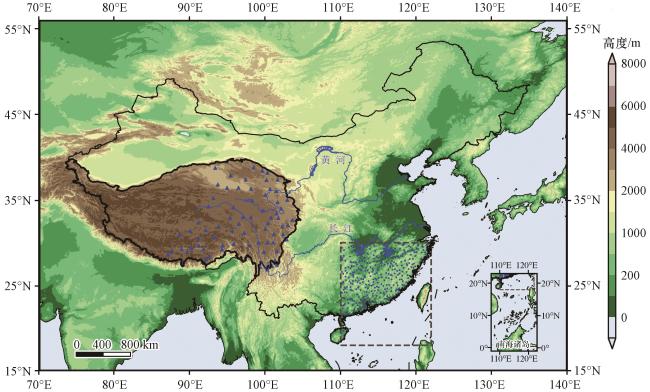
本文所用资料包括: (1)1982 -2020年高原中东部地区 (26°N -40°N, 80°E -105°E) 73个地面气象站逐日观测资料和中国南方地区 (18°N -30°N, 110°E -122°E) 402个气象站逐日降水观测资料, 站点分布如图1所示。
图1 中国地形以及中国南方站点(蓝色圆点)和高原中东部站点(蓝色三角)分布

Fig.1 Topography of China and distribution of stations in southern China (blue dots) and the central-eastern Qinghai-Xizang Plateau (blue triangle)

(2) 欧洲中期天气预报中心(European Centre for Medium-range Weather Forecasts, ECMWF)提供的第五代再分析数据(the 5th ECMWF Re-Analysis data, ERA5)逐月再分析数据集, 其中包括位势高度场、 U、 V风场、 垂直速度场、 海平面气压和水汽场等环流要素场, 空间分辨率为0.25°×0.25°。
(3) 热带太平洋NINO 3.4区(5°N -5°S, 170°W -120°W)海表温度距平指数和热带印度洋全区一致海温模态(Indian Ocean Basin Mode, IOBM)指数均来自国家气候中心“气候与气候变化监测预测系统”的130项监测指数(http: //cmdp.ncccma.net/Monitoring/cn_index_130.php)。
文中涉及的地图是基于中华人民共和国自然资源部地图技术审查中心标准地图服务系统下载的审图号为GS(2020)4619的中国地图和审图号为GS(2016)1666的世界地图制作,底图无修改。

2.2 地表感热通量计算方法

感热通量利用总体输送公式进行估算, 该方法在高原热力特征及其影响相关研究中得到了广泛应用(Yeh, 1982徐国昌等, 1990李栋梁等, 1997Duan and Wu, 2006周连童和黄荣辉, 2008Yang et al, 2011Zhu et al, 2017Chen et al, 2019Wang et al, 2019a):
S H = ρ c p C h U ( T s - T a )
式中: SH为地表感热(单位: W·m-2); ρ为干空气密度, 由干空气状态方程ρ=Ps/(RdTa确定(单位: kg·m-3); Ps为本站气压(单位: hPa); Rd =287.04 J·K-1·kg-1为干空气比气体常数; cp 是定压状态下干空气的比热, 为1004 J·K-1·kg-1U为10 m风速(单位: m·s-1); Ts 为地面0 m的温度(单位: K), Ta 为1.5 m处百叶箱温度(单位: K); C h 为地表热力输送系数(无量纲), 由高原不同下垫面 Ch-INDV 参数化关系确定(Wang et al, 2019a):
C h = - 0.0045 I N D V 2 + 0.0074 I N D V + 0.0021 0.5 I a v e < 1 0.0062 I N D V 2 - 0.0020 I N D V + 0.0021 0.35 I a v e < 0.5 0.0120 I N D V   2 - 0.0015 I N D V + 0.0029 0 I a v e < 0.35
式中: INDV 为归一化差异植被指数; Iave 为1982 - 2020年各站5 -9月平均INDV 的多年平均, 其中当 0.5≤Iave <1 时, 为长草甸型下垫面, 植被茂密且高度在 10 cm 以上; 当 0.35≤Iave <0.5时, 为短草甸型下垫面, 植被茂密但是高度在10 cm 以下; 当0≤Iave <0.35时, 为稀疏草甸型下垫面, 植被稀疏且低矮。

2.3 高原地表感热春季增强量的定义

本文主要关注高原春季地表感热增强过程, 时间范围为第13~33候。用xii=1, 2, …, 72)代表1年中1~72各侯的感热通量平均值, 每年第13候及其感热值作为春季地表感热开始增强的时间和强度, m a x x i出现的时间T(候)和强度作为春季地表感热最强时间和强度。所以, 春季地表感热增强强度: Q = i = 13 t m a x ( x i )(单位: W·m-2), 其中, Δ x i = x i - x i - 1为逐候增量(单位: W·m-2)。

2.4 南方春雨量的定义

我国南方春雨总量为从春雨开始时间至春雨结束时间的候累积降水量。春雨开始时间为从第13候起第一个雨量大于 4 mm·d-1的候, 且后面3候至少1候也达到4 mm·d-1万日金和吴国雄, 2008王黎娟和高龙龙, 2017胡雅君等, 2017)。由于东亚夏季风的开始以南海夏季风的爆发为标志(Ding and He, 2006Kueh and Lin, 2010), 所以, 本文将南海夏季风的爆发时间(Kajikawa and Wang, 2012)作为春雨结束的时间。
本文选取范围5°N -15°N, 110°E -120°E的南海地区, 参照Kajikawa and Wang(2012)用纬向风的日资料来进行定义南海夏季风爆发时间, 具体为在4月25日之后且满足以下条件: (1)在起始日和起始日后5天期间, 平均的夏季风指数必须大于0(意味着西风稳定建立); (2)在随后的20天中, 夏季风指数必须在至少15天内为正; (3)累积的20天平均夏季风指数必须大于1 m·s-1(意味着持续的季节性转变)。由于分析的高原感热年内增强过程为候尺度, 南海夏季风爆发时间也由日尺度转化为候尺度。

2.5 分析方法

本文使用的分析方法主要包括简单相关、 偏相关、 t检验、 回归分析和合成分析等数理统计分析方法(魏凤英, 2022)。
本文使用高原春季地表感热达最强时间(T)和增强强度(Q)的经验正交函数(EOF)分析第一模态时间系数(PC1), 并参考这两个因子与中国南方春雨量之间相关系数的加权(Wang et al, 2022b)定义了一个高原地表感热增强过程量综合指数(ISH ), 其计算如下:
I S H = r 1 * T   P C 1 + r 2 * Q   P C 1 r 1 + r 2
式中: r 1 r 2表示春雨量与T的PC1和Q的PC1之间的简单相关系数。
温度水平平流可以表征大气的水平运动对热量的输送, 其正值对应暖平流, 负值对应冷平流, 其中暖平流使得局地增温, 冷平流使得局地降温(朱乾根等, 2007)。温度水平平流的计算如下:
- V T = - u d T d x + v d T d y
式中: uv均表示水平风场, T表示大气温度。

3 高原春季地表感热达最强时间和增强强度特征

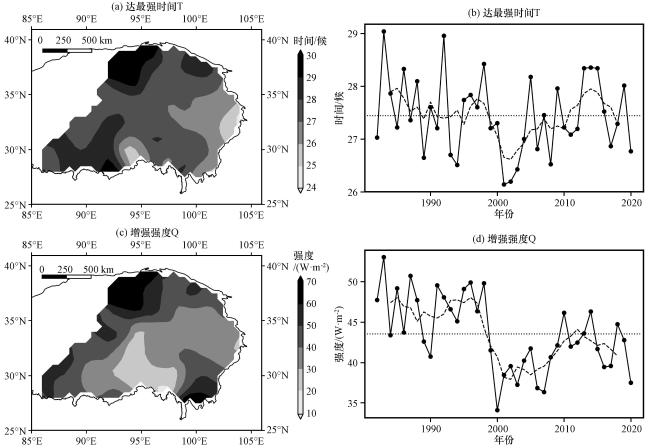
图2给出了高原春季地表感热达最强时间(T)和增强强度(Q)气候态平均的空间分布和时间演变。从图2(a)可以看出, 多年平均的T自东向西逐渐变晚, 在四川西部和青海东南部T较早, 大致在第24~27候, 即在4月底到5月中旬出现, 其中丽江站(100.22°E、 26.85°N)多年平均T最早, 为第24候; 在青海西北部和西藏中部T较晚, 可达第28候之后, 即在5月底出现, 其中小灶火站(93.68°E、 36.80°N)多年平均T最晚, 在第30候出现。由图2(b)可知, 1982 -2020年T在第26~29候之间变化, 平均为第27候, 具有明显的年际波动, 在2001年之前波动下降, 即感热达最强时间有变早趋势, 在2001年之后又开始波动上升, 感热达最强时间变晚。其中1983年T最晚, 可达到第29候, 2001年T最早, 仅为第26候。由Q的平均空间分布[图2(c)]可知, 以西藏东部为中心, Q向四周逐渐增强, 大值中心在青海西北部和四川与云南的西部交界处。在四川西部、 西藏中部和青海西北部Q较强, 可达50 W·m-2以上, 其中丽江站(100.22°E、 26.85°N)Q最强, 为91.3 W·m-2; 在西藏中东部Q最弱, 在30 W·m-2以下, 其中嘉黎站(93.28°E、 30.67°N)Q仅为17.8 W·m-2。由图2(d)可以发现, 1982 -2020年Q有显著减弱趋势, 且存在明显年代际变化, 均值为43.6 W·m-2; 1999年之前Q以偏强为主, 在1983年Q最强, 达53.1 W·m-2; 1999年之后普遍偏弱, 2000年Q在35 W·m-2以下, 这与高原春季地表感热的演变比较一致(张璐等, 2020王慧等, 2022)。高原中东部区域平均TQ的相关系数为0.47, 通过了α=0.01显著性水平t检验(p<0.01), 表明春季地表感热达最强时间T越晚, 增强强度Q往往也越强。
图2 1982 -2020年高原春季地表感热达最强时间T(a, b, 单位: 候)和增强强度Q(c, d, 单位: W·m-2)气候态平均的空间分布(a, c)和时间演变(b, d)

图(b)和(d)中, 虚线为五点平滑值, 点线为平均值

Fig.2 The climatological mean spatial distribution (a, c) and temporal evolution of the peak time T (a, b, unit: pentad) and enhancement intensity Q (c, d; unit: W·m⁻²) of the springtime sensible heat over the Qinghai-Xiang Plateau from 1982 to 2020.In (b) and (d), the dashed line represents the five-point smoothed values, and the solid lines represent the mean values

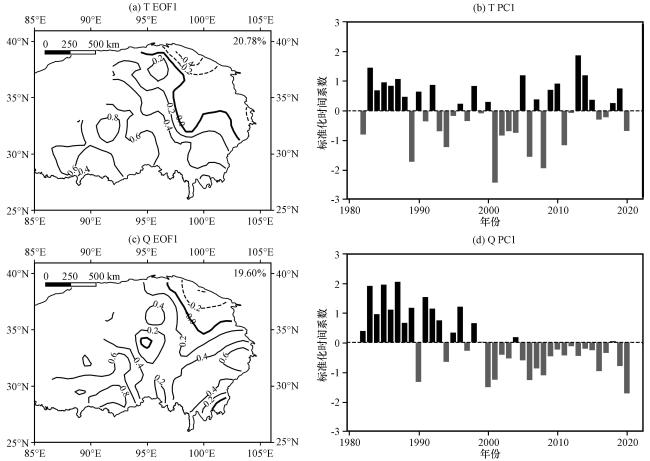
综上可知, 高原春季地表感热达最强时间(T)和增强强度(Q)具有明显的年际和年代际变化。那么, 该演变在整个高原中东部的一致性如何?图3给出了高原春季TQ的EOF分析第一主模态的空间分布及其对应时间系数, 它们的方差贡献率均在20%左右。从图3(a)和图3(c)可以看出, TQ在高原中东部大部分区域表现为一致的变化, 除了青海东北部地区, 这可能与地形和局地气候有关, 青海东北部为祁连山区属于干旱气候, 青海东部为农牧交错区, 地势相对较低, 这些区域与高原中、 南部气候差别较大。TQ第一主模态对应的时间系数PC1s[图3(b), (d)]与高原中东部区域平均序列的相关系数均为0.81(p<0.01), 这说明PC1s可以较好地反映高原中东部TQ的区域平均状况, 特别是高原的中部和南部。
图3 1982 -2020年高原春季地表感热达最强时间T(a, b)和增强强度Q(c, d)EOF第一主模态(a, c)及其对应的标准化时间系数(b, d)(a)和(c)中, 实线(虚线)表示正(负)值

Fig.3 The first EOF mode (a, c) and corresponding standardized time coefficients (b, d) of the peak time T (a, b) and enhancement intensity Q (c, d) of the springtime sensible heat over the Qinghai-Xizang Plateau from 1982 to 2020.In (a) and (c), solid lines (dashed lines) represent positive (negative) values

4 高原春季地表感热增强与中国南方春雨的联系

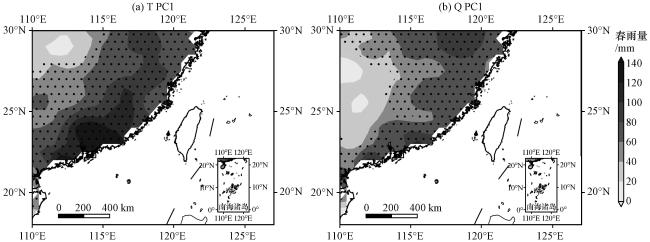
中国南方处于高原东南侧中纬度西风带的下游。众多研究表明, 高原地形和地表感热加热对中国南方春雨的形成具有重要影响(万日金和吴国雄, 2006李超等, 2010Hu et al, 2023)。表1给出了高原春季地表感热达最强时间(T)和增强强度(Q)第一主模态对应的时间系数PC1s与中国南方春雨总量的简单相关和偏相关关系。由表1可知, 两者均与中国南方春雨总量具有显著正相关关系(p<0.01), 相关系数分别为0.55和0.42。由PC1s对南方春雨的回归分析(图4)可知, 中国南方绝大部分区域春雨量均与TQ具有显著的相关关系, 特别是广东、 福建和浙江等沿海地区, 这表明高原春季地表感热增强异常偏强和感热达最强时间异常偏晚均有利于中国南方春雨量的异常偏多。
表1 高原地表感热增强与中国南方春雨量的相关系数

Table 1 The relationship between the surface sensible heat enhancement on the Qinghai-Xizang Plateau and the spring rainfall over the southern China

T PC1 Q PC1 ISH ISH-ININO3.4 ISH-IIOBM
相关系数 0.55** 0.42** 0.60** 0.55** 0.60**

**代表通过α=0.01显著性水平t检验(** represents over 0.01 significance level of t test)

图4 感热达最强时间T(a)和增强强度Q(b)的PC1回归中国南方春雨总量(单位: mm)

打点区域通过了α=0.1显著性水平t检验

Fig.4 Regression of PC1 for the peak sensible heat occurrence time T (a) and the intensity Q (b) on total spring rainfall in Southern China.Units: mm.The dotted areas passed the t-test of significance level α=0.1

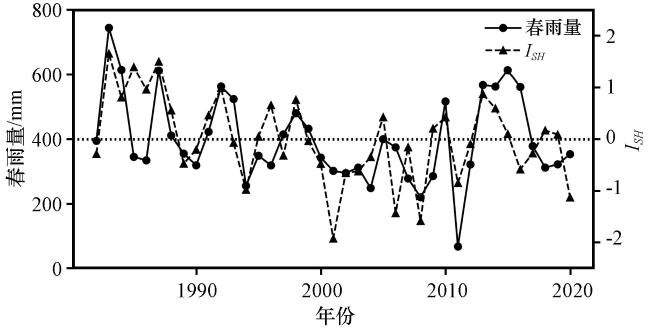
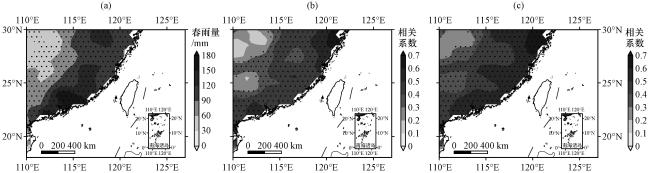
综上可知, 高原地表感热增强过程量TQ均与中国南方春雨量关系密切, 为了考察两者的综合影响, 这里以两者与春雨量的简单相关系数作为权重, 对PC1s进行加权计算(Wang et al, 2022), 定义了高原地表感热增强过程量综合指数(ISH )。研究表明, 该指数与中国南方春雨的关系(相关系数0.60, p<0.01)比TQ的单独影响有了一定的提高(表1图6), 整个中国南方几乎全部表现为显著正相关(p<0.1), 除了湖南西北部部分区域[图6(a)], 大值中心位于广东省沿海地区。从图5也可以看出, 中国南方春雨总量平均为400 mm, 具有明显的年际和年代际变化, 在20世纪80年代、 90年代和21世纪10年代春雨总量以偏多为主, 在21世纪00年代春雨总量偏少; 在2010年前呈现波动减少趋势, 气候倾向率为-70 mm·(10a)-1p<0.01), 在2010年后又开始增多, 这与You and Jia (2018)杜晖等(2024)的研究结论一致; 春雨总量最多为1983年, 达700 mm以上, 最少为2011年, 不足100 mm。中国南方春雨的演变趋势与ISH 指数演变具有很好的一致性(图5)。前人研究指出, 中东太平洋和热带印度洋海温异常是影响中国华南和西南地区春季降水的重要外强迫因子(Chen et al, 2014Duan et al, 2020Wen et al, 2021)。因此, 有必要探究一下ENSO和热带印度洋海盆一致模(IOBM)对高原春季地表感热增强与中国南方春季降水联系的影响。研究发现, 去除春季中东太平洋海温 Niño3.4指数(ININO3.4 )和春季印度洋海盆一致模指数(IIOBM )后ISH 指数与中国南方春雨总量的偏相关分别为0.55和0.60(表1), 仍为显著相关(p<0.01), 他们的分布与简单相关分布类似[图6(b), (c)], 相关性不仅没有减弱, 在沿海地区还有明显提高, 特别是去除IIOBM 后, 在江南地区的相关性大大提高。这说明春季赤道太平洋和热带印度洋海温可能对高原地表感热增强与中国南方春雨量的联系具有一定的抑制作用, 剔除海温影响之后, 两者的联系更加密切, ISH 指数对中国南方春雨的影响是独立于海温的影响的。
图5 1982 -2020年ISH 指数与中国南方春雨的逐年演变

Fig.5 Annual evolution of ISH index and spring rain in Southern China from 1982 to 2020

图6 ISH 指数回归中国南方春雨总量(a, 单位: mm), 以及分别去除春季ININO3.4 (b)和IIOBM (c)影响后的偏相关

打点区域通过了α=0.1显著性水平t检验

Fig.6 Regression of ISH index and total spring rain in Southern China (a, unit: mm), and partial correlations after removing the influence of spring ININO3.4 (b) and IIOBM (c), respectively.The dotted areas passed the t-test of significance level α=0.1

5 高原春季地表感热增强影响中国南方春雨的关键环流系统

由上文的分析可知, 高原地表感热增强综合指数与中国南方春雨量关系密切。那么, 它们之间联系的关键环流系统和物理过程是什么?为了探究这一问题, 这里以ISH 异常值超过0.8倍标准差为标准, 分别选取了典型高值年和典型低值年, 其中高值年7个, 分别为1983年、 1984年、 1985年、 1986年、 1987年、 1992年和2013年, 低值年6个, 分别为1994年 、 2001年、 2006年、 2008年、 2011年和2020年, 对典型异常年份大气环流背景场进行了合成分析。

5.1 西风急流的影响

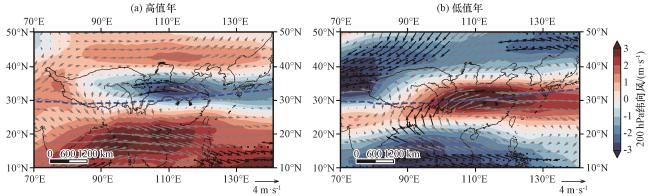
图7给出了ISH 异常高值年和低值年合成的春季200 hPa纬向风场分布。由图7可以发现, 在ISH 高指数年, 东亚副热带西风急流在高原中东部至江淮地区和日本南部异常偏弱, 西风过高原分为南北两支, 南支在高原以南的孟加拉湾、 中南半岛至西太平洋上空异常加强, 急流位置异常偏南; 在ISH 低指数年, 在高原东南部至长江流域和日本以南西风异常加强, 在低纬度地区和高原西部及其以北西风异常减弱。西风急流偏南一方面可以加强中国南方地区高空的辐散, 另一方面低层西风可以引导来自孟加拉湾和南海的水汽进入中国南方, 有利于该地区春雨的产生(Jia et al, 2021)。Diallo et al (2024)研究指出, 高原的热力作用会引发沿高层西风急流向东传播的强波活动, 导致水汽辐合加剧和对流不稳定性, 有利于其下游地区强降雨的形成。
图7 ISH 异常高值年(a)和低值年(b)合成的春季200 hPa纬向风场分布(阴影, 单位: m·s-1)和风场(矢量, 单位: m·s-1

蓝色虚线为春季西风急流轴平均位置; 打点区域和黑色箭头通过了α=0.1显著性水平t检验

Fig.7 Composite distribution of the spring 200 hPa zonal wind (shading, unit: m·s-1) and wind vectors (arrows, unit: m·s-1) for years with high (a) and low (b) ISH anomalies.Blue dashed line represents the average position of the spring westerly jet axis, the dotted areas and black arrows passed the t-test of significance level α=0.1

5.2 中低层环流的影响

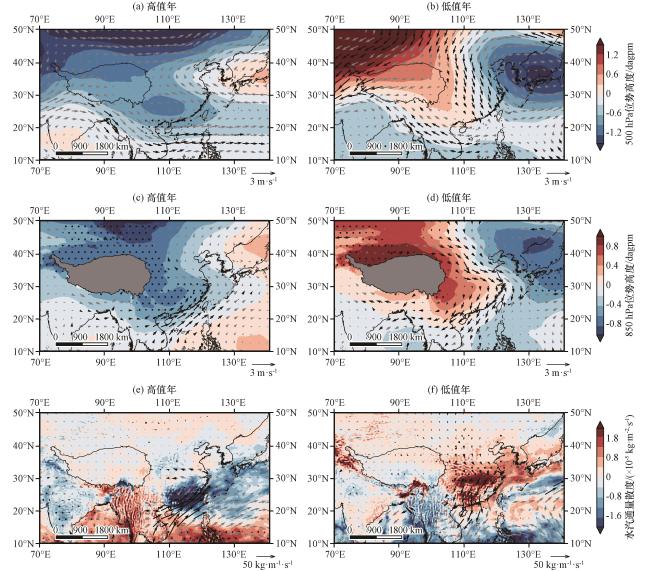
图8给出了ISH 异常高值年和低值年合成的春季500 hPa和850 hPa位势高度场和风场以及整层水汽通量场分布。图8(a)显示, 在ISH 高指数年, 中国大陆500 hPa位势高度场均异常偏低, 高原及其以北存在异常气旋性环流, 中国西南地区上空出现切断低压系统, 位于110°E, 28°N附近, 表明西南涡加强, 在该西南涡的东侧低层西南风异常加强[图8(c)], 有利于来自孟加拉湾和南海的水汽在中国南方聚集, 产生降水。整层水汽通量场[图8(e)]也显示, 在高原南侧西风异常加强, 引导孟加拉湾反气旋环流北侧的水汽进入中国南方, 在西太平洋也存在反气旋异常, 其西北侧的西南风也为中国南方带来充足水汽。Gu et al(2018)研究也指出, 对流层低层西南风对华南地区的暖平流和水汽输送具有重要作用。在ISH 低指数年, 中低层环流形势与高指数年几乎相反, 500 hPa和850 hPa位势高度在中国大陆均异常偏高, 在日本海上空异常偏低, 中国东部500 hPa为显著西北风异常[图8(b)], 850 hPa为显著东北风异常[图8(d)], 阻碍低纬度水汽的北上, 中国南方为水汽的显著辐散区[图8(f)], 不利于该地区春雨的形成。
图8 ISH 异常高值年和低值年合成的春季500 hPa(a, b) 和850 hPa(c, d)位势高度场(阴影, 单位: dagpm)和风场(矢量, 单位: m·s-1)、 整层水汽通量(矢量, 单位: kg·m-1·s-1) 和水汽通量散度(阴影, 单位: ×10-5 kg·m-2·s-1)(e, f)打点区域和黑色箭头表示通过了α=0.1显著性水平t检验, (a), (c), (e)为高值年; (b), (d), (f)为低值年

Fig.8 Composite of the spring 500 hPa (a, b) and 850 hPa (c, d) geopotential height (shading, unit: dagpm) and wind (vector, unit: m·s-1), spring total column water vapor flux (vector, unit: kg·m⁻¹·s⁻¹) and water vapor flux divergence (shaded, unit: ×10⁻⁵ kg·m⁻²·s⁻¹) (e, f) for years with high and low ISH anomalies.Dotted areas and black arrows indicate significance at the α=0.1 level based on the t-test; (a), (c), (e) for high value years; (b), (d), (f) for low value years

5.3 垂直环流的影响

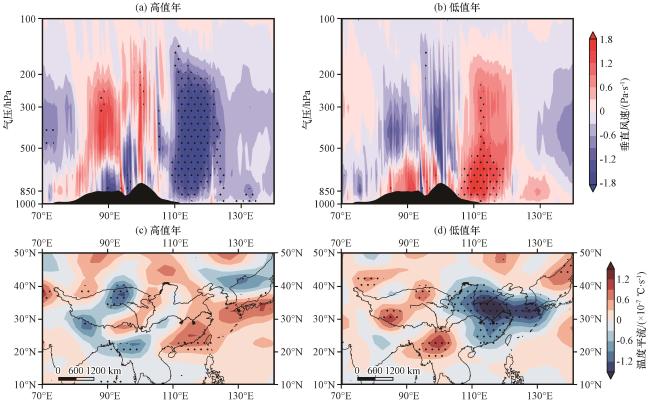
ISH 异常高值年和低值年合成的春季垂直速度场和500 hP温度平流场如图9所示, 在高原地表感热增强高指数年, 中国南方存在强上升运动, 上升区可达200 hPa[图9(a)], 这与图8(a)和(c)所示由低层到高层准正压结构一致; 在高原东部、 中国南方和日本南部存在暖平流[图9(c)], 由500 hPa环流形势[图8(a)]可知, 该暖平流主要来自高原和低纬度海洋。而在高原地表感热增强低指数年, 中国南方存在显著下沉运动, 但强度弱于高指数年, 只在500 hPa以下显著下沉[图9(b)]; 在中国南方、 江淮地区及其以东海面存在显著冷平流[图9(d)], 由500 hPa环流形势[图8(b)]可知, 该冷平流主要来自中国北方大陆。
图9 ISH 异常高值年和低值年合成的春季20°N -30°N平均剖面垂直风速(a, b, 单位: Pa·s-1)和500 hPa温度平流场(c, d, 单位: ×10-7 ℃·s-1)打点区域通过了α=0.1显著性水平t检验, (a), (c)为高值年; (b), (d)为低值年

Fig.9 Composite of the spring average vertical wind speed profile between 20°N -30°N (a, b, unit: Pa·s-1) and the 500 hPa temperature advection (c, d, unit: ×10⁻⁷ ℃·s-1) for years with high and low ISH anomalies.Dotted areas indicate significance at the α=0.1 level based on the t-test; (a), (c) for high value years; (b), (d) for low value years

综上所述, 高原地表感热增强强度和达最强时间对中国南方春雨量有重要影响。在ISH 高指数年, 副热带西风急流异常偏南, 中国大陆上空高度场异常偏低, 中国南方受异常低压系统控制, 西南涡加强, 低层受异常西南方影响, 大量来自孟加拉湾和西太平洋的水汽在此辐合, 配合暖平流和强上升运动, 有利于产生异常降水。在地表感热增强低指数年, 副热带西风急流异常偏强, 中国大陆上空高度场异常偏高, 中国南方受异常高压系统控制, 盛行偏北风, 存在冷平流、 水汽辐散和下沉运动, 不利于该地区降水的产生, 所以春雨量异常偏少。

6 结论与讨论

基于高原中东部73个气象站地面观测数据计算的逐日地表感热通量资料、 中国南方402个气象站点逐日降水资料以及ERA5再分析资料等, 分析了高原春季地表感热增强特征及其与中国南方春雨总量的联系和物理过程, 得出以下几点结论:
(1) 高原春季地表感热达最强时间(T)和增强强度(Q)具有明显的年际和年代际变化。空间上, T自东向西逐渐变晚, Q以西藏东部为中心, 向四周逐渐增强; 时间上, T在2001年之前波动下降, 在2001年之后又开始波动上升, 即感热达最强时间2001年之前变早, 后又变晚。Q在1999年之前以偏强为主, 之后整体偏弱。TQ在高原中东部大部分区域表现为一致的变化, 特别是高原的中部和南部。两者互为显著正相关关系, 即高原春季地表感热达最强时间越晚, 往往感热增强强度越强。
(2) 高原春季地表感热增强异常偏强和感热达最强时间异常偏晚均与中国南方春雨量有显著的正相关关系。为了考察两者的综合影响, 定义了高原地表感热增强量综合指数(ISH ), 该指数与中国南方春雨的关系(相关系数0.60, p<0.01)比TQ的单独影响有了一定的提高。研究表明, ISH 指数对中国南方降水的影响在一定程度上独立于中东太平洋和热带印度洋海温的影响。
(3) 在ISH 高(低)指数年, 副热带西风急流异常偏南(偏强), 高原以南西风异常加强(减弱), 中国大陆上空500 hPa和850 hPa高度场均异常偏低(高), 南方地区的对流层低层受异常低(高)压系统控制, 东部沿海地区低空西南(东北)风异常偏强, 水汽辐合(辐散), 配合暖(冷)平流和强上升(下沉)运动, 有(不)利于降水产生, 所以, 中国南方春雨量异常偏多(偏少)。
本文主要基于高原中东部气象站点的逐日地表感热资料, 研究其春季增强特征与我国南方春雨的联系。有研究表明, 高原3 km以上地区热动力强迫对我国南方地区次季节降水具有重要影响, 但其延伸期预报结果在不同的海温外强迫背景下存在较大不确定性(He et al, 2025), 这表明我国南方地区降水预报的复杂性。特别是, 在不同的气候系统背景下, 高原地表热强迫对我国南方地区降水影响的相对贡献可能会有所不同。由于受气象站点分布的限制, 目前缺乏对高原西部地表热力作用的认识。研究表明, 青藏高原西部积雪可以通过影响局地热力作用, 改变东亚大陆-北太平洋西部地区的大气环流, 进而影响我国南方的气候变化(Jia et al, 2021)。所以, 利用多源地表感热资料对高原西部热力特征及其影响的认识需要进一步深入研究。
本文研究表明, ISH 指数通过影响东亚副热带急流强度和位置对中国南方春雨量起作用, 这与Hu et al(2023) 的研究结论一致, 该研究也指出在季节内尺度高原感热通量可提前5~7天对中国南方春雨产生影响。同时本文研究也表明, ISH 指数通过影响中国南方对流层低层的异常气旋, 引导强盛的西南气流向中国南方输送水汽, 这与Jia et al(2021)Duan et al(2020)的研究结论一致, 这些研究均通过线性斜压模式的敏感性实验证实, 青藏高原上的加热异常促进了华南低层气旋环流的增强。高原感热增强过程量对中国南方春雨影响的物理机理还需要通过数值模式进一步模拟验证, 这也是我们下一步工作的重要内容。许多研究指出, 海温和中高纬度大气次季节振荡过程均对中国南方降水具有重要影响(Ailikun and Yasunari, 2001Yu et al, 2021Zhu et al, 2024), 尽管本文剔除了ENSO和IOBM的影响, 但中高纬外强迫因素对两者之间的联系可能也会产生一定的影响, 多种外强迫因素对两者关系的综合影响需要进一步深入研究。
Ailikun B Yasunari T2001.ENSO and Asian summer monsoon: persistence and transitivity in the seasonal march[J].Journal of the Meteorological Society of Japan.Ser.II79(1): 145-159.DOI: 10.2151/jmsj.79.145 .

Chen J P Wen Z P Wu R G, et al, 2014.Interdecadal changes in the relationship between Southern China winter-spring precipitation and ENSO[J].Climate Dynamics43(5): 1327-1338.DOI: 10.1007/s00382-013-1947-x .

Chen L Pryor S C Wang H, et al, 2019.Distribution and variation of the surface sensible heat flux over the central and eastern Tibetan Plateau: comparison of station observations and multireanalysis products[J].Journal of Geophysical Research: Atmospheres124(12): 6191-6206.DOI: 10.1029/2018JD030069 .

Diallo I Xue Y K Chen Q Y, et al, 2024.Effects of spring Tibetan Plateau land temperature anomalies on early summer floods/droughts over the monsoon regions of South East Asia[J].Climate Dynamics62(4): 2659-2681.DOI: 10.1007/s00382-021-06053-8 .

Ding Y H He C2006.The summer monsoon onset over the tropical eastern indian ocean: the earliest onset process of the Asian summer monsoon[J].Advances in Atmospheric Sciences23(6): 940-950.DOI: 10.1007/s00376-006-0940-2 .

Duan A M Hu D Hu W T, et al, 2020.Precursor effect of the Tibetan Plateau heating anomaly on the seasonal march of the East Asian summer monsoon precipitation[J].Journal of Geophysical Research: Atmospheres125(23): e2020JD032948.DOI: 10. 1029/2020JD032948 .

Duan A M Li F Wang M R, et al, 2011.Persistent weakening trend in the spring sensible heat source over the Tibetan Plateau and its impact on the Asian summer monsoon[J].Journal of Climate24(21): 5671-5682.DOI: 10.1175/JCLI-D-11-00052.1 .

Duan A M Sun R Z He J H2017.Impact of surface sensible heating over the tibetan plateau on the Western Pacific subtropical high: a land-air-sea interaction perspective[J].Advances in Atmospheric Sciences34(2): 157-168.DOI: 10.1007/s00376-016-6008-z .

Duan A M Wang M R Lei Y H, et al, 2013.Trends in summer rainfall over china associated with the Tibetan Plateau sensible heat source during 1980-2008[J].Journal of Climate26(1): 261-275.DOI: 10.1175/JCLI-D-11-00669.1 .

Duan A M Wu G X2005.Role of the Tibetan Plateau thermal forcing in the summer climate patterns over subtropical Asia[J].Climate Dynamics24(7): 793-807.DOI: 10.1007/s00382-004-0488-8 .

Duan A M Wu G X2006.Change of cloud amount and the climate warming on the Tibetan Plateau[J].Geophysical Research Letters33(22).DOI: 10.1029/2006GL027946 .

Duan A M Wu G X2008.Weakening trend in the atmospheric heat source over the Tibetan Plateau during recent decades.part I: observations[J].Journal of Climate21(13): 3149-3164.DOI: 10.1175/2007JCLI1912.1 .

Fan W W Ma W Q Hu Z Y, et al, 2021.Recovery of sensible heating and its elevation amplification over and around the Tibetan Plateau since 2000s[J].Theoretical and Applied Climatology, 146: 617-630.DOI: 10.1007/s00704-021-03737-3 .

Gu W Wang L Hu Z Z, et al, 2018.Interannual variations of the first rainy season precipitation over south china[J].Journal of Climate31(2): 623-640.DOI: 10.1175/JCLI-D-17-0284.1 .

He B He X Y Liu Y M, et al, 2025.Role of thermal and dynamical subdaily perturbations over the Tibetan Plateau in 30-day extended-range forecast of East Asian precipitation in early summer[J].NPJ Climate and Atmospheric Science8(1): 1-15.DOI: 10. 1038/s41612-025-00931-2 .

Hu W T Duan A M Wu G X, et al, 2023.Quasi-biweekly oscillation of surface sensible heating over the central-eastern Tibetan Plateau and its relationship with spring rainfall in China[J].Journal of Climate36(19): 6917-6936.DOI: 10.1175/JCLI-D-22-0892.1 .

Jia X J Zhang C Wu R G, et al, 2021.Influence of Tibetan Plateau autumn snow cover on interannual variations in spring precipitation over southern China[J].Climate Dynamics, 56: 767-782.DOI: 10.1007/s00382-020-05497-8 .

Kajikawa Y Wang B2012.Interdecadal change of the South China sea summer monsoon onset[J].Journal of Climate25(9): 3207-3218.DOI: 10.1175/JCLI-D-11-00207.1 .

Kueh M T Lin S C2010.A climatological study on the role of the south China sea monsoon onset in the development of the East Asian summer monsoon[J].Theoretical and Applied Climatology99(1): 163-186.DOI: 10.1007/s00704-009-0136-7 .

Li Q Zhang R H2012.Seasonal variation of climatological bypassing flows around the Tibetan Plateau[J].Advances in Atmospheric Sciences29(5): 1100-1110.DOI: 10.1007/s00376-012-1154-4 .

Liu Y M Lu M M Yang H J, et al, 2020.Land-atmosphere-ocean coupling associated with the Tibetan Plateau and its climate impacts[J].National Science Review7(3): 534-552.DOI: 10. 1093/nsr/nwaa011 .

Qiu J2008.China: the third pole.[J].Nature454(7203): 393-397.DOI: 10.1038/454393a .

Tian S F Yasunari T1998.Climatological aspects and mechanism of spring persistent rains over central China[J].Journal of the Meteorological Society of Japan.Ser.II76(1): 57-71.DOI: 10. 2151/jmsj1965.76.1_57 .

Wan R J Wu G X2007.Mechanism of the spring persistent rains over southeastern China[J].Science in China Series D: Earth Sciences50(1): 130-144.DOI: 10.1007/s11430-007-2069-2 .

Wang H Hu Z Y Li D L, et al, 2019a.Estimation of the surface heat transfer coefficient over the east-central Tibetan Plateau using satellite remote sensing and field observation data[J].Theoretical and Applied Climatology138(1): 169-183.DOI: 10.1007/s00704-019-02815-x .

Wang H Li D L2018.Decadal variability in summer precipitation over Eastern China and its response to sensible heat over the Tibetan Plateau since the early 2000s[J].International Journal of Climatology39(3): 1604-1617.DOI: 10.1002/joc.5903 .

Wang H Zhang J Chen L, et al, 2022.Relationship between summer extreme precipitation anomaly in central Asia and surface sensible heat variation on the central-eastern Tibetan Plateau[J].Climate Dynamics59(3): 685-700.DOI: 10.1007/s00382-022-06148-w .

Wang J Liu Y J Song C Y, et al, 2022.Synergistic impacts of westerlies and monsoon on interdecadal variations of late spring precipitation over the southeastern extension of the Tibetan Plateau[J].International Journal of Climatology42(14): 7342-7361.DOI: 10.1002/joc.7648 .

Wang Z Q Yang S Duan A M, et al, 2019b.Tibetan Plateau heating as a driver of monsoon rainfall variability in Pakistan[J].Climate Dynamics, 52: 6121-6130.DOI: 10.1007/s00382-018-4507-6 .

Wen D Y Yang Y L Cao J2021.Interdecadal variation of early spring rainfall over the southeastern edge of the Tibetan Plateau[J].Journal of Geophysical Research: Atmospheres126(1): e2020JD033058.DOI: 10.1029/2020JD033058 .

Wu G X Duan A M Liu Y M, et al, 2015.Tibetan Plateau climate dynamics: recent research progress and outlook[J].National Science Review2(1): 100-116.DOI: 10.1093/nsr/nwu045 .

Wu G X Zhang Y S1998.Tibetan plateau forcing and the timing of the monsoon onset over south Asia and the south china sea[J].Monthly Weather Review126(4): 913-927.DOI: 10.1175/1520-0493(1998)126<0913: TPFATT>2.0.CO; 2 .

Yanai M Li C F Song Z S1992.Seasonal heating of the tibetan plateau and its effects on the evolution of the Asian summer monsoon[J].Journal of the Meteorological Society of Japan.Ser.II70(1B): 319-351.DOI: 10.2151/jmsj1965.70.1B_319 .

Yang K Guo X F Wu B Y2011.Recent trends in surface sensible heat flux on the Tibetan Plateau[J].Science China Earth Sciences54(1): 19-28.DOI: 10.1007/s11430-010-4036-6 .

Yang K Wu H Qin J, et al, 2014.Recent climate changes over the Tibetan Plateau and their impacts on energy and water cycle: a review[J].Global and Planetary Change, 112: 79-91.DOI: 10.1016/j.gloplacha.2013.12.001 .

Yeh T C1982.Some aspects of the thermal influences of the Qinghai-Tibetan Plateau on the atmospheric circulation[J].Archives for Meteorology, Geophysics, and Bioclimatology, Series A, 31(3): 205-220.DOI: 10.1007/BF02258032 .

You Y J Jia X J2018.Interannual variations and prediction of spring precipitation over China[J].Journal of Climate31(2): 655-670.DOI: 10.1175/JCLI-D-17-0233.1 .

Yu W Liu Y M Yang X Q, et al, 2021.Impact of North Atlantic SST and Tibetan Plateau forcing on seasonal transition of springtime south Asian monsoon circulation[J].Climate Dynamics56(1): 559-579.DOI: 10.1007/s00382-020-05491-0 .

Zhang H X Li W P Li W J2019.Influence of late springtime surface sensible heat flux anomalies over the Tibetan and Iranian Plateaus on the location of the south Asian high in early summer[J].Advances in Atmospheric Sciences36(1): 93-103.DOI: 10. 1007/s00376-018-7296-2 .

Zhao P Chen L X2001.Climatic features of atmospheric heat source/sink over the Qinghai-Xizang Plateau in 35 years and its relation to rainfall in China[J].Science in China Series D: Earth Sciences44(9): 858-864.DOI: 10.1007/BF02907098 .

Zhu L H Huang G Fan G Z, et al, 2017.Evolution of surface sensible heat over the Tibetan Plateau under the recent global warming hiatus[J].Advances in Atmospheric Sciences34(10): 1249-1262.DOI: 10.1007/s00376-017-6298-9 .

Zhu Z W Wu J T Huang H J2024.The influence of 10-30-day boreal summer intraseasonal oscillation on the extended-range forecast skill of extreme rainfall over southern China[J].Climate Dynamics62(1): 69-86.DOI: 10.1007/s00382-023-06900-w .

戴逸飞, 王慧, 李栋梁, 2016.卫星遥感结合气象资料计算的青藏高原地面感热特征分析[J].大气科学40(5): 1009-1021.DOI: 10.3878/j.issn.1006-9895.1512.15225.Dai Y F

Wang H Li D L.2016.Characteristics of surface sensible heat flux calculated from satellite remote sensing and field observations in the Tibetan Plateau[J].Chinese Journal of Atmospheric Sciences40 (5): 1009-1021.DOI: 10.3878/j.issn.1006-9895.1512.15225 .

杜晖, 王娟怀, 黄惺惺, 等, 2024.华南地区对流性和大尺度降水特征分析[J].高原气象43(6): 1462-1474.DOI: 10.7522/jissn.1000-0534.2024.00031.Du H

Wang J H Huang X X, et al, 2024.Characteristics analysis of convective precipitation and large-scale precipitation in south China based on ERA5 Data[J].Plateau Meteorology43(6): 1462-1474.DOI: 10.7522/jissn.1000-0534.2024.00031 .

胡雅君, 刘屹岷, 吴琼, 等, 2017.影响江南春雨年际变化的前期海洋信号及可能机理[J].大气科学41(2): 395-408.DOI: 10.3878/j.issn.1006-9895.1605.16133.Hu Y J

Liu Y M Wu Q, et al, 2017.Preceding oceanic influences on the inter-annual variation of spring persistent rain in Jiangnan of China and the possible mechanism[J].Chinese Journal of Atmospheric Sciences41 (2): 395-408.DOI: 10.3878/j.issn.1006-9895.1605.16133 .

蒋艳蓉, 何金海, 祁莉, 2008.春季青藏高原绕流作用变化特征及其影响[J].气象与减灾研究31(2): 14-18.DOI: 10.3969/j.issn.1007-9033.2008.02.003.Jiang Y R

He J H Qi L2008.Variation characteristics of the function of detouring flow around Tibetan Plateau in spring[J].Meteorology and Disaster Reduction Research31(2): 14-18.DOI: 10.3969/j.issn.1007-9033.2008.02.003 .

蒋艳蓉, 何金海, 温敏, 等, 2009.冬、 春季青藏高原东侧涡旋对特征及其对我国天气气候的影响[J].高原气象28(5): 945-954.

Jiang Y R He J H Wen M, et al, 2009.Characteristic of a couple of vortexes on the east side of Tibetan Plateau from winter to spring and their impact on the weather and climate in China[J].Plateau Meteorology28(5): 945-954.

雷润芝, 余晔, 周国兵, 等, 2023.1984-2020年青藏高原感热通量长期变化趋势分析[J].高原气象42(4): 833-847.DOI: 10.7522/j.issn.1000-0534.2023.00032.Lei R Z

Yu Y Zhou G B, et al, 2023.Long-term variation of sensible heat flux over the Qinghai-Xizang Plateau from 1984 to 2020[J].Plateau Meteorology42(4): 833-847.DOI: 10.7522/j.issn.1000-0534.2023.00032 .

李超, 徐海明, 朱素行, 等, 2010.江南春雨形成机制的数值模拟[J].高原气象29(1): 99-108.

Li C Xu H M Zhu S X, et al, 2010.Numerical analysis on formation mechanism of spring persistent rain[J].Plateau Meteorology29(1): 99-108.

李栋梁, 李维京, 魏丽, 等, 2003.青藏高原地面感热及其异常的诊断分析[J].气候与环境研究8(1): 71-83.DOI: 10.3878/j.issn.1006-9585.2003.01.09.Li D L

Li W J Wei L, et al, 2003.A diagnostic study of surface sensible heat flux anomaly over the Qinghai-Xizang Plateau[J].Climatic and Environmental Research8(1): 71-83.DOI: 10.3878/j.issn.1006-9585.2003.01.09 .

李栋梁, 章基嘉, 吴洪宝, 1997.夏季青藏高原下垫面感热异常的诊断研究[J].高原气象16(4), 367-375.

Li D L Zhang J J Wu H B1997.A diagnostic study on surface sensible heat flux anomaly in summer over the Qinghai-Xizang Plateau[J].Plateau Meteorology16(4), 367-375.

李天航, 刘宣飞, 2016.高原东南角早春雨的气候特征及其成因研究[J].热带气象学报32(5): 717-724.DOI: 10.16032/j.issn.1004-4965.2016.05.014.Li T H

Liu X F2016.Climatic features of early spring rains over southeastern Tibetan Plateau and their causes[J].Journal of Tropical Meteorology32(5): 717-724.DOI: 10.16032/j.issn.1004-4965.2016.05.014 .

刘宣飞, 袁旭, 2013.江南春雨的两个阶段及其降水性质[J].热带气象学报29(1): 99-105.Liu X F, Yuan X, 2013.Two stages of spring persistent rains over southeastern China and the nature of precipitations[J].Journal of Tropical Meteorology, 29(1), 99-105.

万日金, 吴国雄, 2006.江南春雨的气候成因机制研究[J].中国科学(地球科学)36(10): 936-950.DOI: 10.1360/zd2006-36-10-936.Wan R J

Wu G X2006.Mechanism of the spring persistent rains over southeastern China[J].Science in China Series D: Earth Sciences36(10): 936-950.DOI: 10.1360/zd2006-36-10-936 .

万日金, 吴国雄, 2008.江南春雨的时空分布[J].气象学报66(3): 310-319.DOI: 10.11676/qxxb2008.029.Wan R J

Wu G X2008.Temporal and spatial distribution of the spring persistent rains over southeastern China[J].Acta Meteorological Sinica66(3): 310-319.DOI: 10.11676/qxxb2008.029 .

王慧, 张璐, 石兴东, 等, 2022.青藏高原中东部地表感热趋势转折特征的季节差异[J].大气科学46(1): 133-150.DOI: 10.3878/j.issn.1006-9895.2105.21026.Wang H

Zhang L Shi X D, et al, 2022.Seasonal differences in the trend turning characteristics of surface sensible heat over the central and eastern Tibetan Plateau[J].Chinese Journal of Atmospheric Sciences46(1): 133-150.DOI: 10.3878/j.issn.1006-9895.2105.21026 .

王黎娟, 高龙龙, 2017.江南春雨的时空分布特征及其旱涝年环流差异[J].大气科学学报40(3): 310-320.DOI: 10.13878/j.cnki.dqkxxb.20150812001.Wang L J

Gao L L2017.The spatial and temporal distribution of the spring persistent rains and circulation differences between its drought and flood years[J].Trans Atmos Sci40(3): 310-320.DOI: 10.13878/j.cnki.dqkxxb.20150812001 .

王蕊, 李栋梁, 王慧, 等, 2023.青藏高原与中国西北干旱区地面感热季节增强时间的差异及相互关系[J].高原气象42(2): 283-293.DOI: 10.7522/j.issn.1000-0534.2022.00045.Wang R

Li D L Wang H, et al, 2023.The difference and correlation of seasonal enhancement time of surface sensible heat between the Qinghai-Xizang Plateau and the arid region of northwest China[J].Plateau Meteorology42(2): 283-293.DOI: 10.7522/j.issn.1000-0534.2022.00045 .

魏凤英, 2022.现代气候统计诊断与预测技术(第3版)[M].北京: 气象出版社.Wei F Y, 2022.Statistical diagnosis and prediction technology of the climate (Ⅲ)[M].Beijing: China Meteorological Press.

吴国雄, 刘屹岷, 何编, 等, 2018.青藏高原感热气泵影响亚洲夏季风的机制[J].大气科学42(3): 488-504.DOI: 10.3878/j.issn.1006-9895.1801.17279.Wu G X

Liu Y M He B, et al, 2018.Review of the impact of the Tibetan Plateau sensible heat driven air-pump on the Asian summer monsoon[J].Chinese Journal of Atmospheric Sciences42 (3): 488-504.DOI: 10.3878/j.issn.1006-9895.1801.17279 .

徐国昌, 李栋梁, 陈丽萍, 1990.青藏高原地面加热场强度的气候特征[J].高原气象9(1): 32-43.

Xu G C Li D L Chen L P1990.The climatic characteristics of surface heating fields over the Qinghai-Xizang Plateau[J].Plateau Meteorology9(1): 32-43.

叶笃正, 高由禧, 1979.青藏高原气象学[M].北京: 科学出版社.Ye D Z, Gao Y X, 1979.Meteorology of the Qinghai-Tibet Plateau[M].Beijing: Science Press.

叶笃正, 罗四维, 朱抱真, 1957.西藏高原及其附近的流场结构和对流层大气的热量平衡[J].气象学报28(2): 108-121.

Yeh T C Luo S W Chu P C1957.The wind structure and heat balance in the lower troposphere over Tibetan Plateau and its surroundings[J].Acta Meteorological Sinica28(2): 108-121.

于威, 刘屹岷, 杨修群, 等, 2018.青藏高原不同海拔地表感热的年际和年代际变化特征及其成因分析[J].高原气象37(5): 1161-1176.DOI: 10.7522/j.issn.1000-0534.2018.00027.Yu W

Liu Y M Yang X Q, et al, 2018.The interannual and decadal variation characteristics of the surface sensible heating at different elevations over the Qinghai-Tibetan Plateau and attribution analysis[J].Plateau Meteorology37(5): 1161-1176.DOI: 10.7522/j.issn.1000-0534.2018.00027 .

张璐, 王慧, 石兴东, 等, 2020.青藏高原中东部地表感热趋势转折特征及成因分析[J].高原气象39(5): 912-924.DOI: 10.7522/j.issn.1000-0534.2020.00050.Zhang L

Wang H Shi X D, et al, 2020.Characteristics and causes of surface sensible heat trend transition in central and Eastern Qinghai-Xizang Plateau[J].Plateau Meteorology39(5): 912-924.DOI: 10.7522/j.issn.1000-0534.2020.00050 .

张永莉, 左洪超, 高晓清, 等, 2023.冬半年青藏高原绕流与中国降水和气温的关系[J].高原气象42(3): 529-542.DOI: 10.7522/j.issn.1000-0534.2023.00018.Zhang Y L

Zuo H C Gao X Q, et al, 2023.The Relationship between the Flow Around the Qinghai-Xizang Plateau and the Precipitation and Temperature in China in Winter Half-year[J].Plateau Meteorology42(3): 529-542.DOI: 10.7522/j.issn.1000-0534.2023.00018 .

周连童, 黄荣辉, 2008.中国西北干旱、 半干旱区感热的年代际变化特征及其与中国夏季降水的关系[J].大气科学32(6): 1276-1288.DOI: 10.3878/j.issn.1006-9895.2008.06.04.Zhou L T

Huang R H2008.Interdecadal variability of sensible heat in arid and semi-arid regions of Northwest China and its relation to summer precipitation in China[J].Chinese Journal of Atmospheric Sciences32(6): 1276-1288.DOI: 10.3878/j.issn.1006-9895.2008.06.04 .

朱乾根, 林锦瑞, 寿绍文, 等, 2007.天气学原理和方法(第4版)[M].北京: 气象出版社.Zhu Q G, Lin J R, Shou S W, et al, 2007.Synoptic principles and methods (Ⅳ)[M].Beijing: China Meteorological Press.

Outlines

/