Modulation of Indian and Pacific Ocean Temperature Anomalies to Winter Precipitation of China

  • Wentao ZHANG , 1 ,
  • Yue BO 2 ,
  • Xiaolan LI 3 ,
  • Hongxia SHI 4 ,
  • Chenghai WANG , 1
Expand
  • 1. key Laboratory of Arid Climate Resource and Environment of Gansu Province,School of Atmospheric Sciences Lanzhou University,Lan Zhou 730000,Gansu,China
  • 2. Meteorological Bureau of Yantai Economic Development Zone,Yantai 264003,Shandong,China
  • 3. Climate Centre of Sichuan Province,Chengdu 610072,Sichuan,China
  • 4. School of Atmospheric Sciences,Chengdu University of Information Technology,Chengdu 610225,Sichuan,China

Received date: 2024-11-11

  Revised date: 2025-05-31

  Online published: 2026-02-28

Copyright

© Editorial Department of Plateau Meteorology (CC BY-NC-ND)

Abstract

This paper analyzes the spatial and temporal characteristics of winter precipitation variability in China and its relationship with SST anomalies in the Indian and Pacific Oceans using precipitation data observed at meteorological stations from 1961 to 2021, ERA5 reanalysis data and SST data.The results show that from 1961 to 2021, winter precipitation in the southeastern coastal areas of China, where the interannual variability of winter precipitation is the largest, has an increasing trend [6.7 mm·(10a)-1].The interannual variability of winter precipitation in the lower reaches of the Yangtze River is second, but the increase in precipitation is the most significant [9.6 mm·(10a)-1].The increase rates of winter precipitation in these two regions are higher than the national average [1.5 mm·(10a)-1].Winter precipitation in China is closely related to SST anomalies in the Indo-Pacific.Specifically, SST anomalies in the Equatorial Central and Eastern Pacific (ECEP) and the Indian Ocean (IO) both have a significant lead positive correlation with winter precipitation in China, but their spatial distribution is different.The ECEP SST anomalies in summer and autumn are significantly positively correlated with winter precipitation in the southeastern coastal areas of China, and the IO SST anomalies in winter enhance the positive correlation between precipitation in the southeastern coastal areas of China and the ECEP SST anomalies.The positive correlation between the IO SST anomalies and winter precipitation in the southeastern coastal areas only appears in autumn, while the positive correlation with winter precipitation in northern China already appears in spring.The impact of the winter IO SST anomalies on winter precipitation in northern China is independent of the ECEP SST.The different evolutions of the ECEP SST anomalies in summer and autumn, that is, the different evolutions of El Niño and La Niña, have different effects on China's winter precipitation.If the summer El Niño continues to autumn, China's winter precipitation is higher in 78% of the years; if La Niña appears and develops in autumn, China's winter precipitation is lower in 83% of the years.The La Niña events that occur in summer and continue to autumn and the El Niño events that occur in autumn and continue to winter have weak indicative significance for China's winter precipitation.In the persistent El Niño (developing La Niña), the 850 hPa circulation of ECEP is characterized by abnormal easterly (westerly) winds, which stimulates abnormal cyclonic (anticyclonic) circulation in the South China Sea.The southeastern coast of China is affected by abnormal southwesterly (northeasterly) winds, and the water vapor from the South China Sea is abnormally more (less).The water vapor is characterized by convergence (divergence) anomalies, and the precipitation in the region is more (less).The IO SST anomaly stimulates the abnormal circulation in the northwest Pacific, affects the winter circulation system north of China and the water vapor transported from east to west, and thus regulates China's winter precipitation.Therefore, the prediction of China's winter precipitation needs to comprehensively consider the ECEP SST anomaly and the IO SST anomaly, especially the evolution of the SST in the equatorial central and eastern Pacific in summer and autumn.

Cite this article

Wentao ZHANG , Yue BO , Xiaolan LI , Hongxia SHI , Chenghai WANG . Modulation of Indian and Pacific Ocean Temperature Anomalies to Winter Precipitation of China[J]. Plateau Meteorology, 2026 , 45(2) : 531 -547 . DOI: 10.7522/j.issn.1000-0534.2025.0072

1 引言

IPCC第六次评估报告指出, 全球气温上升导致各个区域均面临着前所未有的气候变化(IPCC, 2022)。其中, 降水是最主要和易受影响的气象要素之一(Donat et al, 2016Groisman et al, 2005Fischer and Knutti, 2016)。研究指出, 随着全球变暖, 水汽循环加强, 在全球尺度上表现为年降水量增加, 中国年降水量也呈现增加趋势, 其中冬季降水的增加率最为突出(Zhai et al, 2005Sun and Ao, 2013Sui et al, 2013; 王澄海等, 2021a, 2021b; 徐铭阳和曹杰, 2024)。
中国冬季气候的特点是寒冷少雨。相比于汛期, 冬季降水占全年的比重偏小, 但具有显著的时空差异。研究表明, 冬季降水在北方大部分地区大多以固态——雪的形式发生(王澄海等, 20002009), 西北地区的冬季降水从1961 -2018年呈现出增加趋势(王澄海等, 2021a, 2021b); 青藏高原的冬季降水在1986年前后由减少变为增加趋势(王澄海等, 2015王腾等, 2023); 东北地区的冬季降水在1980年后出现明显的空间差异, 即冬季降水在降水丰富的地区增加显著, 而在降水不足的地区呈现减少趋势(邹旭东等, 2013)。中国南方大部分地区的冬季降水以液态或固液混合——雨或冻雨形式发生, 1960 -2009年冬季降水在长江流域及云南部分地区显著增加(智协飞等, 2011), 长江以南地区的冬季降水在20世纪中期呈减少趋势, 1988年之后转变为增加趋势(王林和冯娟, 2011)。1979 - 2019年, 从冬末到初春(2 -4月), 中国南方冬季降水呈减少趋势。初冬(11月和12月), 中国南方冬季降水增加(Li et al, 2021)。上述表明中国冬季降水在过去几十年间发生了变化, 且在时空变化上存在着差异。
中国冬季降水发生在以干冷偏北风为基本气流的背景下。研究表明, 中国冬季降水和冬季风强度呈负相关, 当冬季风系统偏强(弱)时, 对流层低层干冷北风偏强(弱), 则不利(有利)于降水发生(王林和冯娟, 2011张自银等, 2012)。因此, 过去冬季降水的预测一般侧重于北方冷空气的变化。然而, 由于冬季风是一个复杂的环流系统, 其变化也受到海洋信号的调控。研究指出, 大多数El Niño(La Niña)事件爆发后, 即赤道中东太平洋异常偏暖(冷), 东亚海平面气压异常偏低(高), 异常南(北)风偏强, 这种异常环流形势不利(有利)于冷空气向南爆发, 冬季风偏弱(强), 导致中国华南和青藏高原冬季降水偏多(少)(穆明权和李崇银, 1999; 陶诗言和张庆云, 1998Wang et al, 2000陈文, 2002)。也有研究表明印度洋海温异常对冬季风系统起调控作用, 进一步影响中国冬季降水。当印度洋海温异常偏暖时, 东亚大槽偏弱, 冬季风偏弱, 中国南方地区受异常西南风控制, 导致降水偏多, 反之亦然(Han et al, 2014吴国雄等, 2000彭京备, 2012)。印度洋和西太平洋海温异常对中国东南地区冬季降水异常表现出协同作用, 印度洋偶极子(IOD)与厄尔尼诺—南方涛动(El Niño-Southern Oscillation, ENSO)同时发生年份相比各自单独发生年份, 和中国东南地区冬季降水的相关性更显著(Zhang et al, 2022a2022b)。研究表明, 印太海温异常和中国冬季降水的联系存在年代际变化, 1995年以后ENSO与中国南方冬季降水的正相关关系显著高于1995年以前(Zhang et al, 2021), 20世纪80年代后, 正印度洋偶极子(PIOD)与El Niño事件发生的频率更高, 是中国东南部冬季降水事件发生频率偏多的原因之一。可见, 印太海温异常在冬季风系统和中国冬季降水变化中起重要的作用。
海温异常变化对降水的影响具有滞后性。前期海温异常变化会通过海—气相互作用导致后期环流异常, 从而引起降水异常。因此, 前期印太海温异常被作为中国降水预测中的重要预测因子(丁一汇, 2011Latif et al, 1998Wei et al, 2024)。研究表明, ENSO和热带印度洋全区一致海温模态分别是赤道太平洋和印度洋海温变化最主要的特征(丁一汇, 2011Klein et al, 1999黄刚等, 2016)。Li and Ma(2012)的研究表明, 在ENSO作为预报因子的情况下, 对中国南方冬季降水具有大约半年的潜在可预报性。彭京备(2012)认为前期秋季的印度洋海温异常也可以作为中国南方冬季降水的跨季节预测因子。以往研究更多关注南方冬季降水, 前期印太海温异常对中国冬季降水的调控是否存在区域差异需要进一步研究。此外, 前期ENSO变化具有多样性, 多样性表现在El Niño/La Niña的发展、 持续或转换等演变过程存在差异, 对应的海温异常的演变也存在差异(Timmermann et al, 2018刘嘉锡等, 2024)。例如, 在El Niño衰减年, 赤道太平洋暖海表温度异常迅速下降, 而La Niña衰减年, 赤道中东太平洋冷海表温度异常却持续存在(Okumura and Deser, 2010)。El Niño和La Niña的不同演变过程, 造成全球气候的不同变化, 这也导致前期海温异常对中国冬季降水的调控仍存在不确定性(杨辉和李崇银, 2005李崇银等, 2008Kessler, 2002Li et al, 2021Gao and Li, 2023)。因此, 前期El Niño/La Niña信号的变化和冬季降水的关系也需要深入认识。
上述研究结果表明, 过去几十年间中国冬季降水变化存在空间差异性, 与同期冬季印、 太海温有密切的联系。那么1961 -2021年中国冬季降水变化在空间上存在怎样的特征?冬季前期印太海温异常对中国冬季降水的调控是否存在区域差异?冬季前期El Niño/La Niña信号的不同演变和中国冬季降水存在怎样的关系?本文利用1961 -2021年冬季降水观测和ERA5再分析资料, 试图回答上述问题。

2 资料和方法

本文分析降水的资料来源于2472个气象站点的降水观测利用距平逼近法构建的格点化日降水资料, 即CN05格点降水资料(吴佳和高学杰, 2013)。CN05资料的水平分辨率为0.25°×0.25°, 时间范围1961 -2021年。该数据涵盖了整个中国区域, 相比GPCC、 CRU等日降水观测(空间分辨率0.5°×0.5°)具有较高的空间分辨率, 且偏差更小, 被广泛应用于中国地区降水变化的研究(Yang et al, 2023Lu et al, 2024)。本文在逐日降水数据的基础上计算得到冬季降水数据, 其中冬季指当年12月至次年2月。
为了分析印太海温异常和冬季降水的关系, 本文使用赤道中东太平洋NINO 3.4区海温距平指数(NINO3.4)和热带印度洋全区一致海温模态指数(IOBW)表示印太海温异常, 具体的定义和计算如表1所示。根据《厄尔尼诺/拉尼娜事件判别方法》(GB/T 33666-2017), 本文用NINO 3.4区海温是否异常偏暖(冷)0.5 °C来判别El Niño(La Niña)。
表1 印太海温异常指数定义

Table 1 Definition of the Indian and Pacific Ocean Sea Surface Temperature Anomaly Index

指数 名称 定义
NINO 3.4 NINO 3.4区海温距平指数 S S T ¯ ( 5 ° S - 5 ° N , 170 ° W - 120 ° W )
IOBW 热带印度洋全区一致海温模态指数 S S T ¯ ( 20 ° S - 20 ° N , 40 ° E - 110 ° E )
为了分析中国冬季降水的变化特征使用了变异系数(Coefficient of Variation, CV), 线性趋势分析, 经验正交函数分析(Empirical Orthogonal Function, EOF)。其中, 变异系数是统计学中描述离散程度的一个归一化量度, 用于比较平均值不同的变量的相对变率, 其定义为标准差( σ)和平均值( μ)的比值:
C V = σ μ
本研究采用非参数化的蒙特卡洛方法, 检验相关系数的显著性(Livezey and Chen, 1983施能等, 1997)。对A和B两个序列相关系数的蒙特卡洛检验方法如下: 若A的样本数为N, 则将A中的N个样本随机排列后, 与B求相关。如此重复1000次, 将所得1000个相关系数从小到大排序。若A和B的相关系数超过了该组相关系数的95%分位数, 则认为A和B的相关系数通过了信度为95%的显著性检验(施能等, 1997李维京等, 2018)。
为了分析赤道中东太平洋和印度洋海温对中国冬季降水的独立影响, 使用偏回归的方法(Zhou and Wu, 2010), 得到剔除IOBW信号的ENSO指数(NINO 3.4_I)和剔除ENSO信号的IOBW指数(IOBW_I):
N I N O 3.4 _ I = N I N O 3.4 - R 1 ( N I N O 3.4 , I O B W ) × I O B W
I O B W _ I = I O B W - R 2 ( I O B W , N I N O 3.4 ) × N I N O 3.4
式中: R 1 R 2)表示 N I N O 3.4(N I O B W)对 I O B W I N O 3.4)的回归系数。
为了分析赤道中东太平洋和印度洋海温对中国冬季降水的协同作用, 使用NINO 3.4和IOBW通过二元回归至冬季降水( P), 利用回归系数拟合得到的冬季降水( P r)代表印、 太海温对中国冬季降水的协同贡献, 拟合公式为:
P r = β 1 × N I N O 3.4 + β 2 × I O B W + b
式中: β 1 β 2分别为 N I N O 3.4 I O B W标准化回归至 P的回归系数; b为常数项。
文中涉及的地图是基于中华人民共和国自然资源部地图技术审查中心标准地图服务系统下载的审图号为GS(2020)4632号的中国地图制作, 底图无修改。

3 1961 -2021年中国冬季降水的空间变化特征

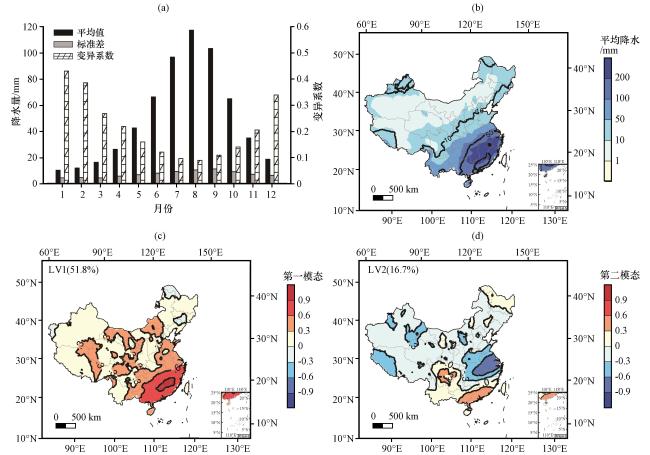
图1给出了观测的中国冬季降水的基本特征。图1(a)是1961 -2021年中国多年平均的逐月降水, 标准差和变异系数。冬季12月、 1月、 2月的月平均降水量和标准差相比其他月份小, 变异系数(CV)比其他月份大, 表明冬季降水量相比其他月份小, 但变异系数大。图1(b)给出了中国冬季多年平均降水量和标准差的空间分布, 总体上呈现自东南沿海向西北内陆递减的分布, 中国冬季降水主要集中在中国东南部, 降水中心位于福建和江西省为主的东南沿海地区, 多年平均降水量在200 mm以上。中国西北地区的冬季降水量最少, 其中南疆, 青海, 甘肃和内蒙等地的冬季平均降水量不足10 mm。中国东南沿海地区也是冬季降水异常变化最显著的地区, 降水平均年际变率(标准差)大于50 mm, 其中降水标准差的大值中心相对于冬季降水量的大值中心偏南, 位于广东以北地区, 降水标准差大于100 mm, 表明该地区冬季降水不稳定, 年际变率大, 而福建、 江西等地的冬季降水较多且相对稳定。
图1 1961 -2021年中国冬季降水的基本特征 (a)中国多年逐月降水的平均值(单位: mm), 标准差(单位: mm)和变异系数, (b)冬季降水的多年平均值(填色)和标准差(等值线)的空间分布, (c)中国冬季降水量的第一模态, (d)中国冬季降水量的第二模态

Fig.1 Winter precipitation characteristics in China from 1961 to 2021.(a) monthly mean (unit: mm), standard deviation (STD, unit: mm), and CV of precipitation in China, (b) distribution of the mean (shading) and standard deviation (solid lines) of winter precipitation, (c) the first mode of winter precipitation in China, (d) the second mode

为了进一步分析冬季降水异常变化的空间分布特征, 对1961 -2021年中国冬季降水进行EOF分析[图1(c), (d)]。由解释方差来看, 中国冬季降水的收敛性较好, 前两个特征向量解释了冬季降水总方差的70%。第一特征向量场[LV1, 图1(c)]表现出空间上的一致性变化, 该模态占总方差贡献的51.8%, 反映了中国大部分区域冬季降水的变化基本一致, 东北大兴安岭以及长白山地区和全国的冬季降水呈反相变化。LV1的大值中心位于东南沿海地区, 该区域靠近海洋, 水汽丰富, 同时也是冷空气南下的最远点。每年冷空气南侵强度的变化导致北方冷空气与南方暖湿气流的交汇不稳定, 从而使得该地区降水不稳定。因此, 该地区冬季降水的年际变化尤为显著, 这与图1(b)所反映的特征基本一致。
第二特征向量场[LV2, 图1(d)]表现出冬季降水的第二个特征, 此模态占总方差的16.7%。LV2的中心位于长江下游地区, 其次是华南和东北的大兴安岭地区, 反映了这三个地区冬季降水的年际异常变化显著。图1(d)也反映出华南、 西南、 东北大兴安岭地区和中国其他地区的冬季降水变化相反。长江下游地区是北方冷空气和南方暖湿气流交汇频繁的地区, 该地区冬季降水的变化反映了冷暖空气相对强弱的变化。长江下游地区和华南到西南的冬季降水变化相反的现象, 反映了冷空气南下的东、 西路径。

4 1961 -2021年中国冬季降水的时间变化特征

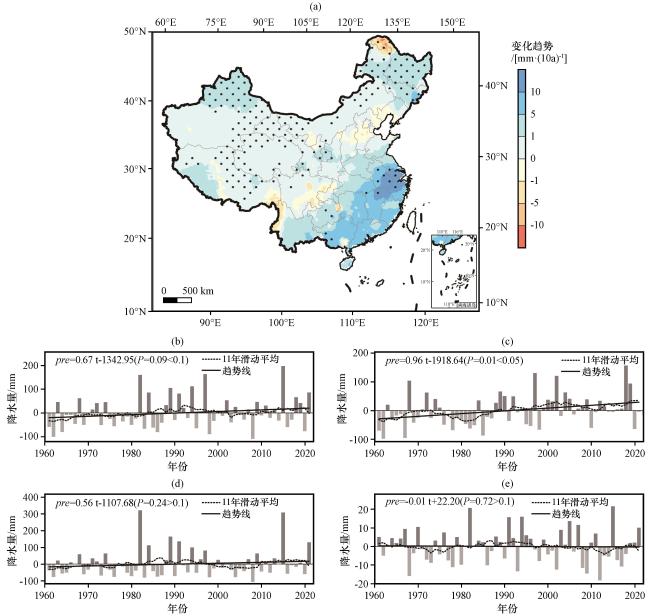
为了分析在过去60年中国冬季降水的时间变化特征, 图2给出了1961 -2021年冬季降水的变化趋势。从图2(a)可以看出, 冬季降水总体呈现增加趋势, 平均线性增加率为1.56 mm·(10a)-1, 东南沿海地区降水增加率超过5 mm·(10a)-1, 其中增加最为显著的长江下游地区, 线性增长率超过10 mm·(10a)-1。而东北大兴安岭地区有显著的减少趋势, 减少趋势超过5 mm·(10a)-1
图2 1960 -2021年中国冬季降水(单位: mm)的时间变化特征 (a)变化趋势[填色, 单位: mm·(10a)-1], 其中打点区域表示通过95%信度检验, (b) 东南沿海 [图1(c)中LV1>0.6区域]的冬季降水随时间变化, (c) 长江下游[图1(d)中 L V 2>0.6区域], (d)华南沿海[图1(d)中 L V 2>0.3区域], (e)西南地区[图1(d)中 L V 2>0.3区域]

Fig.2 Temporal characteristics of winter precipitation (unit: mm) in China from 1960 to 2021.(a) the trend of winter precipitation [shading, unit: mm·(10a)-1], where dotted areas indicate passing the 95% significance test, (b) winter precipitation time series in the southeast coast (LV1>0.6 area), (c) the lower reaches of the Yangtze River (|LV2|>0.6 area), (d) Southern China coastal region (|LV2|>0.3 area), and (e) the southwest region (|LV2|>0.3 area)

图2(b)~(e)给出了过去60年中国冬季降水变率中心(东南沿海、 长江中下游、 华南沿海和西南地区)的冬季降水时间变化特征。图2(b)显示, 过去60年, 东南沿海地区的冬季降水呈现增长趋势, 线性增长率为6.75 mm·(10a)-1, 通过了90%信度检验。该地区冬季降水也存在年代际变化特征, 在1985年前降水偏少, 1980 -2000年和2010年后降水偏多。
图2(c)给出的长江下游地区是第二模态中年际变率最大的区域( L V 2>0.6), 过去60年间, 该地区降水增加趋势最显著, 线性增加率为9.64 mm·(10a)-1, 通过了95%信度检验。同样, 该地区降水也存在年代际变化特征, 其中降水在1985年前偏少, 1985年后偏多。
图2(d)是华南沿海地区(第二特征 L V 2>0.3的区域)在过去60年间冬季降水的变化, 该地区的冬季降水呈增加趋势, 线性增长率为5.6 mm·(10a)-1; 华南沿海的冬季降水也存在明显的年代际变化特征, 其中在1980年前和2000 -2010年降水偏少, 而在1980 -2000年和2010年以后降水偏多。
图2(e)给出的西南地区(第二特征 L V 2>0.3的区域), 不同于上述三个地区, 该地区的冬季降水在过去60年呈现减少趋势, 线性趋势为-0.1 mm·(10a)-1。同样, 该地区的冬季降水也存在年代际变化, 在1970-1980年和2010-2020年偏少, 而在1980-2000年偏多。
在1961-2021年, 中国冬季降水总体上呈现出增加的趋势, 其中长江下游地区冬季降水量的增加最为显著, 线性增加率为9.6 mm·(10a)-1, 高于中国年降水量的增加趋势[5.5 mm·(10a)-1]和中国冬季降水量的增加趋势[1.5 mm·(10a)-1], 也高于全球降水量的增加趋势[1.1 mm·(10a)-1](中国气象局气候变化中心, 2022)。
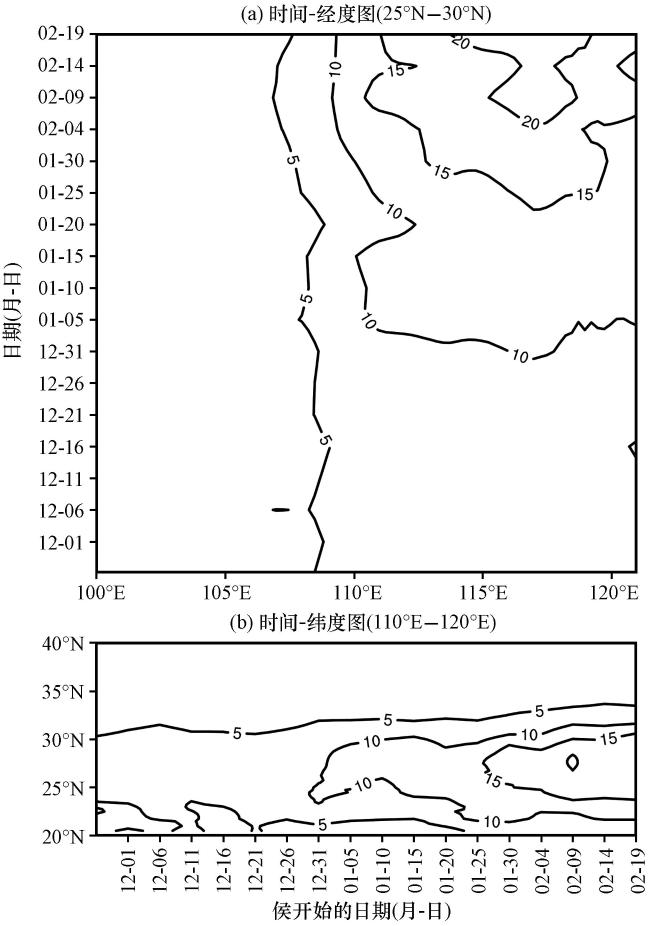
为进一步理解中国冬季降水变率中心(25°N - 40°N, 110°E -120°E, 东南沿海)的冬季降水的时空变化特征, 图3给出了降水变率中心的多年平均冬季降水随纬度和经度的变化。从图3(a)中可以看出, 12月至次年2月, 降水集中在107 °E -120 °E, 降水量为5 mm·pentad-1, 进入2月份, 降水中心移至115 °E -120 °E, 降水逐渐增加至20 mm·pentad-1。从图3(b)中可以看出, 从12月至次年2月, 主要降水基本稳定在30 °N 以南地区, 随着时间推进, 降水量从5 mm·pentad-1逐渐增加至15 mm·pentad-1, 降水区域仍位于25 °N -30 °N。可见, 降水变率中心的冬季降水量在季节内随时间增加, 从5 mm增加至20 mm左右, 降水中心的位置随时间的变化较小, 从25 °N -30 °N, 107 °E -120 °E移至25 °N - 30 °N, 115 °E -120 °E。
图3 1961 -2021年中国冬季降水变率中心(东南沿海地区)的冬季降水(单位: mm·pentad-1) 逐候变化

Fig.3 Pentad change in precipitation (unit: mm·pentad-1) in the central region of precipitation variability in China (Southeast coastal region of China) from 1961 to 2021

5 海温异常对中国冬季降水的调控

研究表明, 海温异常是影响中国降水的主要外强迫, 其中赤道中东太平洋和印度洋海温异常是中国降水季节预测中重要的预测因子(王会军等, 2008丁一汇, 2011)。大量研究表明冬季赤道中东太平洋和印度洋海温异常和同期中国冬季降水存在正相关关系, 具体而言, 冬季赤道中东太平洋、 印度洋异常偏暖(冷), 中国南方冬季降水偏多(少)(陶诗言和张庆云, 1998陈文, 2002吴国雄等, 2000彭京备, 2012Han et al, 2014)。但是前期赤道中东太平洋和印度洋海温异常如何影响后期中国冬季降水的变化需要进一步研究。
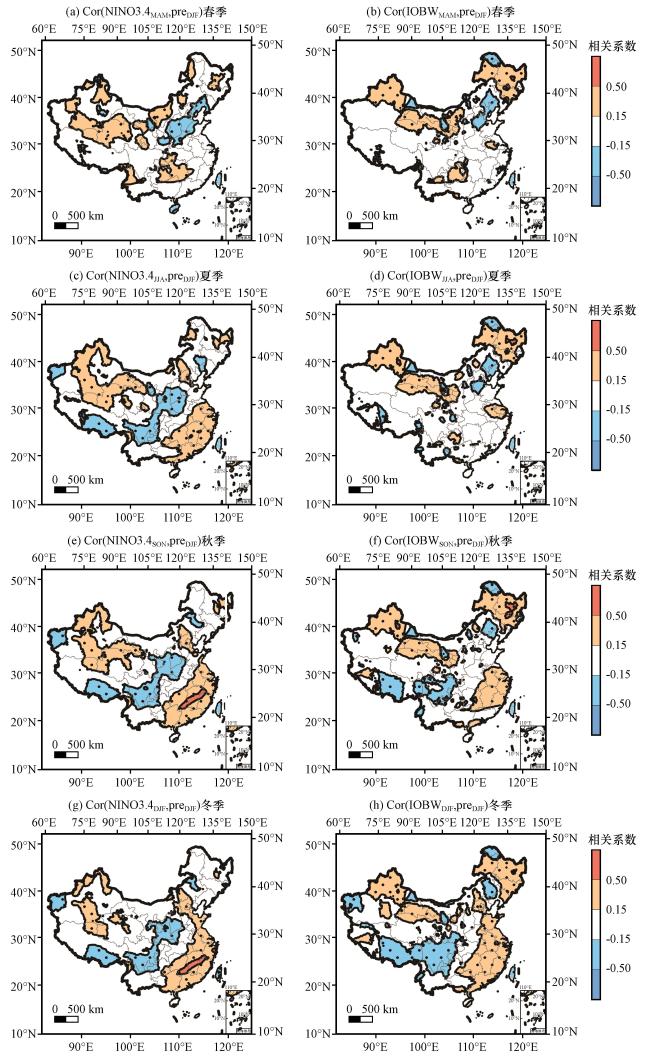
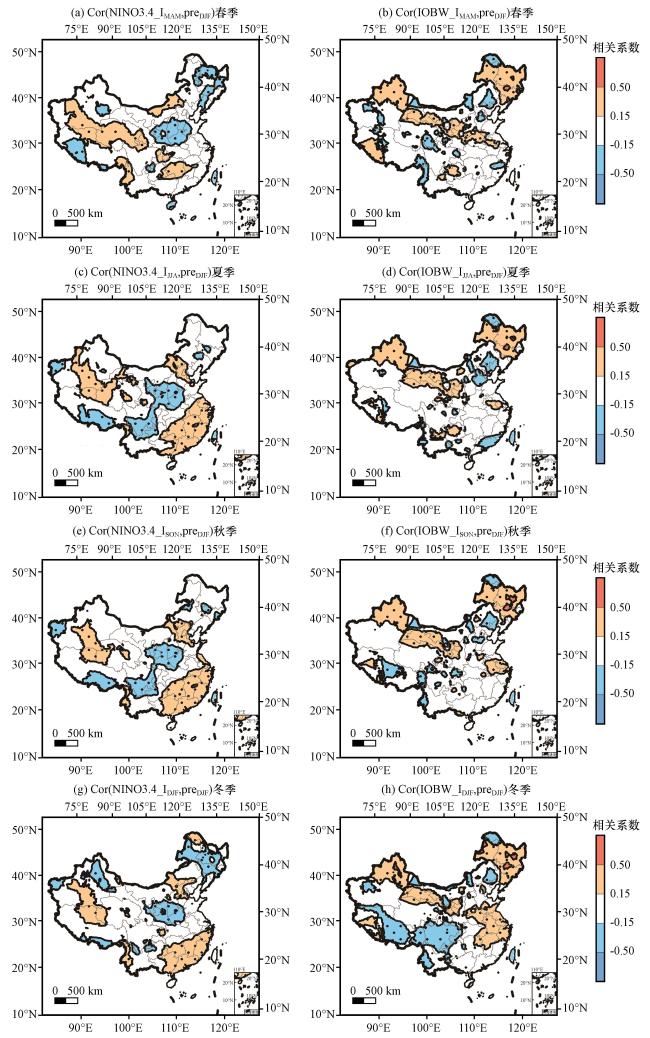
为揭示1961 -2021年前期和同期赤道中东太平洋和印度洋海温异常信号对中国冬季降水的影响, 图4给出了春, 夏, 秋和冬季去线性趋势后的NINO3.4、 IBOW指数和冬季降水的相关系数, 从图4中可以看出, 不同季节的NINO3.4指数和冬季降水的相关关系在中国东南(西南)呈现出正(负)相关, 春季以外其他季节的NINO3.4指数和冬季降水之间的相关程度和范围存在差异, 但总体上差异不显著, 尤其在冬季降水年际变率较大的东南沿海、 青藏高原东侧和北侧、 西北中部, 表明赤道中东太平洋海温异常对中国冬季降水的影响显著且相对稳定, 且这一影响具有提前两个季节的特征。从图4中还可以看出, IOBW指数与中国北方冬季降水总体呈现正相关, 在西南和东北大兴安岭的部分地区出现负相关, 即热带印度洋海温偏暖(冷)时, 冬季中国北方地区总体上降水偏多(少), 中国西南地区降水偏少(多)。
图4 1961 -2021年不同季节去线性趋势后赤道中东太平洋和热带印度洋海温异常信号(NINO3.4和IOBW)与中国冬季降水的相关系数 打点区域通过90%信度检验

Fig.4 Correlation coefficients of detrended SST anomaly signals (NINO3.4 and IOBW) in the Eequatorial East-central Pacific and Tropical Indian Ocean with winter precipitation in China of different seasons from 1961 to 2021.The dotted area passed the 90% significance test

图4揭示出赤道中东太平洋和热带印度洋海温异常均与中国冬季降水存在显著的超前相关关系, 然而相关的空间分布有所不同。有趣的是, 热带印度洋海温异常信号(IOBW)与中国冬季降水的显著相关性主要出现在黄河以北地区, 且在提前三个季节的春季表现出显著的正相关性。而东南沿海地区的冬季降水与该海温异常的相关性则延迟至秋季才逐渐显现。这表明, 不同海域的海温异常对中国冬季降水的调控机制各异, 中东赤道太平洋和热带印度洋海温异常可以相互补充, 作为预测中国冬季降水的信号。
研究表明, 印、 太海温之间存在联系, 当厄尔尼诺现象在冬季增强时, 印度洋偶极子结构消失, 转变为印度洋全区一致增温模态(IOBW), 印度洋东南部与厄尔尼诺相关的反气旋异常强迫罗斯贝波西传, 增加印度洋温跃层的范围, 促进了印度洋变暖(Xie et al, 2009Chakravorty et al, 2013Liu et al, 2021)。NINO3.4和IOBW的相关系数在夏(秋)季为0.2(0.47), 冬季为0.80, 通过了95%信度检验。可见, 印度洋海温和赤道中东太平洋海温在夏秋季相对独立, 而在冬季存在显著的正相关关系。
为了理解冬季的印度洋海温和赤道中东太平洋海温信号对中国冬季降水独立和协同作用, 用偏回归的方法得到剔除IOBW信号的ENSO指数(NINO 3.4_I)和剔除ENSO信号的IOBW指数(IOBW_I)。图5给出了春, 夏, 秋和冬季去线性趋势后的NINO3.4_I、 IOBW_I指数和冬季降水的相关系数。从图5中可以看出, 在春、 夏、 秋季, NINO3.4_I和IOBW_I与冬季降水相关关系与NINO3.4和IOBW与冬季降水的相关关系基本一致[图4(a)~(f)], 赤道中东太平洋和热带印度洋海温异常与中国冬季降水显著超前相关关系是独立且稳定的。剔除IOBW信号后的冬季ENSO和冬季降水的相关关系在东南沿海地区减弱, 说明印度洋海温调控增强了ENSO和中国东南沿海降水的正相关关系[图5(g)]。剔除和未剔除ENSO信号的冬季IOBW和中国北方冬季降水的相关关系基本一致, 说明印度洋海温对中国北方冬季降水的影响独立于ENSO[图5(h)]。
图5 1961 -2021年不同季节去掉线性趋势后赤道中东太平洋和热带印度洋海温独立异常信号(NINO3.4_I和IOBW_I)与中国冬季降水的相关系数 打点区域通过90%信度检验

Fig.5 Correlation coefficients of detrended SST anomaly independent signals (NINO3.4_I and IOBW_I)in the Equatorial East-central Pacific and Tropical Indian Ocean with winter precipitation in China of different seasons from 1961 to 2021.The dotted area passed the 90% significance test

为了进一步理解冬季赤道中东太平洋和印度洋海温对中国冬季降水的独立和协同作用。表2给出了NINO3.4和IOBW回归拟合的中国东南沿海和中国北方冬季降水。用单一信号NINO3.4_I(IOBW_I)拟合的东南沿海降水解释方差为12.6%(2.6%), 拟合结果与原值相关系数为0.36(0.16), 采用NINO3.4和IOBW两个因子拟合东南沿海降水解释方差增加到34.8%, 与原值的相关系数为0.59, 说明东南沿海冬季降水与赤道中东太平洋海温呈现显著正相关关系, 印度洋海温调控增强了东南沿海冬季降水和赤道中东太平洋海温的正相关关系。对于中国北方冬季降水, 用单一信号NINO3.4_I拟合冬季降水的解释方差仅2.9%, 而用单一IOBW_I和NINO3.4、 IOBW两个信号拟合得到冬季降水的解释方差和与原值相关系数相近, 分别为26.9%(30%)和0.52(0.54), 说明印度洋海温对中国北方冬季降水的影响独立于赤道中东太平洋海温, 与图5一致。
表2 冬季标准化赤道中东太平洋和印度洋海温指数回归拟合的中国东南沿海和中国北方冬季降水

Table 2 The validity of fitting winter precipitation in Southeastern coastal and Northern of China using the NINO3.4 and IOBW

区域 回归模型 解释方差/% 拟合结果与原值的相关系数
东南沿海 P r = 22.7 × N I N O 3.4 _ I 12.6 0.36*
P r = 10.4 × I O B W _ I 2.6 0.16
P r = 28.5 × N I N O 3.4 + 13 × I O B W 34.8 0.59*
中国北方 P r = - 0.6 × N I N O 3.4 _ I 2.9 0.17
P r = 1.9 × I O B W _ I 26.9 0.52*
P r = - 0.8 × N I N O 3.4 + 2.3 × I O B W 30 0.54*

*表示通过95%信度检验(* indicates that the value passed the 95% significance test)

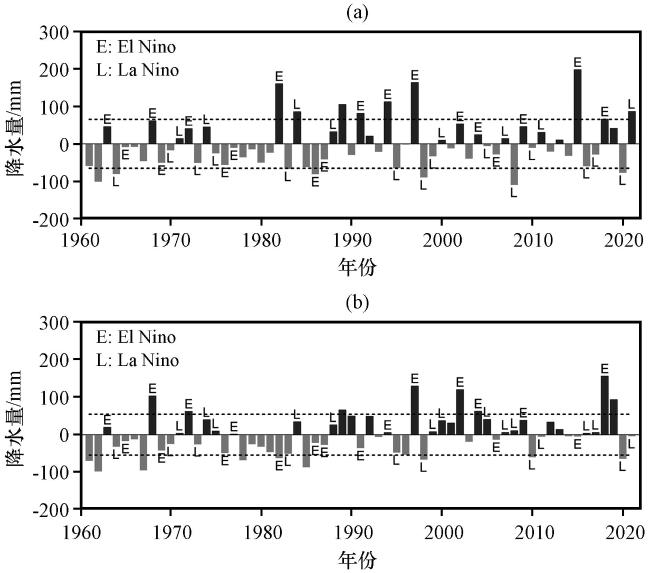
为了进一步理解赤道中东太平洋海温和中国冬季降水的关系, 图6给出了中国冬季降水年际变率较大区域(东南沿海和长江下游)的冬季降水和冬季El Niño、 La Niña事件的对应关系。由图6可以看出, 大多数冬季El Niño事件发生的年份对应东南沿海冬季降水偏多, 偏多概率约63%(12/19), 表明El Niño事件对中国东南沿海的冬季降水具有显著的影响; 长江下游地区降水偏多概率较小约为53%(10/19), 这表明El Niño事件对该地区冬季降水的影响并非唯一且确定的因素。而冬季出现La Niña事件时, 东南沿海地区的冬季降水偏少的概率约为64%(14/22), 即La Niña事件和东南沿海地区的冬季降水减少具有较强的关系; 长江下游的冬季降水偏少概率约为45%(10/22)。结合图4, 赤道中东太平洋海温异常对东南沿海冬季降水的指示意义明显强于对长江下游地区的冬季降水。
图6 1960 -2021年东南沿海(a)和长江下游(b)的冬季降水异常与冬季El Niño、 La Niña事件的关系 虚线表示冬季降水偏离1倍标准差

Fig.6 Relationship between winter precipitation anomalies in the southeastern coastal area (a) and the lower reaches of the Yangtze River (b) with winter El Niño and La Niña events from 1960 to 2021.The dotted line represents the deviation of winter precipitation by 1 standard deviation

为了进一步明晰中国冬季降水与夏、 秋季El Niño和La Niña事件之间的关系, 将El Niño(La Niña)分为发展型和持续型两类, 即夏季存在的El Niño(La Niña)事件持续到秋季, 记为El Niño(La Niña)持续型, 而El Niño(La Niña)在秋季出现并持续发展, 记为El Niño(La Niña)发展型。
表3给出了反映上述4类事件的夏、 秋季赤道中东太平洋NINO3.4区海温异常和冬季降水的关系。由表3所示, El Niño发展型对应5年的中国冬季降水偏多, 5年冬季降水偏少, 各占50%的概率, 其中冬季降水在东南沿海偏多概率也为50%, 长江下游为60%, 即El Niño事件如果从秋季出现然后发展, 则对中国冬季降水的调控作用并不显著; El Niño持续型则有7年中国冬季降水偏多, 即78%的El Niño持续型年份中国冬季降水偏多, 其中东南沿海冬季降水偏多的概率为78%, 长江下游仅44%, 即El Niño事件如果从夏季建立持续到秋季, 则对接下来的中国东南沿海地区冬季降水起着更显著的调控作用; 同样, La Niña发展型对应5年的中国冬季降水偏少, 1年中国冬季降水偏多, 即La Niña发展型的83%年份中国冬季降水偏少, 其中东南沿海地区冬季降水偏少概率为83%, 长江下游为50%, 即La Niña事件如果从秋季持续到冬季, 则显著的调控和影响中国东南沿海地区的冬季降水; La Niña持续型对应的7年中国冬季降水偏少, 6年冬季降水偏多, 东南沿海和长江下游地区冬季降水偏少概率也为53%, 表明La Niña持续型对中国冬季降水的指示意义并不显著。表3也表明, El Niño持续型和La Niña发展型对东南沿海冬季降水指示意义高于长江下游地区。
表3 冬季降水异常和夏、 秋El NiñoLa Niña事件的关系

Table 3 Relationship between winter precipitation anomalies and summer and autumn El Niño and La Niña events

年份 夏季NINO3.4海温距平/ 秋季NINO3.4海温距平/ 东南沿海冬季降水距平/mm 长江下游冬季降水距平/mm 全国冬季降水距平/mm
El Niño发展型 1968 0.46 0.58 61.98 103.66 6.24
1969 0.43 0.82 -50.22 -42.21 -7.93
1976 0.16 0.76 -56.22 -49.05 -9.74
1977 0.37 0.70 -10.68 1.91 -0.59
1986 0.21 0.93 -80.95 -22.02 -6.52
1994 0.43 0.77 112.45 6.03 12.30
2004 0.46 0.68 24.68 63.14 6.20
2006 0.12 0.75 -28.01 -13.30 -2.57
2009 0.44 1.03 46.25 38.60 4.57
2018 0.10 0.72 66.21 156.57 13.56
El Niño持续型 1963 0.84 1.29 45.89 20.06 6.05
1965 1.20 1.93 -8.71 -16.98 -1.77
1972 1.14 1.84 40.98 62.41 4.20
1982 0.86 1.91 160.64 -62.41 10.44
1987 1.48 1.46 -41.30 -27.15 -6.00
1991 0.67 0.87 81.80 -35.88 7.99
1997 1.57 2.29 163.86 130.25 17.85
2002 0.77 1.18 53.16 120.52 11.85
2015 1.52 2.38 198.09 -4.68 19.60
La Niña发展型 1983 0.32 -0.76 -66.89 -50.72 -12.30
1984 -0.30 -0.57 85.90 34.78 7.88
1995 -0.27 -0.93 -64.47 -47.51 -10.89
2016 -0.32 -0.66 -59.73 3.89 -1.29
2017 0.11 -0.62 -28.42 6.29 -4.78
2020 -0.43 -1.11 -77.03 -64.18 -8.20
La Niña持续型 1964 -0.61 -0.79 -80.39 -32.07 -9.73
1970 -0.56 -0.79 -17.10 -24.89 0.72
1971 -0.77 -0.88 14.09 3.86 1.20
1973 -1.09 -1.70 -50.89 -25.72 -10.77
1974 -0.56 -0.59 45.36 40.05 3.38
1975 -1.10 -1.45 -25.24 9.88 -0.94
1988 -1.24 -1.49 32.57 26.51 7.09
1998 -0.68 -1.38 -89.69 -66.46 -14.57
1999 -1.08 -1.29 -33.43 8.23 -1.71
2000 -0.57 -0.64 9.76 37.51 3.60
2007 -0.61 -1.30 14.20 6.18 2.38
2010 -1.02 -1.61 -10.73 -60.15 -0.73
2011 -0.51 -0.98 30.78 -5.22 -0.99

距平为相对于1961-2021年的多年平均值(Anomaly is relative to the multi-year average from 1961 to 2021)

研究指出, El Niño和La Niña事件一般在夏、 秋季建立, 在冬季成熟, 在次年春季消亡(Kessler, 2002李崇银等, 2008)。本文的分析表明, 如果El Niño事件秋季建立, 则其对后期冬季气候的影响一般较弱; 如果El Niño事件在夏季以及夏季前建立并持续到秋季, 则对冬季气候的影响一般较强。如果La Niña事件在秋季发生并发展到冬季, 对冬季气候的影响强于La Niña事件在夏季以及夏季前建立并维持到秋冬季。
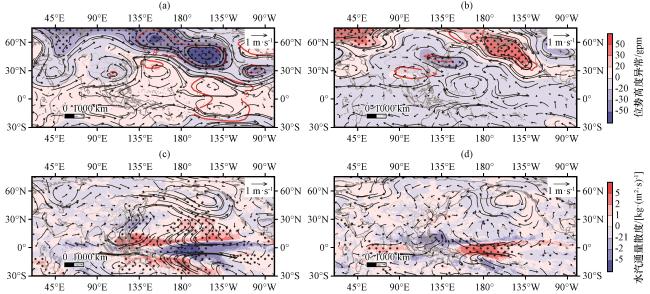
为了理解冬季降水和夏、 秋季El Niño、 La Niña不同演变类型之间关系的可能原因, 文中选择了两种对冬季降水具有显著指示意义的类型, 即El Niño持续型和La Niña发展型, 并进一步分析这两种类型对应的冬季大气环流。图7给出了上述两种类型合成的冬季环流形势。图7(a)中El Niño持续型的500 hPa位势高度异常表现为中国大部分地区负异常, 异常中心位于西南地区, 也对应500 hPa温度负异常的中心, 表明El Niño持续型在西南地区形成了异常低压。图7(c)给出了El Niño持续型对应的850 hPa环流和水汽通量散度异常。从图7(c)可以看出, 赤道中东太平洋低层异常东风, 在西太平洋低层激发出异常反气旋性环流, 中国东南沿海地区为异常西南风, 有利于水汽从海洋输入内陆, 此外, 水汽在中国东南沿海的大部分区域为异常辐合, 有利于该地区降水的形成。从图7(b)可以看出, La Niña发展型对应的500 hPa位势高度异常表现为中国大部分地区为负异常, 而西南地区为正异常, 且对应温度的正异常中心, 表明在中国西南存在异常高压区, 受到异常反气旋环流的影响; 图7(d)中La Niña发展型对应的850 hPa环流和水汽通量散度异常可以看出, 赤道中东太平洋低层异常西风, 西太平洋低层激发出异常气旋性环流, 中国东南沿海地区存在异常偏北风, 并且水汽表现为异常辐散, 不利于降水的形成。
图7 1961 -2021 年El Niño持续型(a, c)和La Niña发展型(b, d)合成的冬季环流 (a, b)500 hPa位势高度异常(填色, 单位: gpm)、 风场异常(箭头, 单位: m·s-1)、 温度异常(红色等值线, 单位 : ); (c, d)850 hPa环流异常(箭头, 单位: m·s-1)和水汽通量散度[填色, 单位: kg·(m2 s)-1]; 打点区域表示通过90%信度检验

Fig.7 Composite circulation of El Niño persistent type(a, c) and La Niña development type(b, d) from 1961 to 2021.(a, b) 500 hPa geopotential height anomaly (shading, unit: gpm), wind field anomaly (arrow, unit: m·s-1), and temperature anomaly (red lines, unit: ℃); (c, d) 850 hPa wind speed anomaly (arrow, unit: m·s-1) and water vapor flux divergence [shading, unit: kg·(m2 s)-1]; the dotted areas indicate passing the 90% significance test

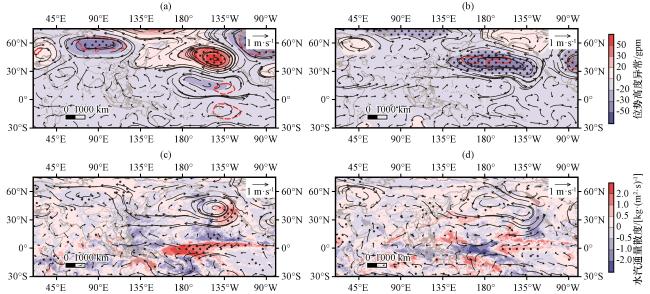
不同于太平洋, 印度洋海温最主要的空间变化特征是整个区域一致性变暖或变冷, 热带印度洋(IOBW)区海温异常信号常被用来表征印度洋海温的异常变化(Klein et al, 1999黄刚等, 2016)。选择去掉ENSO信号的印度洋海温异常指数(IOBW_I)判断印度洋海温异常年份, 在判断年份时选择高(低)于1倍标准差来定义印度洋海温异常的年份。根据这一标准, 偏暖年包括1964、 1970、 1988、 1989、 2000、 2012和2013年, 而偏冷年则为1976、 1977、 1987、 1992、 1993、 1994和1995年。热带印度洋偏暖对应的500 hPa位势高度异常表现为西北太平洋正异常中心, 对应温度正异常中心, 西伯利亚为负异常中心, 对应温度负异常中心, 中国北方受异常西南风影响[图8(a)]; 然而, 图8(b)中热带印度洋海温偏冷年对应的500 hPa位势高度异常表现为西北太平洋负异常中心, 对应温度负异常中心, 中国北方受异常西风影响。图8(c)给出了热带印度洋偏暖对应的850 hPa环流和水汽通量散度异常, 西北太平洋环流表现为反气旋性异常, 中国北方地区受异常东南风的影响, 利于水汽从中国东部海洋进入北方, 水汽在中国北方大部分区域表现为辐合性异常, 利于降水的形成; 然而, 从热带印度洋偏冷对应的850 hPa环流和水汽通量散度异常[图8(d)]中可以看出, 西北太平洋环流表现为气旋性异常, 中国北方受异常西北风影响, 不有利于水汽从中国东部海洋进入北方内陆, 并且水汽在中国北方大部分区域表现为异常辐散, 不有利于降水。以往研究也表明, 印度洋海温异常能够远距离调控西北太平洋的大气环流, 印度洋增暖能激发西北太平洋反气旋异常(黄刚和胡开明, 2008)。可能的原因是印度洋激发的开尔文波动触发的局地对流—大尺度环流相互作用, 导致了西北太平洋低层反气旋异常形成和维持(Xie et al, 2009), 以及印度洋增暖引起的印度洋异常东风向西延伸到西北太平洋, 通过风-蒸发-海温机制使得西北太平洋海温异常偏低, 有利于西北太平洋反气旋式大气环流异常的形成和维持(Chen et al, 2021)。由此可见, 印度洋海温通过低纬度的热力强迫, 影响西北太平洋环流以及中国北方低层850 hPa从东向西的水汽输送, 从而对中国北方冬季降水进行调控。
图8 1961 -2021年去掉ENSO的印度洋海温异常(IOBW_I)偏暖年(a, c)和偏冷年(b, d)合成的冬季环流 (a, b)500 hPa位势高度异常(填色, 单位: gpm)、 风场异常(箭头, 单位: m·s-1)、 温度异常(红色等值线, 单位: ); (c, d)850 hPa环流异常(箭头, 单位: m·s-1)和水汽通量散度[填色, 单位: kg·(m2 s)-1], 其中打点区域表示通过90%信度检验

Fig.8 Composite circulation of anomalously cold(b, d) and warm(a, c) Indian Ocean SST removed ENSO signal (IOBW_I) from 1961 to 2021.(a, b) 500 hPa geopotential height anomaly (shading, unit: gpm), wind field anomaly (arrow, unit: m·s-1), and temperature anomaly (red lines, unit: ℃); (c, d) 850 hPa wind speed anomaly (arrow, unit: m·s-1) and water vapor flux divergence [shading, unit: kg·(m2 s)-1], the dotted areas indicate passing the 90% significance test

图7图8揭示出前期赤道中东太平洋和热带印度洋海温异常(NINO3.4和IOBW)对冬季大气环流的调控机制存在差异。赤道中东太平洋海温异常主要影响中国以南的冬季环流系统和从南海向中国大陆输送的水汽, 而热带印度洋海温异常主要影响中国以北的冬季环流系统和从东向西输送的水汽, 从而调控中国冬季降水。因此, 赤道中东太平洋和热带印度洋海温异常分别显著调控东南沿海和黄河以北的冬季降水, 这与图4反映的特征一致。

6 结论

本文利用1961 -2021年降水观测资料, ERA5再分析和海温资料, 分析了中国冬季降水的时空变化特征, 并探讨太平洋、 印度洋海温异常对中国冬季降水的调控, 得到以下主要结论:
(1) 1961 -2021年, 中国冬季降水呈现出增加趋势, 平均1.5 mm·(10a)-1, 长江下游地区增加最为显著, 线性增加趋势为9.6 mm·(10a)-1。中国冬季降水年际变率最大地区在东南沿海。长江下游地区的冬季降水和西南、 华南沿海的冬季降水呈反位相变化。
(2) 赤道中东太平洋和热带印度洋海温前期的异常对中国冬季降水的调控范围存在差异。夏、 秋季赤道中东太平洋海温异常对中国东南沿海和长江流域冬季降水有显著正相关关系, 冬季印度洋海温增强了赤道中东太平洋海温和中国东南沿海冬季降水的正相关关系。相比之下, 热带印度洋海温异常和东南沿海冬季降水的正相关关系在秋季才出现, 而对中国北方冬季降水的影响在春季便已经出现, 冬季印度洋海温对中国北方冬季降水的影响独立于赤道中东太平洋海温。中国冬季降水的预测需要综合考虑赤道中东太平洋海温和热带印度洋海温异常。
(3) 前期夏、 秋赤道中东太平洋海温异常的不同演变, 即El Niño和La Niña的不同演变对中国冬季降水的调控各异。夏季的El Niño如果持续到秋季, 78%的年份中国冬季降水偏多; 秋季出现La Niña并发展, 则有83%的年份中国冬季降水偏少。夏季发生并持续到秋季的La Niña事件和秋季发生持续到冬季的El Niño事件对中国冬季降水的指示意义较弱。
(4) 中国冬季降水受赤道中东太平洋和热带印度洋海温异常(NINO3.4和IOBW)的调控机制不同。赤道中东太平洋海温异常伴随赤道中东太平洋低层异常东风, 在西太平洋低层激发出异常反气旋性环流, 影响中国以南的环流系统和从南海向中国大陆输送的水汽, 而印度洋海温异常通过激发西北太平洋异常环流, 影响中国以北的冬季环流系统和从东向西输送的水汽, 从而对中国冬季降水进行调控。
Chakravorty S Chowdary J S Gnanaseelan C2013.Spring asymmetric mode in the tropical Indian Ocean: role of El Niño and IOD[J].Climate Dynamics40(5): 1467-1481.DOI: 10.1007/s00382-012-1340-1 .

Chen Z S Li Z N Du Y, et al, 2021.Trans-basin influence of southwest tropical Indian Ocean warming during early boreal summer[J].Journal of Climate: 34, 9679-9691.DOI: 10.1175/jcli-d-20-0925.1 .

Donat M G Lowry A L Alexander L V, et al, 2016.More extreme precipitation in the world’s dry and wet regions[J].Nature Climate Change6(5): 508-513.DOI: 10.1038/nclimate2941 .

Fischer E M Knutti R2016.Observed heavy precipitation increase confirms theory and early models[J].Nature Climate Change6(11): 986-991.DOI: 10.1038/nclimate3110 .

Gao C J Li G2023.Asymmetric effect of ENSO on the maritime continent precipitation in decaying summers[J].Climate Dynamics61(5): 2839-2852.DOI: 10.1007/s00382-023-06716-8 .

Groisman P Y Knight R W Easterling D R, et al, 2005.Trends in intense precipitation in the climate record[J].Journal of Climate18(9): 1326-1350.DOI: 10.1175/jcli3339.1 .

Han W Q Vialard J McPhaden M J, et al, 2014.Indian Ocean decadal variability: a review[J].Bulletin of the American Meteorological Society95(11): 1679-1703.DOI: 10.1175/bams-d-13-00028.1 .

Kessler W S2002.Is ENSO a cycle or a series of events?[J].Geophysical Research Letters29(23): 2125.DOI: 10.1029/2002GL015924 .

Klein S A Soden B J Lau N C1999.Remote sea surface temperature variations during ENSO: evidence for a tropical atmospheric bridge[J].Journal of Climate12(4): 917-932.DOI: 10.1175/1520-0442(1999)012<0917: rsstvd>2.0.co; 2 .

Latif M Anderson D Barnett T, et al, 1998.A review of the predictability and prediction of ENSO[J].Journal of Geophysical Research: Oceans103(C7): 14375-14393.DOI: 10.1029/97JC03413 .

Li C Ma H2012.Relationship between ENSO and winter rainfall over Southeast China and its decadal variability[J].Advances in Atmospheric Sciences29(6): 1129-1141.DOI: 10.1007/s00376-012-1248-z .

Li G Gao C J Lu B, et al, 2021.Inter-annual variability of spring precipitation over the Indo-China Peninsula and its asymmetric relationship with El Niño-Southern Oscillation[J].Climate Dynamics56(7): 2651-2665.DOI: 10.1007/s00382-020-05609-4 .

Liu B C Fang Y Sun S W, et al, 2022.Increasing precipitation in early winter over the Southern China during the past 40 years[J].Geophysical Research Letters49(24): e2022GL101134.DOI: 10.1029/2022GL101134 .

Liu F Y Zhang W J Jin F F, et al, 2021.Decadal modulation of the ENSO-Indian ocean basin warming relationship during the decaying summer by the interdecadal Pacific Oscillation[J].Journal of Climate34(7): 2685-2699.DOI: 10.1175/jcli-d-20-0457.1 .

Livezey R E Chen W Y1983.Statistical field significance and its determination by Monte Carlo techniques[J].Monthly Weather Review111(1): 46-59.DOI: 10.1175/1520-0493(1983)111<0046: sfsaid>2.0.co; 2 .

Lu J Y Wang K C Wu G C, et al, 2024.Evaluation of multisource datasets in characterizing spatiotemporal characteristics of extreme precipitation from 2001 to 2019 in China[J].Journal of Hydrometeorology25(3): 515-539.DOI: 10.1175/jhm-d-23-0162.1 .

Okumura Y M Deser C2010.Asymmetry in the duration of El Niño and La Niña[J].Journal of Climate23(21): 5826-5843.

Sui Y Jiang D B Tian Z P2013.Latest update of the climatology and changes in the seasonal distribution of precipitation over China[J].Theoretical and Applied Climatology113(3): 599-610.DOI: 10.1007/s00704-012-0810-z .

Sun J Q Ao J2013.Changes in precipitation and extreme precipitation in a warming environment in China[J].Chinese Science Bulletin58(12): 1395-1401.DOI: 10.1007/s11434-012-5542-z .

Timmermann A An S I Kug J S, et al, 2018.El Niño-Southern Oscillation complexity[J].Nature559(7715): 535-545.DOI: 10.1038/s41586-018-0252-6 .

Wang B Wu R G Fu X2000.Pacific-East Asian teleconnection: how does ENSO affect East Asian climate?[J].Journal of Climate13(9): 1517-1536.DOI: 10.1175/1520-0442(2000)013<1517: peathd>2.0.co; 2 .

Wei S T Wang C H Zhang F M, et al, 2024.Prediction of seasonal sea surface temperature based on temperature and salinity of subsurface ocean using machine learning[J].International Journal of Climatology44(5): 1326-1338.DOI: 10.1002/joc.8384 .

Xie S-P Hu K M Hafner J, et al, 2009.Indian Ocean capacitor effect on indo-western Pacific climate during the summer following El Niño[J].Journal of Climate22(3): 730-747.DOI: 10. 1175/2008jcli2544.1 .

Yang L Y Liang X D Yin J F, et al, 2023.The extreme precipitation and added value of East Asia regional reanalysis system[J].International Journal of Climatology43(14): 6831-6850.DOI: 10. 1002/joc.8238 .

Zhai P M Zhang X B Wan H, et al, 2005.Trends in total precipitation and frequency of daily precipitation extremes over China[J].Journal of Climate18(7): 1096-1108.DOI: 10.1175/jcli-3318.1 .

Zhang L Shi R Z Fraedrich K, et al, 2022a.Enhanced joint effects of ENSO and IOD on Southeast China winter precipitation after 1980s[J].Climate Dynamics58(1): 277-292.DOI: 10.1007/s00382-021-05907-5 .

Zhang R H Tian W S He X, et al, 2021.Enhanced influence of ENSO on winter precipitation over Southern China in recent decades[J].Journal of Climate, 34, 7983-7944.DOI: 10.1175/jcli-d-21-0182.1 .

Zhang Y Zhou W Wang X, et al, 2022b.IOD, ENSO, and seasonal precipitation variation over Eastern China[J].Atmospheric Research: 270, 106042.DOI: 10.1016/j.atmosres.2022.106042 .

Zhou L T Wu R G2010.Respective impacts of the East Asian winter monsoon and ENSO on winter rainfall in China[J].Journal of Geophysical Research: Atmospheres115(D2): 2009JD012502.DOI: 10.1029/2009JD012502 .

陈文, 2002.El Nino和La Nina事件对东亚冬、 夏季风循环的影响[J].大气科学26(5): 595-610.

Chen W2002.Impacts of El Nino and La nina on the cycle of the East Asian winter and summer monsoon[J].Chinese Journal of Atmospheric Sciences26(5): 595-610.

丁一汇, 2011.季节气候预测的进展和前景[J].气象科技进展1(3): 14-27.

Ding Y H2011.Progress and prospects of seasonal climate prediction[J].Advances in Meteorological Science and Technology1(3): 14-27.

黄刚, 胡开明, 2008.夏季北印度洋海温异常对西北太平洋低层反气旋异常的影响[J].南京气象学院学报31(6): 749-757.

Huang G Hu K M2008.Impact of north Indian Ocean SSTA on northwest Pacific lower layer anomalous anticyclone in summer[J].Journal of Nanjing Meteorological Institute31(6): 749-757.

黄刚, 胡开明, 屈侠, 等, 2016.热带印度洋海温海盆一致模的变化规律及其对东亚夏季气候影响的回顾[J].大气科学40(1): 121-130.DOI: 10.3878/j.issn.1006-9895.1505.15143.Huang G

Hu K M Qu X, et al, 2016.A review about Indian Ocean Basin mode and its impacts on East Asian summer climate[J].Chinese Journal of Atmospheric Sciences40(1): 121-130.DOI: 10.3878/j.issn.1006-9895.1505.15143 .

李崇银, 穆穆, 周广庆, 等, 2008.ENSO机理及其预测研究[J].大气科学32(4): 761-781.

Li C Y Mu M Zhou G Q, et al, 2008.Mechanism and prediction studies of the ENSO[J].Chinese Journal of Atmospheric Sciences32(4): 761-781.

李维京, 刘景鹏, 任宏利, 等, 2018.中国南方夏季降水的年代际变率主模态特征及机理研究[J].大气科学42(4): 859-876.DOI: 10.3878/j.issn.1006-9895.1802.17283.Li W J

Liu J P Ren H L, et al, 2018.Characteristics and corresponding mechanisms of the leading modes of interdecadal variability of summer rainfall in Southern China[J].Chinese Journal of Atmospheric Sciences42(4): 859-876.DOI: 10.3878/j.issn.1006-9895.1802.17283 .

刘嘉锡, 朱志伟, 卢睿, 等, 2024.ENSO循环海表温度演变多样性的客观分类[J].高原气象43(6): 1433-1447.DOI: 10.7522/j.issn.1000-0534.2024.00026.Liu J X

Zhu Z W Lu R, et al, 2024.Objective classification of sea surface temperature evolution diversity of ENSO cycle[J].Plateau Meteorology43(6): 1433-1447.DOI: 10.7522/j.issn.1000-0534.2024.00026 .

穆明权, 李崇银, 1999. 东亚冬季风年际变化的ENSO信息Ⅰ.观测资料分析[J].大气科学, 23(3): 276-285.

Mu M Q Li C Y1999.ENSO signals in the interannual variability of east-Asian winter monsoon.part Ⅰ: observed data analyses[J].Scientia Atmospherica Sinica23(3): 276-285.

彭京备, 2012.东印度洋海温对中国南方冬季降水的影响[J].气候与环境研究17(3): 327-338.DOI: 10.3878/j.issn.1006-9585.2011.10139.Peng J B , 2012.Influence of the sea surface temperature in the Eastern Indian Ocean on the wintertime rainfall in the Southern Part of China[J].Climatic and Environmental Research, 17(3): 327-338.DOI: 10.3878/j.issn.1006-9585. 2011.10139 .

施能, 魏风英, 封国林, 等, 1997.气象场相关分析及合成分析中蒙特卡洛检验方法及应用[J].南京气象学院学报20(3): 355-359.

Shi N Wei F Y Feng G L, et al, 1997.Monte Carlo test used in correlation and composite analysis of meteorological fields[J].Journal of Nanjing Meteorological Institute20(3): 355-359.

陶诗言, 张庆云, 1998.亚洲冬夏季风对ENSO事件的响应[J].大气科学22(4): 399-407.

Tao S Y Zhang Q Y1998.Response of the Asian winter and summer monsoon to ENSO events[J].Chinese Journal of Atmospheric Sciences22(4): 399-407.

王澄海, 董安祥, 王式功, 等, 2000.青藏高原积雪与西北春季降水的相关特征[J].冰川冻土22(4): 340-346.DOI: 10.3969/j.issn.1000-0240.2000.04.008.Wang C H

Dong A X Wang S G, et al, 2000.The correlation between precipitation in Northwest China during spring and snow depth in the Tibetan Plateau[J].Journal of Glaciology and Geocryology22(4): 340-346.DOI: 10.3969/j.issn.1000-0240.2000.04.008 .

王澄海, 李燕, 王艺, 2015.北半球大气环流及其冬季风的年代际变化对青藏高原冬季降雪的影响[J].气候与环境研究20(4): 421-432.DOI: 10.3878/j.issn.1006-9585.2015.14169.Wang C H

Li Y Wang Y2015.Impacts of interdecadal variability of circulation and winter monsoon on winter snowfall over the Tibetan Plateau[J].Climatic and Environmental Research20(4): 421-432.DOI: 10.3878/j.issn.1006-9585.2015.14169 .

王澄海, 王芝兰, 崔洋, 2009.40余年来中国地区季节性积雪的空间分布及年际变化特征[J].冰川冻土31(2): 301-310.

Wang C H Wang Z L Cui Y2009.Snow cover of China during the last 40 years: spatial distribution and interannual variation[J].Journal of Glaciology and Geocryology31(2): 301-310.

王澄海, 张晟宁, 李课臣, 等 , 2021a.1961 -2018年西北地区降水的变化特征[J].大气科学45(4): 713-724.DOI: 10.3878/j.issn.1006-9895.2101.20216.Wang C H , ZhangS N, LiK C, et al, 2021a.Change characteristics of precipitation in northwest China from 1961 to 2018[J].Chinese Journal of Atmospheric Sciences, 45(4): 713-724.DOI: 10.3878/j.issn.1006-9895.2101. 20216 .

王澄海, 张晟宁, 张飞民, 等 , 2021b.论全球变暖背景下中国西北地区降水增加问题[J].地球科学进展36(9): 980-989.WangCH, ZhangSN, ZhangFM, et al, 2021b.On the increase of precipitation in the northwestern China under the global warming[J].Advances in Earth Science, 36(9): 980-989.

王会军, 孙建奇, 郎咸梅, 等, 2008.几年来我国气候年际变异和短期气候预测研究的一些新成果[J].大气科学32(4): 806-814.

Wang H J Sun J Q Lang X M, et al, 2008.Some new results in the research of the interannual climate variability and short-term climate prediction[J].Chinese Journal of Atmospheric Sciences32(4): 806-814.

王林, 冯娟, 2011.我国冬季降水年际变化的主模态分析[J].大气科学35(6): 1105-1116.

Wang L Feng J2011.Two major modes of the wintertime precipitation over China[J].Chinese Journal of Atmospheric Sciences35(6): 1105-1116.

王腾, 孙博, 王会军, 等, 2023.三江源地区冬季降水年代际变化特征及相关物理机制[J].大气科学47(6): 1863-1875.DOI: 10.3878/j.issn.1006-9895.2204.22034.Wang T

Sun B Wang H J, et al, 2023.Interdecadal variations of winter precipitation over the three river source region in China and associated physical mechanisms[J].Chinese Journal of Atmospheric Sciences47(6): 1863-1875.DOI: 10.3878/j.issn.1006-9895.2204.22034 .

吴国雄, 刘平, 刘屹岷, 等, 2000.印度洋海温异常对西太平洋副热带高压的影响-大气中的两级热力适应[J].气象学报58(5): 513-522.DOI: 10.3321/j.issn: 0577-6619.2000.05.001.Wu G X

Liu P Liu Y M, et al, 2000.Impacts of the sea surface temperature anomaly in the Indian ocean on the subtropical anticyclone over the western Pacific-two-stage thermal adaptation in the atmosphere[J].Acta Meteorologica Sinica58(5): 513-522.DOI: 10.3321/j.issn: 0577-6619.2000.05.001 .

吴佳, 高学杰, 2013.一套格点化的中国区域逐日观测资料及与其它资料的对比[J].地球物理学报56(4): 1102-1111.DOI: 10.6038/cjg20130406.Wu J

Gao X J2013.A gridded daily observation dataset over China region and comparison with the other datasets[J].Chinese Journal of Geophysics56(4): 1102-1111.DOI: 10.6038/cjg20130406 .

徐铭阳, 曹杰, 2024.环球遥相关对东南亚低纬高原冬季降水年际变化影响的研究[J].高原气象43(4): 1011-1025.DOI: 10.7522/j.issn.1000-0534.2023.00031.Xu M Y

Cao J2024.Influence of circumglobal teleconnection on the interannual variability of winter precipitation over the Southeast Asian low-latitude Highlands[J].Plateau Meteorology43(4): 1011-1025.DOI: 10.7522/j.issn.1000-0534.2023.00031 .

杨辉, 李崇银, 2005.厄尔尼诺持续时间与大气环流异常形势[J].地球物理学报48(4): 780-788.DOI: 10.3321/j.issn: 0001-5733.2005.04.008.Yang H

Li C Y2005.Lasting time of El Nino and circulation anomaly[J].Chinese Journal of Geophysics48(4): 780-788.DOI: 10.3321/j.issn: 0001-5733.2005.04.008 .

张自银, 龚道溢, 胡淼, 等, 2012.多种东亚冬季风指数及其与中国东部气候关系的比较[J].地理研究31(6): 987-1003.

Zhang Z Y Gong D Y Hu M, et al, 2012.Comparisons of the multiple East Asian winter monsoon indices and their relations to climate over Eastern China[J].Geographical Research31(6): 987-1003.

智协飞, 张玲, 潘嘉露, 2011.我国南方冬季气候变暖前后极端降水事件分析[J].热带气象学报27(2): 166-172.DOI: 10.3969/j.issn.1004-4965.2011.02.004.Zhi X F

Zhang L Pan J L2011.An analysis of the winter extreme precipitation events on the background of Southern China climate warming[J].Journal of Tropical Meteorology27(2): 166-172.DOI: 10.3969/j.issn.1004-4965.2011.02.004 .

中国气象局气候变化中心, 2022.中国气候变化蓝皮书(2022)[M].北京: 科学出版社.CMA Climate Change Centre, 2022.Blue book on climate change in China (2022)[M].Beijing: Science Press.

邹旭东, 张飞民, 王澄海, 等, 2013.我国东北地区冬季降水和东亚冬季风的关系研究[J].冰川冻土35(6): 1454-1461.

Zou X D Zhang F M Wang C H, et al, 2013.The relationship between winter precipitation and Eastern Asian winter monsoon in Northeast China[J].Journal of Glaciology and Geocryology35(6): 1454-1461.

Outlines

/