Objective Typing and Circulation Characterization of Warm Season Precipitation in Guizhou based on Autoencoder and Self-organizing Maps

  • Yumeng YANG , 1 ,
  • Xiaodong YAN , 1 ,
  • Liang ZHAO 2 ,
  • Yang XIA 1 ,
  • Qingquan LI 3 ,
  • Qiuhong HU 4 ,
  • Xinyong SHEN 5
Expand
  • 1. Guizhou Meteorological Administration Institute of Mountain Meteorological Science,Guiyang 550081,GuiZhou,China
  • 2. State Key Laboratory of Numerical Modeling for Atmosphere Sciences and Geophysical Fluid Dynamics (LASG),Institute of Atmospheric Physics,Chinese Academy of Sciences,Beijing 100029,China
  • 3. China Meteorological Administration Key Laboratory for Climate Prediction Studies,National Climate Centre,Beijing 100081,China
  • 4. Anshun Meteorological Administration,Anshun 561000,GuiZhou,China
  • 5. Key Laboratory of Meteorological Disaster,Ministry of Education/Joint International Research Laboratory of Climate and Environment Change/Collaborative lnnovation Center on Forecast and Evaluation of Meteorological Disasters/ Join Center for Data Assimilation Research and Applications,Nanjing University of lnformation Science & Techmology,Nanjing 210044,Jiangsu,China

Received date: 2024-12-31

  Revised date: 2025-03-25

  Online published: 2026-05-22

Copyright

© Editorial Department of Plateau Meteorology (CC BY-NC-ND)

Abstract

Based on the CN01 daily precipitation dataset and ERA5 global atmospheric reanalysis from 1979 to 2022, anomalous warm-season precipitation envents in Guizhou were identified using the Autoencoder, and objectively categorized via Self-Organizing Maps.Statistical and diagnostic methods were employed to investigate the associated circulation anomalies and moisture transport characteristics.The results indicate that: (1) The spatial distribution of anomalous precipitation in Guizhou can be objectively classified into four types: Northern, Province-wide Heavy Precipitation, Southern and Eastern.These events are primarily concentrated from mid-June to late July, and exhibit significant interannual variability, with the 1990s and post-2010 period identified as high-frequency decades for such anomalies.(2) All four precipitation types are governed by high-latitude blocking and the East Asia-Pacific(EAP) teleconnection pattern.Under this onfiguration, the West Pacific Subtropical High(WPSH) shifts anomalously westward, and the South Asian High(SAH) intensifies.The southerly flow on the northwestern flank of the anomalous anticyclonic circulation provides continuous moisture transport and convergence over Guizhou.Simultaneously, the strengthened SAH enhances upper-level divergence, inducing intense lower-to-middle tropospheric convergence, which provides optimal moisture and dynamic conditions for precipitation.(3) Distinct circulation configurations configurations drive the variability between types.At 500hPa the relative positions of the eastward-extensional ridge over the Arabian Peninsula upstream and the negative geopotential height anomaly center over northern Indian Peninsula dictate the displacement of the downstream westerly trough.This factors, superimposed on variations in the WPSH position, drive the diverse distribution of rainbands.Mesoscale analysis further reveals the genesis and frequency of Southwest Vortices(SWVs) vary across types.The Northern type is most signficantly influenced by SWVs, the over 50% of precipitation days afeaturing SWV activity centered at more northerly locations.

Cite this article

Yumeng YANG , Xiaodong YAN , Liang ZHAO , Yang XIA , Qingquan LI , Qiuhong HU , Xinyong SHEN . Objective Typing and Circulation Characterization of Warm Season Precipitation in Guizhou based on Autoencoder and Self-organizing Maps[J]. Plateau Meteorology, 2026 , 45(3) : 770 -781 . DOI: 10.7522/j.issn.1000-0534.2025.00042

1 引言

贵州省位于印度季风和太平洋季风交汇影响的边缘地带, 夏季降水占年总降水的比重较大(Wang et al, 2018), 其降水分布和强度具有显著的时空差异(Cheng et al, 2019Yuan et al, 2019), 同时受多尺度天气系统协同作用影响。大尺度上, 有高纬度和印度洋-孟加拉湾的冷暖气流(张玉琴和李栋梁, 2019)、 印度、 东亚夏季风(Fu et al, 2019)、 西太平洋副热带高压(以下简称西太副高)和南亚高压(Yuan et al, 2018Xu et al, 2021)、 中高纬阻塞高压和印缅槽(Zong et al, 2012)。天气尺度上, 有切变线(易升杰等, 2019)、 准静止锋(杨春艳等, 2023) 以及中尺度西南涡(韩林君和白爱娟, 2019)。不同环流系统配置和演变影响着降水发生的强度、 频数和范围, 多尺度系统叠加效应会引发特大洪涝灾害, 对人类社会和生态系统造成重大影响。如2016年7月铜仁市特大暴雨造成16.9万人受灾; 2019年7月六盘水强降水导致灾难性滑坡, 造成42人死亡, 9人失踪。如此多的因素使得强降水预报预测仍存在挑战与必要性。
在全球变暖背景下, 强降水发生频率及强度逐年上升(姚颖等, 2025)。以往研究(Zhai et al, 2005李娟等, 2020)发现1951年后西南地区的强降水量及降水日数开始增加, 中国降水变率更加显著, 区域性差异更加明显(Tang et al, 2006褚利玲等, 2025)。以往降水研究通常根据降水强度定义, 使用阈值法(尹红和孙颖, 2019Davenport et al, 2021)或最大值法(王倩等, 2019; Li et al, 2020)。然而这类方法只考虑降水事件强度, 忽略了事件的空间范围。另一方面, 针对贵州降水空间分布的相关研究(肖蕾等, 2021; 吕阳坤等, 2022; 郑蓓等, 2022), 尚未明晰贵州降水发生热点区域及区域性差异分布成因。在这样的背景下, 如何区别于大区域背景下的降水研究, 着眼于贵州省内降水空间格局变化, 深入研究不同异常降水类型的系统配置及影响机制, 对提高气象预报的准确性和有效性具有一定意义。针对上述目标, 文中提出以下研究问题: (1)区别于传统强度定义方法, 如何使用深度学习方法从降水空间特征角度研究贵州降水?(2)贵州极端降水热点区域在哪里?(3)影响极端降水分布的相关环流异常和外强迫因子有哪些?
为解决上述问题, 首先, 本研究采用Murakami et al(2022)使用的深度学习方法——自编码器(Autoencoder)来识别“异常降水事件”。相关研究发现自编码器不但能很好地复现在数据中频繁出现的样本, 且在识别精度方面优于传统方法, 不依赖于主观预定义异常事件阈值(Murakami et al, 2022Huang et al, 2023), 已广泛应用于地球科学及其他领域识别异常事件(Chow et al, 2020)。其次, 关注贵州异常降水热点区域需要对异常降水事件进行客观分类。研究发现主成分分析方法得到的气候模态往往忽视了非线性内部变率(Liu et al, 2006; Hounsou et al, 2019), 但自组织映射(Self-organizing Map, SOM)由于不强制模态与输入数据特征的正交性, 而是关注模态与数据的密切关系(Gibson et al, 2017Gu and Gervais, 2021), 所以其识别结果更为客观合理。因此, 本研究使用自组织映射研究不同异常降水分布对应的环流形势及影响机理, 以期加深对贵州降水空间分布的探究及认识, 为极端降水预报预测提供理论基础。

2 数据来源与方法介绍

2.1 数据来源

本文所使用的资料包括: (1) 国家青藏高原科学数据中心提供的0.1°×0.1°中国逐日降水再分析资料CN01。时间范围为1979 -2022年5 -10月; 空间范围为24°N -30°N, 103°E -110°E(缪驰远等, 2023)。(2)欧洲中期天气预报中心第五代再分析资料(European Centre for Medium-Range Weather Forecasts Reanalysis v5, ERA5)逐日数据。时间范围为1979 -2022年5 -10月; 水平分辨率分别为1°×1°和0.1°×0.1°的200 hPa、 500 hPa、 700 hPa、 850 hPa的纬向(u)及经向(v)风, 位势高度(z), 比湿(sp)(Hersbach et al, 2018)。文中涉及的地图是基于国家测绘地理信息局标准地图服务网站下载的审图号为GS(2017)3320号的中国地图制作, 底图无修改。

2.2 研究方法

2.2.1 自编码器的特征数据集和识别

本研究关注长历时降水事件, 基于CN01资料计算5天滑动平均的日降水距平。同时对数据做最大-最小归一化处理, 将数据大小范围控制在0~1区间内, 得到日降水距平特征数据集。在识别方法上, 引入了无监督深度学习模型-自编码器(Autoencoder), 该模型通过编码器将高维数据转化为低维表示。再经解码器还原, 对低维数据解压缩, 返回与输入数据相同维度的重构数据。由于自编码器能够优先学习并重构样本中出现频率较高的共有特征(即一般事件), 而对罕见模式的重构能力较弱。因此, 通过计算原始场与重构场之间的均方误差(Mean Squared Error, MSE), 可有效识别误差较大的异常降水事件。该方法能够客观提取降水场的空间结构特征, 为异常事件的检测提供可靠依据。
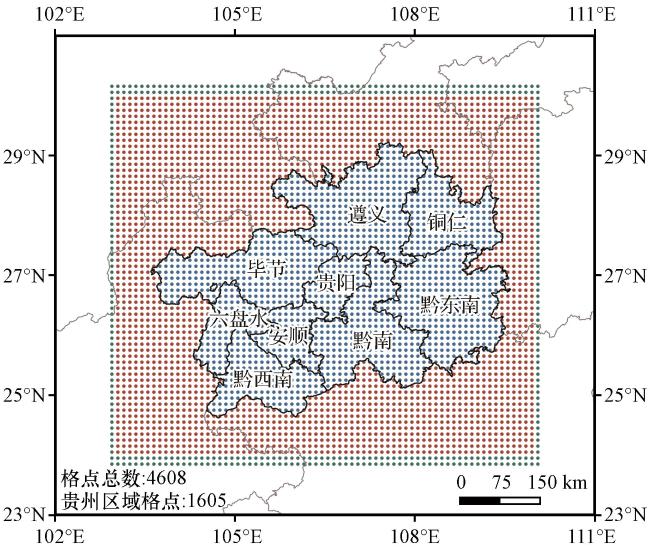
为保证自编码器计算效率, 本研究对空间格点进行了调整, 确保格点总数能被12整除, 单边格点数能被8整除。调整后的输入数据维度为(8090, 64×72), 其中新增边缘填充格点如图1中绿点所示。为聚焦研究区域并消除背景噪声, 对贵州省境外区域进行掩膜处理, 将其降水值设为0。同时使用5轮交叉验证法(5-fold Cross-Validation)进行模型训练, 通过计算5次实验结果平均值, 得到时间长度为8090天的逐日重构MSE序列。最后, 以重构误差的前5%(95%分位数)作为阈值, 筛选出模型难以重构的异常样本, 最终构建包含405天的异常降水日数据集。
图1 研究区域CN01资料格点分布(红色-蓝色区域)

绿色点为确保自编码器计算增加维度, 其中绿色-红色区域数值设为0

Fig.1 Distribution of grid points of CN01 dataset in the study area (red-blue area).The green points are included to ensure dimensionality augmentation in Autoencoder computations, with values set to zero in the green-red region

2.2.2 自组织映射客观分类和显著区域检验

本研究采用自组织映射对识别出的405天异常降水事件进行聚类分析, 以划分多个空间模式。相比传统的线性主成分分析方法, 自组织映射通过非线性映射, 竞争学习和邻域函数, 能够更好地保持原始数据的拓扑结构, 在有效减少数据噪声影响的同时, 捕捉数据中的非线性结构和局部特征。
在确定聚类规模时, 通常指定分类数目越多, 类内成员间的差异越小。所以实践中为了使分类结果具有实际意义, 通过较少分类以确保类间的显著差异(成泽伦等, 2023)。考虑贵州地理尺度较小且异常降水演变迅速, 过多分型会导致类间距离减小。因此, 本研究权衡分型的物理意义, 综合考虑选取拓扑误差(Topographic Error, TE)最低的2×2网格结构作为最优分型方案(吴胜男和江志红, 2019)。随后, 为识别异常降水热点区域, 引入蒙特卡洛实验(Monte Carlo test)方法, 通过500次随机实验对统计量进行显著性评估, 以确定一个特定模式下异常降水是否在某些典型区域具有显著发生倾向。

2.2.3 西南涡定义

参考以往关于西南涡的定义(马勋丹等, 2018张敬萍等, 2023), 同时满足以下条件定义为西南涡: (1)在700 hPa等压面上, 能分析出至少1根闭合位势高度等值线, 该等值线中心生成时位于(26°N -33°N, 103°E -110°E)范围内; (2)对于0.25°×0.25°分辨率的ERA5再分析资料, 涡旋核心区域及4倍格距(100 km)为气旋式环流; (3)该闭合环流中心附近有对应的风场散度负值中心及涡度正值中心。

3 结果与分析

3.1 降水空间分布特征

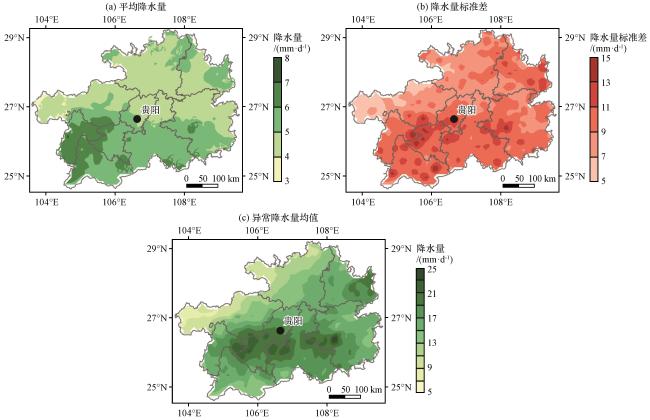
贵州1979 -2022年暖季(5 -10月)气候平均降水量[图2(a)]呈由南向北减少的分布特征, 大值中心位于贵州西南部的六盘水-安顺-黔西南。然而, 降水气候平均态难以刻画安顺西部及黔东南西部降水的高变率特征[图2(b)]。基于自编码器识别出的异常降水场[图2(c)]有效整合了降水均值及变率的异常信号: 其空间格局整体维持南多北少的态势, 但大值中心移至安顺-黔南-黔东南。该异常大值中心与贵州“雨窝”分布特点一致, 表明自编码器在贵州的异常降水识别精度上的可信度。综合分析表明, 贵州降水具有变率大, 空间分布不均的特点, 尤其是安顺地区表现出日均降水量大、 降水强度强且雨季时间长的典型特征。在此基础上, 后续进一步利用SOM方法对异常降水空间分布进行客观分类。
图2 1979 -2022年贵州暖季(5 -10月)气候平均降水量(a, 单位: mm·d-1), 降水量标准差(b, 单位: mm·d-1), 异常降水量均值(c, 单位: mm·d-1)的空间分布

Fig.2 Spatial distribution of climate-averaged precipitation (a, unit: mm·d-1), standard deviation of precipitation (b, unit: mm·d-1), and averaged anomalous precipitation (c, unit: mm·d-1) for May-October in Guizhou from 1979 to 2022

3.2 异常降水的典型类型及时间特征

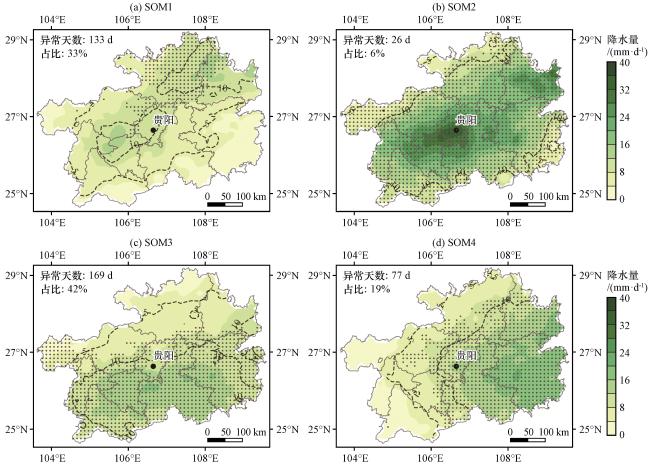
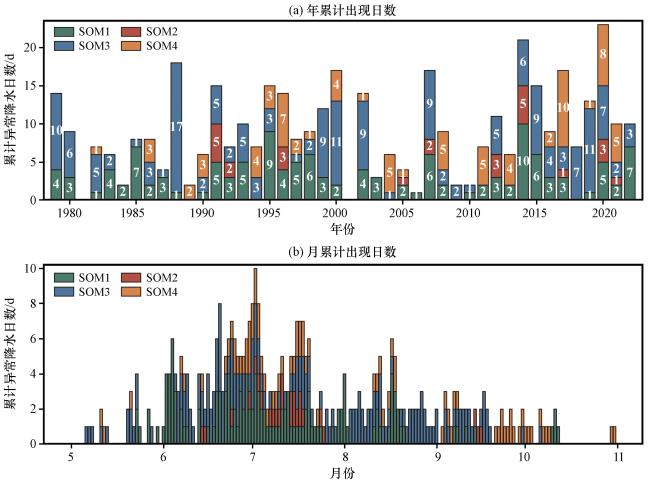
基于SOM神经元顺序的405天异常降水距平合成结果(图3)显示, 4类异常降水在空间分布与发生频次上呈现出显著的地域性与差异化特征。第1类(北部型)SOM1降水中心位于安顺北-遵义西一带, 尽管其发生频次占总数的33%, 但降水强度为4类中最弱。第2类(全省强降水型)SOM2表现为全省范围异常降水, 强度居四类之首, 但发生频率最低。第3类(南部型)SOM3降水中心位于贵州南部, 发生天数达169天(占比42%), 是贵州暖季最主要的异常降水模态。第4类(东部型)SOM4降水中心与高发热点区域均集中在贵州东部。从时间演变特征来看(图4), 每类异常降水都有较强的年际变率特征, 6月中旬至7月下旬为异常降水多发时段, 进入8月后逐渐减少。具体而言, 北部型年内发生次数分布较集中; 全省强降水型活跃期与20世纪90年代及2010年后的异常降水多发期吻合; 南部型频次呈明显的年际振荡特征; 而东部型降水在近10年间呈现增多趋势。鉴于上述4类模式在时空特征上的显著差异, 后文将深入探讨其背后的环流水汽输送特征异同。
图3 4类异常降水事件降水量合成场(单位: mm·d-1

黑色打点区域为异常降水热点区域

Fig.3 Composite fields of precipitation (unit: mm·d-1) for four types of anomalous precipitation events.The black dotted areas denote hotspots of anomalous precipitation

图4 1979 -2022年贵州四类异常降水的年累计出现日数(a)和月累计出现日数(b)

Fig.4 The annual(a) and monthly(b) cumulative occurrence days of the four types of anomalous precipitation in Guizhou from 1979 to 2022

3.3  4类异常降水对应的环流和水汽输送特征

3.3.1 大尺度环流型差异
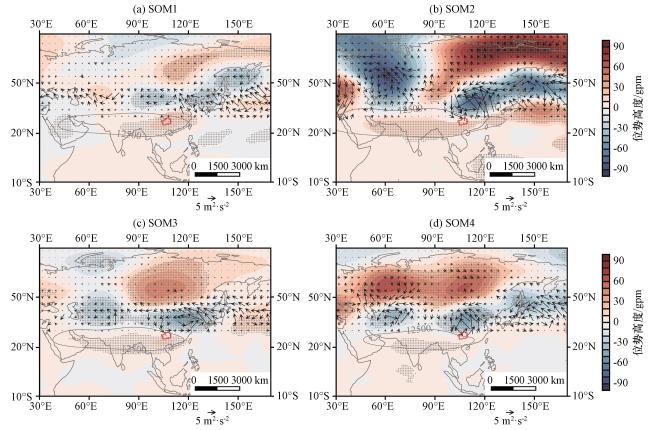
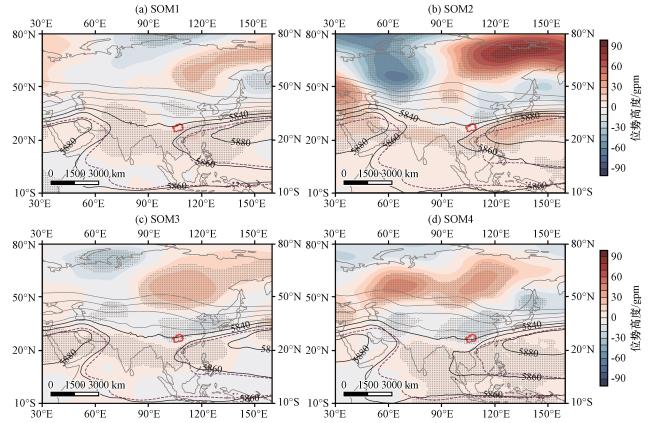
分析200 hPa位势高度异常和T-N波通量的合成场(图5)发现, 4类异常降水日高纬度地区均伴有阻塞高压活动, 而贵州大部则受南亚高压直接控制。作为行星尺度的斜压系统, 南亚高压的控制促使对流层中下层产生气流辐合与上升运动, 为降水提供动力条件。波作用通量分析显示, 南亚高压异常主要受高纬阻塞高压南传和西太平洋西传的两支罗斯贝波列共同驱动。北部、 南部及东部型降水期间, 西太平洋西传波列尤为清晰。相比之下, 全省强降水型的西传波列位置虽偏北, 但其阻塞高压南传信号更为强劲。位势高度场配置特征为: 西北太平洋及西伯利亚地区正变高, 鄂霍茨克海及华中地区负变高。结合500 hPa环流场(图6)发现西太副高与阻塞高压通过波列传输的异常信号叠加, 这种耦合效应可能诱导南亚高压的异常加强并向东扩展。与南亚高压东伸伴随着西太副高西伸协同演变的研究(王小玲等, 2017常军等, 2022)结论一致。
图5 贵州4类异常降水的200 hPa位势高度(填色, 单位: gpm, 灰色打点区域通过95%置信水平的显著性检验)和T-N波作用活动通量(箭头, 单位: m2·s-2)距平合成场

红色实线为贵州省行政边界(下同)

Fig.5 200 hPa potential height(shading, unit: gpm, the gray dotted area passing significant test at 95% confidence level) and T-N wave action activity flux (arrows, unit: m2·s-2) anomalous composite fields of four clusters of anomalous precipitation in Guizhou.The red solid lines denote the administrative boundaries of Guizhou Province (the same as after)

图6 贵州4类异常降水的500 hPa位势高度距平合成场(填色, 单位: gpm, 灰色打点区域通过95%置信水平的显著性检验)黑线为位势高度合成(紫色线为气候态5860 gpm线)

Fig.6 500 hPa potential height anomaly(shading, unit: gpm, the gray dotted area passing significant test at 95% confidence level) composite fields of four clusters of anomalous precipitation in Guizhou.Black lines represent the composite geopotential height, and the purple line indicates the climatological 5860 gpm contour

500 hPa位势高度及其异常场合成结果(图6)发现, 异常降水日高纬鄂霍茨克海上空存在阻塞形势。东亚地区存在“+-+”的东亚-太平洋遥相关型, 这种南北向模态有利于西太副高西伸并增强(张灵玲等, 2015)。受其西伸影响, 华南地区为反气旋环流, 利于低层南海向贵州的水汽输送, 为降水创造水汽条件。但北部型、 全省强降水型西太副高位置偏北, 南部型、 东部型位置偏南。另一方面, 贵州上游非洲大陆588 dagpm线异常东伸, 在阿拉伯半岛上空形成高压脊, 利于高纬冷空气持续向南平流进入中国西部(罗连升等, 2016)。受青藏高原地形阻挡, 西行气流在高原北部形成脊, 利于冷空气南传; 南部形成气旋性环流。尽管贵州总体位于西风槽前, 但印度半岛北部位势高度异常导致槽区位置差异, 正(负)变高分别对应下游槽偏北(南)。具体而言, 北部型(全省强降水型)与南部型(东部型)的槽前分别位于贵州西北(北部)及贵州中部(东南部), 提供降水有利上升条件。后续将结合局地环流及中尺度系统, 进一步分析降水机制异同。

3.3.2 局地环流特征

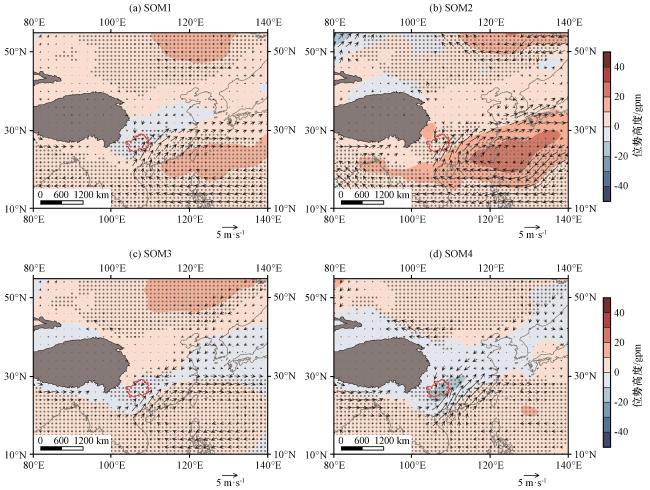
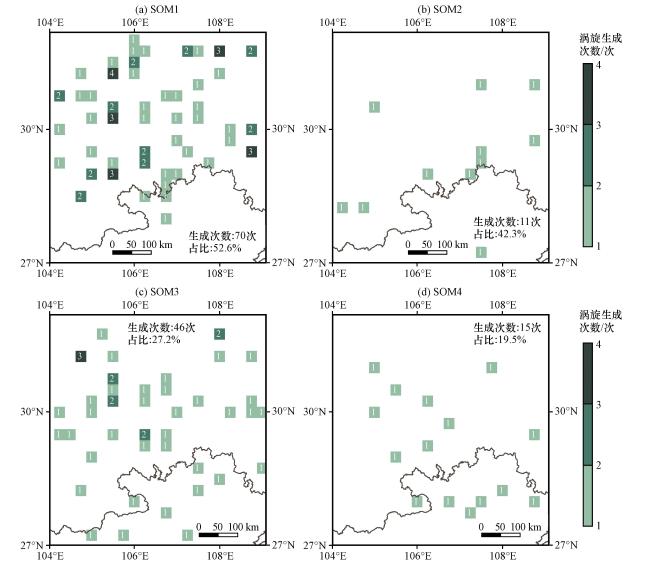
850 hPa位势高度叠加风速异常合成(图7)显示, 西太副高控制区为一致的反气旋性环流。在该环流引导下, 偏南气流经由华南地区向北输送南海水汽, 为贵州异常降水提供充沛的水汽条件。另一方面, 不同降水类型偏北风源地存在差异: 北部型降水主要受青藏高原北侧绕流气流影响; 全省强降水型主要受四川盆地生成的偏北风驱动; 南部及东部型则受渤海湾向西南传播的偏北气流驱动。降水期间, 这些偏北气流与来自南海的暖湿空气在贵州上空发生风向风速辐合, 提供降水的动力上升条件。进一步对异常降水时段内中尺度西南涡的生成数量进行统计(图8)发现, 不同异常降水的西南涡贡献存在明显差异。北部型受西南涡影响最大, 西南涡生成次数占总降水日数的52.6%, 生成热点区域在贵州西北侧; 全省强降水型西南涡生成频率为42.3%, 但生成源地分布较为分散; 南部型降水日存在西南涡的比例为27.2%, 西南涡位置偏西偏南, 且贵州境内出现较多,东部型(19.5%)的西南涡位置则整体偏东。
图7 贵州4类异常降水的850 hPa位势高度(填色, 单位: gpm, 打点区域通过95%置信水平的显著性检验)和风速(箭头, 单位: m·s-1)距平合成场

Fig.7 850 hPa potential height (shading, unit: gpm, the dotted area passing significant test at 95% confidence level) and wind speed anomaly(arrows, unit: m·s-1) composite fields of four clusters of anomalous precipitation in Guizhou

图8 贵州4类异常降水的700 hPa西南涡生成次数合成场(单位: 次)

Fig.8 700 hPa Southwest Vortex genesis frequency composite fields of four clusters of anomalous precipitation in Guizhou.Unit: time

3.3.3 水汽来源及输送路径

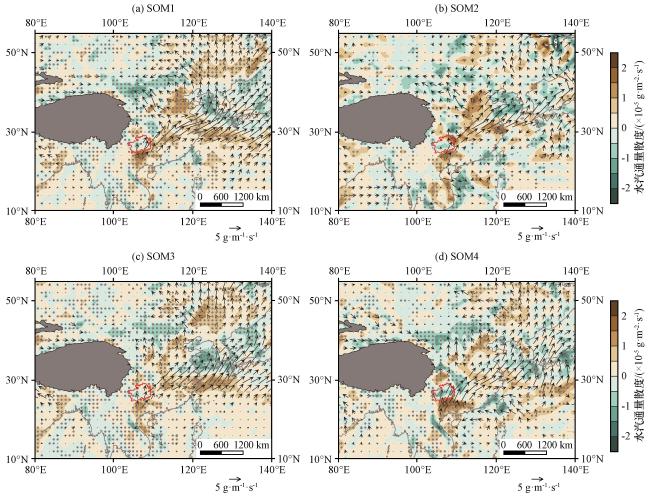
通过水汽通量及其散度(图9)分析不同异常降水型的水汽来源和路径。由于大气水汽集中于对流层中下层, 本文重点讨论850 hPa层的水汽条件。水汽通量分布显示, 存在一支源自南海, 经广西向北传输的反气旋式水汽输送带, 而来自孟加拉湾的水汽贡献相对较弱, 与以往将贵州纳入大尺度区域的水汽分析有所区别(Nie and Sun, 2021成泽伦等, 2023)。各类异常降水型对应的水汽辐合中心位置也有区别。北部型水汽辐合中心位于贵州西北侧, 四川盆地水汽通量较弱并呈弱辐散特征。水汽输送主要集中于贵州北部。全省强降水型水汽辐合中心位于贵州中南部, 水汽主要从东南向北输送, 在广西和贵州西北部各存在一个强辐散中心。南部型水汽辐合中心位于贵州西部, 与前述安顺-六盘水强降水中心位置吻合。东部型水汽条件最优越, 水汽辐合中心覆盖安顺及黔东南两侧, 而广西表现为强烈的水汽辐散中心。结合环流分析发现, 西太副高的西伸为贵州异常降水提供了充沛的水汽来源, 配合大尺度环流背景下的中低层动力辐合, 为异常降水发生发展创造有利条件。然而, 西风槽前位置及水汽输送路径差异, 最终导致了各类型异常降水的雨带位置不同。
图9 贵州4类异常降水的850 hPa水汽通量(箭头, 单位: g·m-1·s-1, 灰色打点区域通过90%置信水平的显著性检验)及散度(填色, 单位: ×10-5 g·m-2·s-1)距平合成场

Fig.9 850 hPa water vapor flux(arrows, unit: g·m-1·s-1, the dotted area passing significant test at 90% confidence level) and vapor flux divergence(shading, unit: ×10-5 g·m-2·s-1) anomalous composite fields of four clusters of anomalous precipitation in Guizhou

4 结论

本文使用自编码器对1979 -2022年贵州暖季逐日降水数据进行筛选以识别异常降水, 并采用SOM方法进行客观分型。通过诊断不同类型异常降水的空间分布、 演变频次、 环流背景及水汽特征, 得到主要结论如下:
(1) 贵州暖季气候平均降水呈“南多北少”的特征。降水高变率区主要集中在安顺西部、 黔西南及黔东南西部。异常降水的均值中心位于安顺-黔南-黔东南及铜仁东部, 符合气候平均降水及降水变率信号。通过SOM方法识别出4类空间分布和持续时段差异较大的异常降水类型: 北部型、 全省强降水型、 南部型和东部型。其中, 南部和北部型在异常降水中较为常见。统计显示近44年异常降水年际变率大, 20世纪90年代及2010年后为异常降水多发期。北部型和南部型出现时间较早, 是贵州主要的异常降水类型。20世纪80年代后东部型开始出现, 且在2000年后出现次数逐渐增多。90年代后全省强降水型出现, 并在2010年后出现频率增多。异常降水多集中在6 -7月, 8月出现次数开始减少, 北部、 南部型持续时间最长, 从5月持续到10月。
(2) 4类异常降水日, 500 hPa中高纬地区均存在阻塞高压, 东亚地区为“+-+”经向型东亚-太平洋遥相关, 有利于西太副高西伸并增强。200 hPa波作用通量分析发现, 阻塞形势叠加西太副高异常信号, 有利于南亚高压异常东伸并控制贵州区域。南亚高压作为斜压系统, 其结构有利于在对流层中下层诱发强辐合及上升运动, 配合西太副高激发的对流层中下层反气旋性气流进行水汽输送, 为贵州异常降水的形成及维持提供有利条件。
(3) 500 hPa非洲大陆东伸的异常气流在阿拉伯半岛上空形成脊, 有利于冷空气东传进入中国西部。在青藏高原大地形条件影响下, 贵州上空形成高空槽。然而, 印度半岛北部负变高位置偏差导致下游槽前位置差异。文中进一步统计了降水日内西南涡生成位置及数量, 发现不同类型降水受西南涡的影响程度不一: 西南涡对北部型贡献最大, 生成热点区域在贵州西北侧; 全省强降水型西南涡生成源地较为分散; 南部型西南涡位置偏西偏南, 在贵州境内出现次数最多; 东部型西南涡位置偏东。环流配置结合水汽通量输送差异是造成雨带位置偏差的主要原因。
本文结果表明贵州4类异常降水大尺度流型存在相似信号, 西太副高和南亚高压的协同效应为降水发生发展创造了良好的背景场。但中尺度系统及西风槽前位置差异是导致贵州异常降水雨带位置偏差的主要外强迫因素。目前本研究主要以大尺度流型解释对贵州异常降水影响, 关于西南涡对降水变化的精细化调控作用尚不明晰。未来研究将从中尺度系统、 对流初生及移动路径等方面, 进一步阐明贵州降水变化的影响因子及物理机制。
Cheng Q P Gao L Zuo X A, et al, 2019.Statistical analyses of spatial and temporal variabilities in total, daytime, and nighttime precipitation indices and of extreme dry/wet association with large-scale circulati-ons of Southwest China, 1961-2016[J].Atmospheric Research, 219: 166-182.DOI: 10.1016/j.Atmo-sres.2018.12.033 .

Chow J K Su Z Wu J, et al, 2020.Anomaly detection of defects on concrete structures with the convolutional autoencoder[J].Advanced Engineering Informatics, 45: 101105.DOI: 10.1016/j.aei.2020.101105 .

Davenport F V Diffenbaugh N S2021.Using machine learning to analyze physical causes of climate change: A case study of U.S.midwest extreme precipitation[J].Geophysical Resecorch Letters, 48, e2021GL093787.DOI: 10.1029/2021GL093787 .

Fu S M Mai Z Sun J H2019.Impacts of convective activity over the Tibetan Plateau on plateau vortex, southwest vortex, and downstream precipitation[J].Journal of the Atmospheric Sciences76(12): 3803-3830.DOI: 10.1175/jas-d-18-0331.1 .

Gibson P B Perkins K S E Uotila P, et al, 2017.On the use of self-organizing maps for studying climate extremes[J].Journal of Geophysical Research Atmospheres122(7): 3891-3903.DOI: 10.1002/2016JD026256 .

Gu Q X Gervais M2021.Exploring North Atlantic and North Pacific decadal climate prediction using selforganizing, maps[J].Journal of Climate34(1): 123-141.

Hersbach H Bell B Berrisford P, et al, 2018.ERA5 monthly averaged data on pressure levels from 1979 to present(C3S) Climate Data Store (CDS) [DS].available at: https: //cds.climate.copernicus.eu/cdsapp#!/dataset/10.24381/cds.bd0915c6 tab=overview.

Hounsou-Gbo G A Servain J Araujo M, et al, 2019.SST indexes in the Tropical South atlantic for forecasting rainy seasons in Northeast Brazil[J].Atmosphere10(6): 335.DOI: 10.3390/atmos10060335 .

Huang Z Q Tan X Z Wu X X, et al, 2023.Long-term changes, synoptic behaviors, and future projections of large-scale anomalous precipitation events in China detected by a deep learning autoencoder[J].Journal of Climate36(12): 4133-4149.DOI: 10.1175/jcli-d-22-0737.1 .

Li L Zhang R H Wu P L, et al, 2020.Roles of Tibetan Plateau vortices in the heavy rainfall over southwestern China in early July 2018[J].Atmospheric Research, 245: 105059.DOI: 10.1016/j.Atmosre-s.2020.105059 .

Liu Y G Weisberg R H Mooers C N K2006.Performance evaluation of the self-organizing map for feature extraction[J].Journal of Geophysical Research: Oceans111(C5): 2005JC003117.DOI: 10.1029/2005JC003117 .

Murakami H Delworth T L Cooke W F, et al, 2022.Increasing frequency of anomalous precipitation events in Japan detected by a deep learning autoencoder[J].Earth's Future10(4): e2021EF002481.DOI: 10.1029/2021ef002481 .

Nie Y B Sun J Q2021.Synoptic-scale circulation precursors of extreme precipitation events over Southwest China during the rainy season[J].Journal of Geophysical Research: Atmospheres126(13): e2021JD035134.DOI: 10.1029/2021JD035134 .

Tang Y B Gan J J Zhao L, et al, 2006.On the climatology of persistent heavy rainfall events in China[J].Advances in Atmospheric Sciences23(5): 678-692.DOI: 10.1007/s00376-006-0678-x .

Xu H W Chen H P Wang H J2021.Interannual variation in summer extreme precipitation over Southwestern China and the possible associated mechanisms[J].International Journal of Climatology41(6): 3425-3438.DOI: 10.1002/joc.7027 .

Wang L Huang G Chen W, et al, 2018.Wet-to-dry shift over southwest China in 1994 tied to the warming of tropical warm pool[J].Climate Dynamics51(7-8): 3111-3123.DOI: 10.1007/s00382-018-4068-8 .

Yuan J P Zhao D Yang R W2018.Predecessor rain events over China’s low-latitude highlands associated with Bay of Bengal tropical cyclones[J].Climate Dynamics50(3): 825-843.DOI: 10.1007/s00382-017-3643-8 .

Yuan W H Hu X L Tian Q2019.Regional differences in rainfall frequency and amount over southwestern China[J].Atmospheric and Oceanic Science Letters12(5): 313-319.DOI: 10.1080/16742834.2019.1626194 .

Zhai P M Zhang X B Wan H, et al, 2005.Trends in total precipitation and frequency of daily precipitation extremes over China[J].Journal of Climate18(7): 1096-1108.DOI: 10.1175/JCLI-3318.1 .

Zong H F Bueh C Jie W, et al, 2012.Intensity of the trough over the bay of bengal and its impact on the Southern China precipitation in winter[J].Atmospheric and Oceanic Science Letters5(3): 246-251.DOI: 10.1080/16742834.2012.11446998 .

常军, 王君, 吴璐, 等, 2022.黄河流域夏季 6-8月极端强降水的主要环流型[J].暴雨灾害41(5): 536-543.DOI: 10.12406/byzh.2022-028.Chang J

Wang J Wu L, et al, 2022.Characteristics of the sy-noptic conditions of summer extreme heavy precipitation in the Yellow River Basin[J].Torrential Rain and Disasters41(5): 536-543.DOI: 10.12406/byzh.2022-028 .

成泽伦, 谢作威, 布和朝鲁, 等, 2023.中南半岛和华南地区极端降水时空特征[J].大气科学47(4): 957-974.DOI: 10.3878/j.issn.1006-9895.2112.21120.Cheng Z L

Xie Z W Bueh C, et al, 2023.Spatiotemporal characteristics of extreme precipitation in the Indochina Peninsula and South China[J].Chinese Journal of Atmospheric Sciences47(4): 957-974.DOI: 10.3878/j.issn.1006-9895.2112.21120 .

韩林君, 白爱娟, 2019.2004-2017年夏半年西南涡在四川盆地形成降水的特征分析[J].高原气象38(3): 552-562.DOI: 10.7522/j.issn.1000-0534.2018.00100.Han L J

Bai A J2019.Precipitation characteristics of southwest vortex in Sichuan Basin from May to October in 2004-2017[J].Plateau Meteorology38(3): 552-562.DOI: 10.7522/j.issn.1000-0534.2018.00100 .

李娟, 闫会平, 朱志伟, 2020.中国夏季极端气温与降水事件日数随平均气温变化的定量分析[J].高原气象39(3): 532-542.DOI: 10.7522/j.issn.1000-0534.2019.00042.Li J

Yan H P Zhu Z W2020.Quantitative analysis of changes of summer extremes temperature and precipitation days over China with respect to the mean temperature increase[J].Plateau Meteorology39(3): 532-542.DOI: 10.7522/j.issn.1000-0534.2019.00042 .

罗连升, 段春锋, 毕云, 等, 2016.春季青藏高原大气热源与长江中下游盛夏高温的关系[J].气象科学36(5): 614-621.DOI: 10.3969/2015jms.0062.Luo L S

Duan C F Bi Y, et al, 2016.Relation between atmospheric heat source in spring over the Tibetan Plateau and mid-summer high temperature events in middle-lower reaches of the Yangtze River[J].Journal of the Meteorological Sciences36(5): 614-621.DOI: 10.3969/2015jms.0062 .

吕阳昆, 李阳, 杜小玲, 2022.贵州西南部近5a突发性暴雨时空特征分析[J].中低纬山地气象46(1): 54-60.

Lv Y K Li Y Du X L2022.Analysis of temporal and spatial characteristics of sudden rainstorms in Southwest Guizhou in the past 5 years[J].Mid-Low Latitude Mountain Meteorology46(1): 54-60.

马勋丹, 智协飞, 王静, 等, 2018.1979-2016年夏季西南涡活动及其与降水的关系[J].大气科学学报41(2): 198-206.

Ma X D Zhi X F Wang J, et al, 2018.Analysis of the southwest vortex activities in summer and their relationship with precipitation during the period of 1979-2016[J].Transactions of Atmospheric Sciences41(2): 198-206.

缪驰远, 韩静雅, 苟娇娇, 2023.中国逐日降水数据集(1961-2022, 0.1°/0.25°/0.5°)[DS].国家青藏高原数据中心.https: //cstr.cn/18406.11.Atmos.tpdc.300523.Miao C, Han J, Gou J, 2023.A new daily gridded precipitation dataset for the Chinese mainland based on gauge observations[DS].National Tibetan Plateau / Third Pole Environment Data Center.

王倩, 翟盘茂, 余荣, 2019.2018年7月北半球极端天气气候事件及环流特征分析[J].大气科学学报42(1): 28-35.WangQ, ZhaiPM, YuR, 2019.Analysis of extreme weather and climate events and circulation characteristics in the Northern Hemisphere in July 2018[J].Transactions of Atmospheric Sciences, 42(1): 28-35.

王小玲, 丁一汇, 张庆云, 2017.中国东部夏季持续强降水发生的主要环流模态和水汽输送研究[J].气候与环境研究22(2): 221-230.DOI: 10.3878/j.issn.1006-9585.2016.16056.Wang X L

Ding Y H Zhang Q Y2017.Circulation pattern and moisture transport for summertime persistent heavy precipitation in Eastern China[J].Climatic and Environmental Research22(2): 221-230.DOI: 10.3878/j.issn.1006-9585.2016.16056 .

吴胜男, 江志红, 2019.基于自组织映射的长江中下游夏季天气分型及其降水特征[J].气象科学39(5): 588-598.DOI: 10.3969/2018jms.0055.Wu S N

Jiang Z H2019.Synoptic classification and precipitation characteristics in summer over the Yangtze River Basin based on self-organizing map[J].Journal of the Meteorological Sciences39(5): 588-598.DOI: 10.3969/2018jms.0055 .

肖蕾, 杜小玲, 武正敏, 等, 2021.贵州省短时强降水时空分布特征分析[J].暴雨灾害40(4): 383-392.DOI: 10.3969/j.issn.1004-9045.2021.04.006.Xiao L

Du X L Wu Z M, et al, 2021.Temporal and spatial distribution characteristics of short-time heavy rainfall in Guizhou Province[J].Torrential Rain and Disasters40(4): 383-392.DOI: 10.3969/j.issn.1004-9045.2021.04.006 .

杨春艳, 白慧, 孔德璇, 等, 2023.贵州冬季云贵准静止锋及其锋面降雨的气候特征研究[J].高原气象42(5): 1207-1217.DOI: 10.7522/j.issn.1000-0534.2022.00099.Yang C Y

Bai H Kong D X, et al, 2023.Study on the climatic characteristics of the quasi-stationary front in Yunnan and Guizhou and its frontal rainfall in winter in Guizhou[J].Plateau Meteorology42(5): 1207-1217.DOI: 10.7522/j.issn.1000-0534.2022.00099 .

姚颖, 李谢辉, 王磊, 等, 2025.CMIP6 不同气候变化情景下川渝地区暴雨洪涝灾害风险未来预估[J].高原气象44(4): 943-960.DOI: 10.7522/j.issn.1000-0534.2024.00108.CSTR: 32265.14.gyqx.CN62-1061/P.2024.00108.Yao Y

Li X H Wang L, et al, 2025.Future projection of rainstorm and flood disaster risk in Sichuan-Chongqing Region under CMIP6 different climate change scenarios[J].Plateau Meteorology44(4): 943-960.DOI: 10.7522/j.issn.1000-0534.2024.00108.CSTR: 32265.14.gyqx.CN62-1061/P.2024.00108 .

易升杰, 郑飞, 肖天贵, 2019.西南地区两次典型大暴雨环境场的对比分析[J].气候与环境研究24(1): 73-85.DOI: 10.3878/j.issn.1006-9585.2018.18043.Yi S J

Zheng F Xiao T G2019.Comparative analysis of environmental fields of two typical rainstorm cases in southwest China[J].Climatic and Environmental Research24(1): 73-85.DOI: 10.3878/j.issn.1006-9585.2018.18043 .

尹红, 孙颖, 2019.基于ETCCDI指数2017年中国极端温度和降水特征分析[J].气候变化研究进展15(4): 363-373.DOI: 10.12006/j.issn.1673-1719.2018.164.Yin H

Sun Y, , 2019.Characteristics of extreme temperature and precipitation in China in 2017 based on ETCCDI indices[J].Climate Change Reseach15(4): 363-373.DOI: 10.12006/j.issn.1673-1719.2018.164 .

张敬萍, 靳双龙, 冯双磊, 等, 2023.中尺度涡旋客观识别与三维追踪的新方法及其效果评估[J].大气科学47(5): 1434-1450.DOI: 10.3878/j.issn.1006-9895.2111.21178.Zhang J P

Jin S L Feng S L, et al, 2023.A new objective identification method for mesoscale vortices: threedimensional tracking and quantitative evaluation[J].Chinese Journal of Atmospheric Sciences47(5): 1434-1450.DOI: 10.3878/j.issn.1006-9895.2111.21178 .

张灵玲, 谢倩, 杨修群, 2015.大气热源年代际异常与20世纪70年代末期东亚夏季风年代际减弱[J].气象科学35(6): 663-671.DOI: 10.3969/2015jms.0064.Zhang L L

Xie Q Yang X Q2015.Interdecadal anomaly of atmospheric diabatic heating and interdecadal weakening of East Asian summer mons-oon at the end of 1970s[J].Journal of the Meteorological Sciences35(6): 663-671.DOI: 10.3969/2015jms.0064 .

张玉琴, 李栋梁, 2019.华南汛期旱涝急转及其大气环流特征[J].气候与环境研究24(4): 430-444.DOI: 10.3878/j.issn.1006-9585.2018.18024.Zhang Y Q

Li D L2019.Drought-flood abrupt alternation and its atmospheric circulation characteristics during flood season in Southern China[J].Climatic and Environmental Research24(4): 430-444.DOI: 10.3878/j.issn.1006-9585.2018.18024 .

郑蓓, 白慧, 于飞, 等, 2022.影响贵州低频强降水的主要气象因子特征[J].中低纬山地气象46(6): 15-20.

Zheng B, Bai H, Yu F, et al, Characteristics of main meteorological factors affecting low-frequency heavy precipitation in Guizhou[J].Mid-Low Latitude Mountain Meteorology46(6): 15-20.

褚利玲, 刘丽珺, 梁友嘉, 等, 2025.中国1979-2023年降水-风速复合极端事件气候特征研究[J].高原气象44(2): 335-348.DOI: 10.7522/j.issn.1000-0534.2024.00076.CSTR: 32265.14.gyqx.CN62-1061/P.2024.00076.Chu L L

Liu L J Liang Y J, et al, 2025.Climate Characteristics Analysis of Compound Precipitation and Wind Speed Extremes in China from 1979 to 2023[J].Plateau Meteorology44(2): 335-348.DOI: 10.7522/j.issn.1000-0534.2024.00076.CSTR: 32265.14.gyqx.CN62-1061/P.2024.00076 .

Outlines

/