论文

基于机器学习的中国夏季降水延伸期预报及土壤湿度的可能贡献

  • 叶宇辰 ,
  • 陈海山 ,
  • 朱司光 ,
  • 董寅硕
展开
  • 1. 南京信息工程大学气象灾害预报预警与评估协同创新中心/气象灾害教育部重点实验室,江苏 南京 210044
    2. 南京信息工程大学大气科学学院,江苏 南京 210044

叶宇辰(1998 -), 男, 河南新乡人, 硕士研究生, 主要从事陆气相互作用及机器学习在气象中的应用研究 E-mail:

收稿日期: 2023-01-05

  修回日期: 2023-03-22

  网络出版日期: 2024-01-11

基金资助

国家自然科学基金基础科学中心项目(42088101)

Machine Learning-Based Prediction of Summer Extended-Range Precipitation and Possible Contribution of Soil Moisture over China

  • Yuchen YE ,
  • Haishan CHEN ,
  • Siguang ZHU ,
  • Yinshuo DONG
Expand
  • 1. Key Laboratory of Meteorological Disaster,Ministry of Education (KLME)/Joint International Research Laboratory of Climate and Environment Change (ILCEC)/Collaborative Innovation Center on Forecast and Evaluation of Meteorological Disasters (CIC-FEMD),Nanjing University of Information Science and Technology (NUIST),Nanjing 210044,Jiangsu,China
    2. School of Atmospheric Sciences,Nanjing University of Information Science and Technology (NUIST),Nanjing 210044,Jiangsu,China

Received date: 2023-01-05

  Revised date: 2023-03-22

  Online published: 2024-01-11

摘要

延伸期预报准确率较低的问题仍然是目前重要的科学难题, 做好延伸期预报对防灾减灾具有重要意义。本文利用机器学习方法开展了中国夏季降水延伸期(5~30天)预报试验, 并探讨了土壤湿度对降水延伸期预报的可能贡献。结果表明机器学习方法的预报结果准确率要比传统线性模型方法有较大改善, 且在诸多机器学习方法中, 以Catboost, Lightgbm和Adaboost三个机器学习模型为最优。进一步分析发现长江流域表层土壤湿度异常导致的蒸发异常和感热异常, 能够引起大气环流和垂直运动异常, 最终对夏季降水产生影响。使用三个最优的机器学习方法的集合计算出模型中各个预报因子的贡献率, 发现在长江流域的延伸期降水中, 局地土壤湿度主要在5~10天占主导作用, 而前期降水主要在10~15天占主导作用, 长江流域20~30天的延伸期降水基本上受到大尺度环流控制。还评估了非局地土壤湿度在延伸期降水中的作用, 发现中南半岛表层土壤湿度主要对15~30天的长江流域延伸期降水有重要贡献。将中南半岛表层土壤湿度加入到东北地区延伸期降水模型中, 发现对该地区延伸期降水预报准确率并无提升作用, 验证了机器学习模型的可用性。该研究为延伸期降水预测以及探究预报因子贡献率提供了一定的参考。

本文引用格式

叶宇辰 , 陈海山 , 朱司光 , 董寅硕 . 基于机器学习的中国夏季降水延伸期预报及土壤湿度的可能贡献[J]. 高原气象, 2024 , 43(1) : 184 -198 . DOI: 10.7522/j.issn.1000-0534.2023.00025

Abstract

Low accuracy of extended forecast remains an important scientific problem in the current stage, and qualified extended forecast is of great significance for disaster prevention and mitigation.In this study, the machine learning method was used to forecast the summer precipitation during the extension period (5~30 days) in China, and explore the possible contribution of soil moisture to extended forecast of precipitation.Based on the results, machine learning methods remarkably outweigh traditional linear models in terms of forecast accuracy, with Catboost, Lightgbm and Adaboost being the optimal machine learning methods.According to further analysis, the abnormal evaporation and sensible heat anomaly caused by the surface soil moisture anomaly in the Yangtze River Basin can lead to the atmospheric circulation and vertical movement anomaly, which eventually affects summer precipitation.The set of three optimal machine learning methods was applied to calculate the contribution rate of each forecasting factor in the model.It was found that the local soil moisture dominated the extended precipitation in the Yangtze River Basin from the 5th day to the 10th day, while the local soil moisture played a dominant role on previous precipitation from the 10th day to the 15th day, and the extended precipitation in the Yangtze River Basin during the period of Day 20~30 was basically controlled by large-scale circulation.Besides, the influence of non-local soil moisture on extended precipitation was evaluated, the results of which showed that the surface soil moisture in Indo-China Peninsula mainly contributed to the extended precipitation in the Yangtze River Basin from the 15th day to the 30th day.By adding the surface soil moisture of Indo-China Peninsula to the extended precipitation model in Northeast China, it was found that surface the soil moisture failed to improve the extended forecast accuracy of precipitation in this area, which verified the availability of the machine learning model.This study provides a certain reference for forecasting precipitation in the extended period and exploring the contribution rate of forecasting factors.

1 引言

延伸期预报是指中期预报(10天以下)的延伸, 是10~30天期间的天气过程的预报(孙国武等, 2010)。做好延伸期预报对防灾减灾具有重要意义(Xin and Yang, 2019), 目前延伸期预报准确率较低的问题仍然是重要的科学难题(Xia et al, 2015), 还面临诸多的挑战: 首先, Lorenz(1963)提出, 大气初始状态和边界条件的误差在预报模式不断积分过程中会被逐渐放大; 在某个预报时长之后, 预报会由于较大的误差而变得失真。其次, 动力学模型难以预测延伸期这一时间尺度上气象要素的变化; 目前主流的10天以内的天气预报及30天以上的气候预测都具有一定的预报技巧, 但10~30天的延伸期预报的预报技巧远远低于天气预报和气候预测(Kim et al, 2009White et al, 2017)。再者, Krishnamurthy(2019)指出, 预报模型和预报因子的不完善也会导致延伸期预报的不准确。综上所述, 延伸期预报仍然是目前重要的科学难题。
自1990年欧洲中期天气预报中心的延伸期预报计划提出后, 诸多学者对于延伸期预报的研究层出不穷(Palmer et al, 1990)。目前延伸期预报主要着重于降水(Hsu et al, 2015Zhu and Li, 2017cPan et al, 2018Raghav et al, 2020)和2 m气温(Zhu and Li, 2017a2017bXin and Yang, 2019Peng et al, 2020)的预报, 原因是二者在延伸期内的变化均是显著的。Zhu and Li(2017a)研究中发现10~30天2 m气温方差占10~80天2 m气温总方差的大部分, 同时Hsu et al(2015)通过小波分析发现降水在10~30天的延伸期中具有很强的变化周期。所以延伸期降水预报属于延伸期预报中重要的一环。
要做好延伸期降水的预报, 选择有效的预报因子是前提。从20世纪起, 就有诸多学者对延伸期降水预报的预报因子进行了研究。在海洋中, Buchmann et al(1995)发现, 大西洋海温异常对于北美东部降水预报准确率有显著影响。而Pan et al(2018)研究表明, 太平洋海温异常会显著影响美国西海岸延伸期降水预报的准确率: 对于相同的预报模型, La Nina年的延伸期降水预报准确率要明显高于El Nino年和Neutral年, 说明海洋因子会作为背景场影响延伸期降水预报的准确率。而在大气中, Madden-Julian震荡(Madden-Julian Oscillation, MJO)(Masutani and Hoskins, 1991Donald et al, 2006Zhang et al, 2009)和大气季节内震荡(ISO)(Xavier, 2003Hsu et al, 2015)等预报因子会影响延伸期降水的变化。Zhang et al(2009)的研究中证明了对于MJO的不同位相, 中国夏季东南地区的延伸期降水的异常值会有所不同, 特别是MJO处于第四位相时, 中国东南地区的延伸期降水会有明显的正异常; 而Hsu et al(2016)在研究中指出, 不同位相的北半球大气季节内震荡(Boreal Summer Intra-Seasonal Oscillation, BSISO)对于中国南方延伸期降水也有不同的影响。而对于陆面因子, 不少学者也证明了局地的土壤湿度对于延伸期降水有显著的影响(Chou et al, 2000Koster et al, 2011Zhu and Li, 2017c)。Zhu and Li(2017c)在研究中发现, 青藏高原夏季延伸期降水与前期的局地土壤湿度有一定的相关关系, 并且把局地的土壤湿度加入到预报模型中, 也能够取得一定的预报效果。也有部分学者考虑了局地土壤湿度在延伸期降水中贡献率的大小, Yang et al(2016)使用多元线性回归模型求得土壤湿度和海温等预报因子对于延伸期降水的贡献, 发现在北非和西亚这些干旱地区, 局地土壤湿度对于延伸期降水尤为关键, 其对于延伸期降水的贡献几乎与海温相当; 这种局地土壤湿度与大气之间的相互作用, Yang et al(2016)在他们的文章中也进行了解释: 局地的土壤湿度异常会引起非绝热加热异常以及蒸发异常; 非绝热加热异常又会引起大气环流异常, 大气环流异常会导致水汽输送异常, 最后水汽输送异常和局地的蒸发异常会共同影响降水异常。
然而对于前人的研究, 还存在部分问题需要解决: 首先, 在前人的研究中, 大多数延伸期降水预报的准确率都差强人意。大多数延伸期降水预报的预报值和真实观测值之间的相关系数都在0.1~0.4 (Hsu et al, 2015Yang et al, 2016Zhu and Li, 2017c)。这很有可能是因为在这些研究中, 学者们使用的用于预报延伸期降水的模型均为线型模型, 而实际大气中降水与各个预报因子之间的关系应该是复杂的非线性关系, 所以单纯地使用简单的线型模型可能无法很好还原预报因子和延伸期降水之间的关系。其次, 绝大部分研究均未考虑非局地土壤湿度对于延伸期降水的影响, 然而诸多学者均表明, 在短期天气预报(Su et al, 2014Wei et al, 2015Su and Dickinson, 2017)和长期气候预测(Zhu et al, 2021Dong et al, 2022Dong et al, 2023)中非局地土壤湿度对于降水都起到关键的作用: 例如Su and Dickinson(2017)在对美国的短期降水的预报中表明, 土壤湿度异常会通过影响大气水汽输送从而对风向的下游地区降水产生影响。那么在延伸期降水预报中, 非局地的土壤湿度会对降水产生怎样的影响?再者, 在延伸期降水预报中, 有关预报因子贡献率的研究少之又少, 不同的预报因子在不同预报时次下对于延伸期降水的贡献是怎样的?陆面因子与其他大气中的预报因子相比谁更加重要?以上的问题都是延伸期降水预报中需要进一步研究的问题。

2 数据来源和方法介绍

2.1 数据来源

本文使用1981 -2020年ERA-5逐小时陆面再分析资料(Muñoz,2019),要素包含了1层的土壤水分(0~7 cm),其时间分辨率为1 h,空间分辨率为0.1°×0.1°;1979 -2020年ERA-5逐小时多层次资料(Hersbach et al,2023),要素包含了200 hPa、 500 hPa、 850 hPa的位势高度, 700 hPa的相对湿度, 200 hPa和500 hPa的经向风V和纬向风U, 850 hPa的相对涡度, 其时间分辨率为1 h, 空间分辨率为0.25°×0.25°; 1974 -2021年NOAA逐日出射长波辐射资料(Chelliah and Arkin, 1992), 其时间分辨率为1天, 空间分辨率为2.5°×2.5°; 1979 -2020年CPC逐日降水资料(Xie et al, 2007Chen et al, 2008), 其时间分辨率为1天, 空间分辨率为0.5°×0.5°。为了统一研究时段, 选取1981 -2020年的夏季作为研究时段, 共2840天。同时, 对使用的ERA-5的逐小时数据进行日平均, 得到ERA-5逐日数据。在训练集和测试集切分上, 使用随机切分的方式, 即随机选取75%的样本(2130个样本)作为训练集, 剩下25%的样本(710个样本)作为测试集, 经过选取过后的预报因子和预测值之间仍然是一一对应的。
所有数据在随机切分之前, 都经过了去季节循环、 10~80天Buterworth滤波(Butterworth, 1930Roberts and Roberts, 1978游佳慧, 2015; 岳晓媛, 2020)以及去趋势处理。

2.2 方法介绍

决策树算法最早由Quinlan(1979)提出, 经过不断改进后生成了多种分支。决策树是一种十分常用的分类方法。它是一种监督学习, 所谓监督学习就是给定一堆样本, 每个样本都有一组属性和一个类别, 这些类别是事先确定的, 通过学习得到一个分类器, 这个分类器能够对新出现的对象给出正确的分类。决策树(Decision Tree)是在已知各种情况发生概率的基础上, 通过构成决策树来求取净现值的期望值大于等于零的概率, 评价项目风险, 判断其可行性的决策分析方法, 是直观运用概率分析的一种图解法。由于这种决策分支画成图形很像一棵树的枝干, 故称决策树。
决策树算法的两种著名变体是Bagging算法(Breiman, 1996)和Boosting算法(Schapire, 1990), 而Bagging算法中比较著名的算法有随机森林(Random Forest, RF)(Breiman, 2001)。RF属于早期被广泛应用的决策树算法, 并且在诸多领域被应用(Ham et al, 2005Qi, 2012Mariana and Lucian, 2016)。然而已经有学者证明, RF在其研究中的效果并不出众(Sahin, 2020), 其原因也很好通过模型的构建机理被解释: Bagging算法通常使用投票法来给出预测结果, 即将模型中包含的所有决策树得到的预测结果结合。这就有可能导致很多学习效果较差的学习器的结果也被包含考虑进来。假设考虑等权投票, 那么Bagging算法的预测效果一定会被某些学习能力较差的学习器所影响。
而Boosting算法的原理则不同, 其算法基于“残差逼近”思想。Boosting算法的目标函数为:
O b j ( t ) = i = 1 n l ( y i , y i t - 1 + ( f t ( x i ) ) ) + Ω ( f t ) + C
式中: Obj是目标函数; l是损失函数; y i是真实值; y ^ i是预测值; fx)表示新加入的回归树; Ω ( f t )表示正则项; C为常数项。
很明显, 最终目的是要目标函数尽可能越小越好, 代表预测值与真实值更加接近。而Boosting与Bagging在构建模型上的不同在于, Boosting并不是一次性将所有决策树都加入到模型当中。Boosting的做法分别为三步: (1)首先随机构建一个决策树, 然后计算该树的目标函数以及残差; (2)加入一棵新的决策树, 该树的目标是拟合残差部分(即没有被预测到的部分), 同时该树必须使得目标函数下降而不是上升; (3)重复第(2)步, 直到达成某种停止条件。
这样, 在Boosting中, 加入的决策树的数量越多, 其目标函数一定是越小的(因为效果差的学习器将被抛弃), 而Bagging却并不能达到这个目标。因为Bagging后加入的决策树很有可能效果比之前的要差, 而Bagging仍然把拟合结果较差的决策树加入到了模型当中, 导致模型中可能有很多学习效果很差的学习器。
在本研究中, 使用梯度提升决策树算法(Gradient Boosting Decision Tree, GBDT), 其属于将Boosting算法和决策树结合的算法。GBDT的子算法众多, 比较著名的算法有Xgboost(Chen and Guestrin, 2016)、 LightGBM(Ke et al, 2017)、 Catboost(Dorogush et al, 2018)以及Adaboost(Freund and Schapire, 1997), 本研究将比较Boosting算法与Bagging算法以及传统线型拟合方法在本研究中的优劣。

3 结果分析

本研究主要选取Zhu and Li(2017c)文章中的R3区域(长江流域, Yangtze River Basin, YRB), 其大气中的预报因子时空范围均采取Zhu and Li(2017c)文章中的预报因子时空范围, 如表1。对于陆面因子的选取, 本研究选取的局地表层土壤湿度空间范围与延伸期降水空间范围一致, 非局地表层土壤湿度的空间范围使用Dong et al(2023)文章中的中南半岛区域(10°N -20°N, 97°E -110°E)。
表1 预报因子具体信息

Table 1 Forecast factor specific information

预报因子 数据来源 空间范围
850 hPa纬向风(U850) ERA-5多层次小时数据 5°N -50°N, 80°E -160°E
200 hPa纬向风(U200) ERA-5多层次小时数据 5°N -50°N, 80°E -160°E
850 hPa经向风(V850) ERA-5多层次小时数据 5°N -50°N, 80°E -160°E
200 hPa经向风(V200) ERA-5多层次小时数据 5°N -50°N, 80°E -160°E
出射长波辐射(OLR) NOAA多层次小时数据 5°N -50°N, 80°E -160°E
850 hPa位势高度(H850) ERA-5多层次小时数据 5°N -50°N, 80°Ev160°E
500 hPa位势高度(H500) ERA-5多层次小时数据 5°N -50°N, 80°E -160°E
200 hPa位势高度(H200) ERA-5多层次小时数据 5°N -50°N, 80°E -160°E
700 hPa相对湿度(Rhum700) ERA-5多层次小时数据 5°N -50°N, 80°E -160°E
850 hPa相对涡度(Curl850) ERA-5多层次小时数据 5°N -50°N, 80°E -160°E
前期降水(Ppre) NOAA陆面小时数据 28.0°N -35.0°N, 107.0°E -125.0°E
局地表层土壤湿度(YRB-SSM) ERA-5陆面小时数据 28.0°N -35.0°N, 107.0°E -125.0°E
机器学习算法在气象中有广泛的应用(贾何佳等, 2022谭晓晴等, 2022)。在机器学习相关研究中, 评估标准的选取是首要任务。在诸多机器学习相关研究中, 均方根误差(Root Mean Square Error, RMSE)和均方误差(Mean Square Error, MSE)是机器学习结果好坏的首要评估标准(Machado et al, 2019Wadoux et al, 2019Zheng and Wu, 2019)。本研究将同时使用RMSE, 时间相关系数(Time Correlation Coefficient, TCC)作为评估标准来阐述不同模型在延伸期降水预报中的效果。

3.1 不同模型在长江流域延伸期降水预报的准确率

目前已有的有关延伸期预报的诸多研究中, 延伸期预报准确率较低仍然是诸多学者研究的重点难题(Hsu et al, 2015Yang et al, 2016Zhu and Li, 2017c)。在本小节中, 使用了7种不同模型, 并对比它们在YRB不同预报时次下延伸期降水预报的时间相关系数(TCC)和均方根误差(RMSE)。7种模型中, 包含5种机器学习模型(LightGBM、 Catboost、 Xgboost、 Adaboost、 RandomForest)和2种线型模型(多元线性回归模型MLR; 时空投影模型Stpm)。
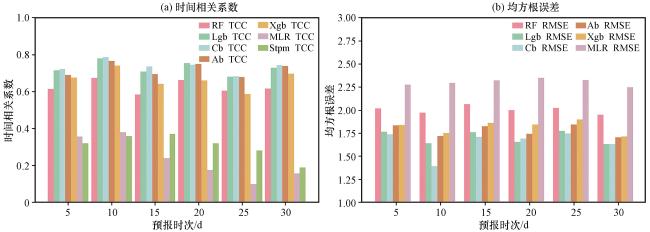
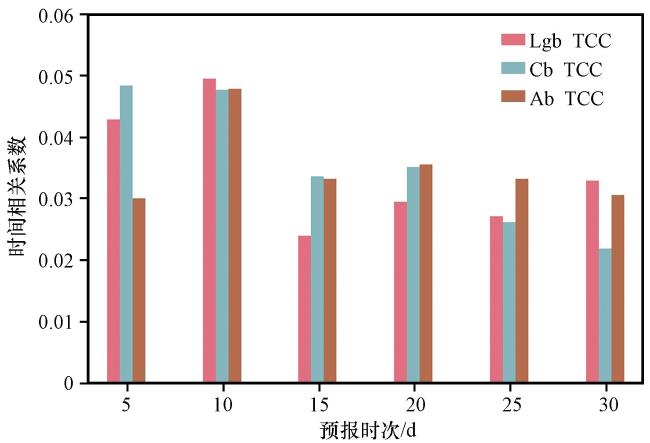
图1中, RF代表随机森林, Lgb代表LightGBM, Cb代表Catboost, Ab代表Adaboost, Xgb代表Xgboost, MLR代表多元线性回归, Stpm代表时空投影模型; 其中Stpm模型是Zhu and Li(2017c)的研究中使用的模型。由于Zhu and Li(2017c)的模型只给出了时间相关系数, 故均方根误差评估中不包含Stpm模型。从图1(a)中可以明显看出, 与线性模型相比(MLR和Stpm), 机器学习模型(RF, Lgb, Cb, Ab和Xgb)在所有预报时次上的TCC都更加优异。而且在使用线性模型进行延伸期降水预报时, TCC随着预报时次的增加, 有明显的下降趋势; 但是使用机器学习模型时, 并不会因为预报时次的增加而导致明显的TCC降低。进一步对比各个机器学习模型的TCC, RF的预报TCC明显比其他四种机器学习算法的效果要差, 这也验证了方法中的推测。4种GBDT算法在延伸期降水预报中平均TCC排名为: Cb(0.7361), Lgb(0.7282), Ab(0.7198), Xgb(0.6676)。而图1(b)的结果也显示, MLR模型的RMSE在各个预报时次下均要高于机器学习模型; 在机器学习模型中, GBDT的4个子模型的RMSE又要比RF模型的RMSE低。在四个GBDT模型中, 平均RMSE从低到高的排名为: Cb(1.6507), Lgb(1.7033), Ab(1.7769), Xgb(1.8169)。
图1 各模型不同预报时次下时间相关系数(a)和均方根误差(b)对比

Fig.1 Comparison of time correlation coefficient (a) and root mean square error (b) under different forecast time of each model

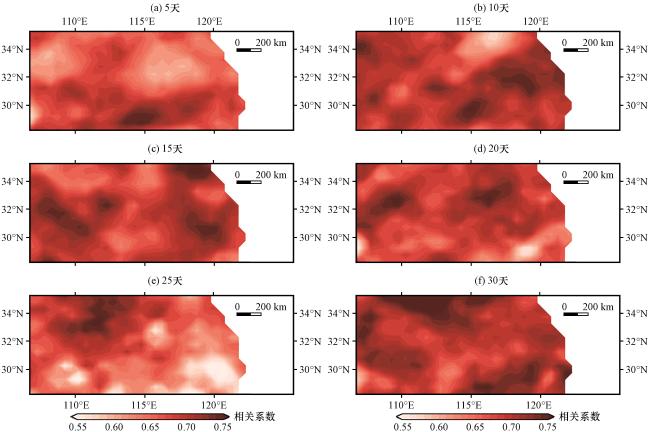
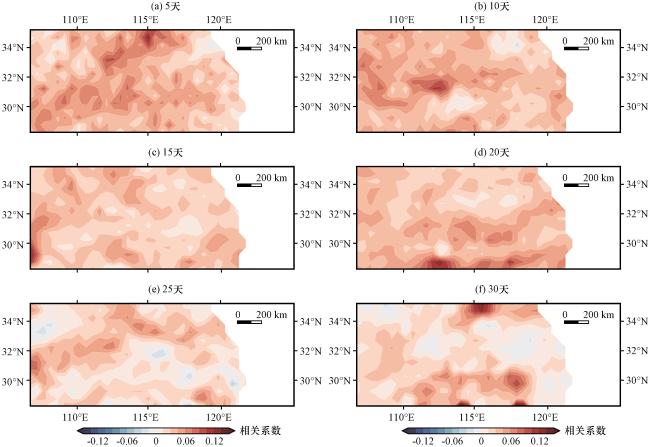
图1的结果表示, 在所有的模型中, LightGBM、 Catboost和Adaboost三个模型的区域平均TCC和RMSE均为最优, 本文接下来的所有研究, 均使用上述三个模型的集合预报模型。采用集合预报模型得到YRB夏季5~30天延伸期降水预报的空间效果图(图2)。图2的结果表明, 采用三种机器学习模型的集合预报在空间上的预报效果较为优秀, 其在5~30天的延伸期降水预报中TCC最低不低于0.52, 而最高可达到0.80。对于10~30天的延伸期预报而言, 其绝大多数区域的预报效果均在TCC平均值(0.68)以上。
图2 使用机器学习模型集合预报5~30天(a~f)延伸期降水相关系数空间分布

图中填色区域均通过显著性水平为0.05的显著性检验

Fig.2 The correlation coefficients spatial distribution of extended-range precipitation map using machine learning model ensemble during the 5~30 days (a~f).The color-filled areas in the figure all passed the significance test with a significance level of 0.05

上述研究表明, 在延伸期降水预报中, 使用相同预报因子时, 机器学习中的GBDT算法的效果要显著优于Bagging算法以及传统线性拟合方法。机器学习中的GBDT算法可以成为延伸期降水预报中的新方法。

3.2 局地表层土壤湿度对长江流域延伸期降水的影响

局地土壤湿度对于降水具有重要贡献(Liu et al, 2017)。本小节将揭示长江流域表层土壤湿度(Surface Soil Moisture in the Yangtze River Basin, YRB-SSM)对于长江流域延伸期降水(Extended Range Precipitation of the Yangtze River Basin, YRB-ERP)的影响机理。
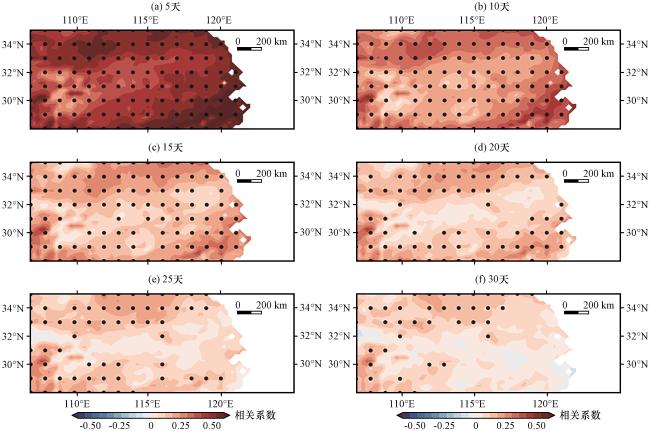
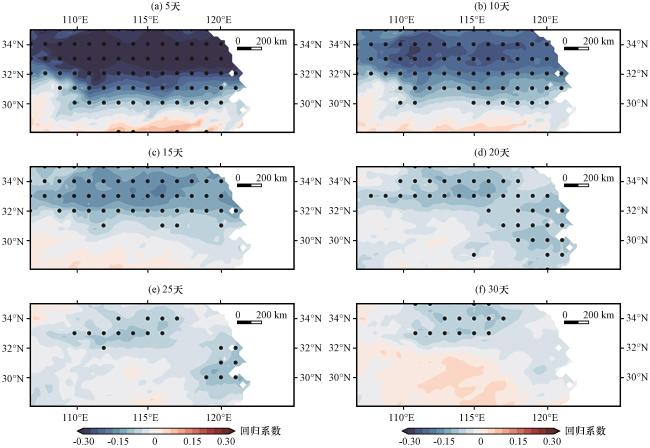
首先, 对YRB-SSM分别滞后5天, 10天, 15天, 20天, 25天和30天, 计算其滞后自相关系数, 来表征YRB-SSM的持续性(图3), 阴影打点区域通过了显著性水平为5%的显著性检验。可以发现YRB-SSM在滞后5~15天内有较好的持续性, 绝大部分区域的自相关系数都通过了显著性检验; 而滞后15天以上时, 自相关系数开始迅速下降, 滞后25天和30天时绝大部分区域都不能通过显著性检验。这与前人的研究结论一致: 表层的土壤湿度持续性通常在月尺度以内, 而更深层的土壤湿度往往持续性能达到季节尺度甚至年际尺度(Wu et al, 2002)。
图3 长江流域表层土壤湿度滞后5~30天(a~f)自相关系数空间分布

图中打点区域通过了显著性水平为0.05的显著性检验

Fig.3 The spatial distribution map of autocorrelation coefficients of YRB-SSM lag 5~30 days (a~f) in the Yangtze River Basin.The dotted area in the figure passed the significance test with a significance level of 0.05

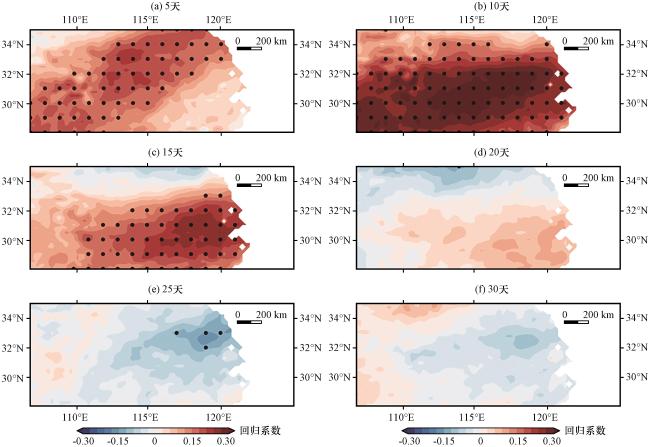
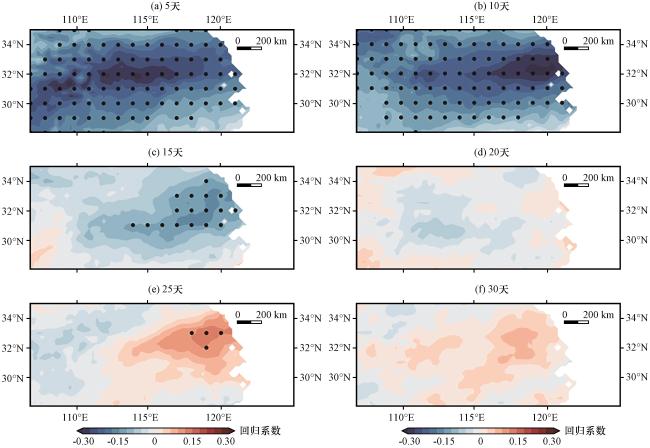
之后, 我们分别将滞后5天, 10天, 15天, 20天, 25天和30天的地表蒸发回归到前期的YRB-SSM上, 图4展示了回归结果。通常, 当土壤湿度与蒸发呈负相关时, 蒸发影响土壤湿度; 即强蒸发使土壤湿度降低; 而土壤湿度和蒸发呈正相关时, 则土壤湿度影响蒸发; 即高土壤湿度导致蒸发加强(Dirmeyer et al, 2009Seneviratne et al, 2010)。从图4可以发现, 在滞后5~15天的情况下, YRB-SSM与地表蒸发呈正相关关系, 说明YRB较高的土壤湿度在持续性可达到5~15天的情况下使得YRB的地表蒸发加强, 并且绝大多数区域都可以通过显著性水平为5%的显著性检验(图中阴影打点区域); 而滞后20~25天时, 则两者相关关系不显著, 大部分区域都无法通过显著性检验。这与图3的结论相吻合。
图4 长江流域表层土壤湿度回归到滞后5~30天(a~f)的地表蒸发空间分布图

图中打点区域通过了显著性水平为0.05的显著性检验

Fig.4 The spatial distribution map of surface evaporation in the Yangtze River basin regressing to YRB-SSM lag 5~30 days (a~f).The dotted area in the figure passed the significance test with a significance level of 0.05

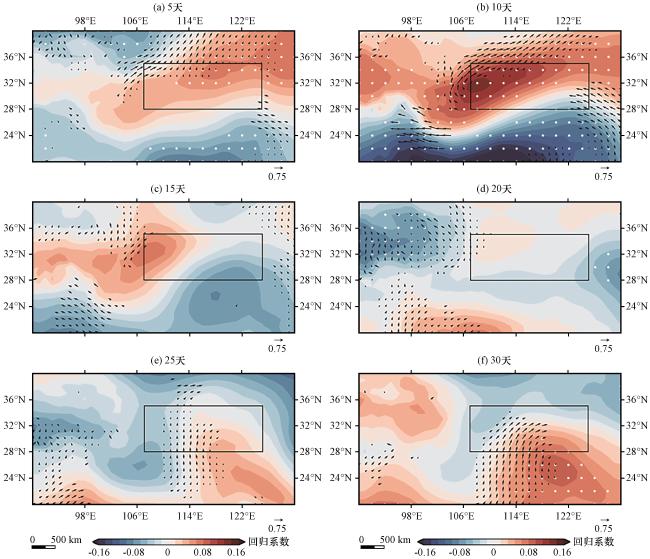
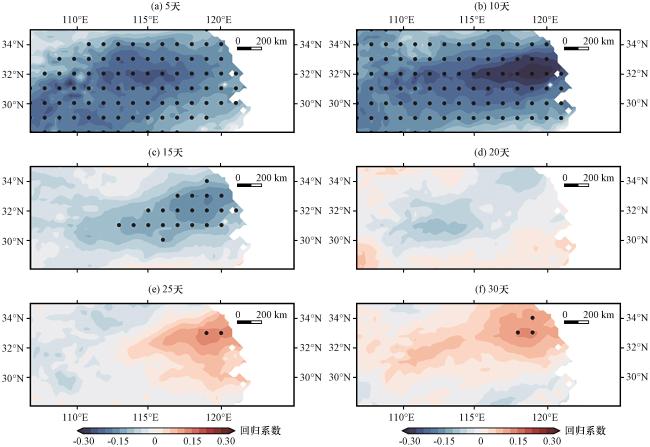
图5显示了分别滞后5天, 10天, 15天, 20天, 25天和30天的地表感热通量回归到前期YRB-SSM的结果, 阴影打点区域代表通过了显著性水平为5%的显著性检验。与图3图4一致, 若 YRB-SSM较高, 导致的蒸发加强会造成地表向上感热通量的减弱, 这种效应在滞后5~15天尤为明显, 在滞后20~30天时逐渐减弱。而地表向上感热通量的减弱将进一步使得大气冷却, 700 hPa高度在5~15天有较强的下沉运动(图6, 阴影打点区域代表通过显著性水平为5%的显著性检验)。对应YRB 5~10天为反气旋性环流控制, 15天处于高压前部受偏北气流影响但不甚明显, 20天环流场和气压场均不明显, 25~30天处于高压顶后部, 为异常偏南风控制(图7, 矩形框区域为YRB, 填色图代表位势高度场回归系数, 矢量图代表风场回归系数, 打点白色区域通过了显著性水平为10%的显著性检验, 没有通过显著性检验的风矢量不显示)。而对应到降水上可以发现5~10天的降水明显降低, 15天降水降低没有5~10天明显, 20天的降水几乎不受YRB-SSM影响, 而25~30天部分地区降水有增加趋势(图8, 阴影打点区域代表通过显著性水平为5%的显著性检验)。
图5 长江流域表层土壤湿度回归到滞后5~30天(a~f)的地表感热空间分布图

图中打点区域通过了显著性水平为0.05的显著性检验

Fig.5 The spatial distribution map of surface sensible heat in the Yangtze River basin regressing to YRB-SSM lag 5~30 days (a~f).The dotted area in the figure passed the significance test with a significance level of 0.05

图6 长江流域表层土壤湿度回归到滞后5~30天(a~f)700 hPa垂直速度空间分布

图中打点区域通过了显著性水平为0.05的显著性检验

Fig.6 The spatial distribution map of 700 hPa vertical velocity in the Yangtze River basin regressing to YRB-SSM lag 5~30 days (a~f).The dotted area in the figure passed the significance test with a significance level of 0.05

图7 长江流域表层土壤湿度回归到滞后5~30天(a~f)的700 hPa风场/位势高度场空间分布

图中打点区域通过了显著性水平为0.1的显著性检验; 矩形框表示长江流域; 填色图表示位势高度场回归系数; 矢量表示风场回归系数W

Fig.7 The spatial distribution map of 700 hPa wind field /Geopotential field in the Yangtze River basin regressing to YRB-SSM lag 5~30 days (a~f).The dotted area in the figure passed the significance test with a significance level of 0.1; The rectangular box represents the Yangtze River Basin; The colouring diagram represents the regression coefficient of geopotential height field.Vector represents wind field regression coefficient

图8 长江流域表层土壤湿度回归到滞后5~30天(a~f)的降水空间分布

图中打点区域通过了显著性水平为0.05的显著性检验

Fig.8 The spatial distribution map of precipitation in the Yangtze River basin regressing to YRB-SSM lag 5~30 days (a~f).The dotted area in the figure passed the significance test with a significance level of 0.05

综上所述, 由于YRB-SSM仅在延伸期前期有较好的持续性, 高的YRB-SSM将会导致延伸期前期蒸发增强, 地表向上感热通量减弱, 从而导致地表对大气的加热作用减弱, 大气中低层存在反气旋环流, 有强烈的下沉运动, 不利于降水的发生。

3.3 局地/非局地土壤湿度对长江流域延伸期降水的贡献

在上一小节中, 我们尝试揭示YRB-SSM影响YRB-ERP的物理机制。那么YRB-SSM对该区域延伸期降水的定量贡献如何?在以往的研究中, 极少学者采用线性模型对该问题进行研究(Koster et al, 2011Yang et al, 2016)。然而第3.1节的结果显示, 线性模型所预报的延伸期降水的TCC远远低于机器学习模型预报的结果, 所以本小结尝试使用机器学习模型计算延伸期中不同预报时次下的各个预报因子的贡献。
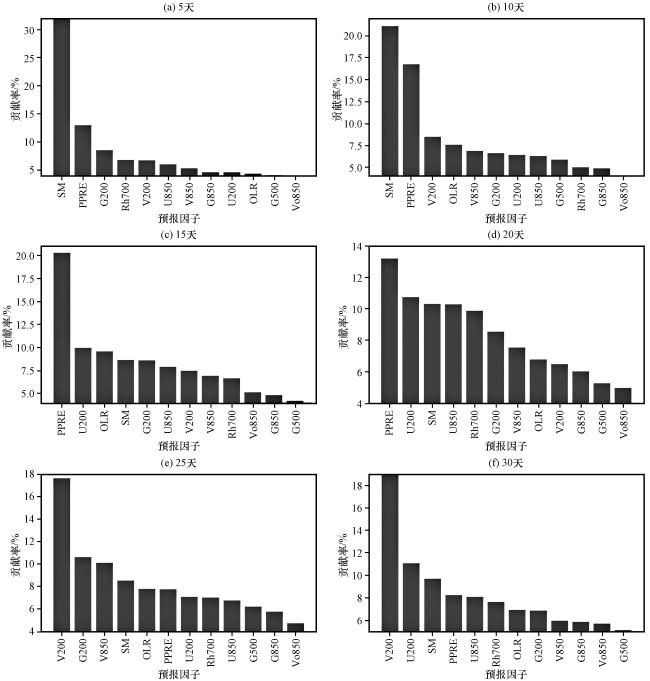
图9展示了通过三个最优机器学习模型计算的YRB-ERP中不同预报因子在不同预报时次下贡献率排名。从图9中可以看出, YRB 5~20天的降水主要受到YRB-SSM和前期降水的影响, 而YRB-SSM主要主导5天和10天的降水, 随着预报时次的增加, YRB-SSM贡献率逐步下降。前期降水的贡献主要在15~20天占主导, 且其贡献也随着预报时次的增加而降低。在预报时次为20天以后, 大尺度环流因子(V200)的贡献率逐渐上升, 到25天和30天时大尺度的环流因子(V200)完全占据主导。这与我们之前的结论一致, YRB-SSM由于其持续能力主要集中于延伸期前期, 所以其对于延伸期降水的贡献也在延伸期前期占主导作用; 在延伸期中期, 由于YRB-SSM持续能力的下降, 其对于延伸期降水的贡献也在下降, 前期降水的影响占主导地位; 到了延伸期后期, 大尺度环流因子对于延伸期的主导作用是不可忽视的。机器学习模型可以把土壤湿度对大气的影响从定性研究转化为定量研究。
图9 5~30天(a~f)长江流域延伸期降水预报中各预报因子相对贡献

Fig.9 The relative contribution of each forecast factor in YRB-ERP during 5~30 days (a~f)

为了进一步验证YRB-SSM对于YRB-ERP在不同时期的贡献, 对比了在三个最优的机器学习模型中, 加入YRB-SSM与不加入YRB-SSM的模型预报TCC之差(图10)。从图10可以明显地看出, 在延伸期预报前期(5天和10天), 加入YRB-SSM比不加入YRB-SSM得到的延伸期降水TCC要更高, 而延伸期的中后期(15~30天)虽然加入YRB-SSM均可以使得模型预报TCC更高, 但是YRB-SSM对于模型的提升效果不如延伸期预报前期明显。这与图9的结论是一致的, 进一步证明了YRB-SSM对于延伸期降水的重要贡献。
图10 不同模型加入与不加入长江流域表层土壤湿度的预报相关系数之差

Fig.10 The difference of prediction TCC between different models with and without YRB-SSM

更进一步地, 仍然采取集合预报的方式, 绘制了加入与不加入局地土壤湿度的预报TCC之差的空间分布图。图11展示了加入与不加入YRB-SSM的机器学习模型预报TCC之差空间分布图。从图11中可以看出, 对于YRB的大部分区域, 加入YRB-SSM时模型的预报TCC要显著高于不加入YRB-SSM时模型的预报TCC, 只有极少部分区域相反。从时间上对比, 图11也印证了图9图10的结论, 即对于5~10天的延伸期降水预报来说, 局地土壤湿度的贡献较大, 而对于15~30天的延伸期降水预报来说, 局地土壤湿度的贡献有所降低, 但仍然不能够忽视。图9图10以及图11的结果证明了YRB-SSM对于延伸期降水的重要影响。
图11 加入与不加入提前5~30天(a~f)长江流域表层土壤湿度的模型预报相关系数之差空间分布

Fig.11 The spatial distribution map of the difference between the prediction TCC of the model with and without 5~30 days (a~f) YRB-SSM

已经有学者表明, 非局地的土壤湿度(Su et al, 2014Wei et al, 2015Su and Dickinson, 2017Zhu et al, 2021)会对天气尺度和季节尺度的降水产生影响。Dong et al(2023)的最新研究指出, 中南半岛土壤湿度负异常将导致陆面温度上升, 地表向大气的感热通量增加, 加热低层大气, 使位势高度抬升, 有利于西太副高西伸, 并使得东亚夏季风减弱, 西北太平洋出现异常反气旋, YRB的水汽输送和水汽辐合增加, 影响YRB降水。那么中南半岛表层土壤湿度(Surface Soil Moisture in the Indochina Peninsula, IP-SSM; 10°N -20°N, 90°E -110°E)对YRB-ERP的影响是怎样的?在不同预报时次下的影响是否有显著差异?对于不同地区来说, 机器学习计算出的非局地土壤湿度贡献是否一致, 即机器学习计算结果是否可信?
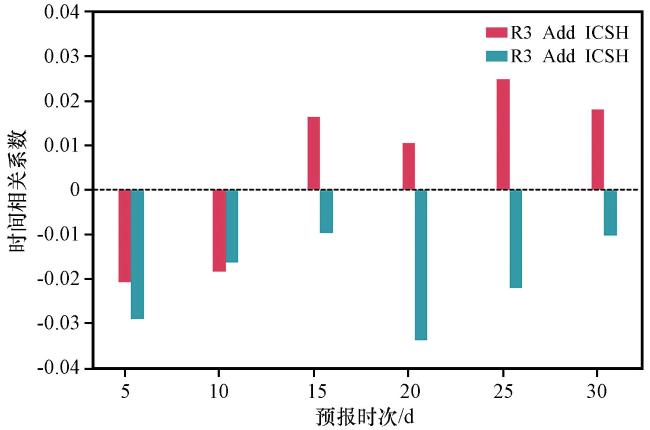
同时将IP-SSM加入到YRB(28.0°N -35.0°N, 107.0°E -125.0°E, 图12中简称R3)延伸期降水预报模型和东北地区(42.5°N -55.0°N, 110°E -132°E, 图12中简称R7)延伸期降水预报模型中, 结果如图12所示。图12的结果表明, IP-SSM在延伸期中后期(15~30天)对YRB-ERP有影响, 而在延伸期前期(5~10天)对YRB-ERP没有影响(加入预报模型后TCC提升为负)。对于东北地区来说, 目前暂无研究表明IP-SSM能够在延伸期内对该区域降水产生影响, 机器学习模型也论证了这一点: 在所有预报时次下, IP-SSM都对东北地区延伸期降水没有影响(加入预报模型后TCC提升为负)。该对照试验同时也证明了机器学习模型的正确性。
图12 R3和R7区域加入与不加入中南半岛表层土壤湿度模型预报相关系数之差

Fig.12 The difference of prediction TCC between R3 and R7 regions with and without the IP-SSM

图12综合之前的结论, 证明了延伸期中后期非局地表层土壤温度通过大气环流可以影响YRB-ERP; 而在延伸期前中期, YRB-SSM通过大气环流对YRB-ERP起到主导作用。YRB-SSM和非局地土壤湿度主导地位在预报时次10~15天时发生明显变化。

4 结论

本研究尝试使用一种非线性的机器学习方法来改善延伸期降水预报TCC, 并且通过大气环流尝试解释YRB-SSM对于YRB-ERP的影响; 最后通过非线性的机器学习模型, 探究不同区域的表层土壤湿度在不同预报时次下对YRB-ERP的贡献大小, 得到如下结论:
(1) 非线性的机器学习方法能够改善延伸期降水预报TCC低的问题。在以往研究中, 诸多学者延伸期降水预报的TCC多在0.1~0.4之间, 而使用机器学习模型计算出各个预报时次下的TCC均在0.52以上。传统线型模型计算的TCC会随着预报时次的增加而下降, 但在非线性机器学习模型中, 这种问题并不存在。机器学习各个模型的区域平均TCC均要比传统线性模型高, 而机器学习各个模型区域平均RMSE均要比传统线性模型低, 其中以LightGBM、 Catboost和Adaboost三个模型为最优。
(2) 探究了YRB-SSM对YRB-ERP的影响, 发现YRB-SSM的持续性主要在5~15天。YRB-SSM异常会导致地表蒸发异常, 而地表蒸发异常将导致地表向上感热输送异常, 从而引起大气环流异常和垂直运动异常, 最后影响降水。
(3) 采用三个最优机器学习模型对YRB-ERP不同时次下不同预报因子的贡献大小进行比较, 发现YRB-SSM在5~10天的预报中起到了主导性作用, 前期降水在15~20天起主导作用。而到了20天以后, 大尺度环流在YRB-ERP预报中占到了主导作用。同时研究了IP-SSM对于YRB-ERP的影响, 发现IP-SSM主要在15~30天对YRB-ERP产生影响, 而在5~10天对YRB-ERP无影响。目前暂时无研究表明IP-SSM会对东北地区延伸期降水产生影响; 将IP-SSM加入到东北地区的延伸期降水预测机器学习集合模型中, 会导致各个预报时次下的预报TCC均下降, 证明了机器学习集合模型的正确性和可用性。
然而本研究的模型基础是机器学习模型, 其从根本上而言是一个黑箱模型。机器学习模型属于统计模型, 目前机器学习还需要进一步与物理过程相结合。当然, 从结果好坏而言, 机器学习无疑能够对延伸期降水的TCC和RMSE进行一定的改善。单从预报结果和探究预报因子贡献方面来讲, 机器学习方法可以提供一定的参考。

参考文献

null
Breiman L1996.Bagging predictors[J].Machine Learning24(2): 123-140.DOI: 10.1023/A: 1018054314350 .
null
Breiman L2001.Random forests[J].Machine Learning45(1): 5-32.DOI: 10.1023/A: 1010933404324 .
null
Buchmann J Buja L E Paegle J, et al, 1995.Further experiments on the effect of tropical atlantic heating anomalies upon GCM rain forecasts over the Americas[J].Journal of Climate8(5): 1235-1244.DOI: 10.1175/1520-0442(1995)008 <1235: FEOTEO>2.0.CO; 2 .
null
Butterworth S1930.On the theory of filter amplifiers[J].Wireless Engineer, 7: 536-541.
null
Chelliah M Arkin P1992.Large-scale interannual variability of monthly outgoing longware radiation anomalies over the global tropics[J].Journal of Climate, 5: 371-389.DOI: 10.1175/1520-0442(1992)005<0371: LSIVOM>2.0.CO; 2 .
null
Chen M Y Shi W Xie P P, et al, 2008.Assessing objective techniques for gauge-based analyses of global daily precipitation[J].Journal of Geophysical Research: Atmospheres, 113: D04110.DOI: 10.1029/2007JD009132 .
null
Chen T Q Guestrin C2016.XGBoost: a scalable tree boosting system[J].ACM, 2016: 785-794.DOI: 10.1145/2939672.2939785 .
null
Chou S C Nunes A Cavalcanti I2000.Extended range forecasts over South America using the regional eta model[J].Journal of Geophysical Research: Atmospheres105(D8): 10147-10160.DOI: 10.1029/1999JD901137 .
null
Dirmeyer P A Schlosser C A Brubaker K L2009.Precipitation, recycling, and land memory: an integrated analysis[J].Journal of Hydrometeorology, 10: 278-288.DOI: 10.1175/2008JHM1016.1 .
null
Donald A Meinke H Power B, et al, 2006.Near-global impact of the Madden-Julian Oscillation on rainfall[J].Geophysical Research Letters, 33: L09704.DOI: 10.1029/2005GL025155 .
null
Dong X Chen H S Zhou Y, et al, 2022.Local and nonlocal atmospheric effects of abnormal soil moisture over Indochina during May-June.[J].Quarterly Journal of the Royal Meteorological Society148(747): 2903-2926.DOI: 10.1002/qj.4341 .
null
Dong Y S Chen H S Dong X2023.Impact of antecedent soil moisture anomalies over the Indochina Peninsula on the Super Mei-yu Event in 2020[J].Journal of Meteorological Research54(9/10): 3845-3861.DOI: 10.1007/s13351-023-2144-4 .
null
Dorogush A V Ershov V Gulin A2018.CatBoost: gradient boosting with categorical features support[J].ArXiv, 2018: 1-7.DOI: 10.48550/arXiv.1810.11363 .
null
Freund Y Schapire R E1997.A decision-theoretic generalization of on-line learning and an application to boosting[J].Journal of Computer and System Sciences55(1): 119-139.DOI: 10. 1006/jcss.1997.1504 .
null
Ham J Chen Y C Crawford M M, et al, 2005.Investigation of the random forest framework for classification of hyperspectral data[J].IEEE Transactions on Geoscience and Remote Sensing43(3): 492-501.DOI: 10.1109/TGRS.2004.842481 .
null
Hersbach H Bell B Berrisford P, et al, 2019.ERA5 monthly averaged data on pressure levels from 1959 to present[DB].Copernicus Climate Change Serv-ice (C3S) Climate Data Store (CDS).DOI: 10.24381/cds.6860a573 .
null
Hsu P C Lee J Y Ha K J2016.Influence of boreal summer intraseasonal oscillation on rainfall extremes in southern China[J].International Journal of Climatology36(3): 1403-1412.DOI: 10. 1002/joc.4433 .
null
Hsu P C Li T You L, et al, 2015.A spatial-temporal projection model for 10-30 day rainfall forecast in South China[J].Climate Dynamics44(5/6): 1227-1244.DOI: 10.1007/s00382-014-2215-4 .
null
Ke G L Qi M Thomas F2017.LightGBM: a highly efficient gradient boosting decision tree[C]//Ulrike V L, Isabelle G, eds.Proceedings of the 31st International Conference on Neural Information Processing Systems (NIPS' 17).California: Curran Associates Inc., 3149-3157.DOI: 10.5555/3294996.3295074 .
null
Kim D Sperber K Stern W, et al, 2009.Application of MJO simulation diagnostics to climate models[J].Journal of Climate22(23): 6413-6436.DOI: 10.1175/2009JCLI3063.1 .
null
Koster R D Mahanama S P P Yamada T J, et al, 2011.The second phase of the global land-atmosphere coupling experiment: soil moisture contributions to subseasonal forecast skill[J].Journal of Hydrometeorology12(5): 805-822.DOI: 10.1175/2011JHM1365.1 .
null
Krishnamurthy V2019.Predictability of weather and climate[J].Earth and Space Science6(3): 1043-1056.DOI: 10.1029/2019EA000586 .
null
Liu L Zhang R H Zuo Z Y2017.Effect of spring precipitation on summer precipitation in Eastern China: role of soil moisture[J].Journal of Climate30(22): 9183-9194.DOI: 10.1175/JCLI-D-17-0028.1 .
null
Lorenz E N1963.Deterministic nonperiodic flow[J].Journal of Atmospheric Sciences, 20: 130-148.DOI: 10.1175/1520-0469(1963)020<0130: DNF>2.0.CO; 2 .
null
Machado M R Karray S Sousa I T D2019.LightGBM: an effective decision tree gradient boosting method to predict customer loyalty in the finance industry[C]//Machado M R, et al, eds.2019 14th International Conference on Computer Science & Education (ICCSE).Toronto: IEEE, 1111-1116.DOI: 10.1109/ICCSE.2019.8845529 .
null
Mariana B Lucian D2016.Random forest in remote senfsing: a review of applications and future directions[J].ISPRS Journal of Photogrammetry and Remote Sensing, 114: 24-31.DOI: 10. 1016/j.isprsjprs.2016.01.011 .
null
Masutani M Hoskins B1991.Tropical extratropical interaction associated with the 30-60 day oscillation[C]//Masutani M, Hoskins B, eds.Fifth Conference on Climate Variation.Denber: AMS, 1-4.
null
Mu?oz S J2019.ERA5-Land hourly data from 1950 to present.[DB/OL].(2023-01-01)[2023-01-03].dataset/reanalysis-era5-land.
null
Palmer T N Brankovic C Molteni F, et al, 1990.The European Centre for Medium-Range Weather Forecasts (ECMWF) program on extended-range prediction[J].Bulletin of the American Meteorological Society71(9): 1317-1330.DOI: 10.1175/1520-0477(1990)071<1317: TECFMR>2.0.CO; 2 .
null
Pan B Hsu K Aghakouchak A, et al, 2018.Precipitation prediction skill for west coast United States from short to extended range[J].Journal of Climate32(1): 161-182.DOI: 10.1175/JCLI-D-18-0355.1 .
null
Peng T Zhi X F Ji Y, et al, 2020.Prediction skill of extended range 2-m maximum air temperature probabilistic forecasts using machine learning post-processing methods[J].Atmosphere11(8): 823-839.DOI: 10.3390/atmos11080823 .
null
Qi Y J2012.Random forest for bioinformatics[J].Ensemble Machine Learning, 2012: 307-323.DOI: 10.1007/978-1-4419-9326-7_11 .
null
Quinlan J R1979.Discovering rules by induction from large collections of examples[J].Expert Systems in the Micro Electronics Age2(9): 168-201.
null
Raghav P Borkotoky S S Joseph J, et al, 2020.Revamping extended range forecast of Indian summer monsoon[J].Climate Dynamics55(11): 3397-3411.DOI: 10.1007/s00382-020-05454-5 .
null
Roberts J Roberts T D1978.Use of the Butterworth low‐pass filter for oceanographic data[J].Journal of Geophysical Research: Oceans, 1978, 83(C11): 5510-5514.DOI: 10.1029/JC083iC11p05510 .
null
Sahin E K2020.Assessing the predictive capability of ensemble tree methods for landslide susceptibility mapping using XGBoost, gradient boosting machine, and random forest[J].SN Applied Sciences2(7): 1-17.DOI: 10.1007/s42452-020-3060-1 .
null
Schapire R E1990.The strength of weak learnability[J].Machine Learning5(2): 197-227.DOI: 10.1007/BF00116037 .
null
Seneviratne S I Corti T Davin E L, et al, 2010.Investigating soil moisture-climate interactions in a changing climate: a review[J].Earth-Science Reviews99(3/4): 125-161.DOI: 10.1016/j.earscirev.2010.02.004 .
null
Su H Dickinson R E2017.On the spatial gradient of soil moisture-precipitation feedback strength in the 2011 April drought in the Southern Great Plains[J].Journal of Climate30(3): 829-848.DOI: 10.1175/JCLI-D-13-00185.1 .
null
Su H Zong L Y Dickinson R E, et al, 2014.Spring soil moisture‐precipitation feedback in the Southern Great Plains: How is it related to large‐scale atmospheric conditions?[J].Geophysical Research Letters41(4): 1283-1289.DOI: 10.1002/2013GL058931 .
null
Wadoux J C Brus D J Heuvelink G2019.Sampling design optimization for soil mapping with random forest[J].Geoderma, 2019, 355(1): 113913.DOI: 10.1016/j.geoderma.2019.113913 .
null
Wei J F Hua S Yang Z L2015.Impact of moisture flux convergence and soil moisture on precipitation: a case study for the southern United States with implications for the globe[J].Climate Dynamics46(1/2): 1-15.DOI: 10.1007/s00382-015-2593-2 .
null
White C J Carlsen H Robertson A W, et al, 2017.Potential applications of subseasonal-to-seasonal (S2S) predictions[J].Meteorological Applications24(1): 315-325.DOI: 10.1002/met.1654 .
null
Wu W R Geller M A Dickinson R E2002.The response of soil moisture to long-term variability of precipitation[J].Journal of Hydrometeorology3(5): 604-613.DOI: 10.1175/1525-7541(2002)003<0604: TROSMT>2.0.CO; 2 .
null
Xavier P K2003.Extended range predictability and prediction of indian summer monsoon[J].Geophysical Research Letters30(18): 1966.
null
Xia Z Y Chen H B Xu L S, et al, 2015.Extended range (10-30 days) heavy rain forecasting study based on a nonlinear cross-prediction error model[J].Advances in Atmospheric Sciences32(12): 1583-1591.DOI: 10.1007/s00376-015-4252-2 .
null
Xie P P Chen M Y Song Y, et al, 2007.A gauge-based analysis of daily precipitation over East Asia[J].Journal of Hydrometeorology, 8: 607-626.DOI: 10.1175/JHM583.1 .
null
Xin Q Yang J2019.Extended-range prediction of a heat wave event over the Yangtze River Valley: role of intraseasonal signals[J].Atmospheric and Oceanic Science Letters12(6): 451-457.DOI: 10.1080/16742834.2019.1669408 .
null
Yang K Wang C H Bao H Y2016.Contribution of soil moisture variability to summer precipitation in the Northern Hemisphere[J].Journal of Geophysical Research Atmospheres121(20): 108-124.DOI: 10.1002/2016JD025644 .
null
Zhang L N Wang B Z Zeng Q C2009.Impacts of the Madden-Julian Oscillation on summer rainfall in Southeast China[J].Journal of Climate22(2): 201-216.DOI: 10.1175/2008JCLI1959.1 .
null
Zheng H Wu Y H2019.A XGBoost Model with weather similarity analysis and feature engineering for short-term wind power forecasting[J].Applied Sciences9(15): 3019-3030.DOI: 10. 3390/app9153019 .
null
Zhu S G Qi Y J Chen H S, et al, 2021.Distinct impacts of spring soil moisture over the Indo-China Peninsula on summer precipitation in the Yangtze River basin under different SST backgrounds[J].Climate Dynamics, 56: 1895-1918.DOI: 10.1007/s00382-020-05567-x .
null
Zhu Z W Li T2017a.Extended-range forecasting of Chinese summer surface air temperature and heat waves[J].Climate Dynamics50(2): 1-15.DOI: 10.1007/s00382-017-3733-7 .
null
Zhu Z W Li T2017b.Statistical extended‐range forecast of winter surface air temperature and extremely cold days over China[J].Quarterly Journal of the Royal Meteorological Society143(704): 1528-1538.DOI: 10.1002/qj.3023 .
null
Zhu Z W Li T2017c.The statistical extended-range (10-30-day) forecast of summer rainfall anomalies over the entire China[J].Climate Dynamics48(1): 209-224.DOI: 10.1007/s00382-016-3070-2 .
null
贾何佳, 李谢辉, 王磊, 等, 2022.基于机器学习的西南地区遥感干旱监测与评估[J].高原气象41(6): 1572-1582.DOI: 10.7522/j.issn.1000-0534.2022.00006.Jia H J
null
Li X H Wang L, et al, 2022.Remote sensing drought monitoring and assessment in southwestern China based on machine learning[J].Plateau Meteorology41(6): 1572-1582.DOI: 10.7522/j.issn. 1000-0534.2022.00006 .
null
孙国武, 信飞, 孔春燕, 等, 2010.大气低频振荡与延伸期预报[J].高原气象29(5): 1142-1147.
null
Sun G W Xin F Kong C Y, et al, 2010.Atmospheric low-frequency oscillation and extended range forecast[J].Plateau Meteorology29(5): 1142-1147.
null
谭晓晴, 罗斯琼, 舒乐乐, 等, 2022.基于机器学习的土壤温度预估研究综述[J].高原气象41(2): 268-281.DOI: 10.7522/j.issn.1000-0534.2022.00024.Tan X Q
null
Luo S Q Shu L L, et al, 2022.A review of soil temperature estimation research based on machine learning[J].Plateau Meteorology41(2): 268-281.DOI: 10.7522/j.issn.1000-0534.2022.00024 .
null
游佳慧, 2015.MJO的基本特征重构及其与我国降水影响的因果分析[D].南京: 南京信息工程大学.You J H, 2015.MJO: Its propertiy reconstruction and casual influences on the precipitation over China[D].Nanjing: Nanjing University of Information Science & Technology.
null
岳小媛, 2020.天山夏季降水年代际和年际变化的影响因子研究[D].北京: 中国气象科学研究院.Yue X Y, 2020.Research on the factors regulating summer precipitation over the Tianshan Mountains on interdecadal and interannual time scales[D].Beijing: Chinese Academy of Meteorological Sciences.
文章导航

/