祁连山草地坡面土壤水时空动态及时间稳定性

  • 刘源 ,
  • 田杰 ,
  • 王水献
展开
  • 1. 兰州大学 资源环境学院,甘肃 兰州 730000
    2. 兰州大学资源环境学院西部环境教育部重点实验室,旱区流域科学与水资源研究中心,甘肃 兰州 730000

刘源(1998 -), 男, 山东东营人, 硕士研究生, 主要从事寒区土壤水文方面的研究. E-mail:

收稿日期: 2023-09-30

  修回日期: 2024-01-11

  网络出版日期: 2024-01-11

基金资助

国家自然科学基金重点项目(42030501); 国家自然科学基金青年科学基金项目(42101022); 甘肃省水利重点科研计划项目(22GSLK057)

Spatiotemporal Dynamics and Temporal Stability of Soil Moisture on Grassland Slopes in Qilian Mountains

  • Yuan LIU ,
  • Jie TIAN ,
  • Shuixian WANG
Expand
  • 1. College of Earth and Environmental Sciences,Lanzhou University,Lanzhou 730000,Gansu,China
    2. Center for Dryland Water Resources Research and Watershed Science,Ministry of Education Key Laboratory of West China’s Environmental System,College of Earth and Environmental Sciences,Lanzhou University,Lanzhou 730000,Gansu,China

Received date: 2023-09-30

  Revised date: 2024-01-11

  Online published: 2024-01-11

摘要

土壤水分作为连接地表与大气水热交换的关键水文变量, 影响陆-气水热交换和碳循环过程。但由于高寒山区土壤水分监测困难, 相关研究存在一定困难。而时间稳定性研究能够通过选择代表性点位从而降低土壤水分获取难度。本研究选取祁连山区石羊河流域上帐房沟草地坡面, 组建高密度、 高时间分辨率土壤水分监测网, 探讨高寒山区坡面尺度土壤水分时空变化及时间稳定性。研究结果表明: (1)表层土壤水分(10 cm, 15.90%)显著高于深层(50 cm, 11.78%), 其时间变异性(Cv T=19.46%)也强于深层(Cv T=10.67%), 但空间变异性(CvS =20.05%)弱于深层(CvS =27.06%)。(2)表层时间稳定性指数(Index of Temporal Stability, ITS)(0.24)强于深层(0.34), 表层和深层分别通过3个或5个土壤水分监测点即可代表坡面表层土壤水分(决定系数R 2>0.90)。(3)坡位和土壤水文属性对时间稳定性的作用效果显著: 时间稳定性点位更容易出现在坡下容重较大、 形状参数n较小的位置。研究结果有助于更好理解高寒山区坡面土壤水分时空变异规律、 时间稳定性特征及其控制作用。

本文引用格式

刘源 , 田杰 , 王水献 . 祁连山草地坡面土壤水时空动态及时间稳定性[J]. 高原气象, 2024 , 43(5) : 1249 -1258 . DOI: 10.7522/j.issn.1000-0534.2024.00001

Abstract

Soil moisture, as a key hydrological variable connecting the surface and atmospheric water and heat exchange, affects the land-air water and heat exchange and carbon cycle process.However, due to the difficulty in monitoring soil moisture in alpine mountain areas, there are some difficulties in related research.The study of time stability can reduce the difficulty of soil moisture acquisition by selecting representative points.In this study, the slope of Shangzhangfanggou grassland in Shiyang River basin of Qilian Mountain was selected to set up a high-density and high-time resolution soil moisture monitoring network to explore the temporal and spatial variation and temporal stability of soil moisture on the slope scale in alpine mountainous areas.The research results show that: (1) The surface soil moisture (10 cm, 15.90%) is significantly higher than that in the deep layer (50 cm, 11.78%), and its temporal variability (Cv T=19.46%) is also stronger than that in the deep layer (Cv T=10.67%), but its spatial variability (CvS =20.05%) is weaker than that in the deep layer (CvS =27.06%).(2) The time stability Index of Temporal Stability (0.24) is stronger than that of the deep layer (0.34), and the surface layer and the deep layer can represent the surface soil moisture of the slope through 3 or 5 soil moisture monitoring points respectively (R 2> 0.90).(3) Slope position and soil hydrological properties have obvious influence on time stability, and the time stability point is more likely to appear at the position with larger bulk density and smaller shape parameter n under the slope.The research results are helpful to better understand the temporal and spatial variation law, temporal stability characteristics and control function of soil moisture on slope in alpine mountain areas.

1 引 言

土壤水分作为关键水文变量, 控制地表产汇流过程, 调节植被生长与土壤碳循环过程, 影响陆面与大气水热交换(刘维成等, 2021; 符晴等, 2021; 丁旭等, 2022), 准确的土壤水分数据对气象水文过程分析、 陆面水文模拟及遥感数据的验证与开发至关重要(程文举等, 2022)。但由于高寒山区环境恶劣, 缺乏坡面尺度高密度、 高时间分辨率土壤水分及环境因子综合监测(田杰等, 2023)。因此, 如何快速准确获取高寒山区土壤水分数据对开展相关研究至关重要。
土壤原位监测技术虽能精确获取土壤水分数据, 但监测尺度较小, 存在数据代表性低、 监测成本高的缺点(田杰等, 2023)。空间遥感技术虽然可以获取区域平均土壤水分, 但是在地形复杂的山区及高植被覆盖区不确定性较大(Tian et al, 2020)。为了解决上述问题, Vachaud et al(1985)提出了TSA(Temporal Stability Analysis)即土壤水分时间稳定性概念, 并将其定义为“空间位置与给定土壤特性的经典统计参数之间的时不变关联”。Jacobs et al (2004)通过改进相对差分法, 提出了时间稳定性指数ITS, 优化了代表性点位的选择标准。目前, 土壤水分时间稳定性的可靠性在不同研究区都得到了广泛验证(Gao et al, 2019He et al, 2020Liu et al, 2022)。
国内外学者的研究表明, 土壤水分时间稳定性容易受到土壤水文属性、 坡位、 研究尺度等多种因素影响(Duan et al, 2017He et al, 2018Bai et al, 2021)。其中, 土壤水文属性对时间稳定性的影响作用不可忽视: 时间稳定性点位更易出现在研究区土壤质地接近均值的位置(He et al, 2018); 而土壤饱和导水率过高易使雨水迅速渗漏或蒸发从而影响时间稳定性(Duan et al, 2017); 有机碳通过改善土壤结构、 根系密度和土壤生物活性间接影响时间稳定性, 有机碳含量越高, 说明该点植物根系密度高, 土壤孔隙大, 土壤水分下渗蒸发速度快, 时间稳定性弱(Wang et al, 2016)。此外, 监测点位在坡面的位置同样对坡面土壤水分时间稳定性影响显著, 但目前关于土壤水分时间稳定性点位更易出现在坡面什么位置尚未达成统一结论(Joshi et al, 2011He et al, 2020Bai et al, 2021)。时间稳定性的控制因素在高寒山区不同研究尺度同样存在差异, 样地尺度下深度是控制时间稳定性的主要因素(Zhu et al, 2020), 坡面尺度下LAI、 容重是时间稳定性的主控因素(He et al, 2018), 而魏玲娜等(2022)在流域尺度发现植被覆盖类型和土壤质地是控制时间稳定性的主要因素。通过揭示不同尺度土壤水分时间稳定性的影响因素, 有助于快速确定代表性点位(蔺鹏飞等, 2018)。虽然目前已经针对土壤水分时间稳定性进行了很多研究, 但由于土壤水分时间稳定性影响因素较为复杂(Zhu et al, 2020), 同时还有极强的季节、 深度和空间尺度依赖性, 不同研究区的结论难以通用(蔺鹏飞等, 2018), 因而目前对于高寒山区土壤水分时间稳定性特征及其影响因子的认知较为欠缺, 难以快速准确判断代表性点位以获取土壤水分数据。
高寒山区受限于人力物力成本, 坡面尺度土壤水分时间稳定性研究多为定期采样(He et al, 2018Zhu et al, 2020)。受限于高寒山区环境恶劣, 采样难度较大, 采样间隔一般较长。但是, 较长的采样间隔容易忽略降水过程中及降水后土壤水分短时间剧烈波动过程, 导致分析获取的时间稳定性点位不能系统代表该区域土壤水分的完整模式, 只有高时间分辨率的土壤水分监测数据才能准确捕捉这种模式(Rosenbaum et al, 2012)。为此, 本研究以高寒山区草地坡面高密度、 高时间分辨率土壤水分监测数据为基础, 结合经典统计方法、 时间稳定性指数, 分析坡面尺度土壤水分时空动态变化, 明确土壤水分时间稳定性及影响因素, 以期为高寒山区坡面尺度开发更有效的土壤水分监测方案提供一定的理论依据。

2 数据来源与方法介绍

2.1 研究区概况

本研究选取祁连山区石羊河流域上游的上帐房沟小流域内草地坡面为研究区(101°51′E, 37°40′N, 平均海拔2940 m)。坡面主要土壤类型为粉砂壤土, 坡长约为70 m, 平均坡度为25°。研究区属大陆性温带干旱气候, 多年平均气温3.56 ℃(1965—2018年), 降水主要集中在夏季(敬文茂等, 2022), 年平均降雨量382 mm (1959—2018年)(罗晓玲等, 2022)。

2.2 坡面布点及土壤水文属性测定

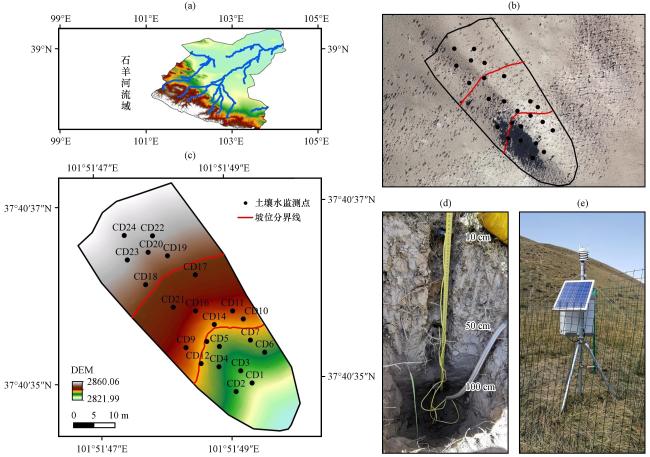
本研究选取草地坡面(长70 m, 宽28 m), 依据坡面微地形, 结合坡面等高线绘制坡位分界线, 将坡面分为坡上、 坡中、 坡下, 密集布设24个土壤水分定位监测点。结合土壤剖面及植物根系深度, 安装土壤水分监测传感器(10 cm、 50 cm、 100 cm), 土壤水分监测间隔为5 min, 组建高密度、 高时间分辨率土壤水分监测网[图1(b), (c)]。土壤水分监测结果显示, 100 cm深度土壤水分极少发生波动, 时间变异性较弱, 故本研究仅采用10 cm和50 cm土壤水分开展时间稳定性研究。在坡面安装气象站监测降雨(0.01 mm分辨率), 在实验室中对各点位土壤水分特征曲线、 土壤质地、 土壤饱和导水率、 容重、 有机质进行测定, 详细方法见田杰等(2023)。通过无人机(大疆精灵四pro)获取坡面完整DEM数据(分辨率0.03 m), 坡度则根据草地DEM数据计算得出(表1)。相关学者依据长期地面群落物候观测发现, 祁连山区草地返青期为5月初, 枯黄期为9月底(祝景彬等, 2021)。研究区土壤水分监测探头布设时间为2020年9月, 但是, 由于高寒山区环境恶劣, 且土壤水分数据出现缺测, 最终结合研究区土壤水分温度探头实测土壤水分解冻时间、 草地生长季及主要降水期, 研究时段最终选定为2021年5月1日至9月30日。
图1 研究区位置、 监测网点布点及仪器布设情况 (a)研究区所在流域具体位置, (b)草地坡面无人机拍摄照片, (c)草地坡面高密度土壤水分监测网布点, (d)土壤水分探头布设情况, (e)草地气象站

Fig.1 Research area location, layout of monitoring stations, and instrumentation deployment.(a) the location of the watershed where the study area is located, (b) photo taken by a drone on a grassy slope, (c) the high-density soil moisture monitoring network distribution point of the grassland slope, (d) the layout of soil moisture probes, (e) the grassland weather station

表1 监测点位土壤水文属性和点位信息

Table 1 Monitoring point soil hydrological attributes and location information

深度 坡上 坡中 坡下 深度 坡上 坡中 坡下
容重 10 cm 均值/(g·cm-1 1.00 1.03 1.09 α 10 cm 均值/(l·cm-1 0.02 0.02 0.03
Cv/% 11.84 6.84 8.35 Cv/% 28.13 32.59 34.32
50 cm 均值/(g·cm-1 1.12 1.10 1.13 50 cm 均值/(l·cm-1 0.03 0.02 0.02
Cv/% 7.34 7.11 6.33 Cv/% 31.62 27.34 63.57
有机质 10 cm 均值/% 6.75 4.41 3.82 n 10 cm 均值 1.30 1.29 1.31
Cv/% 17.67 36.51 45.77 Cv/% 4.39 2.52 4.17
50 cm 均值/% 1.82 1.98 1.96 50 cm 均值 1.44 1.40 1.64
Cv/% 65.87 75.99 73.76 Cv/% 9.00 4.28 43.94
黏粒 10 cm 均值/% 11.13 10.56 8.95 θS 10 cm 均值/% 53.12 51.65 47.71
Cv/% 7.47 15.85 11.59 Cv/% 17.52 5.91 7.09
50 cm 均值/% 9.79 9.36 8.49 50 cm 均值/% 50.54 48.54 46.15
Cv/% 12.15 20.06 15.24 Cv/% 9.90 9.49 9.37
粉粒 10 cm 均值/% 83.22 80.02 80.32 θr 10 cm 均值/% 7.02 5.64 5.80
Cv/% 1.58 3.16 1.50 Cv/% 28.79 21.11 30.26
50 cm 均值/% 80.68 79.28 76.13 50 cm 均值/% 9.97 9.23 7.50
Cv/% 3.60 2.07 10.52 Cv/% 28.48 23.34 49.87
Ks 10 cm 均值/(cm·h-1 4.80 7.20 8.40 坡度 10/50 cm 均值/(°) 23.18 26.46 26.82
Cv/% 44.11 62.54 85.84 Cv/% 25.51 27.12 29.74
50 cm 均值/(cm·h-1 1.80 3.60 3.60 高程 10/50 cm 均值/m 2948.00 2939.29 2933.33
Cv/% 53.84 98.36 66.53 Cv/% 12.00 11.00 12.00

Cv为变异系数, Ks为饱和导水率, nα为土壤水分特征曲线形状参数, θS 为饱和含水率, θr 为残余含水率。(Cv is the coefficient of variation, Ks is the saturated hydraulic conductivity, n and α are the shape parameters of the soil moisture characteristic curve, θS is the saturated moisture content, and θr is the residual moisture content.)

2.3 数据分析方法

2.3.1 经典统计方法

采用经典统计参数平均值(Mean.)、 最大值(Max.)、 最小值(Min.)、 变异系数Cv(Coefficient of Variation)、 Spearman相关系数进行结果分析。其中变异系数Cv计算公式见式(1)
C v = S D M e a n * 100 %
式中: SD为标准差, 具体公式见式(2)
S D = i = 1 n ( x i - x ¯ ) 2 n - 1
式中: x i为样本第i个值; x ¯为该样本均值; n为样本总个数。
Cv≤10%时, 变量具有弱变异性; 当10%<Cv<30%, 变量具有中等变异性; 当Cv≥30%, 变量为强变异性(Wilding et al, 1985)。
采用Spearman相关系数评价各因素之间相关关系(Spearman, 1987), 具体见式(3)
r s = 1 - 6 i = 1 N ( R i - R j ) 2 n n 2 - 1
式中: R i R j为每组观测中两个变量的等级差值; n为数据量; r s的绝对值越接近1表示两变量之间的相关性越好。
采用配对t检验或单因素方差分析(ANOVA)评估不同组间的数据差异, 统计检验置信区间为95%(李阔辰, 2023)。

2.3.2 时间稳定性评价方法

时间稳定性反映的是土壤水分空间模式随时间变化的相似程度, 即土壤水分空间变异性越弱, 时间稳定性越强(She et al, 2014Gao et al, 2019)。通过计算平均相对差分(Mean Relative Difference, MRD)、 相对差分标准差(Standard Deviation of Relative Difference, SDRD)(Vachaud et al, 1985)及时间稳定性指数ITS(Jacobs et al, 2004), 能够确定代表性点位, 从而快速准确获取区域土壤水分数据。其中, MRD用于描述监测点的土壤水分与区域平均土壤水分的关系: MRD大于零表示该点土壤水分含量相较平均水平偏高, 小于零则偏低; SDRD反映监测点土壤水分较坡面平均土壤水分的差异大小, 值越接近零说明该点土壤水分相较平均土壤水分相差越小(Grayson and Western, 1998), 即土壤水分越接近平均值。MRD和SDRD的计算公式见式(4)式(5)
M R D = 1 T j = 1 T θ i j - θ j θ j
S D R D = 1 T - 1 j = 1 T θ i j - θ j θ j - M R D
式中: T为样本总数; θ i jj时刻监测点i的土壤水分实测值; θ jj时刻区域平均土壤水分。其中 θ j通过泰森多边形划分各监测点位土壤水分权重计算得到。
时间稳定性指数ITS综合考虑了MRD和SDRD两个参数值, 其越接近零表示该点时间稳定性越强。ITS计算公式见式(5)
I T S = M R D 2 + S D R D 2

3 结果与分析

3.1 土壤水分时空动态

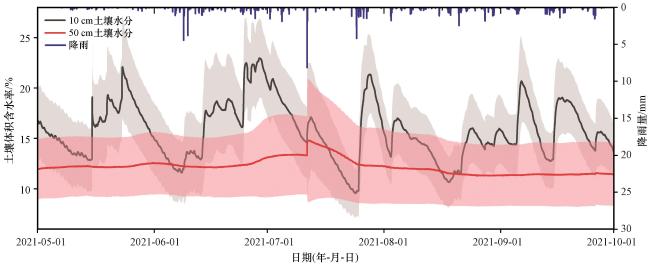
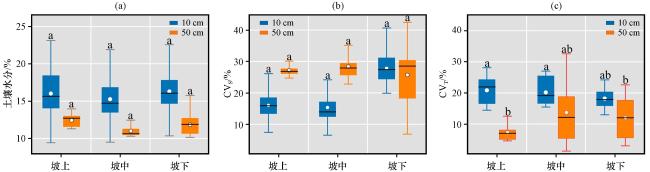
图2反映了不同深度土壤水分均值与降雨量随时间动态变化。从图2中可以看出, 研究期间表层(10 cm)土壤水分变化趋势明显, 波动范围在9.83%~23.46%。而50 cm土壤水分波动相对平稳, 维持在较低的水平(11.08%~15.12%)。10 cm平均土壤水分(15.90%)显著高于50 cm (11.78%)[图3(a)]。结合图3(b)可知, 土壤水分除坡下空间变异性10 cm (27.81%)高于50 cm (25.71%)外, 10 cm均小于50 cm。50 cm土壤水分随时间的变化幅度小于表层, 10 cm土壤水分时间变异性强于50 cm深度[图3(c)]。
图2 2021年5 -9月研究期降雨量和平均土壤水分数据阴影部分为土壤水分标准差SD

Fig.2 Rainfall and average soil moisture data during the study period from May to September, 2021.The shaded area is the standard deviation SD of soil moisture

图3 不同深度土壤水分(a)、 土壤水分空间变异系数CvS(b)和土壤水分时间变异系数CvT(c)箱型分布CvS是土壤水分空间变异系数, CvT是土壤水分时间变异系数, 黑色横线为中位数, 白点为平均值。箱形图上不同的字母表明坡位、 CvS、 CvT存在显著差异, 相同字母则表示无显著差异

Fig.3 Boxplot distributions of soil moisture (a) and coefficients variation of CvS (b) and CvT (c) at different depths.CvS is the spatial variation coefficient of soil moisture, CvT is the temporal variation coefficient of soil moisture, the black horizontal line is the median, and the white dot is the average.Different letters on the box plot indicate significant differences at slope positions, CvS, and CvT, while the same letters indicate no significant differences

通过分析土壤水文属性同土壤水分的Spearman相关性, 能够明确不同土壤水文属性对土壤水分的作用效果。结合表2可知, 土壤水文属性对土壤水分作用效果差异较大。其中有机质对坡下10 cm土壤水分作用显著, 其相关系数可达0.71 (p<0.05), 容重同坡中50 cm土壤水分呈显著负相关, 其相关系数为-0.93 (p<0.01), 形状参数n同坡上、 坡下50 cm土壤水分呈显著负相关, 其相关系数分别为-0.82和-0.76 (p<0.05)。土壤质地对土壤水分的作用效果较为明显, 砂粒、 粉粒含量同坡上、 坡中土壤水分相关系数超过0.60。
表2 土壤水分和土壤水文属性之间的Spearman相关性

Table 2 Spearman correlation between soil moisture and soil hydrological properties

坡位 深度 容重 有机质 砂粒 黏粒 粉粒 Ks n α θS θr
坡上 10 cm 0.09 0.31 -0.61 -0.32 0.61 0.66 -0.54 0.43 -0.09 -0.03
50 cm 0.32 -0.32 0.21 -0.21 -0.18 -0.57 -0.82* 0.43 0.14 0.68
坡中 10 cm -0.25 0.68 -0.39 0.36 0.14 0.09 -0.27 0.25 -0.04 -0.15
50 cm -0.93** 0.64 -0.61 0.71 0.64 0.32 0.46 0.21 0.36 -0.20
坡下 10 cm -0.60 0.71* -0.29 0.55 0.33 0.19 0.16 -0.50 -0.36 -0.08
50 cm 0.26 0.33 -0.29 0.38 0.17 -0.33 -0.76* 0.31 0.10 -0.48

*代表显著性水平 < 0.05, **代表显著性水平 < 0.01(* represents the significance level < 0.05, ** represents the significance < 0.01)

3.2 土壤水分时间稳定性

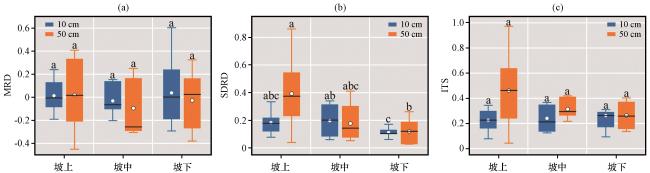
结合图3(a)、 图4(a)可知, 坡上点位土壤水分偏高(10 cm和50 cm MRD分别为1.31、 2.02)。坡中土壤水分含量偏低(10 cm和50 cm MRD分别为-0.34、 -9.62)。坡下SDRD明显低于坡上和坡中, 表明坡下点位土壤水分更接近平均土壤水分。通过对比时间稳定性指数ITS的大小能够确定点位时间稳定性的强弱。其中, 10 cm深度下, 坡上时间稳定性最高, 其ITS为0.23, 但50 cm深度时间稳定性反而最低, ITS高达0.46。坡下ITS在10 cm深度最高, 但与其余两种坡位差距很小(<0.04), 其在50 cm深度稳定性最高(ITS=0.26)。综上所述, 坡下时间稳定性最高。
图4 土壤水分时间稳定性指数箱型分布(a)平均相对差分(MRD), (b)相对差分标准差(SDRD), (c)表层时间稳定性指数(ITS); 黑色横线为中位数, 白点为平均值,箱形图上不同的字母表明坡位存在显著差异, 相同字母则表示无显著差异

Fig.4 Box distribution of soil moisture index of time stability.(a) Mean Relative Difference (MRD), (b) Standard Deviation of Relative Difference (SDRD), (c) Index of Temporal Stability (ITS).The black horizontal line is the median, and the white dot is the average, different letters on the box plot indicate significant differences at slope positions, while the same letters indicate no significant differences

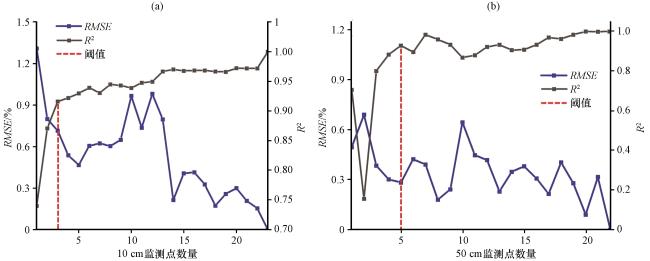
通过计算代表性点位土壤水分代替坡面平均土壤水分的精度, 可以得到研究区代表性点位数量阈值(图5)。“阈值”指精度指标曲线上的端点与代表性点位的数量关系, 达到阈值后, 更多的点位数量不会显著提高精度, 这时便认为点位布设数量达到阈值(Lai et al, 2018)。将各点位按时间稳定性指数ITS从小到大的顺序排列, 就得到了点位代表性的强弱顺序。按代表性从强到弱的顺序判断点位土壤水分代替区域土壤水分的精度是否满足需求, 其中, 10 cm深度3个点位即可达到阈值, R 2从0.74提升至0.92, RMSE从1.31%降低到0.71%, 点位继续增加时精度提升很小甚至可以忽略, 而50 cm需要5个点位才能达到阈值。
图5 不同数量监测点位代替坡面平均土壤水分精度(a) 10 cm监测点, (b) 50 cm监测点

Fig.5 Different number of monitoring points replace the average soil moisture accuracy map of slope.(a) monitoring points of 10 cm, (b) monitoring points of 50 cm

3.3 土壤水分时间稳定性影响因素

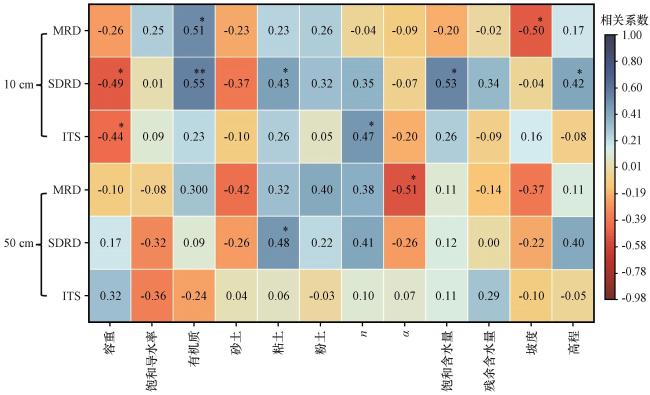
图6为MRD、 SDRD、 和ITS同各影响因素的Spearman相关性。其中, 容重和形状参数n与10 cm深度ITS呈显著正相关(p<0.05), Spearman相关系数分别为-0.44和0.47。MRD主要受有机质和坡度控制, 其中有机质和MRD呈显著正相关(p<0.05), 相关系数为0.51。坡度为显著负相关(p<0.05), 相关系数为-0.50, 坡度越陡, 土壤水分含量相较坡面平均土壤水分越低。SDRD主要受到容重、 有机质、 黏粒含量、 θS 和高程控制, 其中, 容重为显著负相关(p < 0.05), 相关系数为-0.49, 其余影响因素为显著正相关(p < 0.05), 相关系数均超过0.40。50 cm深度下, MRD同α呈显著负相关(p < 0.05), 相关系数为-0.51。黏粒含量同50 cm深度SDRD呈显著正相关(p < 0.05), 相关系数为0.48。
图6 各影响因素同时间稳定性指数的Spearman相关性 *代表显著性水平 < 0.05, **代表显著性水平 < 0.01

Fig.6 Spearman correlation graph between various influencing factors and temporal stability index over time.* represents the significance level < 0.05, ** represents the significance < 0.01

4 讨论

4.1 土壤水分时空动态分析

坡面土壤水分受植被、 降水、 土壤水文属性等因素综合作用, 时空动态变化明显。其中, 降水对10 cm土壤水分的动态调控作用明显, 10 cm深度土壤水分时间变异性较强。这是因为表层土壤水分相较深层更易受外界因素影响扰动(He et al, 2018Liu et al, 2022)。研究区土壤水分同时受到有机质、 容重、 土壤质地和形状参数n控制, 与前人研究结论一致(Hu et al, 2010Yang et al, 2017)。而影响土壤水分的主要因素在50 cm深度变异性几乎都远大于10 cm, 所以50 cm深度土壤水分空间变异性更大。

4.2 不同深度土壤水分时间稳定性分析

10 cm 深度时间稳定性指数ITS小于50 cm, 表明10 cm土壤水分时间稳定性强于50 cm。这与主流观点即表层土壤水分更易受到外界环境因素的影响, 稳定性弱于深层(He et al, 2018Gao et al, 2019Bai et al, 2021)相悖。本研究结论相反主要有以下原因: 结合图3与3.1土壤水分时空动态分析可知, 除坡下外, 10 cm土壤水分空间变异性均远小于50 cm, 且坡下10 cm土壤水分空间变异性仅比50 cm高2%左右, 10 cm土壤水分空间变异性远弱于50 cm。同时, 50 cm深度土壤水分时间变异性也小于10 cm深度, 50 cm深度土壤水分各自保持自身稳定状态, 对外界响应较弱。又因为高寒山区土壤水文属性异质性极大, 各点位之间土壤水分差异较大, 所以50 cm深度土壤水分时间稳定性弱于10 cm。

4.3 时间稳定性影响因素分析

土壤水分时间稳定性受土壤、 地形和植被等因素影响(Li et al, 2016Bai et al, 2021), 虽然植被对土壤水分时间稳定性作用效果不可忽略(He et al, 2018), 但由于本研究只聚焦草地坡面, 植被类型单一, 因此仅分析非植被因素对土壤水分时间稳定性的影响。结合草地坡面密集土壤水分监测网及各点位详细土壤水文属性数据, 本研究能够较为系统地分析各影响因素对时间稳定性的影响。
He et al (2018)研究发现容重会显著影响土壤水分时间稳定性, 本研究通过相关性分析发现容重对土壤水分时间稳定性影响作用不可忽视。表层土壤容重越大, 土壤水分时间稳定性越强(p < 0.05)。这主要是因为容重越大, 土壤颗粒聚集越紧密, 土壤大孔隙减少, 土壤水分不易发生渗漏或蒸发(姜泓旭, 2020), 时间稳定性强。Ks对土壤水分时间稳定性的影响较弱, Zhang et al (2010)认为这可能同Ks对土壤水分的作用效果有关: 降水时, 高Ks的土壤更易湿润, 土壤含水量迅速增加, 但是, 高Ks同样能够使雨水迅速渗漏或蒸发, 两种作用效果相互抵消导致其影响作用难以凸显。综上所述, 土壤水文属性对土壤水分时间稳定性的作用效果主要是通过土壤颗粒组成、 土壤结构等改变土壤持水、 导水能力实现, 稳定性点位更容易出现在土壤容重较大, 形状参数n较小, Ks更接近研究区平均水平的位置。

5 结论

本研究基于祁连山区草地坡面高密度、 高时间分辨率土壤水分监测网, 研究土壤水分时空动态变化规律, 结合相对差分法和时间稳定性指数揭示坡面尺度土壤水分时间稳定性, 采用决定系数R 2与均方根误差RMSE评价点位的代表性, 使用Spearman相关系数确定时间稳定性点位影响因素, 主要结论如下:
(1) 土壤水分时空动态分析表明, 10 cm平均土壤水分(15.79%)与50 cm平均土壤水分(12.20%)差异显著。10 cm土壤水分更易受到包括降雨等外界因素影响, 时间变异性强; 50 cm土壤水分不同点位上的土壤水分存在较大的差异, 空间变异性强。
(2) 10 cm和50 cm土壤水分时间稳定性指数ITS分别为0.24和0.34, 10 cm土壤水分时间稳定性强于50 cm。10 cm和50 cm分别需要3个和5个代表性点位即可较好代表整个草地坡面平均土壤水分。
(3) 坡下点位较坡上、 坡中土壤水分时间稳定性更强; 容重和形状参数n对土壤水分时间稳定性影响作用不可忽视, 确定时间稳定性点位时必须考虑坡位和土壤水文属性的影响。

参考文献

null
Bai Y S Liu M X Yi J, et al, 2021.Temporal stability analysis of soil moisture along a coniferous forest hillslope with subtropical monsoon climate in southwest China[J].Journal of Mountain Science18(11): 2900-2914.DOI: 10.1007/s11629-021-6679-5 .
null
Duan L X Huang M B Li Z W, et al, 2017.Estimation of spatial mean soil water storage using temporal stability at the hillslope scale in black locust (Robinia pseudoacacia) stands[J].Catena, 156: 51-61.DOI: 10.1016/j.catena.2017.03.023 .
null
Gao L Peng X H Biswas A2019.Temporal instability of soil moisture at a hillslope scale under subtropical hydroclimatic conditions[J].Catena, 187: 104362.DOI: 10.1016/j.catena.2019.104362 .
null
Grayson R B Western A W1998.Towards areal estimation of soil water content from point measurements: time and space stability of mean response[J].Journal of Hydrology207(1/2): 68-82.DOI: 10.1016/S0022-1694(98)00096-1 .
null
He M N Wang Y Q Wang L, et al, 2020.Spatio‐temporal variability of multi‐layer soil water at a hillslope scale in the critical zone of the Chinese Loess Plateau[J].Hydrological Processes34(23): 4473-4486.DOI: 10.1002/hyp.13888 .
null
He Z B Zhao M M Zhu X, et al, 2018.Temporal stability of soil water storage in multiple soil layers in high‐elevation forests[J].Journal of Hydrology, 569: 532-545.DOI: 10.1016/j.jhydrol. 2018.12.024 .
null
Hu W Shao M A Han F P, et al, 2010.Watershed scale temporal stability of soil water content[J].Geoderma158(3).DOI: 10.1016/j.geoderma.2010.04.030 .
null
Jacobs J M Mohanty B P Hsu E C, et al, 2004.SMEX02: Field scale variability, time stability and similarity of soil moisture[J].Remote Sensing of Environment92(4): 436-446.DOI: 10. 1016/j.rse.2004.02.017 .
null
Joshi C Mohanty B P Jacobs J M, et al, 2011.Spatiotemporal analyses of soil moisture from point to footprint scale in two different hydroclimatic regions[J].Water Resources Research47(1): 1-20.DOI: 10.1029/2009WR009002 .
null
Lai X M Zhou Z Zhu Q, et al, 2018.Identifying representative sites to simultaneously predict hillslope surface and subsurface mean soil water contents[J].Catena, 167.DOI: 10.1016/j.catena. 2018.05.016 .
null
Li X Z Shao M A Jia X X, et al, 2016.Profile distribution of soil-water content and its temporal stability along a 1340‐m long transect on the Loess Plateau, China[J].Catena, 137: 77-86.DOI: 10.1016/j.catena.2015.09.005 .
null
Liu H W Zhang J Y Liao A M, et al, 2022.Estimation of variability in soil water content in a forested critical‐zone experimental catchment in Eastern China[J].Journal of Contaminant Hydrology248(3/4): 104022.DOI: 10.1016/j.jconhyd.2022.104022 .
null
Rosenbaum U Bogena H R Herbst M, et al, 2012.Seasonal and event dynamics of spatial soil moisture patterns at the small catchment scale[J].Water Resources Research48(10): 3472-3476.DOI: 10.1029/2011WR011518 .
null
She D L Liu D D Liu Y Y, et al, 2014.Profile characteristics of temporal stability of soil water storage in two land uses[J].Arabian Journal of Geosciences7(1): 21-34.DOI: 10.1007/s12517-013-0838-0 .
null
Spearman C1987.The proof and measurement of association between two things[J].The American Journal of Psychology, 100(3/4), 441-471.DOI: 10.1093/ije/dyq191 .
null
Tian J Han Z B Bogena H R, et al, 2020.Estimation of subsurface soil moisture from surface soil moisture in cold mountainous areas[J].Hydrology and Earth System Sciences24(9): 4659-4674.DOI: 10.5194/hess-2019-603 .
null
Vachaud G A Silans A Balabanis P, et al, 1985.Temporal stability of spatially measured soil water probability density function[J].Soil Science Society of America Journal49(4): 822-828.DOI: 10.2136/sssaj1985.03615995004900040006x .
null
Wang S Chen H D Fu Z Y, et al, 2016.Temporal stability analysis of surface soil water content on two karst hillslopes in southwest China[J].Environmental Science and Pollution Research International23(24): 25267-25279.DOI: 10.1007/s11356-016-7686-x .
null
Wilding L P1985.Spatial variability: its documentation, accommodation and implication to soil surveys[A].In: Nielsen D R, Bouma J(Eds.).Soil Spatial Variability[M].Wageningen: Pudoc Wageningen, 166-194.
null
Yang J J He Z B Du J, et al, 2017.Soil water variability as a function of precipitation, temperature, and vegetation: a case study in the semiarid mountain region of China[J].Environmental Earth Sciences76 (5): 1-13.DOI: 10.1007/s12665-017-6521-0 .
null
Zhu X He Z B Du J, et al, 2020.Soil moisture temporal stability and spatio‐temporal variability about a typical subalpine ecosystem in northwestern China[J].Hydrological Processes34 (11): 2401-2417.DOI: 10.1002/hyp.13737 .
null
程文举, 席海洋, 司建华, 等, 2022.内陆河流域浅山区土壤水热时空动态及其对气象因子的响应[J].高原气象41(6): 1435-1445.DOI: 10.7522/j.issn.1000-0534.2021.00089.Cheng W J
null
Xi H Y Si J H, et al, 2022.Temporal and spatial dynamic change of soil water‐heat and its response to meteorological factors in an inland river basin in low coteau area[J].Plateau Meteorology41(6): 1435-1445.DOI: 10.7522/j.issn.1000-0534.2021.00089 .
null
丁旭, 赖欣, 范广洲, 2022.青藏高原春季土壤湿度异常与我国夏季降水的联系[J].高原气象41(1): 24-34.DOI: 10.7522/j.issn.1000-0534.2020.00094.Ding X
null
Lai X Fan G Z2022.Impacts of spring soil moisture anomalies in Qinghai‐Xizang Plateau on the summer precipitation variability in China[J].Plateau Meteorology41(1): 24-34.DOI: 10.7522/j.issn.1000-0534.2020.00094 .
null
符晴, 阳坤, 郑东海, 等, 2022.青藏高原中部土壤有机质含量对不同深度土壤温湿度的影响研究[J].高原气象41(5): 1097-1108.DOI: 10.7522/j.issn.1000-0534.2021.00039.Fu Q
null
Yang K Zheng D H, et al, 2022.Impact of soil organic matter content on soil moisture and temperature at different depths in the central Qinghai‐Xizang Plateau[J].Plateau Meteorology41(5): 1097-1108.DOI: 10.7522/j.issn.1000-0534.2021.00039 .
null
姜泓旭, 2020.秦巴山区土壤物理性质空间变异性研究[D].杨凌: 西北农林科技大学.DOI: 10.27409/d.cnki.gxbnu.2020. 001150. Jiang H X, 2020.Study on spatial variability of soil physical properties in Qinba mountain area[D].Yangling: Northwest A&F University.DOI: 10.27409/d.cnki.gxbnu.2020. 001150 .
null
敬文茂, 任小凤, 赵维俊, 2022.1965-2018年祁连山北麓及其附近地区气温与降水变化的时空格局[J].高原气象41(4): 876-886.DOI: 10.7522/ j.issn.1000-0534.2021.00075.Jing W M
null
Ren X F Zhao W J2022.Spatio‐temporal pattern variations of temperature and precipitation in northern parts of the Qilian Mountains and the nearby regions from 1965 to 2018[J].Plateau Meteorology41(4): 876-886.DOI: 10.7522/j.issn.1000-0534.2021.00075 .
null
李阔辰, 2023.线性回归模型中的异方差检验与估计方法研究[D].太原: 山西财经大学.DOI: 10.27283/d.cnki.gsxcc.2023. 001619.Li K C, 2023.A study of heteroscedasticity test and estimation method in linear regression model[D].Taiyuan: Shanxi University of Finance & Economics.DOI: 10.27283/d.cnki.gsxcc.2023.001619 .
null
蔺鹏飞, 朱喜, 何志斌, 等, 2018.土壤水分时间稳定性研究进展[J].生态学报38(10): 3403-3413.DOI: 10.5846/stxb201704070598. Lin P F
null
Zhu X He Z B, et al, 2018.Research progress on soil moisture temporal stability[J].Acta Ecologica Sinica38( 10): 3403-3413.DOI: 10.5846/stxb201704070598 .
null
刘维成, 张强, 刘新伟, 2021.陆-气相互作用对大气对流活动影响研究进展和展望[J].高原气象40(6): 1278-1293.DOI: 10.7522/j.issn.1000-0534.2021.zk0019.Liu W C
null
Zhang Q Liu X W2021.The impact of land-atmosphere interaction on the initiation and development of convective activities: a review[J].Plateau Meteorology40(6): 1278-1293.DOI: 10.7522/j.issn.1000-0534.2021.zk0019 .
null
罗晓玲, 丁思聪, 杨梅, 等, 2022.气候变化对石羊河流域生态环境的影响分析[J].沙漠与绿洲气象16(4): 49-56.DOI: 10.12057/j.issn.1002-0799.2022.04.007.Luo X L
null
Ding S C Yang M, et al, 2022.Impact of climate change on the ecological environment of the Shiyang River Basin[J].Desert and Oasis Meteorology16(4): 49-56.DOI: 10.12057/j.issn.1002-0799.2022.04.007 .
null
田杰, 张宝庆, 王学锦, 等, 2023.青藏高原东北部高寒山区土壤水文属性数据和土壤水定位观测网[J].中国科学(地球科学)53(8): 1775-1794.DOI: 10.1360/N072022-0336.Tian J
null
Zhang B Q Wang X J He C S, et al, 2023.In situ observations of soil hydraulic properties and soil moisture in a high, cold mountainous area of the northeastern Qinghai‐Tibet Plateau[J].Science China Earth Sciences66(8): 1757-1775.DOI: 10.1360/N072022-0336 .
null
魏玲娜, 欧阳如琳, 谢永玉, 等, 2022.八宝河流域土壤水时间稳定性及其下垫面控制因素分析[J].中国农村水利水电(1): 50-58.DOI: 10.3969/j.issn.1007-2284.2022.01.009.Wei L N
null
Ouyang R L Xie Y Y, et al, 2022.An analysis of soil moisture temporal stability and its controlling factors of underlying surface in babaohe watershed[J].China Rural Water and Hydropower (1): 50-58.DOI: 10.3969/j.issn.1007-2284.2022.01.009 .
null
祝景彬, 张法伟, 李红琴, 等, 2021.祁连山南麓高寒草甸2002~2016年生长季CO2通量对气温日较差的响应[J].科学通报, 66: 85-95.DOI: 10.1360/TB-2020-0896.Zhu J B
null
Zhang F W Li H Q, et al, 2021.The response of CO2 fluxes to the amplitude of diurnal temperature in alpine meadow during growing season from 2002 to 2016 at the southern foot of Qilian Mountains [J].Chinese Science Bulletin, 66: 85-95.DOI: 10.1360/TB-2020-0896 .
文章导航

/