北极海冰快速退缩情景下西伯利亚区域反气旋活动变化和温度异常联系

  • 夏平 , 1 ,
  • 卢楚翰 , 2 ,
  • 黄丁安 3 ,
  • 陈日恒 2 ,
  • 王蕊 4
展开
  • 1. 南京信息工程大学气象灾害教育部重点实验室,江苏 南京 210044
  • 2. 无锡学院中国气象局生态系统碳源汇重点开放实验室,江苏 无锡 214063
  • 3. 福建省三明市气象局,福建 三明 365000
  • 4. 上海市气象服务中心,上海 200030
卢楚翰(1981 -), 男, 广西梧州人, 博士研究生, 主要从事中高纬度大气环流异常研究. E-mail:

夏平(2001 -), 女, 福建三明人, 硕士研究生, 主要从事大气环流异常动力学研究. E-mail:

收稿日期: 2024-09-01

  修回日期: 2025-02-26

  网络出版日期: 2026-01-04

基金资助

江苏省重点研发计划产业前瞻与关键核心技术项目(BE2022161)

江苏省青蓝工程学术带头人项目

无锡学院引进人才科研启动专项

Variability of Anticyclone Activity and Temperature Anomaly Linkages in the Siberian Region under a Scenario of Rapid Arctic Sea Ice Retreat

  • Ping XIA , 1 ,
  • Chuhan LU , 2 ,
  • Dingan HUANG 3 ,
  • Riheng CHEN 2 ,
  • Rui WANG 4
Expand
  • 1. Key Laboratory of Meteorological Disaster,Ministry of Education,Nanjing University of Information Science and Technology,Nanjing 210044,Jiangsu,China
  • 2. Key Laboratory of Ecosystem Carbon Source and Sink,China Meteorological Administration (ECSS-CMA),Wuxi University,Wuxi 214063,Jiangsu,China
  • 3. Sanming Meteorological Bureau,Sanming 365000,Fujian,China
  • 4. Shanghai Meteorological Service Center,Shanghai 200030,China

Received date: 2024-09-01

  Revised date: 2025-02-26

  Online published: 2026-01-04

Copyright

© Editorial Department of Plateau Meteorology (CC BY-NC-ND)

摘要

北极海冰变化与冬季欧亚大陆气温异常变化存在密切联系, 而冬季冷高压系统的频繁活动对于西伯利亚以及东亚地区降温产生直接影响, 在“北极放大”以及未来北极海冰退缩情景下, 西伯利亚近地面反气旋活动如何变化值得深入探究。本研究利用基于深度学习的Mask R-CNN反气旋客观识别算法对欧亚大陆冬季天气尺度反气旋进行识别, 使用欧洲中期天气预报中心(European Centre for Medium-Range Weather Forecasts, ECMWF)ERA5再分析资料、 美国国家海洋和大气管理局(National Oceanic and Atmospheric Administration, NOAA)OISST V2.1每日海冰密集度数据集以及MIROC6模式输出资料, 进一步研究了在未来北极海冰迅速退缩的背景下, 前期秋季海冰异常变化可能对反气旋和冷空气活动产生的影响及其机制。结果表明, 1981 -2022年秋季巴伦支海-卡拉海区域(Barents-Kara Sea, BKS)海冰指数减下降, 而欧亚大陆中高纬度特别是西伯利亚区域的气温显著下降, 冷空气质量异常堆积, 反气旋活动携带的冷空气质量增多。进一步利用北极放大计划(Polar Amplification Model Intercomparison Project, PAMIP)中的模式资料, 统计欧亚大陆反气旋在未来北极海冰较少情景下的活动变化规律, 发现海冰减少条件下, 西伯利亚区是欧亚大陆反气旋的主要影响和生消地之一, 该区域反气旋具有局地活动特征, 对准定常的西伯利亚冷高压以及冷池区冷空气积聚起重要促进作用。气温在欧亚大陆北边缘增高但在欧亚大陆中纬度呈显著下降特征, 伴随着欧亚大陆大部分地区极寒天数增多。进一步研究发现秋季BKS海冰状况可作为前兆因子对后期冬季反气旋活动以及气温异常产生影响, 该地区海冰状况引起区域位涡经向梯度显著降低, 从而使上游东欧平原阻塞发生频率增大, 有利于反气旋活动增强和冷空气的输送, 促使东亚冬季寒冷趋势加剧。

本文引用格式

夏平 , 卢楚翰 , 黄丁安 , 陈日恒 , 王蕊 . 北极海冰快速退缩情景下西伯利亚区域反气旋活动变化和温度异常联系[J]. 高原气象, 2025 , 44(5) : 1273 -1284 . DOI: 10.7522/j.issn.1000-0534.2025.00022

Abstract

The variability of Arctic sea ice is closely linked to anomalous winter temperature changes over the Eurasian continent, while the frequent activity of winter cold high-pressure systems directly influences temperature reductions in Siberia and East Asia.In the context of "Arctic amplification" and projected Arctic sea ice retreat scenarios, it is worth delving into how near-surface anticyclone activity in Siberia will change.This study utilizes a Mask R-CNN anticyclone objective identification algorithm based on deep learning to identify winter synoptic-scale anticyclones over the Eurasian continent.It further investigates the potential impacts and mechanisms of anomalous autumn sea ice changes on anticyclone and cold air activities under the backdrop of rapid future Arctic sea ice retreat, using data from the European Centre for Medium-Range Weather Forecasts (ECMWF) ERA5 reanalysis, the National Oceanic and Atmospheric Administration (NOAA) OISST V2.1 daily sea ice concentration dataset, and outputs from the MIROC6 model.The results indicate that the sea ice index in the Barents-Kara Sea (BKS) region declined during autumn from 1981 to 2022, accompanied by significant temperature drops in the mid-to-high latitudes of the Eurasian continent, particularly in Siberia, where anomalous accumulations of cold air mass occurred, and the cold air mass carried by anticyclone activity increased.Utilizing model data from the Polar Amplification Model Intercomparison Project (PAMIP), the study statistically analyzed the variability of anticyclone activity over the Eurasian continent under scenarios of reduced Arctic sea ice in the future.It was found that under conditions of sea ice reduction, Siberia is one of the main regions influencing the formation and dissipation of anticyclones over the Eurasian continent.Anticyclones in this region exhibit local activity characteristics, significantly contributing to the quasi-stationary Siberian cold high and the accumulation of cold air in the cold pool region.Temperatures increased along the northern edge of the Eurasian continent but significantly decreased at mid-latitudes, accompanied by an increase in extremely cold days across most of the Eurasian continent.Further research revealed that autumn BKS sea ice conditions can serve as a precursor factor influencing subsequent winter anticyclone activity and temperature anomalies.The sea ice conditions in this region result in a significant reduction in the meridional gradient of regional potential vorticity, thereby increasing the frequency of blocking events in the upstream Eastern European Plain, directing cold air to build up over Siberia.This favors the enhancement of anticyclone activity and the transport of cold air, exacerbating the winter cold trend in East Asia.

1 引言

全球变暖大背景下, 北半球积雪覆盖面积减少趋势明显, 积雪作为冰冻圈的重要组成部分, 其快速消融将影响陆气之间的能量和水汽平衡(李延等, 2023王旭蕾等, 2024), 是公认造成“北极放大”效应的重要机制之一。近地表气温的上升几乎是近几十年全球增暖的2倍, 然而冬季中纬度欧亚大陆依旧出现较为频繁的极寒天气事件(Yang and Christensen, 2012Walsh, 2014Lu et al, 2019), 如2008年中国南方地区出现显著低温雨雪冰冻灾害(丁一汇等, 2008; 李崇银和顾薇, 2010), 2016年, 广州出现1949年以来首场降雪(王晓芳等, 2019), 2018年北大西洋超强爆发性气旋“格雷森”给美国东海岸带来了低温暴雪灾害并导致人员伤亡(李昱薇等, 2021), 对人们的生产生活造成极大的不便和负面影响。
前人研究将冬季大气环流的变化、 中纬度地区极端寒冷事件与前期北极海冰的快速消融联系起来, 例如Honda et al(2009)研究表明北极海冰损失加剧将产生异常湍流热通量, 从而引起西伯利亚高压增强, 导致东亚地区寒冷趋势加剧。北极变暖增强同时将导致500 hPa以下垂直厚度梯度减弱, 高空纬向风减弱, 波峰向北延伸同时振幅增大, 这两种影响都会减缓罗斯贝波东传速度(Francis and Vavrus, 2012), 并且激发从戴维斯海峡向东南以及从鄂霍次克海向西南方向传播的波列, 使得我国西北地区上空500 hPa位势高度场距平呈现“西高东低”分布(王岱等, 2024), 会增加干旱、 洪水、 寒潮、 热浪等极端天气发生的可能性。Liu et al(2012)研究表明, 秋季北极海冰面积的减少将导致阻塞频繁发生, 北极地区秋冬季节大气水蒸气含量增加, 导致冬季大雪事件增多。Cohen et al(2012)指出海冰损失促进了北极表面水汽蒸发, 从而导致高纬度陆地降雪时间提前, 土壤隔热作用使得地表冷却加快, 北极高压异常导致气旋频率降低, 进一步增强了温度负异常和阻塞高压的发生。
巴伦支海-卡拉海(BKS)大部分海域处于70°N以北, 北大西洋洋流作用使得该海域海温比周围海域高得多, 该区域海冰也是北极年际变率的主要大值区, 因而该海域的海冰变化是当前研究的热点。BKS海冰减少造成的辐射效应, 会引起海表向上的辐射、 感热以及潜热增加从而激发Rossby波向下游地区传播并诱发异常经向环流, 使AO/NAO负相态和EU遥相关型出现的概率增大, 即北极近地表温度变暖而中纬度变冷(Wu et al, 1999Nakamura et al, 2015)。BKS海温变化同样能对北半球气候产生影响, 当BKS异常增暖, 中高纬欧亚大陆平均西风强度和垂直切变减弱, 中纬度欧亚大陆会出现大范围的与UB相关的冷异常(Yao et al, 2017)。
另一方面, 反气旋活动与冷空气活动联系紧密, 易造成降温、 降水和大风天气。冬季欧亚大陆表面强烈的辐射冷却和整层下沉运动, 有利于西伯利亚高压的快速形成(Ding and Krishnamurti, 1987Ding, 1990), 其较北美大陆发生与冷空气活动相关的冬季反气旋频次更多(Ioannidou and Yau, 2008), 是北半球反气旋活动最为频繁、 发展最为强大的地区。西伯利亚高压是冬季控制欧亚大陆低层的大尺度环流系统, 现有研究主要关注冬季季节/季节内平均的西伯利亚高压长期活动变化及其影响(Lü et al, 2019Zhou et al, 20222024), 然而有研究表明, 冬季欧亚大陆近地面反气旋主要表现为天气尺度系统(秦育婧和卢楚翰, 2017), 其活动与西伯利亚高压有着紧密的关联(Zhang et al, 2012)。Inoue et al(2012)研究表明, BKS海冰很可能通过斜压性控制气旋路径, 从而驱动“暖北极-冷欧亚”异常发生, 在少冰情况下, 巴伦支海上空的暖异常与气旋北移引起的异常暖平流有关, 而气旋北移可以在西伯利亚形成异常反气旋, 引发西伯利亚北部显著异常冷平流。
冬季反气旋的位置、 形状和强度变化会直接对极端寒冷事件造成影响(Park et al, 2010Zhang et al, 2012), 故对反气旋进行单体识别以分析其活动十分必要。近年来, 深度学习模型逐渐应用于气象研究领域, 对传统的识别和预报技术起到了改进和补充的作用(Hong et al, 2017Zhang et al, 2018Wimmers et al, 2019Rüttgers et al, 2019Zhang et al, 2024)。受到海冰影响, 北极区域增暖速度明显大于中纬度, 全球变暖及北极放大效应又使得极端天气发生概率增大, 因此在未来进一步加强的北极放大背景下, 东亚寒冷天气及天气系统的活动会有怎样的响应?其影响机制又是什么?为了研究以上问题, 本文将使用基于深度学习的二维反气旋客观识别算法Mask R-CNN模型识别天气尺度反气旋, 进而对冬季欧亚大陆反气旋的长期活动规律进行研究统计, 并根据反气旋二维影响区域, 定量计算其携带的冷空气质量及对冷空气质量的贡献率, 从而探究未来海冰快速退缩背景下的西伯利亚反气旋活动与温度异常的联系。

2 数据来源与方法介绍

2.1 数据来源

本文所用资料为1981 -2022年欧洲中期天气预报中心ERA5再分析资料(Babar et al, 2019), 时间间隔为6 h, 水平分辨率为2.5°×2.5°, 包括地表气压, 海平面气压(Sea Level Pressure, SLP), 地面2 m气温, 11层温度(100 hPa、 150 hPa、 200 hPa、 250 hPa、 300 hPa、 400 hPa、 500 hPa、 600 hPa、 700 hPa、 850 hPa、 1000 hPa)。采用了美国国家海洋和大气管理局提供的OISST V2.1数据集, 使用其每日海冰密集度数据(Huang et al, 2021), 水平分辨率为0.25°×0.25°。本文以1981 -2022年作为气候态, 取当年12月至次年2月为北半球当年冬季。
本文使用CMIP6北极放大效应比较子计划(PAMIP), 该方法旨在通过一系列以海温和海冰作为外强迫因子的数值试验, 加强人们对北极放大效应的理解(Eyring et al, 2016Smith et al, 2019Komuro et al, 2012)。其中, 本文选取了日本气候系统研究中心开发的MIROC6模式(Tatebe et al, 2019)输出资料进行研究, 该模式被大量运用于研究北极放大响应和冰盖异常变化等问题, 所得结果具有较好的可信度(Yoshimori et al, 2014Ono et al, 20172020Ryouta et al, 2021)。本文使用了PAMIP数据中的两组试验: 一是由现在的海温和海冰为强迫因子(pdSST-pdSIC, 简称pd), 另一组是由现在的海温和未来的BKS区域海冰作为强迫因子(pdSST-futBKSeasSIC, 简称futBK)。其中, 在pd/futBK情景下共200个集合, 要素包含逐日地面2 m气温, 海平面气压(SLP), 纬向风, 位势高度, 水平分辨率为1.4°×1.4°。

2.2 方法介绍

2.2.1 基于Mask R-CNN的反气旋客观识别算法

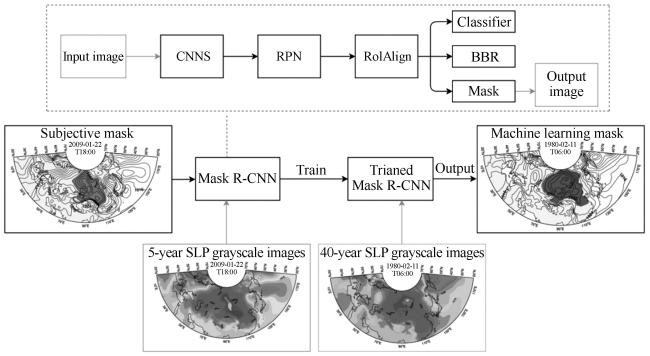
Zhang and Lu(2022)对比了利用人工分析和模型识别两种方法所得到的5年每日四次反气旋数据集, 发现人工分析通常倾向于标记当前时次对中国影响最显著或强度最高的反气旋, 而通过Mask R-CNN模型, 不仅能够捕捉到绝大多数人工识别的反气旋, 还能够对人工分析结果起到补充作用。两者的空间重合性匹配度平均能达到95%, 因此认为利用Mask R-CNN深度学习模型识别近地面2D反气旋具有较好的性能。基于Mask R-CNN的反气旋客观识别算法的步骤和原理如图1所示, 主要分为以下五个步骤: (1)人工识别: 对2008 -2012年冬季蒙古高原地区的主要反气旋系统进行人工分析识别, 通过分析逐日SLP图, 在蒙古高原区域(40°N -55°N, 80°E -120°E)范围内, 寻找存在闭合等值线的反气旋系统, 将系统最外围闭合等值线包围区域内的所有格点标记为反气旋系统的影响范围。生成5年冬季反气旋水平范围的标签数据(人工识别Mask), 准确描述出反气旋的位置、 形状、 影响范围。(2)构建训练数据集: 将5年期间人工标注的Mask与对应时刻的SLP数据转化为灰度图像, 作为训练数据集输入到Mask R-CNN模型中进行训练。(3)机器学习: 将1981 -2022年期间的SLP灰度图像输入训练完成的Mask R-CNN模型, 输出对应的42年冬季反气旋Mask识别结果(机器学习识别数据)(4)客观识别: 步骤(1)着重于识别影响蒙古高原及其周边地区的反气旋活动, 本研究还使用了基于气旋并改进的客观识别算法(Lu, 2017), 计算得到1981 -2022年冬季欧亚大陆地区(0° - 180°E, 20°N -70°N)的反气旋客观识别结果(客观识别Mask), 以补充步骤(1)中的数据。(5)数据整合: 将近42年期间的客观识别Mask与机器学习生成的Mask数据进行整合, 形成新的反气旋识别数据集(合并识别Mask)。合并规则: 当同一区域的客观识别Mask与机器学习Mask重叠时, 选取两者的并集; 如果某一Mask完全包含另一个, 则选取识别范围较广的Mask。
图1 基于Mask R-CNN模型的新反气旋客观识别方法流程

上方灰色虚线框为Mask R-CNN模型的简化结构

Fig.1 Workflow of the new anticyclone objective identification method based on the Mask R-CNN model.The simplified structure of the Mask R-CNN model is shown in the upper gray dashed box

2.2.2 极寒天数

每个格点上的极寒天数定义为, 该格点逐日平均2 m气温连续三天及以上低于1981 -2022年冬季十分位阈值的天数。对于MIROC6数据, 极寒天数以pd情景下的阈值为标准, 即pd情景下100个集合成员的冬季逐日平均2 m气温从小到大排序, 以十分位的温度作为阈值。

2.2.3 冷空气质量

为了研究反气旋活动与冷空气之间的关系, 本文结合了Iwasaki et al(2014)提出的冷空气质量(Cold air mass, CAM)计算方法, 并与本文识别的反气旋标签相结合进行分析, 定量计算了反气旋出现时刻所携带的冷空气质量和反气旋对冷空气质量的贡献率。冷空气质量的定义取地表气压与280 K的等位温面处气压之间的差值, 其计算公式如下:
C A M = P s u c r f a e - P ( θ T = 280 K )
根据某一时刻2D反气旋水平影响范围, 计算对应格点所携带的冷空气质量, 然后以同样方式计算该格点在某一年整个冬季内受到不同反气旋影响时所携带的冷空气质量并作冬季累加, 得到冬季该格点的反气旋携带冷空气质量, 最后除以冬季该格点所有时次冷空气质量总和, 定义为反气旋携带冷空气质量贡献率。

3 结果分析

3.1  BKS区域海冰异常变化与区域降温的联系

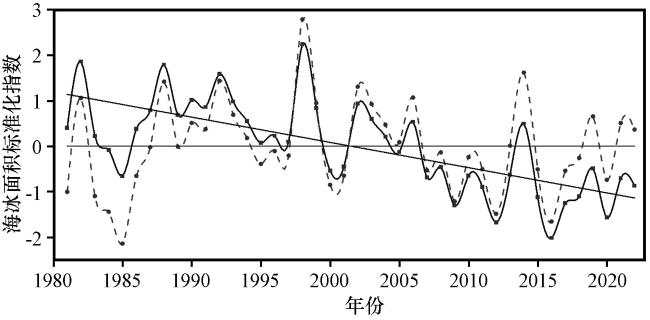
以往研究表明, 前期北极海冰的急剧消融对欧亚大陆后期冬季天气状况存在影响(Honda et al, 2009Ghatak et al, 2010), 而秋季北极海冰异常减少是欧亚大陆寒冬的主要驱动因子(Lu et al, 2019He et al, 2023), 其中巴伦支海和喀拉海区域是北极海冰变化最显著的地区之一, 我们将该区域(70°N -80°N, 30°E -90°E)的逐日海冰密集度(Sea ice concertration, SIC)乘上格点面积大小并累加, 算出每天的海冰指数, 标准化后计算季节平均, 得到海冰面积指数的逐年变化(图2)可以看出, 1981 - 2022年的BKS地区秋季(9 -11月)北极海冰面积指数呈逐年下降趋势, 相对于1981 -2000年的平均值减少了22%, 显著性大于99%, 超过了IPCC AR4气候模型模拟的温室效应导致的变暖速度(Stroeve et al, 2007)。
图2 1981 -2022年秋季平均BKS区域(70°N -80°N, 30°E -90°E)实际(实曲线)和去趋势(虚曲线)的海冰面积标准化指数及其线性趋势(直线)的时间序列

Fig.2 Time series of the standardized sea ice area index (solid line for actual values and dashed line for detrended values) in the BKS region (70°N -80°N, 30°E -90°E) during the autumn for the period 1981 -2022, along with their linear trends (straight lines)

为显示BKS海冰变化与区域气温的联系, 参考Zhuo et al(2024)的定义, 通过取低SIC年份和高SIC年份之间的合成差值, 来测量北极放大响应下反气旋、 区域降温等要素的变化。受到海冰影响, 北极区域增暖速度明显大于中纬度, 全球变暖及北极放大效应同时有利于极端天气发生概率增大。图2红虚曲线统计了秋季BKS区域去除线性趋势并标准化后海冰面积指数, 以大于/小于0的年份来作为ERA5的高/低海冰年, 分别为19/23年, 具体年份如表1所示。
表1 1981 -2022ERA5高、 低海冰年

Table 1 ERA5 high and low sea ice years from 1981 to 2022

年份
高海冰年 1982、 1988、 1990、 1991、 1992、 1993、 1994、 1998、 1999、 2002、 2003、 2004、 2005、 2006、 2013、 2014、 2019、 2021、 2022
低海冰年 1981、 1983、 1984、 1985、 1986、 1987、 1989、 1995、 1996、 1997、 2000、 2001、 2007、 2008、 2009、 2010、 2011、 2012、 2015、 2016、 2017、 2018、 2020
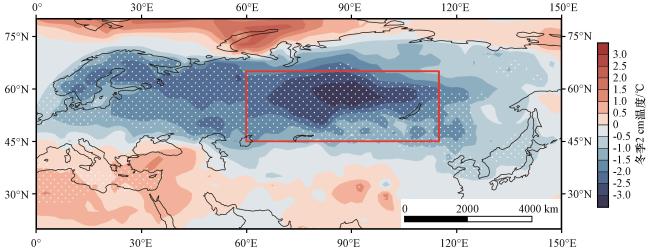
“暖北极-冷欧亚”模态中, 变冷最明显的区域主要集中在欧亚大陆中部地区, 为显示区域降温的分布情况。图3给出了ERA5中冬季t2m合成差值, 在海冰变少的条件下, 北极区域出现更大幅度增暖, 特别是BKS附近, 而欧亚大陆大部分地区均出现温度负异常, 降温大值区位于西伯利亚冷核区, 最大降温可以达到-3 ℃, 通过90%显著性检验, 这与前人研究的前期秋季BKS海冰异常变化对气温研究结论相一致(Wu et al, 1999)。
图3 秋季BKS区域(70°N -80°N, 30°E -90°E)高低海冰年的冬季t2m合成差值(低-高海冰年, 单位: ℃)

白点区域通过0.1的显著性水平检验, 红框区域为西伯利亚冷核区(45°N -65°N, 60°E -115°E)

Fig.3 Synthetic differences of winter temperature at 2 meters between years of low and high sea ice in the BKS region (70°N -80°N, 30°E -90°E) during autumn (low sea ice year - high sea ice year, unit: °C).The areas marked with white dots indicate regions that have passed the significance test at the 0.1 level, the red box highlights the Siberian cold-core region (45°N -65°N, 60°E -115°E)

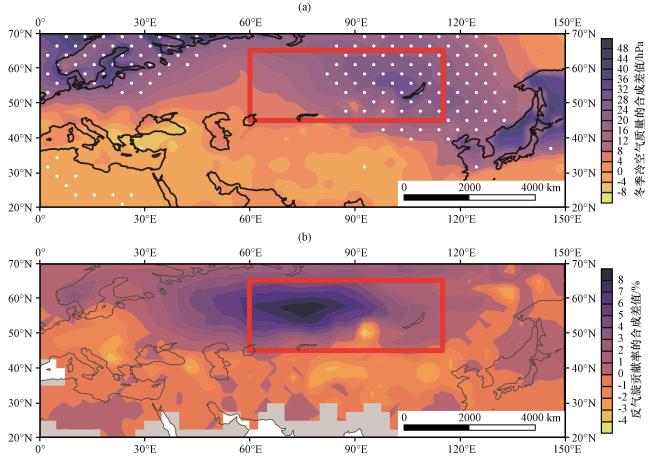
由于温度异常与反气旋的活动密切相关, 因此接下来将通过识别反气旋活动, 定量计算二维反气旋活动范围所携带的冷空气质量及对冬季冷空气堆积的贡献率, 探究冬季大陆反气旋活动与欧亚大陆冷空气活动的联系。从图4可以看出, 海冰减少对应欧亚大陆大部分地区冷空气质量增多, 特别是波罗的海、 东欧平原西部、 贝加尔湖附近以及我国东北区域, 表明这些区域在海冰减少背景下受到冷空气影响最大, 在日本海和鄂霍茨克海附近冷空气质量也增多, 会导致沿海地区气温呈下降趋势。图4(b)计算了不同海冰条件下反气旋对冷空气质量的贡献率, 发现西伯利亚地区在海冰减少背景下, 反气旋对冷空气质量贡献率最大可增多8%, 表明该地区反气旋活动时携带的冷空气增多, 该地区上空反气旋加强有利于对流层上层质量辐合, 对流层下部的冷凝过程又能反过来加强冷高压, 造成西伯利亚及下游地区的大范围降温天气(Ding and Krishnamurti, 1987)。
图4 秋季BKS区域(70°N -80°N, 30°E -90°E)高低海冰年的冬季冷空气质量的合成差值(a, 低-高海冰年, 单位: hPa, 白点区域通过0.1的显著性水平检验)和反气旋对冷空气质量贡献率的合成差值(b, 低-高海冰年, 单位: %, 无反气旋影响区域已设为缺测)

Fig.4 Synthetic differences of winter cold air mass between years of low and high sea ice in the BKS region (70°N -80°N, 30°E -90°E) during autumn (a, low sea ice year - high sea ice year, unit: hPa, the areas marked with white dots indicate regions that have passed the significance test at the 0.1 level) and the composite difference in the contribution rate of anticyclones to cold air mass (Low sea ice year - high sea ice year, unit: %, the regions not affected by anticyclones have been set to missing)

3.2 未来情景下海冰与反气旋活动的联系

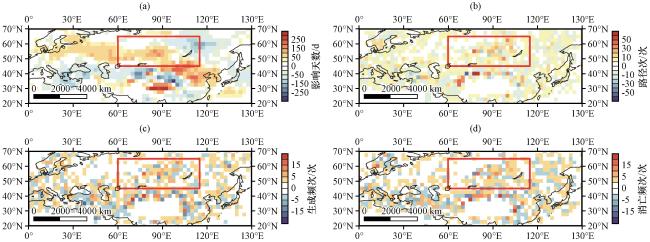
为揭示未来情景下海冰与反气旋活动的联系特征, 利用PAMIP计划的MIROC6输出资料, 结合Mask R-CNN模型首先识别了pd与futBK两组试验中的西伯利亚地区冬季反气旋的长期活动规律。分析发现, 在pd情境下西伯利亚地区(45°N -65°N, 60°E -115°E)的反气旋路径相对欧亚大陆地区的反气旋路径比例达19.4%, 而在futBK-pd情境下西伯利亚区域的反气旋路径占欧亚大陆整体反气旋路径的比例增至78.1%, 这一结果表明, 西伯利亚将成为未来冬季欧亚大陆近地面反气旋活动和影响的主要区域。为了解研究区域内的反气旋活动特点及活动频率, 通过分析反气旋的2D影响范围, 计算每个格点下的反气旋影响天数[图5(a)], 西伯利亚区域有58.11%的格点在未来受冬季反气旋影响天数增多25天以上, 在东亚地区, 由于反气旋受到蒙古高原、 东萨彦岭山脉的阻挡无法继续向东移动, 在西风作用下向南绕过山脉, 因此在内蒙古和东亚地区附近反气旋的影响天数也增多, Ding et al(1990)研究也表明, 西伯利亚地区反气旋通常存在一个低频向南传播的过程。反气旋路径大值区[图5(b)]位于天山山脉-阿尔泰山脉-蒙古高原地区, 以及贝加尔湖以西-东萨彦岭附近, 这些地区在未来将继续作为冬季欧亚大陆冷性反气旋的主要活动区域。
图5 MIROC6在futBK-pd情境下模拟得到的冬季经过西伯利亚地区(45°N -65°N, 60°E -115°E)的反气旋影响天数(a, 单位: 天)、 路径(b, 单位: 次)、 生成频次(c, 单位: 次)和消亡频次(d, 单位: 次)的合成差值

Fig.5 Synthetic differences in winter anticyclone activity over the Siberian region (45°N -65°N, 60°E -115°E) simulated by MIROC6 under the futBK-pd scenario, showing the number of days influenced (a, unit: d), the paths (b, unit: times), the frequency of genesis (c, unit: times), and the frequency of lysis (d, unit: times)

图5(c), (d)分别计算了不同海冰条件下模拟得到的反气旋生成和消亡频次分布合成差, 西伯利亚区域内增多格点所占比例分别为61.2%和58.8%, 不难得出在未来海冰消融背景下, 反气旋的增多区域主要集中于贝加尔湖-阿尔泰山脉-蒙古高原一带, 同时上游地区包括波罗的海以及里海邻近地区反气旋生成频次增多, 表明在未来上游的反气旋系统对下游天气同样重要, 反气旋通过中纬度西风环流引导从大陆西部移入西伯利亚地区。西伯利亚反气旋消亡频数大值区的空间分布与生成源地类似, 这表明该区域反气旋生成消亡的特征变化较为一致, 具有局地活动特征, 对准定常的西伯利亚冷高压以及冷池区冷空气积聚起重要促进作用。通过分析图5发现, 未来反气旋影响天数、 路径、 生成频次在西伯利亚地区增多, 即海冰减少对应西伯利亚地区冬季反气旋活动异常活跃, 可造成局地暴雪、 冻雨、 大风等灾害性天气(Chen et al, 2014)。
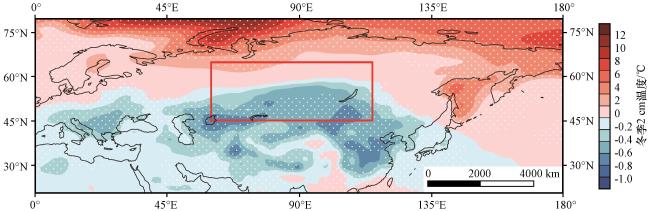
前人研究表明, 异常活跃的反气旋活动有利于西伯利亚高压强度大幅增强, 同时促进欧亚大陆中纬度地区进一步降温(Takaya and Nakamura, 2001Zhang et al, 2012Song et al, 2016Zhi et al, 2019)。为显示未来情景下反气旋与区域降温的联系, 图6给出了pd与futBK两种情境下区域温度的响应特征。从图6中可以看出, 欧亚大陆50°N以北区域在未来出现了更大幅度的变暖, 其中BKS区域甚至达到了10 ℃以上的增温, 进一步说明海冰减少对北极放大效应的关键作用。而在欧亚大陆中纬度却伴随着明显的变冷特征, 这些降温区域一定也伴随着极寒天数的增多。由此看出, 未来全球变暖背景下, 冬季欧亚大陆中纬度气温变化可能存在一定的差异性响应特点。在西伯利亚区域, 北部的增暖与南部的降温将导致该地区温度梯度减弱, 西风环流随之减弱, 阻塞活动更加频繁, 引导北极冷空气南下从而造成中纬度大范围极端降温天气(Overland et al, 2011Tang et al, 2013Francis and Vavrus, 2015)。
图6 MIROC6在futBK-pd情境下模拟得到的冬季t2m合成差值(单位: ℃)

白点区域通过0.1的显著性水平检验

Fig.6 Synthetic differences of winter temperature at 2 meters simulated by MIROC6 under the futBK-pd scenario.Unit: ℃.The areas marked with white dots indicate regions that have passed the significance test at the 0.1 level

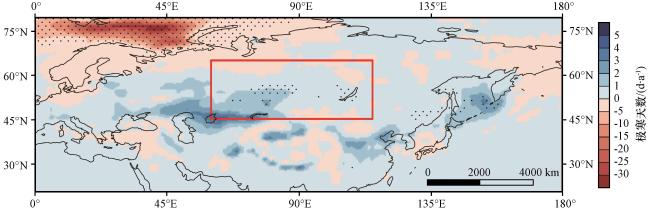
进一步统计欧亚大陆每个格点上极寒天数的变化(图7), 极寒天数在欧亚大陆大部分地区整体为微弱的增加趋势, 但显著区域较少, 主要是在哈萨克斯坦和我国中部, 而在BKS区域, 特别是新地岛以西海域, 极寒天数显著减少, 减少幅度也明显大于欧亚大陆地区的天数变化, 表明“暖北极-冷西伯利亚”气候模式在未来会持续增强, 由于PAMIP试验中只存在海冰和海温两种强迫因子, 故极寒天数呈现的变化可以认为是对北极放大现象的响应(Smith et al, 2019)。
图7 MIROC6在futBK-pd情境下模拟得到的冬季极寒天数合成差值(单位: d·a-1

Fig.7 Synthetic differences in the number of extreme cold days in winter simulated by MIROC6 under the futBK-pd scenario.Unit: d·a-1

根据Luo et al(2019)提出的关于阻塞的非线性多尺度相互作用理论, 阻塞前位涡经向梯度( P V y = P V / y)可显著影响阻塞的寿命、 强度和南北不对称性, 背景PV y 的大小决定了阻塞的能量频散和非线性, 弱PV y 对应阻塞振幅增强且持续时间增长, 而阻塞的建立将进一步降低区域内的PV y, 导致阻塞和PV y 之间存在正反馈机制。在该理论模型中, 正压大气下的无量纲位涡经向梯度为 P V y = β - U y y + F U ( F 1 ), U为无量纲纬向风, β为无量纲科氏力在500 hPa的经向梯度, 可以看出PV y 主要受到背景纬向风强度和经向分布的影响。
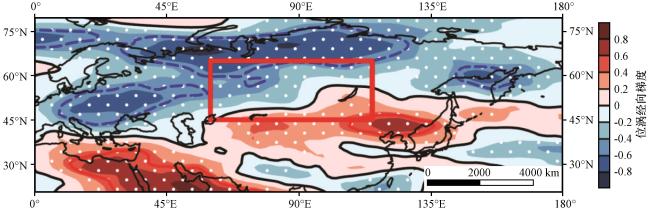
图8给出了不同海冰状况下的PV y 和纬向风的分布差值场。从图8中可以看出, 在里海以西纬向风以40°N为分界线呈北负南正分布, 而里海以东纬向风正值区域北抬至50°N附近, 同时在新地岛以北和挪威岛沿岸纬向风由负值转为正值, 在印度和我国南部纬向风为负值。由此可得, 在青藏高原、 我国长江流域一带和新地岛附近, U从负转正即U y 为正, 而西伯利亚南部U从正转负即U y 为负, U y 在经向上呈正负正分布, 也就是U yy 呈南负北正分布, 结合U的分布情况可得, 这将导致在东欧平原、 乌拉尔山、 西西伯利亚平原、 中西伯利亚高原、 鄂霍茨克海等欧亚大陆中高纬度区域PV y 是减弱的, 表明该区域阻塞受海冰异常减少作用将出现频散性变弱, 非线性变强, 生命期变长的变化, 从而导致东亚冬季寒冷趋势加剧, 极端寒冷事件频发。
图8 MIROC6在futBK-pd情境下模拟得到的无量纲500 hPa位涡经向梯度(PVy)和纬向风的合成差值(单位: m·s-1

白点区域通过0.05的显著性水平检验; 正值为红实线, 负值为蓝虚线, 0为黑实线

Fig.8 Synthetic differences of dimensionless 500 hPa potential vorticity meridional gradient (PVy) and zonal wind simulated by MIROC6 under the futBK-pd scenario.Unit: m·s-1.Areas marked with white dots indicate regions that have passed the significance test at the 0.05 level.Positive values are shown as red solid lines, negative values as blue dashed lines, and zero as a black solid line

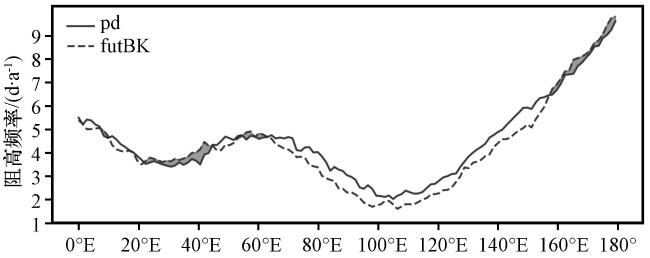
为了进一步研究区域海冰异常变化对阻塞的影响, 本文基于Charney et al(1981)的客观阻塞检测方法, 即50°N、 60°N、 70°N纬度上500 hPa位势高度异常场连续3天以上大于200 gpm, 则认为阻塞发生, 计算每个经度阻塞发生的平均值并绘制图9。可以看出海冰融化对应20°E -60°E及160°E - 180°E区域阻塞发生频率增高, 脊前偏北气流引导冷空气在西伯利亚地区积聚, 西伯利亚冷高压强度增强并导致东亚冬季风加强, 这与前文结论一致, 这样也以数值模拟实验验证了区域海冰异常对区域降温和反气旋活动的影响。
图9 MIROC6在futBK-pd情境下模拟得到的阻高频率合成差值(单位: d·a-1

Fig.9 Synthetic differences in the frequency of blocking highs simulated by MIROC6 under the futBK-pd scenario.Unit: d·a-1

4 结论

本研究利用基于深度学习的Mask R-CNN反气旋客观识别算法对ERA5及PAMIP模式输出数据的欧亚大陆冬季天气尺度反气旋进行识别, 进一步研究了在未来北极海冰迅速退缩的背景下, 前期秋季海冰异常变化可能对反气旋和冷空气活动产生的影响及其机制。其主要研究结果如下:
(1) 1981 -2022年秋季BKS海冰指数呈显著下降趋势, 在海冰减少条件下将出现更大幅度增暖, 而欧亚大陆大部分地区均出现温度负异常, 降温大值区位于西伯利亚冷核区。同时, 海冰减少对应欧亚大陆大部分地区冷空气质量增多, 西伯利亚冷核区的冷空气质量增多受反气旋活动影响最大。
(2) 利用PAMIP试验数据进行相应的敏感性试验, 结果表明西伯利亚区域(45°N -65°N, 60°E - 115°E)在未来将继续作为冬季欧亚大陆冷性反气旋的主要活动和影响区域。在未来海冰偏少背景下, 58.11%的西伯利亚区域受冬季反气旋影响天数增多25天以上, 该区域的天气尺度反气旋具有局地活动特征, 对准定常的西伯利亚冷高压以及冷池区冷空气积聚起重要促进作用。
(3) 在未来全球变暖和海冰减少背景下, 冬季欧亚大陆中纬度气温变化可能存在一定的差异性响应特点, 欧亚大陆50°N以北区域在未来出现了更大幅度的变暖, 而在欧亚大陆中纬度却伴随着显著的变冷, 其与反气旋活动对北极放大效应的响应有关。
前人研究表明, 海冰的异常变化可以通过影响海表吸收到的太阳短波辐射, 改变海洋的热量存储, 导致该地区的海表出现温度暖异常, 以对后期西伯利亚地区反气旋活动变化产生作用(Lu et al, 2019卢睿等, 2021)。除了上述机制, 本文进行了进一步研究, 发现前期秋季巴伦支海区域的海冰状况通过减弱欧亚大陆中纬度地区的位涡经向梯度, 从而影响冬季反气旋活动。BKS海冰减少有利于欧亚大陆中高纬度的位涡经向梯度减弱, 使得该区域阻塞出现频散性减弱, 非线性增强, 生命期变长的变化, 促使冷空气向南输送。与之对应, 阻塞在20°E -60°E及160°E -180°E区域发生频率增高, 引导冷空气在西伯利亚地区积聚, 造成东亚冬季降温事件。
本文综合分析了海冰的异常变化对反气旋活动及区域降温的影响, 特别是通过识别天气尺度的反气旋, 对其活动规律及对冷空气质量的影响做出了较为详细的描述, 后续工作将参考PAMIP计划的敏感性方案以及海冰、 海温等外部驱动场, 进一步加强未来区域海冰变化对反气旋活动以及冬季气候及环流的影响机制研究。另外, 本文数值模拟试验是基于日本气候系统研究中心开发的MIROC6模式, 由于目前该计划中公开可获取的模式成员相对有限, 未来根据模式成员的增减将加入其他模式结果, 进行模式间的一致性分析。
Babar B Graversen R Boström T2019.Solar radiation estimation at high latitudes: assessment of the CMSAF databases, ASR and ERA5[J].Solar Energy, 182: 397-411.DOI: 10.1016/j.solener.2019.02.058 .

Charney J G Shukla J Mo K C1981.Comparison of a barotropic blocking theory with observation[J].Journal of the Atmospheric Sciences38(4): 762-779.DOI: 10.1175/1520-0469(1981)0382.0.CO; 2 .

Chen L Tan B K Kvamstø G N, et al, 2014.Wintertime cyclone/anticyclone activity over China and its relation to upper tropospheric jets[J].Tellus A: Dynamic Meteorology and Oceanography66(1): 1-17.DOI: https: //doi.org/10.3402/tellusa.v66.21889 .

Cohen L J Furtado J Barlow A M, et al, 2012.Arctic warming, increasing snow cover and widespread boreal winter cooling[J].Environmental Research Letters7(1): 014007.DOI: 10.1088/1748-9326/7/1/014007 .

Ding Y H1990.Build-up, air mass transformation and propagation of Siberian high and its relations to cold surge in East Asia[J].Meteorology and Atmospheric Physics44(1-4): 281-292.DOI: 10.1007/BF01026822 .

Ding Y H Krishnamurti T N1987.Heat budget of the Siberian High and the winter monsoon[J].Monthly Weather Review115(10): 2428-2449.DOI: 10.1175/1520-0493(1987)1152428: HBOTSH2.0.CO; 2 .

Eyring V Bony S Meehl A G, et al, 2016.Overview of the Coupled Model Intercomparison Project Phase 6 (CMIP6) experimental design and organization[J].Geoscientific Model Development9(5): 1937-1958.DOI: 10.5194/gmd-9-1937-2016 .

Francis J A Vavrus S J2012.Evidence linking Arctic amplification to extreme weather in mid-latitudes[J].Geophysical Research Letters39(6): L06801.DOI: https: //doi.org/10.1029/2012GL051000 .

Francis J A Vavrus S J2015.Evidence for a wavier jet stream in response to rapid Arctic warming[J].Environmental Research Letters10(1): 014005.DOI: 10.1088/1748-9326/10/1/014005 .

Ghatak D Frei A Gong G, et al, 2010.On the emergence of an Arctic amplification signal in terrestrial Arctic snow extent[J].Journal of Geophysical Research: Atmospheres115(D24): 1-8.DOI: 10.1029/2010JD014007 .

He X L Zhang R N Ding S Y, et al, 2023.Decadal changes in the linkage between autumn sea ice and the winter eurasian temperature in the 20th century[J].Geophysical Research Letters50(14): 1-12.DOI: 10.1029/2023GL103851 .

Honda M Inoue J Yamane S2009.Influence of low Arctic sea-ice minima on anomalously cold Eurasian winters[J].Geophysical Research Letters36(8): 1-6.DOI: 10.1029/2008gl037079 .

Hong S Kim S Joh M, et al, 2017.GlobeNet: Convolutional neural networks for typhoon eye tracking from remote sensing imagery[J].Preprint ArXiv.DOI: 10.48550/arXiv.1708.03417 .

Huang B Liu C Banzon V, et al, 2021.Improvements of the daily optimum interpolation sea surface temperature (DOISST) Version 2.1[J].Journal of Climate34(8): 2923-2939.DOI: 10. 1175/JCLI-D-20-0166.1 .

Inoue J Hori M E Takaya K2012.The role of Barents sea ice in the wintertime cyclone track and emergence of a warm-Arctic cold-Siberian anomaly[J].Journal of Climate25(7): 2561-2568.DOI: 10.1175/JCLI-D-11-00449.1 .

Ioannidou L Yau M K2008.A climatology of the Northern Hemisphere winter anticyclong[J].Journal of Geophysical Research Atmospheres113(D8): 197-219.DOI: 10.1029/2007JD008409 .

Iwasaki T Shoji T Kanno Y, et al, 2014.Isentropic analysis of polar cold airmass streams in the Northern Hemispheric Winter[J].Journal of the Atmospheric Sciences71(6): 2230-2243.DOI: 10.1175/JAS-D-13-058.1 .

Komuro Y Suzuki T Sakamoto T T, et al, 2012.Sea-ice in twentieth-century simulations by New MIROC Coupled Models: a comparison between models with high resolution and with ice thickness distribution[J].Journal of the Meteorological Society of Japan, 90A: 213-232.DOI: 10.2151/jmsj.2012-A11 .

Liu J P Curry J A Wang H J, et al, 2012.Impact of declining Arctic sea ice on winter snowfall[J].Proceedings of the National Academy of Sciences of the United States of America109(11): 4074-9.DOI: 10.1073/pnas.1114910109 .

Lu C H2017.A modified algorithm for identifying and tracking extratropical cyclones[J].Advances in Atmospheric Sciences34(7): 909-924.DOI: 10.1007/s00376-017-6231-2 .

Lu C H Li K L Xie S Q, et al, 2019.Month-to-month variability of Autumn Sea Ice in the Barents and Kara Seas and its relationship to winter air temperature in China[J].Hindawi2019(2): 1-13.DOI: 10.1155/2019/4381438 .

Z Z He S P Li F, et al, 2019.Impacts of the autumn Arctic sea ice on the intraseasonal reversal of the winter Siberian High[J].Advances in Atmospheric Sciences36(2): 173-188.DOI: 10. 1007/s00376-017-8089-8 .

Luo D H Zhang W Q Zhong L H, et al, 2019.A nonlinear theory of atmospheric blocking: a potential vorticity gradient view[J].Journal of the Atmospheric Sciences76(8): 2399-2427.DOI: 10.1175/JAS-D-18-0324.1 .

Nakamura T Yamazaki K Iwamoto K, et al, 2015.A negative phase shift of the winter AO/NAO due to the recent Arctic sea‐ice reduction in late autumn[J].Journal of Geophysical Research: Atmospheres120(8): 3209-3227.DOI: 10.1002/2014JD022848 .

Ono J Komuro Y Tatebe H2020.Impact of sea-ice thickness initialized in April on Arctic sea-ice extent predictability with the MIROC climate model[J].Annals of Glaciology61(82): 1-9.DOI: 10.1017/aog.2020.13 .

Ono J Tatebe H Komuro Y, et al, 2017.Mechanisms influencing seasonal-to-interannual prediction skill of sea ice extent in the Arctic Ocean in MIROC[J].The Cryosphere Discussions12(2): 1-16.DOI: 10.5194/tc-12-675-2018 .

Overland E J Wood R K Wang M Y2011.Warm Arctic-cold continents: climate impacts of the newly open Arctic Sea[J].Polar Research, 30: 1-14.DOI: 10.3402/polar.v30i0.15787 .

Park T W Ho C H Yang S, et al, 2010.Influences of arctic oscillation and madden-julian oscillation on cold surges and heavy snowfalls over korea: a case study for the winter of 2009-2010[J].Journal of Geophysical Research115(D23): 1-13.DOI: 10. 1029/2010JD014794 .

Rüttgers M Lee S Jeon S, et al, 2019.Prediction of a typhoon track using a generative adversarial network and satellite images[J].Scientific reports9(1): 1-15.DOI: 10.1038/s41598-019-42339-y .

Ryouta O Le W C Ayako O A, et al, 2021.PMIP4/CMIP6 last interglacial simulations using three different versions of MIROC: importance of vegetation[J].Climate of the Past17(1): 21-36.DOI: 10.5194/cp-17-21-2021 .

Smith M D Screen A J Deser C, et al, 2019.The Polar Amplification Model Intercomparison Project (PAMIP) contribution to CMIP6: investigating the causes and consequences of polar amplification[J].Geoscientific Model Development12(3): 1139-1164.DOI: 10.5194/gmd-12-1139-2019 .

Song L Wang L Chen W, et al, 2016.Intraseasonal variation of the strength of the east Asian trough and its climatic impacts in boreal winter[J].Journal of Climate29(7): 2557-2577.DOI: 10. 1175/jcli-d-14-00834.1 .

Stroeve J Holland M M Meier W, et al, 2007.Arctic sea ice decline: faster than forecast[J].Geophysical Research Letters34(9): 1-11.DOI: 10.1029/2007GL029703 .

Takaya K Nakamura H2001.A formulation of a phase-independent wave-activity flux for stationary and migratory quasigeostrophic eddies on a zonally varying basic flow[J].Journal of the Atmospheric Sciences58(6): 608-627.DOI: 10.1175/1520-0469(2001)0580608: AFOAPI2.0.CO; 2 .

Tang Q Zhang X Yang X, et al, 2013.Cold winter extremes in northern continents linked to Arctic sea ice loss[J].Environmental Research Letters8(1): 014036.DOI: 10.1088/1748-9326/8/1/014036 .

Tatebe H Ogura T Nitta T, et al, 2019.Description and basic evaluation of simulated mean state, internal variability, and climate sensitivity in MIROC6[J].Geoscientific Model Development12(7): 2727-2765.DOI: 10.5194/gmd-12-2727-2019 .

Walsh E J2014.Intensified warming of the Arctic: causes and impacts on middle latitudes[J].Global and Planetary Change117(3): 52-63.DOI: 10.1016/j.gloplacha.2014.03.003 .

Wimmers A Velden C Cossuth J H2019.Using deep learning to estimate tropical cyclone intensity from satellite passive microwave imagery[J].Monthly Weather Review147(6): 2261-2282.DOI: 10.1175/MWR-D-18-0391.1 .

Wu B Y Huang R H Gao D Y1999.The impact of variation of sea-ice extent in the Kara Sea and the Barents Seas in winter on the winter monsoon over East Asia[J].Journal of Atmospheric Sciences23(3): 267-275.DOI: 10.3878/j.issn.1006-9895. 1999.03.02 .

Yang S T Christensen J H2012.Arctic sea ice reduction and European cold winters in CMIP5 climate change experiments[J].Geophysical Research Letters39(20): 1-7.DOI: 10.1029/2012GL053338 .

Yao Y Luo D H Dai A G, et al, 2017.Increased quasi stationarity and persistence of winter ural blocking and eurasian extreme cold events in response to Arctic warming.Part I: insights from observational analyses[J].Journal of Climate30(10): 3549-3568.DOI: https: //doi.org/10.1175/JCLI-D-16-0261.1 .

Yoshimori M Abe-Ouchi A Watanabe M, et al, 2014.Robust seasonality of arctic warming processes in two different versions of the MIROC GCM[J].Journal of Climate27(16): 6358-6375.DOI: 10.1175/JCLI-D-14-00086.1 .

Zhang J Liu P Zhang F, et al, 2018.CloudNet: ground‐based cloud classification with deep convolutional neural network[J].Geophysical Research Letters45(16): 8665-8672.DOI: 10.1029/2018GL077787 .

Zhang L J Huang M X Sun Z Y2024.Multiscale spatiotemporal meteorological drought prediction: a deep learning approach[J].Advances in Climate Change Research15(2): 211-221.DOI: 10.1016/j.accre.2024.04.003 .

Zhang X D Lu C H Guan Z Y2012.Weakened cyclones, intensified anticyclones and recent extreme cold winter weather events in Eurasia[J].Environmental Research Letters7(4): 044044.DOI: 10.1088/1748-9326/7/4/044044 .

Zhang Y M Lu C H2022.Detection of the synoptic southeastward-extending Siberian cold high during 1978-2017[J].Atmospheric and Oceanic Science Letters15(3): 13-19.DOI: 10.1016/J.AOSL.2021.100140 .

Zhi X F Tian X Liu P, et al, 2019.Interdecadal variations in winter extratropical anticyclones in East Asia and their impacts on the decadal mode of East Asian surface air temperature[J].Meteorology and Atmospheric Physics131(6): 1763-1775.DOI: 10. 1007/s00703-019-00684-7 .

Zhou F Huang M Liu M H, et al, 2024.Distinct intraseasonal periodicity of Siberian high as modulated by ENSO: dominance of Madden-Julian oscillation[J].Environmental Research Letters19(6).DOI: 10.1088/1748-9326/ad502e .

Zhou F Shi J Liu M H, et al, 2022.Linkage between the Nao and Siberian High Events on the Intraseasonal Timescale[J].SSRN Electronic Journal, 281.DOI: 10.2139/ssrn.4142331 .

Zhuo W Q Yao Y Luo D H, et al, 2024.The response of atmospheric blocking and East Asian cold extremes to future Arctic Sea ice loss[J].Atmospheric Research304(107355).DOI: 10.1016/j.atmosres.2024.107355 .

丁一汇, 王遵娅, 宋亚芳, 等, 2008.中国南方2008年1月罕见低温雨雪冰冻灾害发生的原因及其与气候变暖的关系[J].气象学报66(5): 808-825.DOI: 10.3321/j.issn: 0577-6619.2008.05.014.Ding Y H

Wang Z Y Song Y F, et al, 2008.Causes of the rare low-temperature, rain, snow, and freezing disaster in southern China in January 2008 and its relation to global warming[J].Acta Meteorologica Sinica66(5): 808-825.DOI: 10.3321/j.issn: 0577-6619.2008.05.014 .

李崇银, 顾薇, 2010.2008年1月乌拉尔阻塞高压异常活动的分析研究[J].大气科学34(5): 865-874.DOI: 10.3878/j.issn. 1006-9895.2010.05.02.Li C Y , GuW, 2010.Analysis of the abnormal activity of the Ural blocking high in January 2008[J].Chinese Journal of Atmospheric Sciences, 34(5): 865-874.DOI: 10.3878/j.issn.1006-9895.2010.05.02 .

李延, 赵瑞瑜, 陈斌, 2023.青藏高原冬春多源积雪资料年际变化尺度上的适用性分析[J].高原气象43(2): 1-14.DOI: 10.7522/j.issn.1000-0534.2023.00057.Li Y

Zhao R Y Chen B2023.Applicability analysis of multi-source snow cover data on the interannual variation scale in the Qinghai-Tibet Plateau during winter and spring[J].Plateau Meteorology43(2): 1-14.DOI: 10.7522/j.issn.1000-0534.2023.00057 .

李昱薇, 傅刚, 陈莅佳, 等, 2021.2018年1月北大西洋上一个具有“T”型锋面结构的超强爆发性气旋的分析[J].气象学报79(3): 387-399.DOI: 10.11676/qxxb2021.025.Li Y W , FuG, ChenLJ, et al, 2021.Analysis of a super explosive cyclone with a "T"-shaped frontal structure over the North Atlantic in January 2018[J].Acta Meteorologica Sinica, 79(3): 387-399.DOI: 10.11676/qxxb2021.025 .

卢睿, 朱志伟, 李天明, 等, 2021.淮河流域夏季极端降水频次空间分布的客观分类及其形成机理[J].大气科学45(6): 1415-1432.DOI: 10.3878/j.issn.1006-9895.2105.20223.Lu R

Zhu Z W Li T M, et al, 2021.Objective classification of the spatial distribution of extreme precipitation frequency in the Huaihe River Basin during summer and its formation mechanism[J].Chinese Journal of Atmospheric Sciences45(6): 1415-1432.DOI: 10.3878/j.issn.1006-9895.2105.20223 .

秦育婧, 卢楚翰, 2017.冬季欧亚大陆反气旋活动特征及其与中国气温的关系[J].大气科学学报 40(3): 418-424.DOI: 10. 13878/j.cnki.dqkxxb.20150405001.Qin Y J , Lu C H, 2017.Characteristics of winter Eurasian anticyclone activities and their relationship with temperatures in China[J].Transactions of Atmospheric Sciences, 40(3): 418-424.DOI: 10.13878/j.cnki.dqkxxb.20150405001 .

王岱, 杨建玲, 张雯, 等, 2024.北极海冰对中国西北地区东部主汛期7月降水分布型的可能影响[J].高原气象43(2): 318-328.DOI: 10.7522/j.issn.1000-0534.2023.00053.Wang D

Yang J L Zhang W, et al, 2024.Possible impact of Arctic sea ice on the July precipitation pattern during the main flood season in eastern Northwest China[J].Plateau Meteorology43(2): 318-328.DOI: 10.7522/j.issn.1000-0534.2023.00053 .

王晓芳, 程正泉, 姜丽萍, 2019.2016年广东一次罕见寒潮雨雪冰冻天气过程分析[J].气象科技47(1): 106-115.DOI: CNKI: SUN: QXKJ.0.2019-01-013.Wang X F

Cheng Z Q Jiang L P2019.Analysis of a rare cold wave, rain, snow, and freezing weather process in Guangdong in 2016[J].Meteorological Science and Technology47(1): 106-115.DOI: CNKI: SUN: QXKJ.0.2019-01-013 .

王旭蕾, 孙慧, 郭辉, 等, 2024.CMIP6模式对北半球春季积雪覆盖度的评估及预估[J].高原气象43(6): 1397-1415.DOI: 10.7522/j.issn.1000-0534.2024.00029.Wang X L

Sun H Guo H, et al, 2024.Evaluation and projection of spring snow cover over the Northern Hemisphere based on CMIP6 models[J].Plateau Meteorology43(6): 1397-1415.DOI: 10.7522/j.issn.1000-0534.2024.00029 .

文章导航

/