基于CEEMD 方法对森林下垫面湍流相干结构的通量贡献研究

展开
  • 成都信息工程大学大气科学学院/成都平原城市气象与环境四川省野外科学观测研究站,四川 成都 610225

网络出版日期: 2026-01-28

基金资助

国家自然科学基金项目(42275131);第二次青藏高原综合科学考察研究项目(2019QZKK010203

A Study on Flux Contributions of Turbulent Coherent Structures over Forest Underlying Surfaces Using the CEEMD Method

Expand
  • College of Atmospheric SciencesChengdu University of Information Technology /Chengdu Plain Urban Meteorology and
    Environment Sichuan Provincial Field Scientific Observation and Research Station
    Chengdu 610225SichuanChina

Online published: 2026-01-28

摘要

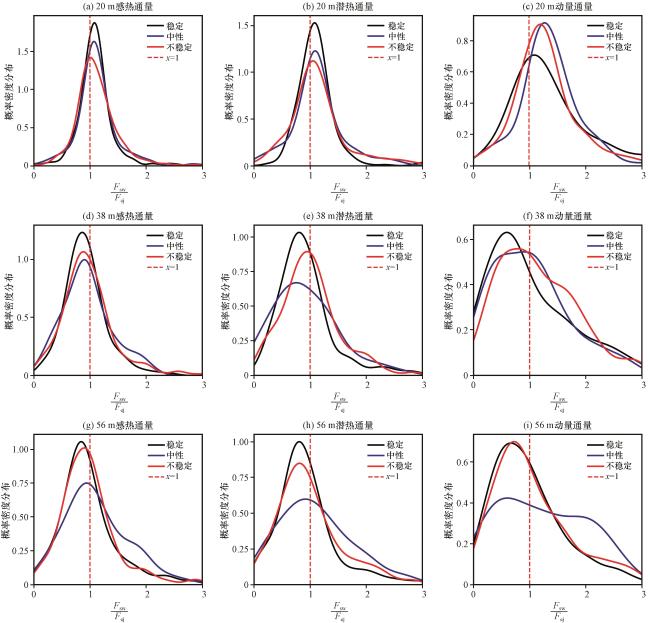
为研究森林复杂下垫面下的湍流相干结构特征,利用20215月位于四川省乐山市四峨山人工森林地区(冠层高度 15 m)架设于 1. 33倍、2. 53倍、3. 86倍冠层度的三层湍流数据,三层数据分别观测了粗糙副层、粗糙副层和常通量层边界、常通量层的湍流特征。利用上述观测数据,在基于互补集合经验模态分解(Complementary Empirical Mode DecompositionCEEMD)算法的基础上对三个高度上不同尺度的相干结构模态进行了提取,并量化了相干结构通量贡献,然后对相干结构的主要特征量进行了分析和研究。结果表明:CEEMD算法能够提取不同尺度的相干结构模态,模态表现出了典型相干性。在相干结构对通量的贡献方面,不同高度上有所差异,对感热、潜热和动量的通量贡献在 20 m 处分别为21%17%11%,在 38 m 处分别为 13%11%7%,而在 56 m 处分别为 12%10%6%。这表明,在三个高度上,相干结构对于感热和潜热通量这些标量的输送效率都要大于动量通量,并且在 20 m粗糙副层上相干结构的通量贡献最大,并随着观测高度的升高而随之减小。在不同稳定层结下相干结构对通量的贡献随着通量类型的不同和层结类型的不同而有所不同。相干结构对感热通量的输送在三个高度上最大的通量贡献均出现在中性条件下,其次是稳定条件下和不稳定条件下,而对于潜热通量而言最大的通量贡献在三个高度均出现在稳定条件下,其次是中性条件下和不稳定条件下。对清扫和喷射过程的通量贡献的结果表明在较高高度(38 m56 m)喷射过程占主导,而随着观测高度降低至接近粗糙副层后清扫过程起了主导作用。最后对相干结构的斜坡强度与稳定度参数和摩擦速度的关系进行了研究,对于水平u风和垂直w风,两者的斜坡强度均随着摩擦速度的增大而增大,但对于稳定度参数两者表现有所差异,水平u风的斜坡强度在中性条件下最大并随着稳定度和不稳定度的增加而减小。而垂直w风的斜坡强度在不稳定条件下最大而随着稳定度的增加相干的垂直运动被抑制而减小。本文的研究结论为深入认识复杂下垫面下相干结构的通量贡献及其相干运动特征提供的统计性认识以及为后续湍流结构的研究提供了支撑。

本文引用格式

王彦淇, 张 宇, 苏有琦, 张 茜, 叶 敏 . 基于CEEMD 方法对森林下垫面湍流相干结构的通量贡献研究[J]. 高原气象, 0 : 1 . DOI: 10.7522/j.issn.1000-0534.2025.00080

Abstract

In order to study the turbulent coherent structure characteristics under the complex underlying surface of foreststhree-layer turbulence data set up at 1. 33 times2. 53 timesand 3. 86 times canopy degrees in the ar‐ tificial forest area of Mount Si E in Leshan CitySichuan Provincecanopy height of 15 min May 2021 were used to observe the turbulent characteristics of the rough sublayerrough sublayerand constant flux layer boundariesas well as the constant flux layer. Based on the observation data mentioned abovethree coherent structural modes of different scales at different heights were extracted using the Complementary Empirical Mode DecompositionCEEMDalgorithm. The flux contribution of coherent structures was quantifiedand the main feature quantities of coherent structures were analyzed and studied. The results indicate that the CEEMD algo‐ rithm can extract coherent structural modes of different scalesand the modes exhibit typical coherence. In terms of the contribution of coherent structures to fluxthere are differences at different heights. The flux contributions to sensible heatlatent heatand momentum are 21%17%and 11% at 20 m13%11%and 7% at 38 mand 12%10%and 6% at 56 mrespectively. This indicates that at three heightsthe transport efficiency of sca‐ lar fluxes such as sensible and latent heat flux by coherent structures is greater than that of momentum fluxand the flux contribution of coherent structures is the largest on the 20 m rough sublayerwhich decreases with in‐ creasing observation height. The contribution of coherent structures to flux varies with different flux types and layer types under different stable layer structures. The maximum flux contribution of coherent structures to the transport of sensible heat flux at three heights occurs under neutral conditionsfollowed by stable and unstable conditions. For latent heat fluxthe maximum flux contribution occurs under stable conditions at all three heightsfollowed by neutral and unstable conditions. The results of the flux contribution to the cleaning and spraying processes indicate that the spraying process dominates at higher heights38 m and 56 m),while the cleaning process plays a dominant role as the observation height decreases to approach the rough sub layer. Final‐ lythe relationship between the slope strengthstability parametersand friction velocity of coherent structural structures was studied. For both horizontal and vertical windthe slope strength of both increases with the in‐ crease of friction velocitybut there are differences in the performance of stability parameters. The slope strength of horizontal wind is maximum under neutral conditions and decreases with the increase of stability and instabili‐ ty. The slope strength of the vertical wind is maximum under unstable conditions and decreases with the increase of stability as the coherent vertical motion is suppressed. The research conclusion of this article provides a statisti‐ cal understanding of the flux contribution and coherent motion characteristics of coherent structures under com‐ plex underlying surfacesand supports the subsequent study of turbulent structures.

文章导航

/