

1 引言
气候舒适度是用于评估人们在不同气候条件下所感受到的舒适程度的指标, 其核心依据是人体与近地大气之间的热交换过程(Parsons, 2014)。作为温度、 湿度、 风力等气候条件的综合表征, 气候舒适度一旦超过阈值, 便会对人类健康和社会经济生活产生严重负面影响(Di et al, 2018)。因此, 开展气候舒适度的评估研究有重要意义。具体而言, 开展相关研究的意义体现在两方面: 一方面, 基于日常地面监测数据分析气候舒适度的长期演变特征, 可深化对气候变化规律及其影响的认知, 为理解区域对全球气候变化的响应提供理论支撑; 另一方面, 揭示其空间分布及其演变趋势, 可为建筑设计、 旅游发展、 公共卫生以及气候适应调控等领域提供科学指导(Chen and Ng, 2012; Cheung and Hart, 2014; Beccali et al, 2018; Aminipouri et al, 2019; Zeng et al, 2025)。国外研究始于Terjung(1966, 1968)提出的舒适指数, 为定量评估奠定了理论基础。该领域发展出多元评价标准, 涵盖人体舒适指数(雷东洋等, 2021)、 炎热指数(王欣睿和景元书, 2005)、 通用热气候指数(唐进时等, 2015; Zeng et al, 2020; Zhou et al, 2022, 金天等, 2025)。近年来, 气候舒适度评估已在巴基斯坦(Ullah et al, 2024)、 西班牙(Hidalgo-García et al, 2025)和印度(Naskar et al, 2024)等地广泛开展。常用的温湿指数(Temperature-Humidity Index, THI)通过考虑温度和湿度来反应人体和周围环境的热量交换(Thom, 1959)。风效指数(Wind Effect Index, WEI)既考虑体表的散热也考虑了太阳辐射后人体的增热, 它是反映体表与周围环境之间的热交换, 即体表单位面积的热交换量率(正值为吸热, 负值为散热)(范业正和郭来喜, 1998)。上述两个指数仅仅考虑了气候要素对人体裸露皮肤的影响程度。着衣指数(Index of Clothing, ICL)考虑人体可通过穿戴衣物改变外界条件给体感舒适带来的影响(Auliciems and de Freitas, 1976)。由于使用单一指数来评估与气候相关的舒适度状态不够可靠(Eludoyin et al, 2013)。为弥补单一指数的局限, 中国学界普遍将这3个指数联立构建气候舒适度指数, 目前已在辽宁省(曹永强等, 2016)、 重庆市(何静等, 2010)、 广东省(Zhang et al, 2022)等多地开展了气候舒适度指数的评估, 为区域气候资源开发与气候适应性管理等提供了科学依据(余珊和戴文远, 2005; 曹云等, 2019; Zhao and Wang, 2021; 黄启锋等, 2024)。
现有研究在各指标赋权方法上普遍采用专家评分结合层次分析法(Analytic Hierarchy Process, AHP)(马丽君等, 2009; 马丽君和孙根年, 2009), 该方法通过构建系统的评价指标体系, 将复杂的气候舒适度评价问题分解为目标层、 准则层和指标层等多个层次结构。该方法将专家的专业知识与定量分析相结合, 有效处理多指标、 多层次的复杂评价问题, 在一定程度上实现了主观判断的科学化与规范化。然而, 其不可避免地存在主观局限性。为应对传统评价方法的主观局限性, 学界在气候舒适度评价研究中不断探索新路径, 王妍方等(2016)通过人体舒适指数、 风寒指数、 THI与ICL构建模糊判断矩阵, 在一定程度上减小因专家主观认知差异导致的评价偏差, 得出了攀枝花适宜旅游的月份。李佳恩等(2022)通过数字高程模型推算空间温度后结合WEI、 THI与ICL进行模糊层次分析, 构建综合舒适评价模型, 进一步评价了攀枝花市的气候舒适度。模糊层次分析法将模糊数学引入层次分析法中, 允许模糊判断, 避免强行精确化导致的偏差。陈力和苑全治(2018)基于客观赋权熵值法原理, 通过各指标值所提供的信息量大小客观确定指标权重, 进而构建了洛阳的旅游气候舒适度评价模型。杨颖璨等(2024)也通过熵值法建立了广东省舒适度综合指数。但如何实现主客观赋权的有效协同仍是亟待解决的问题。
贵州省“冬无严寒、 夏无酷暑”的亚热带湿润季风气候具有显著舒适度优势。独特的地形地貌造就了立体气候特征, 使得省内不同海拔区域呈现出“一山有四季, 十里不同天”的微气候差异。近年来, 向红琼和于飞(2010)对全省旅游气象舒适度进行了分析, 发现夏季具备避暑条件。张波等(2017)通过AHP方法构建的旅游气候舒适度进一步分析夏季旅游气候舒适度, 发现6月是贵州省的最佳避暑月份。这些研究为挖掘贵州省气候旅游等优势特征提供了重要参考。然而, 在气候舒适度指数构建方法上, 现有研究多依赖单一赋权方法, 未能充分平衡主观经验与客观数据的关系, 且对于贵州省气候舒适度的研究多集中于现状评价, 而对其趋势变化的分析则相对较少。AHP方法在计算权重系数时主观性较强, 而CRITIC(Criteria Importance Through Intercriteria Correlation)方法(Diakoulaki et al, 1995)则能够更为客观地评估各指标的权重。AHP方法具有使用简单、 计算高效以及对多层次的定性、 定量数据的普适性等优点。目前我国运用客观方法构建气候舒适度评价体系时, 熵值法(陈力和苑全治, 2018; 杨颖璨等, 2024)较为常用。由于温湿指数、风效指数和着衣指数是根据温度、 湿度、 风速等气象数据计算得到, 其各指标之间具有一定的关联性。相较于熵值法, CRITIC方法能够更合理地分配权重, 减少冗余信息的影响。
因此, 本文基于1994 -2023年贵州省84个国家气象观测站数据, 构建了AHP-CRITIC组合赋权模型, 综合考虑温湿、 风效、 着衣三大指数, 对贵州省的气候舒适度进行了评估, 并借助空间插值技术将站点数据拓展至市州层面。通过运用AHP-CRITIC模型, 深入研究了贵州省9个市州的气候舒适度, 分析了其时空分布特征, 并揭示了近年来贵州省气候舒适度的变化趋势。此外, 本研究还借鉴了归一化偏导数法(Normalized Partial Derivatives, NPD)框架(Naeem et al, 2024), 构建了贡献分解法, 对各因子的贡献率进行了量化分析。
2 数据来源与方法介绍
2.1 数据来源
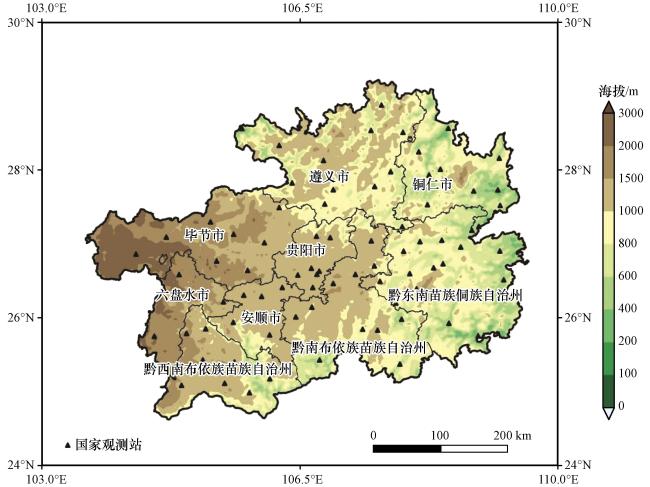
本文利用1994 -2023年贵州省84个国家观测站的逐日气象观测资料, 包括温度、 风速、 日照时数等。图1展示了贵州省地形以及国家观测站点分布情况。文中使用的地图是基于中华人民共和国自然资源部地图技术审查中心标准地图服务系统下载的审图号为GS(2024)0650号的标准地图制作, 底图无修改。
2.2 方法介绍
2.2.1 气候舒适度指数构建
综合考虑气候条件对裸露皮肤的影响及外界环境的改变, 选用了常用的温湿指数(THI)、 风效指数(WEI)和着衣指数(ICL), 并利用这3个指数构建的综合气候舒适度指数(Climate Comfort Index, CCI)模型, 对贵州省气候舒适度进行量化分析。
温湿指数是通过气温和湿度的组合反映人体和周围环境的热量交换, 计算公式(杨颖璨等, 2024)为:
式中: THI为温湿指数; T为气温(单位: ℃); RH为相对湿度(单位: %)。
风效指数由风寒指数演变而来(范业正和郭来喜, 1998), 综合考虑了风速与气温对裸露皮肤的影响, 计算公式(张波等, 2017)为:
式中: WEI为风效指数; T为气温(单位: ℃); V为风速(单位: m·s-1); S为日照时数(单位: h)。
着衣指数指人体可通过穿戴衣物改变外界条件给体感舒适带来的影响, 计算公式(Zhang et al, 2022)为:
式中: ICL为着衣指数; T为气温(单位: ℃); V为风速(单位: m·s-1); H为人体代谢率的75%, 取轻活动量下的代谢率H=87 W·m-2; a=0.06表示人体对太阳辐射的吸收情况; R=1367 W·m-2; 为太阳高度角, 取平均状态的纬度为β, 夏季太阳高度角为(90° β 23°26′), 冬季太阳高度角为(90° β 23°26′), 春秋两季的太阳高度角为(90° β)。
为量化评估气候舒适度指数, 对温湿指数(THI)、 风效指数(WEI)、 着衣指数(ICL)分别进行分级与赋值(表1)。分级逻辑为: 从寒冷不舒适到舒适再到炎热不舒适, 对应赋值依次为1、 3、 5、 7、 9、 7、 5、 3、 1(赋值越高, 代表该指数对应的舒适度越高, 其中赋值9为非常舒适, 1为极不舒适)。表1中详细列出了各指数级别的具体划分标准与对应赋值(马丽君和孙根年, 2009; 曹云等, 2019; Zhang et al, 2022)。
表1 温湿指数、 风效指数、 着衣指数的分级标准Table 1 Classification criteria for temperature-humidity index (THI), wind effect index (WEI), and index of clothing (ICL) |
| 温湿指数(THI) | 风效指数(WEI) | 着衣指数(ICL) | 舒适度评价 | 赋值 | |||
|---|---|---|---|---|---|---|---|
| 分级值 | 人体感觉 | 分级值 | 人体感觉 | 分级值 | 适宜着衣 | ||
| THI≤40 | 极冷 | WEI≤-1000 | 酷冷风 | ICL≥2.5 | 羽绒或毛皮衣 | 极不舒适 | 1 |
| 40<THI≤45 | 寒冷 | -1000<WEI≤-800 | 冷风 | 1.8≤ICL<2.5 | 便服加坚实外套 | 不舒适 | 3 |
| 45<THI≤55 | 偏冷 | -800<WEI≤-600 | 稍冷风 | 1.5≤ICL<1.8 | 冬季常用便服 | 较不舒适 | 5 |
| 55<THI≤60 | 清凉 | -600<WEI≤-300 | 凉风 | 1.3≤ICL<1.5 | 春秋常用便服 | 舒适 | 7 |
| 60<THI≤65 | 凉 | -300<WEI≤-200 | 舒适风 | 0.7≤ICL<1.3 | 衬衫和常用便服 | 非常舒适 | 9 |
| 65<THI≤70 | 暖 | -200<WEI≤-50 | 暖风 | 0.5≤ICL<0.7 | 轻便的夏装 | 舒适 | 7 |
| 70<THI≤75 | 偏热 | -50<WEI≤80 | 暖热风 | 0.3≤ICL<0.5 | 短袖开领衫 | 较不舒适 | 5 |
| 75<THI≤80 | 闷热 | 80<WEI≤160 | 热风 | 0.1≤ICL<0.3 | 热带单衣 | 不舒适 | 3 |
| 80<THI | 极闷热 | 160<WEI | 炎热风 | ICL<0.1 | 短裤 | 极不舒适 | 1 |
CRITIC法(Diakoulaki et al, 1995)可兼顾指标内部变异程度和指标间关联程度对指标权重的影响。它基于评价指标的对比强度和指标之间的冲突性来综合衡量指标的客观权重。对比强度以各指标内部变异大小来衡量, 以标准差的形式表示, 标准差越大, 该指标对应的信息量越大, 权重越高; 冲突性反映了影响因子之间的相关性特征, 用相关系数表示, 相关系数越大, 权重越低。
基于将第j(j=1, 2, …, n)项评估指标在第i(i=1, 2, …, m, m∈N+)日的观测数据记为 , 则初始矩阵为 , 如式(4) 所示:
=
由于各指标量纲和计量单位均有较大差别, 为了消除因量纲所带来的影响, 将各项指标进行归一化处理, 通过式(5) 对初始矩阵进行无量纲化处理, 得到标准矩阵
式中: 为第j项指标中的最大值; 为第j项指标中的最小值。指标变异性以评估指标的标准差 表示:
式中: 为第j项评估指标的均值; 为第j项评估指标的标准差。指标冲突性以 表示:
式中: 为第j项指标与其他指标冲突性量化值; 为第k项指标与第j项指标的相关系数。
第j项评估指标的信息量用 表示:
因此, 第j项指标的客观权重如(10)所示:
基于1994 -2023年全省的观测数据, 通过CRITIC方法得到温湿、 风效、 着衣指数的权重 分别为0.34、 0.43、 0.23。
层次分析法(AHP)通过将复杂问题分解为具有层次结构的指标体系, 结合专家打分的方式, 逐层分析各因素的相对重要性, 提供了主观经验的结构化表达。本文引用马丽君和孙根年(2009)通过专家打分与AHP法得到湿温、 风效、 着衣指数的权重 分别为0.6、 0.3、 0.1。
基于总偏差最小化的原则对AHP法和CRITIC法组合权重进行耦合(林爱军等, 2024), 其计算公式如下:
式中: 为AHP-CRITIC组合赋权法得到的综合权重; 为CRITIC方法的客观权重向量; 为AHP模型的主观权重向量。
通过式(11) 确定AHP-CRITIC模型的温湿、 风效、 着衣指数权重分别为0.47、 0.37、 0.16。建立气候舒适度CCI评价模型:
通过3个指数的分级赋值利用式(12) 对气候舒适度指数(CCI)进行4级分级: 7≤CCI时为舒适等级; 5≤CCI<7时为“较舒适”等级; 3≤CCI<5时为“较不舒适”等级; 1≤CCI<3时为“不舒适”等级。
2.2.2 贡献分解方法
为定量评估气温、 相对湿度、 风速、 日照时数对气候舒适度指数的相对贡献, 本文参考Naeem et al(2024)构建的标准化偏导数模型框架, 用于准确量化气温、 相对湿度、 风速和日照时数对气候舒适度指数贡献率。
本文对每一变量X进行归一化, 消除量纲差异:
式中: 为变量标准化处理后的无量纲值; 为某一观测变量(气温、 相对湿度、 风速与日照时数)的第i个样本; 分别表示1994 -2023年对应季节内的最大值和最小值。对每一个样本i, 计算各指数对气候舒适度指数的边际贡献量:
式中: 为变量k对第i个样本的贡献量。
贡献归一化:
式中: 为变量k在第i个样本中的百分比贡献。
按季节分组求取平均值, 春季(3 -5月)、 夏季(6 -8月)、 秋季(9 -11月)、 冬季(12月至次年2月)得到各季节的相对贡献率:
式中: 为季节s内变量k的平均贡献率; 为季节s的样本总数。
3 结果与分析
3.1 气候舒适度指数时间变化特征
3.1.1 多年平均月季变化
全省的气候舒适度指数在4 -5月、 9 -10月舒适度最高, 1月舒适度最低。全省“较舒适”及以上等级年均天数达到284天, 安顺市、 六盘水市与黔西南州的气候舒适度指数在“较舒适”及以上(“较舒适”与“舒适”)等级的年均天数超过300天。全省气候舒适度指数为“舒适”的天数为160天。六盘水市、 黔西南州、 安顺市、 毕节市、 贵阳市的年均舒适日数均大于全省均值。其中, 六盘水市舒适天数最高, 约203天(表2)。各市州的月际变化呈现“M”型, 即春秋两季舒适水平较高。值得注意的是, 黔西南州气候宜人, 全年气候舒适度指数较高(CCI>5), 冬季较温暖, 夏季较凉爽, 全年处于“较舒适”及以上等级[图2(a)]。六盘水市在4 -10月期间, 气候舒适度指数均达到了“舒适”等级, 且月“舒适”天数均超过了20天[图2(c)]。
表2 1994 -2023年贵州省各市州气候舒适度相关日数及周期统计Table 2 Statistics of climate comfort-related days and periods in cities and prefectures of Guizhou Province during 1994 -2023 |
| 市州 | 舒适天数/d | 舒适期 | 较舒适期 | 较舒适及以上天数/d |
|---|---|---|---|---|
| 安顺市 | 180 | 4 -6月, 9 -10月 | 2 -3月, 7 -8, 11月 | 304 |
| 毕节市 | 168 | 4 -6月月, 8 -10月 | 3月, 7月, 11月 | 284 |
| 贵阳市 | 164 | 4 -6月, 9 -10月 | 3月, 7 -8月, 11月 | 286 |
| 六盘水市 | 203 | 4 -10月 | 2 -3月, 11 -12月 | 302 |
| 黔东南州 | 131 | 4 -5月, 10月 | 2 -3月, 6 -9月, 11 -12月 | 263 |
| 黔南州 | 148 | 4 -5月, 9 -10月 | 2 -3月, 6 -8月, 11 -12月 | 286 |
| 黔西南州 | 181 | 3 -5月, 9 -11月 | 1 -2月, 6 -8月, 12月 | 305 |
| 铜仁市 | 126 | 4 -5月, 10月 | 2 -3月, 6月, 9月, 11 -12月 | 256 |
| 遵义市 | 140 | 4 -5月, 9 -10月 | 2 -3月, 6 -8月, 11 -12月 | 271 |
| 全省 | 160 | 4 -5月, 9 -10月 | 2 -3月, 6 -8月, 11 -12月 | 284 |
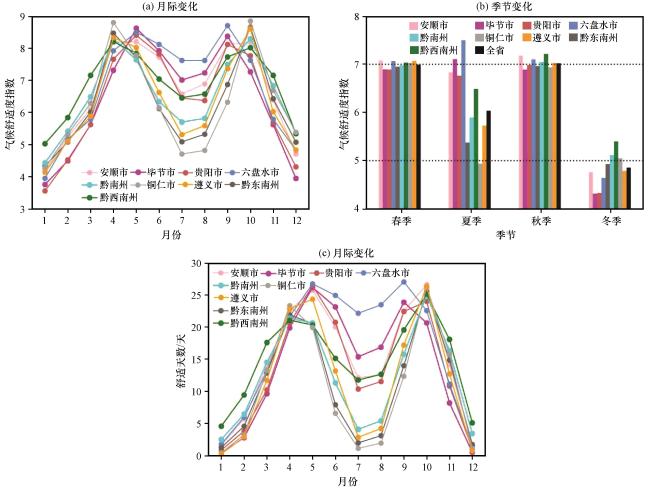
图2 1994 -2023年贵州省气候舒适度指数的月际变化(a)与季节变化(b)、 舒适天数的月际变化(c)(b)中黑色虚线5和7分别为“较舒适”等级和“舒适”等级的基准线 Fig.2 Monthly (a) and seasonal (b) variations of the climate comfort index, and monthly variation of comfortable days (c) in Guizhou Province during 1994 -2023.The black dashed lines 5 and 7 in (b) represent the threshold for “relatively comfortable” and “comfortable” levels, respectively |
从季节变化来看, 全省在春季和秋季达到“舒适”等级, 夏季处于“较舒适”等级, 冬季则处于“较不舒适”等级。其中, 安顺市、 六盘水市、 黔西南州、 铜仁市和遵义市在春季处于“舒适”等级; 毕节市和六盘水市在夏季处于“舒适”等级; 安顺市、 六盘水市、 黔南州、 黔西南州和遵义市在秋季处于“舒适”等级; 冬季黔南州、 黔西南州和铜仁市处于“较舒适”等级, 其余市州处于“较不舒适”等级[图2(b)]。
3.1.2 年际变化
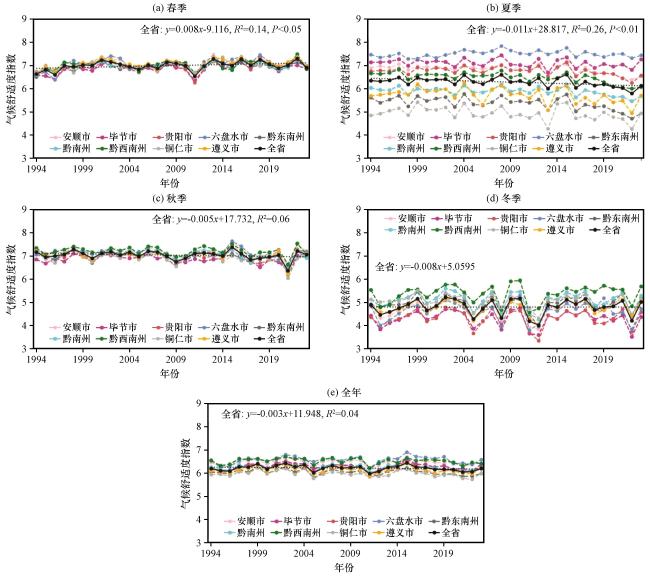
1994 -2023年, 全省各季节气候舒适度呈现出差异化的变化趋势(图3)。其中, 春季气候舒适度以0.08 (10a)-1的速率上升(p<0.05), 表明该季节正从“较舒适”向“舒适”等级过渡; 夏季则以0.11 (10a)-1的速率显著下降(p<0.01), 按此趋势推算, 约102年后全省夏季气候舒适度将从“较舒适”等级降至“较不舒适”等级; 秋季气候舒适度以0.05 (10a)-1的速率下降, 冬季全省的年际变化则不显著。从区域分布来看, 各市州春季和秋季的气候舒适度指数均接近7, 呈现出较好的区域一致性; 相比之下, 各市州夏季和冬季的气候舒适度指数离散程度较高, 区域差异相对明显。具体来看, 夏季气候舒适度呈现空间分化特征: 铜仁市指数最低, 为全省夏季最不舒适的地区; 六盘水市指数最高, 是夏季全省气候舒适度最优的区域。综合来看, 1994 -2023年全省气候舒适度整体以0.03 (10a)-1的速率下降[图3(e)], 这一整体下降趋势主要由夏季气候舒适度的显著下降所主导。
3.2 气候舒适度指数空间分布特征
3.2.1 逐月多年平均空间分布
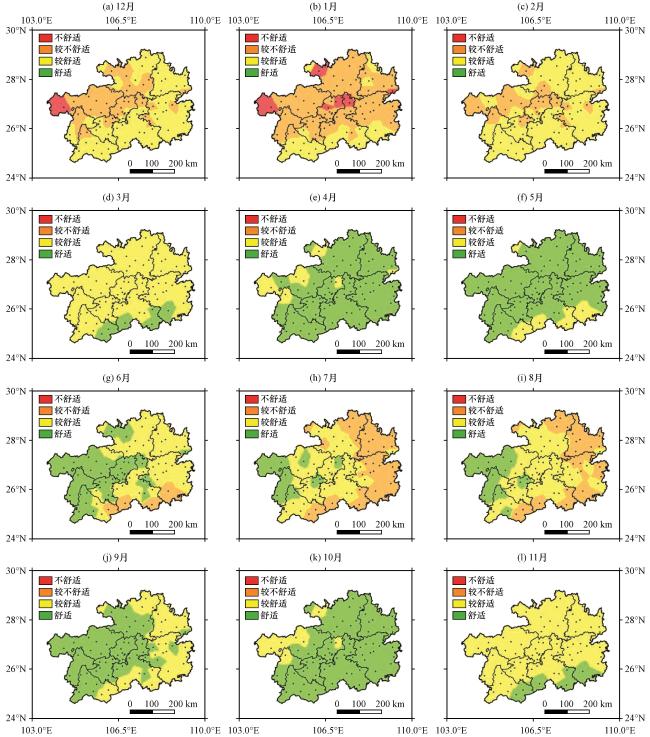
从逐月气候舒适度指数的空间分布(图4)来看, 全年呈现出显著的季节性变化特征。冬季时, 全省中部和西部地区的气候舒适度指数处于“较不舒适”水平, 其中1月“较不舒适”和“不舒适”区域范围达到全年最大。春季, 3月“较舒适”区域开始逐步拓宽, 南部低海拔地区已成为“舒适”区域; 4 -5月, “舒适”区域进一步延伸, 覆盖全省大部分地区。夏季, 6月南部地区气候舒适度指数降至“不舒适”等级; 7 -8月, “较不舒适”区域范围扩大, 涵盖南部地区、 黔东南州中东部、 铜仁市大部, 以及遵义市东北部、 东南部的余庆县和西部的赤水县。秋季, 全省气候舒适度指数均回升到“较舒适”及以上等级; 9 月“舒适”区域主要集中在省中西部; 10月西部为“较舒适”等级, 其余大部分地区均达到“舒适”等级; 11月大部分地区由“舒适”等级降至“较舒适”等级。总体而言, 3 -11月期间, 毕节市、 六盘水市、 贵阳市、 安顺市以及黔西南州西北部地区的气候舒适度指数稳定在“较舒适”及以上等级; 遵义市和铜仁市在3 -6月及9 -11月维持“较舒适”及以上等级; 黔东南州与黔南州的 “较舒适” 及以上等级主要出现在春秋两季; 南部地区在夏季达到“较不舒适”等级, 其余季节均处于“较舒适”及以上水平。
3.2.2 逐月变化趋势空间分布
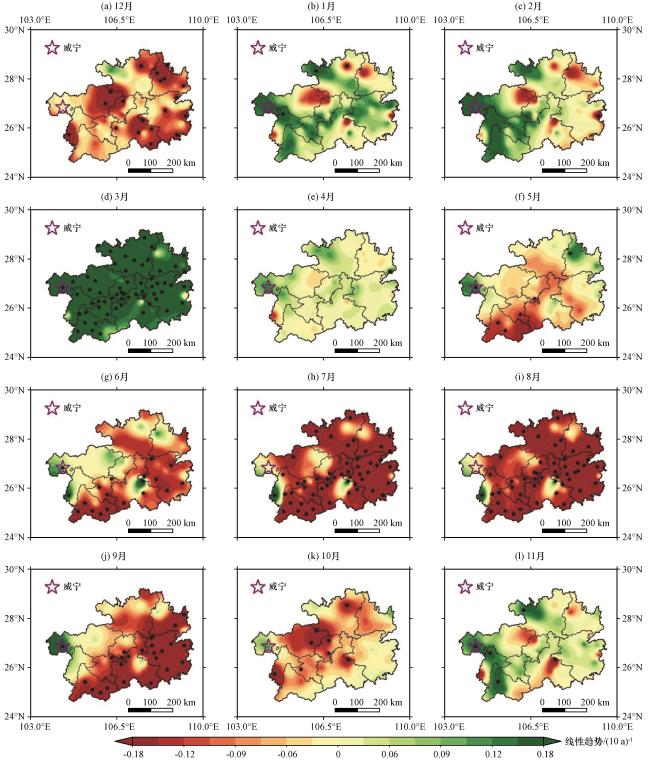
逐月空间演变规律显示(图5), 1月、 2月、 4月、 5月、 10月与11月全省大部分地区气候舒适度的空间变化并不显著。具体来看, 1月、 2月、 4月与11月全省多数区域呈增加趋势, 意味着气候舒适度在逐步提升; 而5月与10月全省大部分地区呈减小趋势, 气候舒适度有所下降。对比之下, 12月、 6月、 7月、 8月及9月的变化特征更为突出, 全省大部分地区呈减小趋势, 舒适度等级逐渐变差; 仅有3月, 全省大部分区域呈增加趋势, 气候舒适度不断改善。综合来看, 全省大部分地区的气候舒适度等级整体呈现逐渐降低的态势。值得关注的是, 毕节市西部的威宁县气候舒适度保持稳态, 且在多数月份呈现向更舒适的方向发展的趋势。
3.3 气候舒适度指数的贡献分析
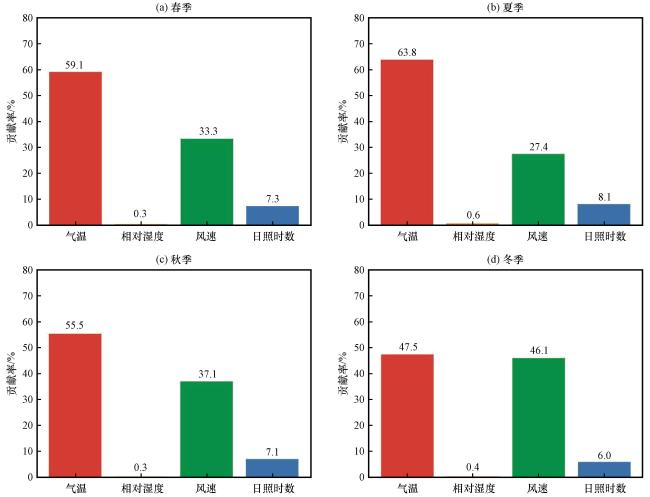
在全省范围内, 气候舒适度展现出明显的季节性变化特征(图4)。Zhao and Wang (2021) 针对河南省的气候舒适度与各气象因子(平均温度、 相对湿度、 日照时数和风速)之间的关系进行了研究, 通过计算皮尔逊相关系数, 发现平均温度和相对湿度是控制气候舒适度变化的主要气候因子。由于气候舒适度指数是由气温、 相对湿度、 日照时数和风速共同作用的结果, 并且这些变量之间也存在一定的关联性, 导致它们对舒适度的影响存在非线性变化。为了进一步探寻这些非线性变化背后的主要影响因素, 以气候舒适度指数为切入点, 利用贡献分解方法深入探究各变量在其中所占的相对贡献权重, 并细致分析了不同季节里各变量的具体贡献率(图6): 春季气温贡献率最高, 达59.1%; 其次为风速(33.3%); 日照时数贡献7.3%; 相对湿度贡献相对微弱, 为0.3%。夏季气温的主导作用更为显著, 贡献率达63.8%; 风速次之(27.4%); 日照时数贡献8.1%; 相对湿度贡献率最低, 为0.6%。近年来, 我国平均的高温日数和热浪次数呈增加趋势(Qian et al, 2019; 张嘉仪和钱诚, 2020; 王勇等, 2024; 卢珊等, 2025), 这使得夏季气候舒适度指数在全省大范围地区呈现降低趋势(图5)。秋季气温贡献率55.5%, 仍居首位; 风速贡献显著增加至37.1%; 日照时数贡献7.1%; 相对湿度贡献维持较低水平(0.3%)。冬季气温贡献率降至47.5%, 而风速贡献率跃升至46.1%, 两者共同构成主要贡献因子; 日照时数贡献6.0%; 相对湿度贡献0.4%。整体而言, 气温是影响气候舒适度的最主要变量, 在四季中均占据主导地位(贡献率47.5%~63.8%); 风速是第二大贡献因子, 其贡献率在冬季尤为突出(46.1%); 相比之下, 相对湿度与日照时数的贡献相对较小。造成这种季节差异的原因, 主要由于各季节太阳高度角存在显著不同, 这直接导致了季节性差异; 同时, 气温、 相对湿度等变量的极差在不同季节也呈现出明显波动, 这些因素共同作用, 使得经过标准化处理后各要素的贡献权重呈现出鲜明的季节特征。


4 结论
基于贵州省1994 -2023年84个国家气象观测站收集的气象数据, 应用AHP-CRITIC模型对全省9个市州的气候舒适度指数展开了深入的时空分析, 并探究了其年际变化趋势。在此基础上, 应用贡献分解方法进一步量化了影响气候舒适度的相对贡献。结论如下:
(1) 全省气候舒适度指数的“舒适”日数达160天。全省春秋季处于“较舒适”及以上等级, 形成双峰式舒适期。其中, 六盘水市年均舒适天数约203天, 4 -10月处于“舒适”等级且月均舒适天数超过20天; 黔西南州全年保持“较舒适”及以上等级的区域, 具有“四季皆宜”的独特气候特征; 六盘水市、 安顺市与黔西南州年均“较舒适”及以上等级日数突破300天。在1994 -2023年, 全省气候舒适度整体呈现下降趋势, 年际变化速率为-0.03 (10a)-1。夏季气候舒适度指数以0.11 (10a)-1的速率显著下降是全省气候舒适度整体下降的重要因素。
(2) 从空间分布特征来看, 全省各市州在春季和秋季的气候舒适度处于“较舒适”及以上等级。夏季期间, 六盘水市、 毕节市、 安顺市、 贵阳市以及黔西南州西北部地区的气候舒适度指数维持在“较舒适”至“舒适”等级, 展现出独特的凉爽优势。相比之下, 冬季除南部地区外, 大部分地区处于“较不舒适”与“不舒适”等级, 1月是冬季气候舒适度最低的时段。3月全省舒适度指数呈正变率, 气候舒适度越来越好; 而夏季, 尤以7 -8月为甚, 大部分地区舒适度呈负变率。值得注意的是, 毕节市西部威宁县维持稳态, 且在大部分月份呈向更舒适方向发展的趋势。
(3) 气温是影响气候舒适度的最主要变量, 在四季中均占据主导地位(贡献率47.5%~63.8%); 风速是第二大贡献因子, 其贡献率在冬季尤为突出(46.1%); 相比之下, 相对湿度与日照时数的贡献相对较小。